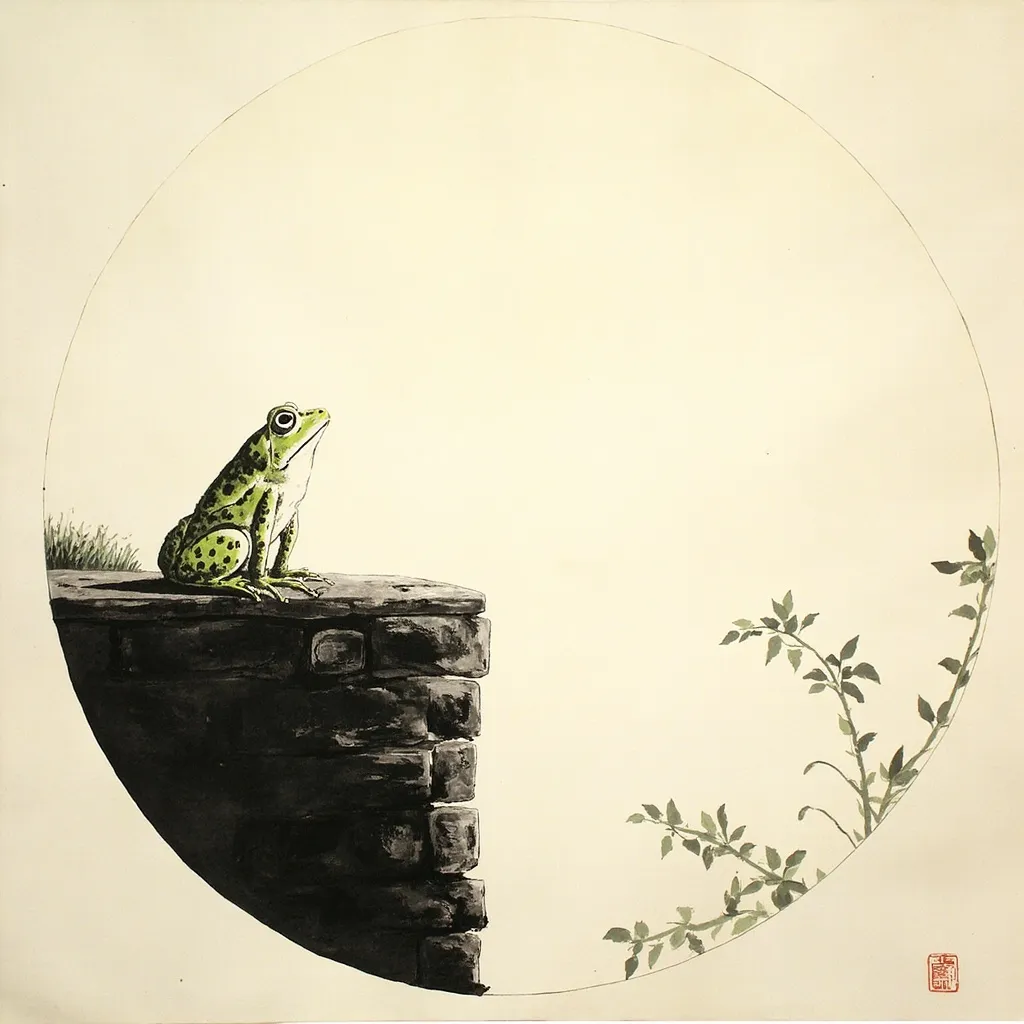
There’s a Chinese idiom that gets used pretty regularly in everyday conversation, especially when someone wants to describe a particular kind of social maneuver: hú jiǎ hǔ wēi — the fox borrowing the tiger’s power.
You’ve probably encountered the dynamic it describes before. Someone walks into a room with an aura of importance, and people naturally defer to them. But it turns out the person themselves has no real authority — they’re just riding on the reputation of someone they’re connected to, or the perception they’ve carefully cultivated. In English, you might call this “piggybacking on someone else’s reputation” or “blowing smoke.” But the Chinese have been using this particular fox-and-tiger image for over two thousand years, and the story behind it is genuinely fun.
The Fable as Zhuangzi Told It
Once again, we turn to Zhuangzi, the playful philosopher from the 4th century BCE who seemed to have a story for every occasion. His version goes like this.
A tiger was hunting through the forest and caught a fox. Now, the tiger was enormous, powerful, and not in a particularly good mood — it was hungry, after all, and a tiger with an empty stomach is not a creature you want to run into. The fox knew it was in serious trouble.
But instead of cowering or trying to flee — both of which would have been futile — the fox did something unexpected. It looked the tiger straight in the eyes and said, with complete composure: “You can’t eat me. I’m the king of all the animals. It’s forbidden. If you don’t believe me, follow me and see for yourself — every creature in this forest runs away when they see me.”
The tiger, intrigued (or maybe just curious enough to delay its meal), agreed to follow the fox and test this claim. As they walked together through the forest, smaller animals spotted them approaching. Deer scattered. Wolves bolted. Monkeys scrambled up trees. Every creature, seeing the tiger looming behind the fox, fled in terror — but of course, they were fleeing the tiger, not the fox.
The fox, walking confidently at the front of this unlikely procession, had achieved exactly what it set out to do. The tiger, seeing all the animals run away, assumed the fox was telling the truth, and let it go.
Borrowed Power vs. Real Power
What makes this fable so enduring isn’t just the cleverness of the fox — it’s the question it raises about where power actually comes from. The fox had no real power at all. It was smaller than most of the animals fleeing from it. It couldn’t fight the tiger, couldn’t outrun it, and couldn’t hide. And yet, by positioning itself next to the tiger, it essentially borrowed the tiger’s fearsome reputation and turned it into its own protection.
This is the core of hú jiǎ hǔ wēi: using someone else’s authority or reputation to make yourself seem more important or formidable than you actually are. The fox didn’t have power, but it understood how power worked in its social environment — and it exploited that understanding brilliantly.
In the millennia since Zhuangzi first told this story, the dynamic it describes has become absolutely central to how human organizations operate. Think about it: when a CEO walks into a meeting, people defer not just to that individual’s abilities but to the office they hold. When a famous professor speaks, audiences assume deeper expertise than they might give to a less celebrated colleague. When someone flashes a badge or name-drops a connection, they’re signaling: “I am connected to something powerful, and you should take me seriously.”
Some of this is perfectly legitimate. Reputation is earned, connections are built, and expertise does accumulate. But the fox’s trick提醒 us that the connection between actual ability and perceived power isn’t always as direct as we assume.
The Tiger’s Blindspot
Here’s an angle that often gets overlooked in discussions of this fable: what does the tiger’s behavior tell us? The tiger was the most powerful creature in the forest. It had no reason to fear anything. And yet, it fell for the fox’s gambit entirely.
Why? Because the tiger was looking for confirmation of something it already believed. It already assumed it was the most fearsome thing in the forest. When animals fled at its approach, that only reinforced what it thought it knew. The tiger never stopped to consider that the fox might be manipulating the situation — because why would it? The tiger was too powerful to suspect a smaller animal of outsmarting it.
This is a classic pattern in organizational life, and in life more broadly. People in positions of great power are often the most vulnerable to being manipulated precisely because they assume their position makes them invulnerable to manipulation. If you’re the tiger, you don’t expect a fox to get the better of you.
But that’s exactly when you need to be most careful. The fable suggests that real wisdom isn’t just about being powerful — it’s about understanding how power operates, including the ways it can be mimicked, borrowed, or counterfeited. The most dangerous moment for the tiger was the moment it felt most secure.
Modern Applications
So what does hú jiǎ hǔ wēi look like in the modern world? You can find examples almost everywhere you look.
In business, it shows up when companies associate themselves with prestigious partners or certifications not because they’ve earned them, but because the association makes them look more established than they are. A startup might prominently display logos of clients they barely work with, or cite affiliations that amount to nothing more than attending a single conference. Investors have learned to look past the logos to the actual revenue.
In social hierarchies, it appears when people leverage connections they barely have. Name-dropping is the most basic version, but it gets more sophisticated: strategically mentioning relationships with influential people, carefully curated social media that shows you in proximity to success, even adopting the speech patterns and mannerisms of a higher-status group.
In politics, the dynamic is everywhere. Candidates borrow endorsements from popular figures. Nations align with more powerful allies to seem more formidable on the world stage. Spin doctors frame issues in ways that borrow credibility from trusted institutions. Pundits invoke the authority of “experts” who may not actually agree with the position being attributed to them.
In academia, junior scholars sometimes cite prestigious names to lend weight to arguments, or pad their CVs with associations that suggest closer ties to famous departments than actually exist. In medicine, the appeal to authority can sometimes override actual evidence — if a famous doctor recommends something, patients assume it must be right.
None of this is necessarily evil — context matters enormously. Sometimes borrowing authority is just smart communication. The fox wasn’t lying about being the king of animals; it was simply allowing others to draw their own conclusions from observed behavior. But the fable serves as a useful reminder: when you see power and influence at work, it’s worth asking how much of it is real, and how much is the fox walking in front while the tiger does the actual intimidating.
What the Fox Knew
There’s something almost admirable about the fox, if you’re willing to look past the moral dimension. The fox understood its environment thoroughly. It knew that the other animals would run from the tiger. It knew the tiger was curious enough to follow rather than simply eating it. It knew that perception, not just physical power, determines outcomes in a social setting.
The fox’s cleverness wasn’t about brute strength — it was about reading the situation accurately and acting on that reading. In that sense, the fable isn’t just a warning about being deceived; it’s also a lesson in strategic thinking. Understanding how power flows through a social system is itself a form of intelligence.
Zhuangzi, for his part, was deeply interested in the gap between how things appear and how they really are. Many of his stories explore how our categories and assumptions blind us to what’s actually happening. The fox and the tiger is a perfect example: the tiger saw what it expected to see, the fox exploited that expectation, and the other animals responded to fear rather than to any real threat.
The fable also raises interesting questions about the relationship between the individual and the system. The fox succeeded not by changing the system, but by working within it — using the existing associations between the tiger and fear to protect itself. Whether that makes the fox a hero or a villain depends a lot on your theory of moral justification.
Reading the Room (and the Forest)
The deeper lesson here might be about awareness — both the kind the fox had, and the kind the tiger lacked. The fox was acutely aware of its situation, its limitations, and the levers of power in its environment. The tiger was powerful but somewhat complacent, operating on assumptions rather than active observation.
In our own lives, there’s something to be said for cultivating that fox-like awareness. Not to manipulate others, necessarily, but to understand the systems we’re embedded in. Who has power here, and why? What’s driving the perceptions I see around me? Am I seeing things clearly, or am I the tiger — reinforcing what I already believe because I assume my position protects me from error?
The fox in the well story warns us about the dangers of limited perspective. This story pushes a slightly different angle: it’s not just about how small your world is, but about how easily you can be fooled by appearances, even when you’re the most powerful creature in the room.
The next time you find yourself deferring to someone’s authority, it might be worth asking: am I responding to this person, or to the tiger behind them? And if you’re in a position of power yourself, the lesson is different but equally important: the fox is always out there, and your confidence in your own invincibility is precisely what makes you vulnerable.
Recommended Reading & Products
Want to sharpen your ability to see through borrowed authority and understand real power dynamics? These resources explore the themes of the fable from different angles:
The Art of Strategy: A Game Theorist’s Guide to Success — Avinash Dixit and Barry Nalebuff break down how power, perception, and strategy work in business and life. Think of it as a modern toolkit for understanding the fox-tiger dynamic, with rigorous analysis of strategic interaction.
The 48 Laws of Power by Robert Greene — Whether you agree with all of it or not, this book catalogs centuries of examples of how power operates, including plenty of hú jiǎ hǔ wēi situations. It’s a useful (if sometimes cynical) supplement to Zhuangzi’s wisdom. Approach with critical thinking.
Influence: The Psychology of Persuasion — Robert Cialdini’s classic on how authority, reciprocity, and social proof actually work in human psychology. Understanding why people defer helps you recognize when you’re being the tiger — and when you’re being the fox.
Bamboo Forest Journal Set — For those who want to reflect on power dynamics and personal strategy. The set includes two journals with subtle Asian-inspired designs, great for capturing observations about the systems you navigate.
The Analects of Confucius — Confucius and Zhuangzi disagreed on plenty, but both offer deep perspectives on how to live well in a social world. This translation by Arthur Waley is still one of the most readable and illuminating.