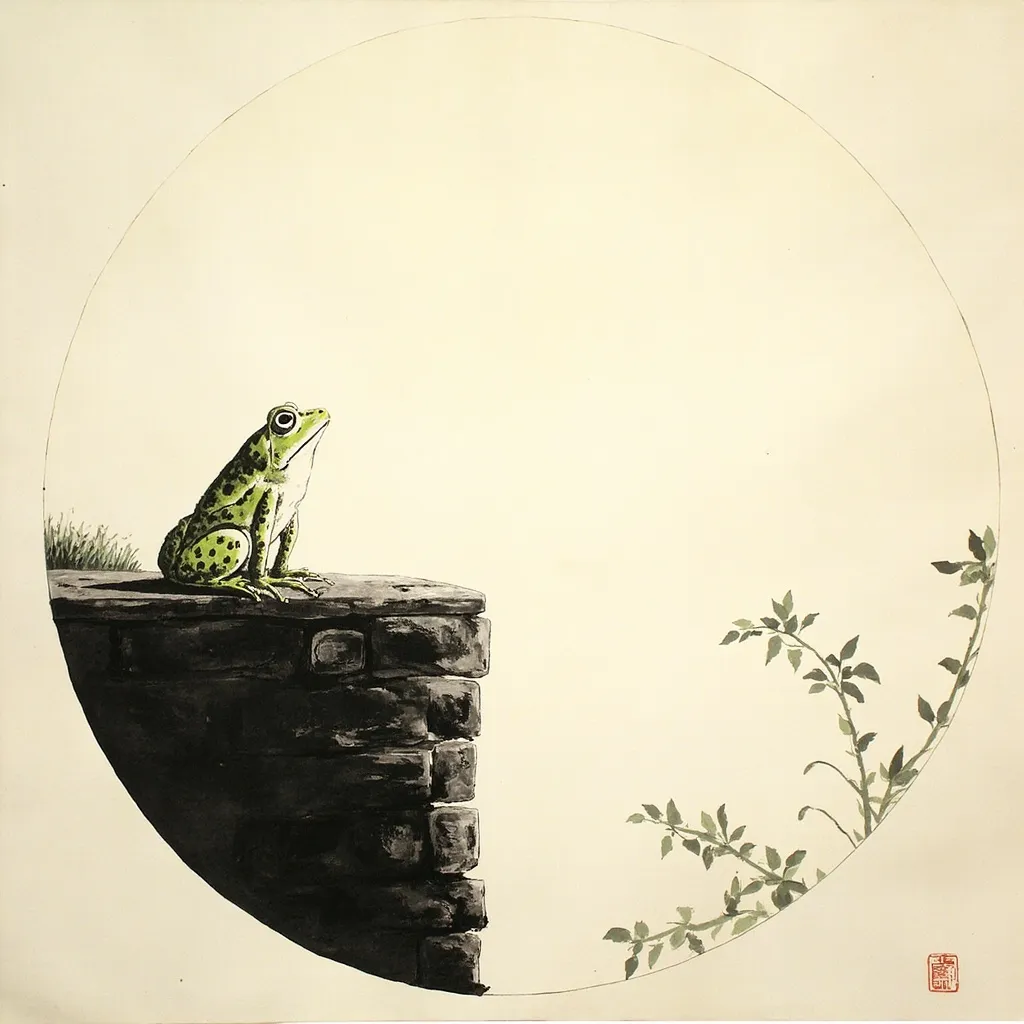
Every culture has its cautionary tales about people who can’t see beyond their own circumstances. In the West, we might say someone is “living in a bubble” or “can’t see the forest for the trees.” But the Chinese have a particularly vivid expression for this kind of narrow-mindedness: jǐng dǐ zhī wā — the frog in the well.
You’ve probably seen those old illustrations: a small frog sits at the bottom of a stone well, gazing up at a circle of sky. From its perspective, that’s the entire universe. It can’t imagine oceans, mountains, or cities beyond that rim. And honestly, why would it? The well is everything the frog has ever known.
The story comes from Zhuangzi, one of the most beloved philosophers of ancient China, who lived around the 4th century BCE. If you’re not familiar with Zhuangzi, think of him as China’s answer to a clever storyteller who happened to have some very deep thoughts about the nature of reality, freedom, and what it means to live well. His book, also called the Zhuangzi, is packed with parables, and the frog in the well is one of its most famous.
The Story Behind the Well
Here’s how Zhuangzi tells it. A frog lived in a well and was perfectly content with its situation. It would hop around on the damp stones at the bottom, splash in the shallow water that collected there, and sleep in the gaps between the bricks. When it was hot, the well offered cool shade. When it rained, the walls kept the worst of the weather out. The frog considered itself quite fortunate.
One day, a turtle from the Eastern Sea wandered by. The frog called out from its well, practically bursting with pride. “Hey there! Come on down! The water here is lovely — just right for wading. The mud is perfect for squelching between my toes. I’ve got insects and grubs everywhere. Honestly, what’s not to like? Why would you ever want to leave this place?”
The turtle tried to comply, but it found the well too cramped. As it stood at the edge looking down, it could barely fit one leg through the opening. It then described to the frog what lay beyond: the vastness of the Eastern Sea, the enormity of the land, the depth of the water that stretched for thousands of miles. The frog’s face went blank. It had no frame of reference for any of this.
Zhuangzi’s point wasn’t just to make fun of the frog. He was using the story to illustrate how limited our understanding becomes when we only know one small corner of existence. The frog wasn’t stupid — it simply had no way to comprehend something so far beyond its experience.
Why This Idiom Still Matters
You might think a 2,300-year-old fable about a amphibian in a hole would feel pretty dated. But if anything, the “frog in the well” mentality seems more relevant than ever. We live in an age of algorithmically curated feeds, where social media platforms show us content designed to reinforce what we already believe. News outlets cater to specific audiences. Even our neighborhoods and workplaces tend to group us with people who share our background, our politics, our interests.
There’s nothing inherently wrong with community and familiarity — humans are social creatures, after all. But the well can get mighty comfortable, and comfort makes it easy to forget there’s an ocean out there.
When someone dismisses an idea they’ve never actually looked into, or ridicules a culture they know nothing about, or insists that the way things are done in their country is the only sensible way — that’s the frog in the well talking. It doesn’t make them bad people. It makes them human. But it does mean they’re missing out on a much bigger picture.
Think about the last time you encountered someone who was absolutely certain about something you knew to be more complicated. Maybe it was a coworker who insisted that a particular market “could never work” without having actually researched it. Maybe it was a relative who was convinced that “people today” were fundamentally different from previous generations without having read any history. The frog in the well isn’t a character from ancient China — it’s a state of mind that every one of us slips into from time to time.
The Other Side of the Coin
Now, here’s something worth considering: the fable has a flip side that doesn’t get talked about as much. The turtle from the Eastern Sea was enormous, experienced, and wise — but was it necessarily wrong to admire the little well? The frog found joy in its small space. It felt safe, fed, and content. Not everyone needs to circumnavigate the globe to live a meaningful life.
Zhuangzi himself was deeply skeptical of the idea that more experience, more knowledge, or more power automatically leads to more happiness. He believed that one of the keys to contentment was understanding what was truly enough for you — and not letting society’s definitions of success make you feel inadequate.
In fact, much of the Zhuangzi is devoted to critiquing the Confucian emphasis on social advancement and moral self-improvement. Zhuangzi thought that constantly striving to become “better” or more accomplished was itself a form of anxiety that prevented people from simply being. The ideal person in Zhuangzi’s philosophy is not the learned scholar or the upright official, but the “useful” person who has let go of ambitions and simply moves with the flow of circumstances.
So perhaps the real lesson isn’t that we should all quit our jobs and travel the world until we “see everything.” Rather, it’s about intellectual humility. The frog wasn’t wrong to enjoy its well. It was wrong to assume that its well was the measure of all things, and wrong to look down on others who lived differently.
Breaking Out of Our Own Wells
So how do we avoid becoming the frog in the well — without abandoning our own contentment? It starts with genuine curiosity about perspectives that differ from our own. Not the curated, comfortable kind of curiosity that confirms our existing views, but the uncomfortable kind that might actually change our minds about something.
This could mean reading books by authors from other countries, traveling to places where you don’t speak the language fluently, or simply having conversations with people who challenge your assumptions rather than reinforcing them. It could mean sitting with discomfort when you encounter an idea that doesn’t fit neatly into what you already believe.
The Chinese have always had a rich tradition of self-cultivation — the idea that wisdom isn’t something you’re born with, but something you develop through lifelong learning and reflection. Confucius talked about it. Mencius talked about it. And Zhuangzi, for all his unconventionality, also believed in the importance of expanding one’s horizons — though he might have phrased it differently.
The frog in the well isn’t a warning against contentment. It’s a warning against the assumption that the view from your particular well is the only view worth having. You can be perfectly happy in your well and still recognize that the sky is bigger than the circle you can see. In fact, that recognition might be what allows you to be genuinely content — because you’re choosing your well freely, rather than simply not knowing any alternative exists.
The Fable’s Place in Chinese Thought
It’s worth noting where the frog in the well sits within the broader landscape of Chinese philosophical thought. Zhuangzi belonged to the Daoist tradition, which took a rather different view of wisdom than its rival, Confucianism. Confucius and his followers were deeply concerned with self-cultivation, moral improvement, and active participation in society. Zhuangzi, by contrast, was more interested in freedom, spontaneity, and liberation from social expectations.
For Zhuangzi, the frog in the well was not just an example of ignorance — it was an example of a particular kind of anxiety that comes from comparing yourself to standards that were never yours to begin with. The frog wasn’t failing to live up to some universal ideal of amphibian experience; it was simply living. That was enough.
This doesn’t mean Zhuangzi endorsed stupidity or refused to learn. His stories are full of characters who discover new perspectives and revise their views. But the discovery always comes through direct experience and reflection, not through external pressure or comparison to others. The turtle didn’t try to shame the frog into leaving the well. It simply described what it had seen and let the frog decide.
In this sense, the fable is as much about how to share knowledge as it is about the limits of knowledge. The turtle’s approach — patient, non-judgmental, descriptive rather than prescriptive — stands in contrast to the way we often try to expand other people’s horizons. We argue, we present evidence, we try to convince. Zhuangzi suggests a gentler path: share what you know, and trust the other person to make of it what they will.
What We Can Learn From the Frog
If the story has stuck around for over two millennia, there’s probably a reason. The frog in the well speaks to something fundamental about human nature: our tendency to mistake familiarity for truth, comfort for happiness, and our own limited experience for the whole of reality.
None of us can escape our perspective entirely. We’re all sitting in some kind of well, shaped by our upbringing, our education, our culture, and our personal experiences. The trick is not to climb out of every well you’ll ever find yourself in — that’s neither possible nor desirable — but to maintain awareness that your well is not the whole world.
There’s also something to learn from the turtle’s response. The turtle didn’t mock the frog or try to force it out of the well. It simply described what it had seen and let the frog make of that what it would. In a world where people are quick to judge and slow to understand, there’s something almost radical about that kind of patient, non-judgmental sharing of perspective.
Next time you find yourself certain that your way of seeing things is the only correct one, it might be worth pausing to ask: is this the Eastern Sea talking, or just a very comfortable well? And if it’s a well — that’s okay. Just know that it is one.
Recommended Reading & Products
Want to explore more Chinese wisdom traditions? Here are some resources that go deeper than the well:
The Complete Writings of Zhuangzi — Burton Watson’s translation remains the gold standard for reading Zhuangzi in English. The fables are surprisingly funny and deeply wise. This is the definitive edition for anyone serious about understanding Daoist philosophy.
Dao De Jing by Laozi — The other great founding text of Daoist philosophy. At just 5,000 words, it’s a quick read that repays rereading for a lifetime. This edition includes helpful commentary and is accessible to beginners.
The Book of Routines: Zen Wisdom for Modern Life — Not specifically about Zhuangzi, but explores how ancient Chinese philosophical ideas can be applied to everyday contentment. Practical wisdom for people who want philosophy that works in daily life.
Chinese Idioms: Their Stories and Usage — A comprehensive dictionary of Chinese idioms with historical context and example sentences. Great for learners and culture enthusiasts alike who want to understand how expressions like 井底之蛙 function in modern Chinese.
Bamboo Qi Pen Set — For the contemplative types who want to jot down reflections while reading. The bamboo body is elegant, and the ink flows smoothly. Includes a small stone ink grinder for an authentic feel.