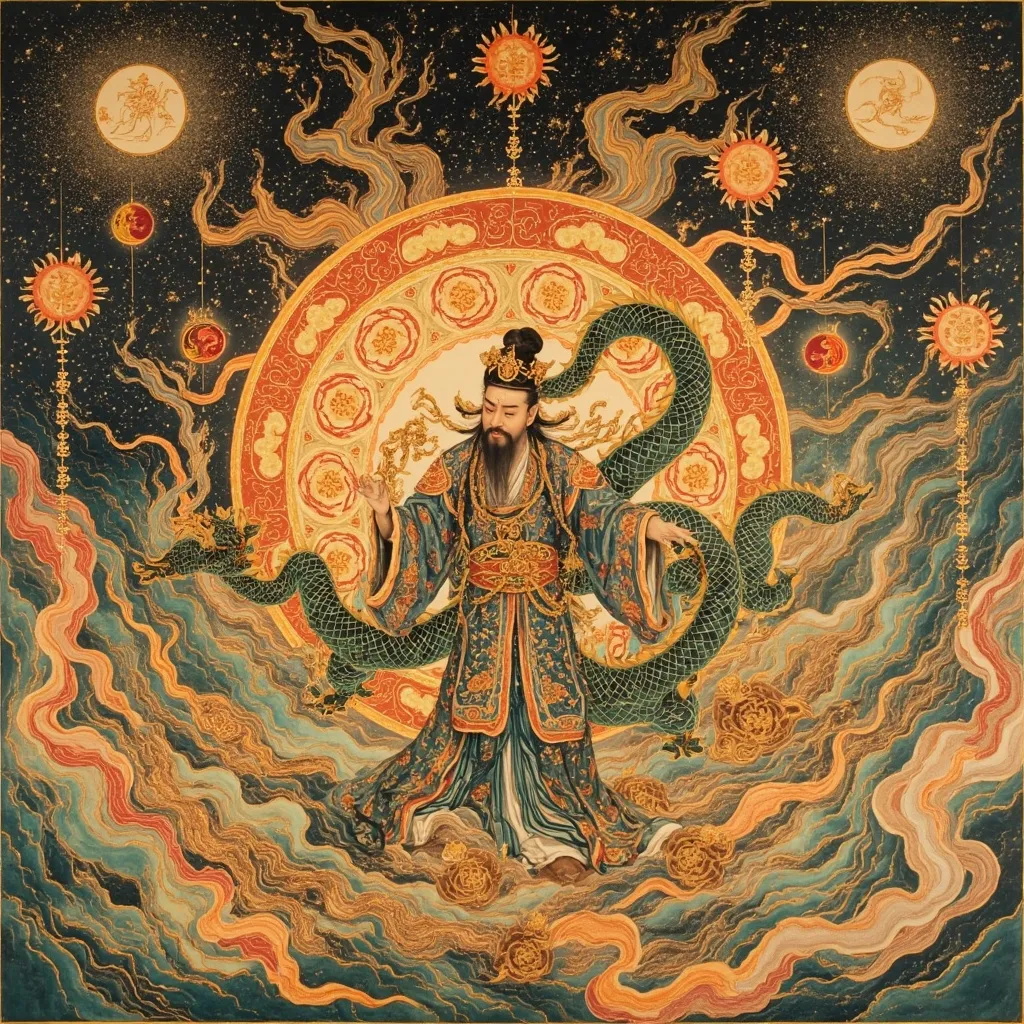
slug: “fuxi-eight-trigrams-bagua” description: “Explore the legendary story of Fuxi, the mythological emperor who received the Eight Trigrams (Ba Gua) through divine revelation, and discover how this ancient wisdom became the foundation of Chinese philosophy, cosmology, and culture.” keywords: “Fuxi, Eight Trigrams, Ba Gua, Chinese mythology, I Ching, Yin Yang, Chinese philosophy, divination, ancient wisdom, cosmological symbols” affiliate_products:
- “I Ching divination kits and interpretation guides”
- “Yin Yang symbol home decor items”
- “Books on Chinese cosmology and ancient philosophy”
- “Handcrafted Ba Gua eight trigram mirrors”
- “Traditional Chinese wisdom philosophy collections” image: “/images/fuxi-bagua.jpg” categories: [Chinese Mythology, Chinese Philosophy] alt_text: “Illustration depicting fuxi and the eight trigrams, in a traditional Chinese cultural setting”—
Fuxi and the Eight Trigrams: The Divine Origins of Chinese Philosophy
In the misty depths of Chinese prehistory, when the boundaries between the mortal world and the divine realm seemed thinner than they are today, a figure emerged from legend who would shape the intellectual foundations of an entire civilization. Fuxi, one of the legendary Three Sovereigns of ancient Chinese mythology, is credited with receiving the Eight Trigrams through a moment of divine inspiration. These eight simple symbols—three lines each, some broken, some unbroken—would go on to become the most influential philosophical framework in Chinese history, underlying everything from martial arts to medicine, from architecture to art, from military strategy to meditation practices.
The story of how Fuxi received the Ba Gua, or Eight Trigrams, is not merely a mythological anecdote. It represents something profound about how ancient Chinese civilization understood the relationship between humanity, nature, and the cosmic order. To appreciate the depth of this story, we need to journey back to a time when philosophy and spirituality were not separate domains, when understanding the patterns of nature was considered essential to living a good and successful life.
The Legend of Fuxi’s Divine Revelation
According to Chinese mythology, Fuxi reigned during a period around 2953 BCE, in the era sometimes called the Great Beginning. He was said to have been born from a union between heaven and earth—or, in some versions of the story, from his mother Youbo, who became pregnant after being touched by a meteor or bathed in a sacred river. What distinguished Fuxi from the beginning was his extraordinary wisdom and his deep connection to the patterns that underlie all existence.
The most famous story about Fuxi concerns the origin of the Eight Trigrams. According to legend, Fuxi was walking along the banks of the Luo River one day when he looked down and saw a strange sight—the water was rippling in patterns that formed distinct shapes. Then, rising from the depths of the river, appeared a creature unlike any he had seen before: a dragon horse with scales that formed an intricate pattern, carrying on its back a design of swirling lines and symbols. This mystical apparition revealed to Fuxi the fundamental structure of reality, which he then distilled into eight trigrams.
Each trigram consists of three lines, with each line either broken (representing yin, the receptive, passive principle) or unbroken (representing yang, the creative, active principle). The eight trigrams are: Qian (creativity, heaven), Kun (receptivity, earth), Zhen (awakening, thunder), Xun (gentleness, wind), Kan (abyss, water), Li (clarity, fire), Gen (stillness, mountain), and Dui (joy, marsh). These eight symbols, when combined in various ways, can represent any situation, any change, any possibility in the universe.
The Philosophical Depth of the Eight Trigrams
What makes the Ba Gua so philosophically rich is not merely the individual meanings of the eight trigrams, but the way they relate to each other and to the concept of change itself. Fuxi’s system was built on the insight that reality is not static—it is always in flux, always changing, always moving between opposing forces that nevertheless complement and need each other. This insight would eventually develop into the more familiar concept of yin and yang, but the Eight Trigrams represent an earlier, more structurally detailed formulation of the same fundamental philosophy.
The arrangement of the trigrams in the so-called “Earlier Heaven” configuration, often attributed directly to Fuxi, shows them positioned in a circle with opposite trigrams facing each other across the center. Heaven (Qian) faces Earth (Kun), Thunder faces Wind, Water faces Fire, Mountain faces Marsh. This arrangement was not random—it represented the ideal state of balance and harmony in the cosmos, a perfect ordering of the fundamental forces that govern existence.
Fuxi is also credited with establishing the principles of marriage and social organization that would structure Chinese society for millennia. According to legend, he instituted the custom of men and women marrying, creating social roles that would allow civilization to function in an orderly way. In some depictions, he and his sister Nüwa are shown as the first married couple, literally founding the human family structure. This connection between Fuxi’s cosmic wisdom and his social teachings reminds us that in ancient Chinese thinking, there was no separation between the big-picture philosophical concepts and the practical details of daily life.
The Eight Trigrams as a Universal Language
One of the most remarkable aspects of the Ba Gua system is its claim to be a universal language capable of describing any situation in the cosmos. Because the trigrams are based on the binary opposition between yin and yang lines, and because there are eight trigrams that can be combined into sixty-four hexagrams (each hexagram consisting of two trigrams stacked), the system offers 64 basic configurations, each capable of infinite variation and interpretation. This is remarkably similar to binary mathematics—in fact, the philosopher Gottfried Wilhelm Leibniz, who developed binary arithmetic, was fascinated by the Eight Trigrams and saw in them a confirmation of his own mathematical discoveries.
The applications of this system were extraordinarily broad. In divination, the I Ching (Book of Changes), which uses a hexagram-based system directly descended from Fuxi’s trigrams, allowed practitioners to seek guidance about any aspect of life—from personal relationships to political decisions, from business ventures to spiritual questions. In medicine, the same principles were applied to understand the flow of qi through the body and to diagnose imbalances that lead to illness. In martial arts, the concept of yin-yang transformation underlies techniques that blend hard and soft, internal and external power. In feng shui, the orientation of buildings and the placement of objects are determined by how they interact with the invisible flows of energy that the Ba Gua system helps to map.
What unified all these applications was a common worldview—a conviction that the same patterns govern all levels of reality, from the movement of stars to the functioning of the human body, from the rise and fall of dynasties to the rhythm of individual breaths. This holistic vision, which modern science has only recently begun to rediscover through concepts like emergence and complex systems theory, represents one of humanity’s most ambitious attempts to find unity in diversity.
The Cultural Legacy of Fuxi’s Wisdom
The influence of Fuxi and the Eight Trigrams on Chinese culture cannot be overstated. Every subsequent development in Chinese philosophy, religion, and science was shaped by the framework that Fuxi established. Confucianism, with its emphasis on proper relationships and social harmony, drew on the same understanding of complementary opposites that the Ba Gua embodies. Daoism, with its focus on naturalness and spontaneous change, found in the trigrams a perfect symbol of how reality flows between opposites. Even Buddhism, which came to China from India, was interpreted through the lens of Eight Trigram thinking as Chinese monks sought to make sense of its teachings in terms familiar to their own philosophical heritage.
The visual representation of the Eight Trigrams—the Ba Gua diagram with its circular arrangement of trigrams surrounding a yin-yang symbol—has become one of the most recognizable symbols of Chinese culture worldwide. You see it on temples and martial arts schools, on jewelry and home decor, on software logos and corporate branding. Yet beneath this widespread visual familiarity lies a philosophical depth that most casual observers never glimpse—a complete system for understanding change, balance, and the fundamental patterns that underlie all existence.
Fuxi himself came to be worshipped as a deity in the Chinese religious tradition, one of the Three Sovereigns who established the foundations of civilization. Temples were built in his honor, and he was invoked for blessings related to wisdom, writing, and cosmic harmony. In some traditions, he is also credited with the invention of nets for fishing and hunting, the establishment of musical instruments, and other practical innovations that improved human life. These attributions reinforce the connection in Chinese thought between spiritual wisdom and practical benefit—between understanding the cosmos and living well within it.
Modern Applications of Ancient Wisdom
Today, the Eight Trigrams continue to influence Chinese culture in ways both obvious and subtle. The I Ching remains widely consulted as a tool for decision-making and self-reflection, used by people who would never think of themselves as superstitious but who find value in the structured reflection that hexagram interpretation encourages. Traditional Chinese medicine continues to apply Ba Gua principles in diagnosing and treating patients, viewing the body as a system of flowing energies that must be balanced rather than as a machine to be repaired. Feng shui practitioners use Eight Trigram calculations to determine optimal placements for everything from home furniture to entire city layouts.
Beyond China, the Ba Gua has attracted serious attention from scholars and practitioners in many fields. Psychologists have found resonances between the Eight Trigram system’s approach to personality types and contemporary personality theories. Business consultants have used the framework to analyze market dynamics and organizational challenges. Artists and designers have drawn on its aesthetic principles to create works that feel balanced and harmonious. The enduring relevance of Fuxi’s insight across such diverse domains suggests that he truly did touch on something fundamental about the way reality is structured.
For those wishing to explore the Eight Trigrams more deeply, there are many resources available. The I Ching remains the essential text for understanding how the trigrams were used in divination, and numerous translations and commentaries are available for serious students. Books on traditional Chinese philosophy often include substantial sections on the Ba Gua and its role in Chinese thought. And for those interested in the more esoteric aspects of the tradition, there are guides to using the Eight Trigrams for meditation, martial arts training, and personal development that claim direct descent from Fuxi’s original teachings.
Recommended Exploration Paths
If the story of Fuxi and the Eight Trigrams has sparked your curiosity, there are wonderful paths of exploration available to you. The I Ching, or Book of Changes, represents the most direct continuation of the Eight Trigram tradition, and even a preliminary study of its hexagrams and interpretations can provide hours of fascinating reflection. Many modern editions include extensive commentaries that connect the ancient text to contemporary concerns.
For those drawn to the philosophical dimensions of the tradition, works on Chinese cosmology and natural philosophy can help situate the Eight Trigrams within the broader context of ancient Chinese thought. Look for books that explore the connection between cosmological symbols and practical ethics, as this relationship was central to how Chinese civilization understood the relationship between understanding the world and living well within it.
Artistic expressions of Ba Gua philosophy also offer rich territory for exploration. Traditional Chinese painting, calligraphy, and garden design often incorporate Eight Trigram principles in subtle ways that can reward careful observation. And for those interested in material culture, the Ba Gua symbol appears on a wide range of traditional and modern objects, from decorative mirrors to jewelry to home furnishings—each offering an opportunity to engage with this ancient wisdom in tangible form.
The story of Fuxi and the Eight Trigrams reminds us that some insights have the power to transcend their original cultural context and speak to universal human concerns. The recognition that reality is structured by complementary opposites, that change is the fundamental nature of existence, and that there are patterns connecting the largest scale of the cosmos to the smallest details of daily life—these are insights that remain relevant regardless of whether one accepts the mythological framework in which they were originally expressed. Fuxi’s divine revelation was really a discovery about the way reality works, and that discovery continues to reward those who take the time to understand it.