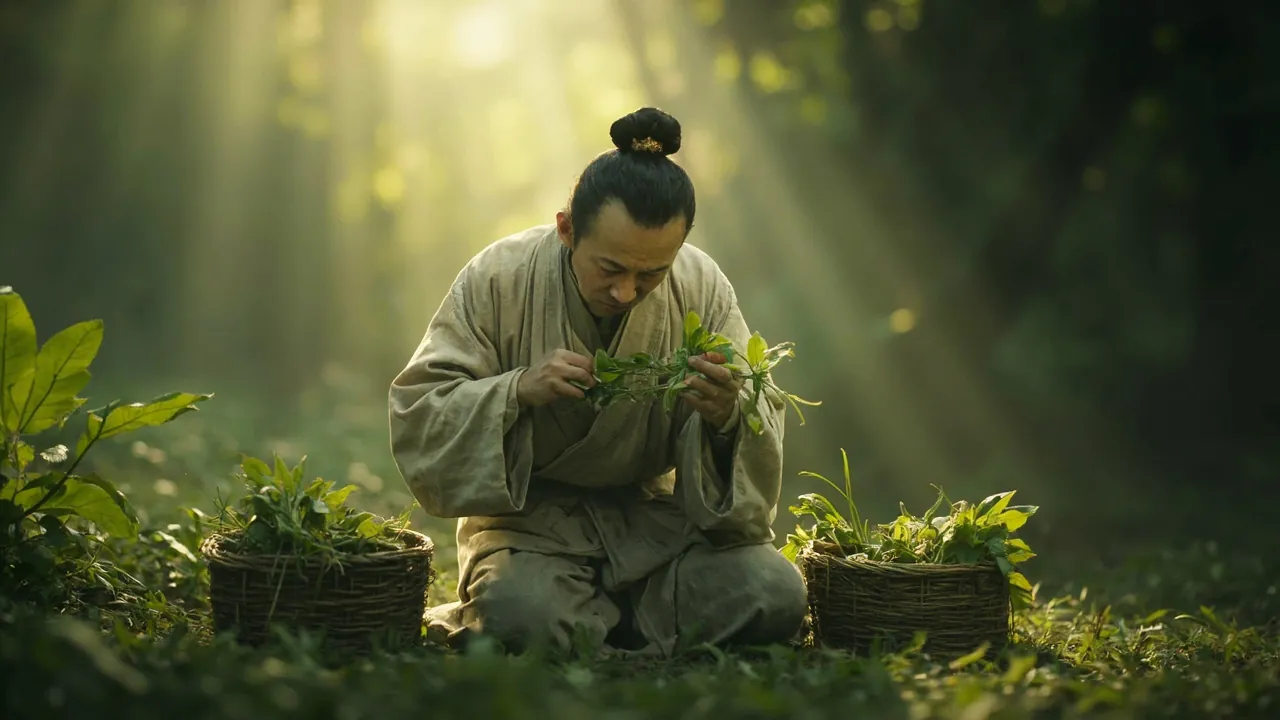
On a forced march through a sun-scorched valley in the summer of the year 207 AD, thousands of soldiers were dying of thirst. Their water supplies had run out days ago. Their lips were cracked, their skin burning, their bodies screaming for water. Officers watched helplessly as men collapsed, unable to take another step. The column had slowed to a crawl. The army was going to die here, in this baking wasteland, unless something changed.
The commander looked at the suffering around him, thought for a moment, and then shouted loud enough for the nearest soldiers to hear: “前方有梅林!” — “There are plum trees ahead! The plums there are so sour your teeth will fall out!”
The soldiers heard him. And something miraculous happened. Their mouths began to water. The dry, cracked lips produced saliva. The desperate, agonizing thirst that had been driving men to collapse somehow became bearable. They found strength to take one more step. Then another. And another. Step by step, the army pushed forward until they finally reached a river where they could drink.
No plums existed in that valley. There was no plum grove anywhere nearby. The commander, a warlord named Cao Cao, had simply told his soldiers to imagine sour plums—and their bodies had responded as if the plums were real.
This is the story behind 望梅止渴 — wàng méi zhǐ kè — “gazing at plums to quench thirst.” It sounds almost too simple to be a profound truth, but it encodes one of the most important insights in Chinese psychology: the mind can control the body in ways that seem almost magical, and understanding this connection has been central to Chinese thought for thousands of years.
The Historical Context: Cao Cao and the Northern Campaign
To appreciate this story fully, you need to understand who Cao Cao was. He is one of the most fascinating figures in Chinese history—a warlord, poet, statesman, and military strategist who lived during the turbulent late Han Dynasty period that later became the subject of the epic novel Romance of the Three Kingdoms. Born in 155 AD to a family with connections to the imperial court, Cao Cao rose from minor official to become the most powerful warlord in northern China.
By 207 AD, when this story takes place, Cao Cao was engaged in a military campaign to unify northern China under his control. He was pursuing a rival warlord named Yuan Shao, whose forces had been beaten in a previous major battle but were still regrouping in the northeast. Cao Cao was racing to catch them before they could recover and mount a counterattack.
The route took his army through a region that is still one of the most arid in northern China—the area near present-day Hebei province, where summer temperatures soar and water sources are sparse. Cao Cao’s army had been moving fast, carrying minimal supplies, and had depleted their water reserves faster than expected. The men were suffering from severe dehydration, and the march had slowed dangerously.
It was in this moment that Cao Cao performed the act that would give Chinese culture one of its most enduring idioms.
The Science Behind the Story
What Cao Cao did seems almost like a magic trick, but modern neuroscience explains exactly what happened. When the soldiers heard about sour plums, their brains triggered a physiological response that is now well-documented: the anticipatory saliva response.
When you imagine tasting something sour—really imagine it, not just think about it abstractly but place yourself in the experience—your brain’s gustatory cortex activates. This is the same area that responds to actual taste. The anticipation of sourness triggers the salivary glands to produce saliva, which is the body’s preparation for processing acidic food.
The soldiers, desperately thirsty, heard about plums and their brains responded as if plums were actually present. The physical sensation of dryness in the mouth decreased slightly. The discomfort became bearable. And crucially, the psychological despair—we are going to die of thirst out here—lifted. They now had something to look forward to: plums ahead, and water beyond them.
This is what the idiom captures: the mind’s power to alter the body’s state not just psychologically but physically. In Chinese medical and philosophical traditions, this connection between mind and body is fundamental. Concepts like qi (气, vital energy) and the interplay of mental states and physical health have been central to Chinese thinking for millennia. Cao Cao’s plum story is an early and vivid illustration of this principle.
The Psychology of Hope as a Survival Tool
There’s a broader principle embedded in the story beyond the neuroscience of salivation. The soldiers weren’t just experiencing a physical response to imagined sourness. They were experiencing something more profound: the restoration of hope.
When humans face extreme deprivation, one of the most dangerous effects is not the physical damage itself but the psychological collapse that accompanies it. When people decide that a situation is hopeless—that there is no possibility of improvement—their bodies often give up before the physical damage is actually fatal. This phenomenon has been documented in concentration camp survivors, in explorers stranded in harsh environments, and in soldiers on death marches.
Conversely, when hope is restored—even through something as simple as the promise of plums ahead—the body finds reserves it didn’t know it had. The mere belief that relief is coming can enable people to survive conditions that should have killed them.
Cao Cao understood this instinctively. He didn’t offer his soldiers a detailed strategic explanation of why they needed to keep marching. He gave them something more powerful: a mental image of something pleasant that was just ahead. Plums. Sour enough to make your teeth hurt. And water beyond them. Keep going. Just a little further.
The promise may have been completely false, but the response was real.
Modern Applications: The Mind-Body Connection at Work
The idiom wàng méi zhǐ kě is used in modern Chinese to describe any situation where someone finds a way to satisfy a need through imagination or expectation rather than through the actual fulfillment of that need. It’s often used somewhat critically—like calling someone’s plan “just gazing at plums”—but it can also be used more neutrally to describe creative problem-solving that addresses psychological needs even when physical needs can’t be immediately met.
In sports psychology, coaches regularly use techniques that parallel what Cao Cao did. Athletes are taught to visualize success, to imagine the feeling of crossing the finish line or making the crucial shot. This isn’t just positive thinking—studies show that mental visualization actually activates the motor cortex in ways that improve physical performance. The brain can’t fully distinguish between a vividly imagined experience and a real one, and it responds to imagined success by releasing endorphins and reducing perceived pain.
In business, leaders who can paint a compelling vision of a future state—the “plums” ahead—can often motivate teams to push through brutal conditions that would otherwise cause collapse. This is why transformational leadership is so often described in terms of creating hope and shared vision rather than simply providing rational arguments for effort.
In personal development, the idiom is often invoked in discussions of mental discipline and the ability to delay gratification. The soldier who thinks about plums while marching through a desert is essentially practicing a form of mental substitution: replacing the immediate suffering with an imagined future pleasure. This capacity for mental substitution is a critical component of resilience.
The Deeper Wisdom: Balance Between Reality and Hope
The story of Cao Cao and the plums also contains a more nuanced lesson. Cao Cao didn’t lie to his soldiers about something trivial. He told them about plums that didn’t exist, yes—but he did it to save their lives. His deception was in service of a genuine good: keeping the army alive long enough to reach real water, which they eventually did.
Chinese culture has always been ambivalent about deception, even when it’s in service of a good cause. The concept of shàn yì (善意)—“good intention”—is often invoked to evaluate situations where the means don’t perfectly match the ends. Cao Cao’s plums are a classic example: the end (survival) justified a means (false promise) that most moral philosophers would otherwise condemn.
But there’s also a lesson here about when such deceptions are appropriate. Cao Cao used the technique once, in a genuine emergency, to save lives. He didn’t make false promises a habit. He understood the difference between using psychological tools in a crisis and using them as a substitute for actually solving problems. The soldiers didn’t just imagine water—they eventually reached a real river. The plums were a bridge across a moment of crisis, not a permanent solution.
This is the wisdom encoded in wàng méi zhǐ kě: imagination is powerful, but it’s most powerful when it’s pointing toward a real destination. Cao Cao’s soldiers were not moving toward imaginary plums—they were moving toward actual water, and the plums simply gave them the psychological strength to make it that far.
The Idiom in Language and Culture
Today, you’ll encounter wàng méi zhǐ kě in Chinese conversations about everything from corporate motivation strategies to personal habit formation. A manager who promises bonuses “just over the next hill” might be accused of using wàng méi zhǐ kě to keep employees working. A dieter who keeps a photo of their target body on the refrigerator is practicing their own version.
The idiom has also become a part of the global vocabulary for understanding placebo effects, visualization techniques, and the broader phenomenon of mind-body connection. What Cao Cao discovered accidentally two thousand years ago has been validated by modern neuroscience: the right mental image at the right moment can quite literally save your life.
And the next time you see someone imagine themselves out of a difficult moment, you might just think of sour plums.
Discover more Chinese wisdom idioms that reveal the deep connections between mind and body that ancient Chinese philosophers understood long before modern science caught up.