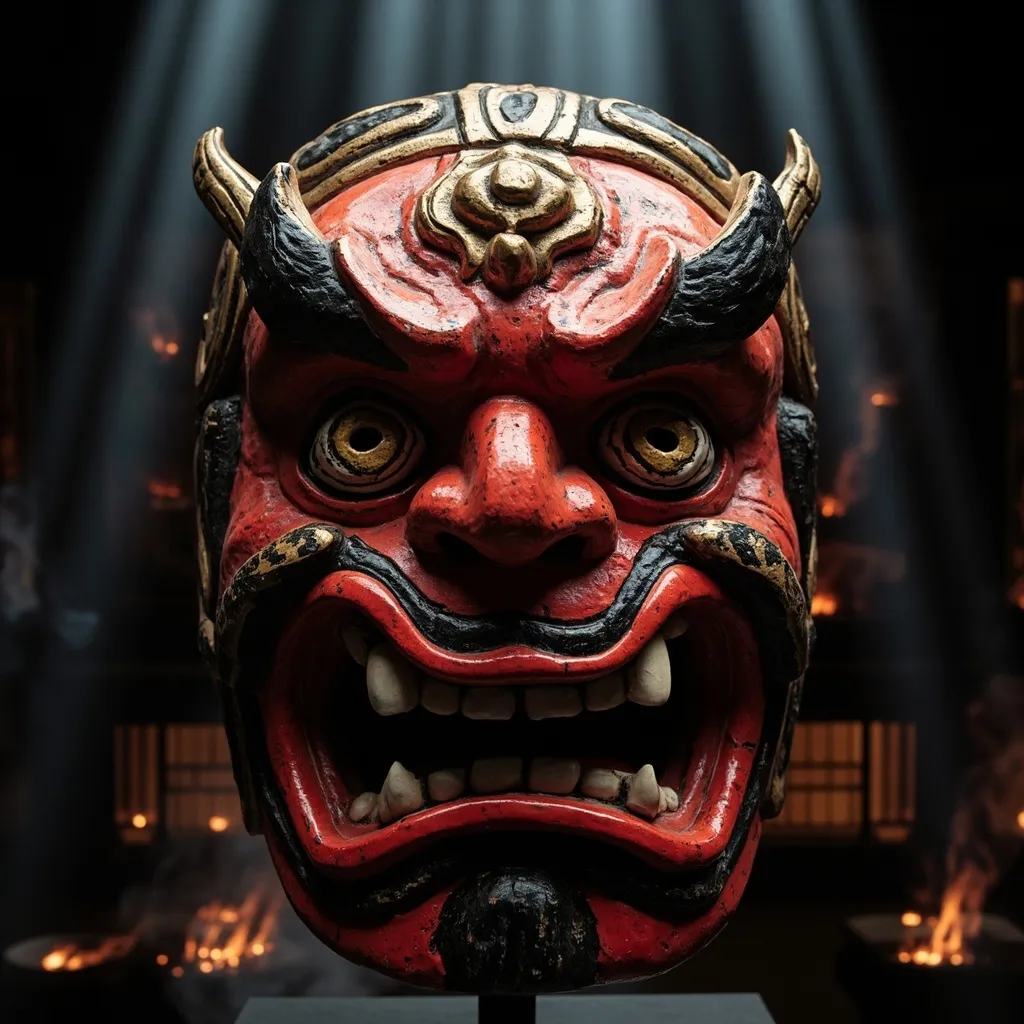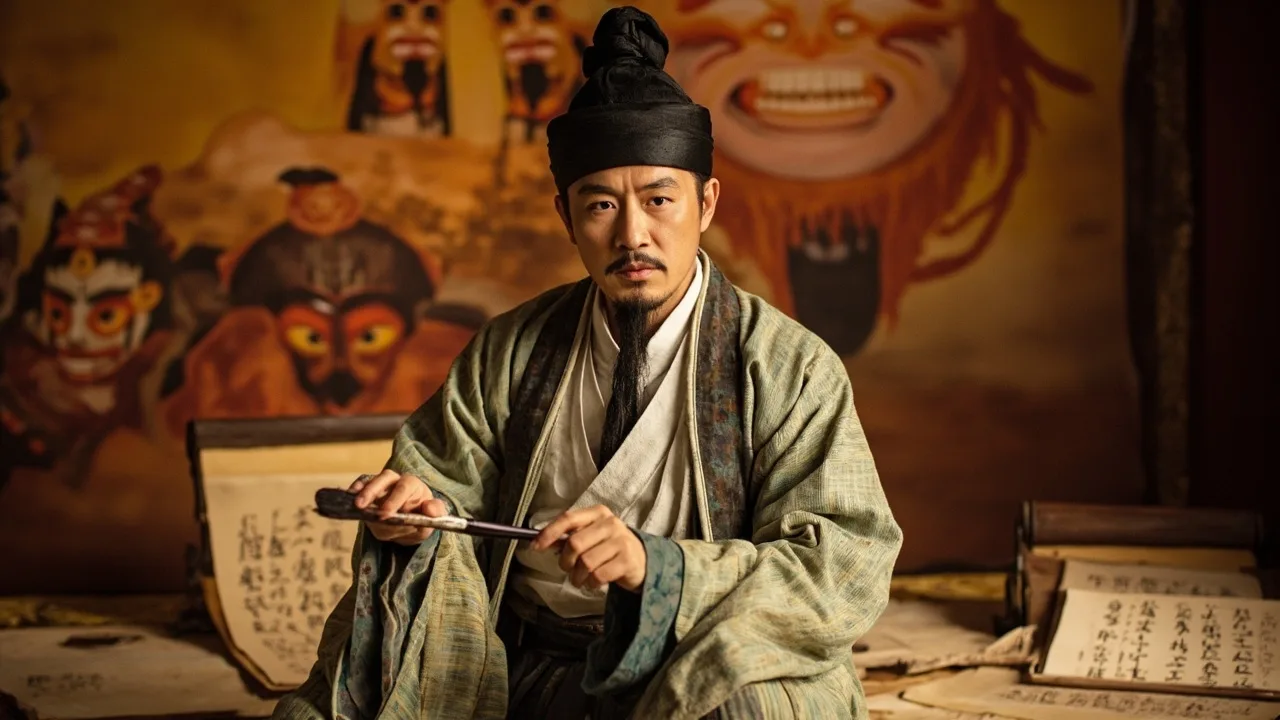
Somewhere around the year 1300 CE, in the bustling Mongol-ruled city of Dadu (大都) — modern Beijing — a man walked into a small theater on the western side of the city, ordered a cup of tea, and listened to a play. He was in his late fifties by then. He had written a few dozen plays of his own by that age, several of which were already being performed in the capital and in the southern cities along the Grand Canal. The play he was watching that night was not his. But the audience laughed, and cried, and one woman near the front shouted something back at the actor — and the playwright, sitting quietly in the back with his tea, smiled. He knew the play had landed.
His name was Guan Hanqing (关汉卿), and by any reasonable reckoning he was the father of Chinese drama (元曲四大家之首) — the most prolific, the most performed, the most reprinted, and the most durable playwright of the entire Yuan dynasty (1271 – 1368 CE), and one of the founding figures of the East Asian theatrical tradition as we now know it.
The Yuan dynasty is a strange period in Chinese history. Founded by Kublai Khan (忽必烈), the grandson of Genghis Khan, it was the first time the whole of China had been ruled by a non-Han dynasty since the early 10th century. It was a period of military expansion, ethnic tension, paper money, drought, famine, and the long administrative headache of running a continent-spanning empire from a steppe capital. It was also, almost paradoxically, one of the most brilliant periods in the history of Chinese literature. Confucian official ideology was in partial eclipse, the imperial examination was suspended for long stretches (it was abolished for 78 years between 1276 and 1315), and a large class of displaced or underemployed Han-Chinese scholars turned to other forms of writing: travel writing, novel-precursor fiction, and especially drama. The zaju (杂剧), a four-act musical play form, became the defining literary genre of the period, and a small group of playwrights — four of them, traditionally — produced a body of work that has stayed in the repertoire ever since.
The four masters — the Yuanqu Sidajia (元曲四大家) — are traditionally listed as:
- Guan Hanqing (关汉卿) — c. 1220 – c. 1305 CE
- Bai Pu (白朴) — 1226 – c. 1310 CE
- Ma Zhiyuan (马致远) — c. 1250 – c. 1321 CE
- Wang Shifu (王实甫) — c. 1250 – c. 1337 CE
This article is about Guan Hanqing, with brief excursions into the other three and into the larger world of Yuan drama. By the end you should have a sense of what these plays actually sounded like, why they have lasted almost seven hundred years, and where to start if you want to read or watch one.
The Man, in the Sparse Historical Light
The problem with writing about Guan Hanqing is that the historical record is thin. He left a body of work — at least 31 surviving plays are confidently attributed to him, plus several dozen short song-cycles (散曲, sanqu) — but he did not leave a biography. The most reliable sources are the three prefaces to collections of his plays written shortly after his death, most importantly the 《录鬼簿》 (Lugui bu, “Register of Ghosts”) by Zhong Sicheng (钟嗣成), a younger playwright who knew Guan Hanqing personally and recorded his impressions of him in the early 14th century.
From these sources and from internal evidence in the plays themselves, we can piece together the following. Guan Hanqing was born around 1220 CE, probably in the city of Yuncheng (运城) in what is now Shanxi province, or possibly in Dadu (Beijing) — the historical sources are not unanimous, and modern scholars lean toward Dadu as the more likely birthplace. He seems to have come from a family of modest means, possibly with some medical or scholarly background, but did not pass the imperial examination (which would have been difficult anyway, given the disruption of the early Yuan period).
What he was, by all accounts, was a working professional in the theater world. The 《录鬼簿》 and other sources describe him as an actor, a director, a playwright, and a kind of theatrical impresario. He is said to have known the major actresses of his day personally. The famous self-description attributed to him in the 《南村辍耕录》 (Nancun Chuogeng lu) by Tao Zongyi (陶宗仪) is worth quoting in full:
“I am a kind of copper coin — fit for stamping with anything, good for nothing. I could be an actor on stage, an entertainer at a banquet, a singer of opera, a player of games. I could be a doctor, a diviner, a salesman of cosmetics, a falconer, a horse trader, a seller of medicinal plasters. I could be a writer, a calligrapher, a painter, a player of weiqi. I could be a wine steward, a tea brewer, a cook. I could be a seller of official titles, a seller of office-seeker certificates, a seller of salt certificates, a seller of grain, a seller of incense. I could be a seller of jade, of silk, of brocade, of pearls. I could be a seller of all the arts of this world.”
It is a self-portrait of a man who lived, almost professionally, in the liminal spaces of Yuan society: the theater district, the tea-house, the marketplace, the banquet hall. He was a yishu (艺书) man — a person of arts — in a society that officially valued only the civil service and the military.
He died around 1305 CE, possibly in Dadu, possibly elsewhere. His tomb has not been reliably identified. But the plays he wrote are still being performed more than seven hundred years after he died.
What a Zaju Play Actually Is
To appreciate what Guan Hanqing did, you have to know what a zaju is.
A zaju is a four-act musical play, written in a mixed prose-and-verse form, performed by a small cast with a single lead actor who plays the principal role. The structure is rigid. Each act is sung to a single set of fixed musical tunes (the 宫调, gongdiao, and 曲牌, qupai) — different tunes for different acts, but a single set per act. The lead role (the 旦, dan, or female role, or the 末, mo, or male role) sings every act; the supporting roles (called once-only roles, *冲末, chongmo, etc.) speak but do not sing. A small instrumental ensemble — fiddles, flutes, drums — provides the music, and a clown role (净, jing, or 丑, chou) provides comic relief.
The four acts typically follow a classical dramatic arc. The first act (楔子, xiezi, or “wedge”) introduces the situation. The second act (第一折, di yi zhe) complicates it. The third act (第二折) deepens the conflict. The fourth act (第三折) brings resolution — usually, in Yuan drama, a tragic or ironic one rather than a happy one. Many Yuan plays also include a short xiezi (often translated as “prologue” or “wedge”) before the first act.
The language is mixed. The principal character’s sung verses are in elaborate lyric registers with strict tonal and rhyme patterns. The supporting characters’ spoken parts are in colloquial Chinese — often including dialect, slang, even crude jokes. This mixture of high lyric and low colloquial speech is part of what makes Yuan drama feel modern to a 21st-century reader. The plays are also remarkably short. A typical zaju runs to about 4,000 to 6,000 Chinese characters, which is roughly equivalent to a one-act play in the Western sense — somewhere between 30 minutes and an hour on stage.
The zaju form was not invented by Yuan playwrights. It has roots in the Song dynasty (960 – 1279) in southern entertainment culture and in the Tang dynasty (618 – 907) in the form of canjunxi (参军戏) and other variety-show forms. What the Yuan masters did, in roughly the 80 years between 1250 and 1330, was to bring the form to a kind of classical maturity — to use it for serious literary and dramatic purposes rather than merely for variety-show entertainment.
Guan Hanqing was the most prolific and the most varied of the Yuan masters. He wrote comedies, tragedies, romances, historical plays, and what modern readers would call “social problem” plays. His surviving plays include:
- 《窦娥冤》(Dou E Yuan, “Injustice to Dou E”, also translated as “Snow in Midsummer”) — his most famous play, the story of a young widow in Huaiyang who is falsely accused of murder, executed, and posthumously vindicated when her ghost causes a summer snowfall at her grave. It is the canonical example of Yuan tragic drama.
- 《单刀会》(Dan Dao Hui, “The Meeting at the Single Sword”) — a historical play about Guan Yu (关羽), the legendary general of the Three Kingdoms, attending a diplomatic meeting alone on the border of enemy territory. It is a tour-de-force of theatrical tension built from almost no physical action.
- 《救风尘》(Jiu Feng Chen, “Rescue of the Courtesan”) — a comedy about a brothel in Kaifeng and the rescue of a young courtesan from a con man. Sharp dialogue, sharp social observation, sharp humor.
- 《包待制智斩鲁斋郎》(Bao Daizhi Zhi Zhan Lu Zhailang, “The Clever Judge Bao Cuts Down Lu Zhailang”) — one of several Yuan plays featuring Bao Zheng (包拯, 999 – 1062 CE), the legendary incorruptible judge of the Northern Song. A play about class, justice, and the failure of official mercy.
- 《拜月亭》(Bai Yue Ting, “The Pavilion for Worshipping the Moon”) — a romantic comedy of separation and reunion, set against the chaos of the Jin-Song wars of the 12th century.
- 《西蜀梦》(Xi Shu Meng, “Dream of Western Shu”) — a play about the death of Liu Bei (刘备), the founding ruler of Shu-Han in the Three Kingdoms period. One of the strangest plays in the Yuan repertoire.
There are several more. Together, they give a sense of a writer who could handle any register, any genre, any audience.
The Other Three Yuan Masters
Bai Pu (白朴) — the second of the four — is sometimes considered the most literary of the Yuan playwrights. His surviving plays include 《梧桐雨》(Wutong Yu, “Rain on the Paulownia Tree”), a romantic drama set in the Tang-dynasty imperial palace, and 《墙头马上》(Qiang Tou Ma Shang, “On the Wall, On the Horse”), a short romantic comedy. His style is more refined, more consciously classical, less populist than Guan Hanqing’s.
Ma Zhiyuan (马致远) — the third — wrote the most famous single play of the entire Yuan period, 《汉宫秋》(Han Gong Qiu, “Autumn in the Han Palace”), a tragedy about the Han-dynasty court in the aftermath of the rape of Emperor Yuan by the Xiongnu. He also wrote the most-quoted single lyric of the Yuan period, the short sanqu 《天净沙·秋思》(Tian Jing Sha · Qiu Si, “Autumn Thoughts”), which reads in full:
“Withered vines, old trees, evening crows; A small bridge, flowing water, a few houses; A old road, the west wind, a lean horse; The sun sinks in the west — The heartbroken traveler at the end of the world.”
It is the most anthologized Chinese poem of the Yuan dynasty. The compressed image-density of those four lines — ten images in thirty Chinese characters — is part of what the Yuan sanqu form made possible.
Wang Shifu (王实甫) — the fourth — wrote 《西厢记》(Xi Xiang Ji, “Romance of the Western Chamber”), the most popular play in the entire Chinese dramatic canon. A long play in five acts (it is the longest of the surviving Yuan zaju), it tells the story of a young scholar, Zhang Sheng (张生), who falls in love with Cui Yingying (崔莺莺), the daughter of a wealthy family, at a Buddhist monastery where he has stopped to take the imperial examinations. The play is famous for its extended lyrical passages — particularly Yingying’s monologue about her conflicted feelings — and for its portrayal of the maid Hongniang (红娘), who serves as a kind of comic go-between. Romance of the Western Chamber has been continuously performed since the 13th century and is the source of the idiom “Hongniang” (红娘) meaning “matchmaker” in modern Chinese.
The four masters are not interchangeable. Guan Hanqing is the most socially engaged; Ma Zhiyuan is the most metaphysical; Wang Shifu is the most lyrical; Bai Pu is the most formally polished. They are, however, working within the same form, in roughly the same century, in roughly the same cultural world.
How the Plays Are Performed, Then and Now
Yuan-dynasty theater was not the elaborate costume-and-makeup spectacle we associate with modern Beijing opera (京剧). The earliest Yuan zaju performances used minimal props — often just a few chairs, a table, and a curtain. Acting was small-scale and intimate; the emphasis was on the sung verse and on the rapid-fire dialogue of the supporting characters. Actors were professionals, often members of family troupes, with specialized training in singing, mime, and acrobatics.
The major venues were the 茶楼 (chalou, tea-houses) of the cities along the Grand Canal — particularly Dadu (Beijing), Hangzhou, Suzhou, and Yangzhou. Audiences paid a small admission fee (about the price of a cup of tea), watched the play, ate snacks, and chatted. The atmosphere was closer to a nightclub than to a formal theater, and troupes might perform the same play dozens of times a year.
This theatrical world collapsed in the late 14th century with the fall of the Yuan dynasty and the rise of the Ming dynasty (1368 – 1644). The early Ming emperors were Confucian bureaucrats who had no use for the popular theater of the previous regime, and many Yuan plays were suppressed or banned. The form survived in modified versions — particularly in the Kunqu (昆曲) opera tradition that crystallized in the 16th century — but the original Yuan zaju, as written, gradually became a literary rather than a performed form. From the 17th century onward, the Yuan plays were treated primarily as texts to be read, annotated, and studied by scholars.
The modern revival of Yuan drama as a performed art is comparatively recent. The Kunqu revival of the 1920s and 1930s, the Peking opera (jingju) reinvention in the same period, and the post-1980s Chinese experimental theater movement have all drawn on Yuan plays as raw material. The most famous modern production is “The Peony Pavilion” (牡丹亭) by Tang Xianzu, which is a Ming-dynasty Kunqu play but is often performed alongside Yuan plays in repertory. A 21st-century staging of Dou E Yuan by the director Lin Zhaohua (林兆华) at the National Theatre of China in 2011 is widely considered one of the most successful modern interpretations of a Yuan play.
If you want to read Guan Hanqing and the other Yuan masters in English, here are a few starting points:
- The Orphan of Zhao and Other Yuan Plays: Four Plays from the Yuan Dynasty (Shih Chung-wen, translator) — The standard English anthology, including Guan Hanqing’s Dou E Yuan and plays by Ma Zhiyuan and Wang Shifu.
- Selected Plays of Guan Hanqing (Translated by Shi Zhongwen et al.) — A focused collection of Guan Hanqing’s surviving plays. Good if you want depth on one playwright.
- Yuan Dynasty Chinese Theatre (illustrated coffee-table book on Yuan drama) — A well-illustrated introduction to the period, with reproductions of Yuan-dynasty theatrical manuscripts, painted scrolls of theater scenes, and photographs of modern revival productions.
- Sumi Ink Stick and Sumi Ink Stone Set for Calligraphy — The Yuan playwrights were also calligraphers, and the standard way to experience their verse is to write it in ink and brush yourself. A quality ink stick (墨, mo) and an inkstone (砚, yan) are the basic equipment.
- Gongfu Tea Set with Yixing Clay Teapot — A traditional Yixing teapot and a few small cups. The Yuan playwrights wrote in a world of tea-house theater; the same kind of slow, attentive tea-drinking is the right mood for reading their plays.
A Closing Note
Guan Hanqing died around 1305 CE, in a Yuan-dynasty city that no longer exists in the form he knew. He left behind a body of work that has stayed continuously alive — through the Ming, the Qing, the Republican era, the Mao years, and the modern Chinese diaspora — as the foundational text of Chinese drama. His plays have been translated into English, French, German, Japanese, Korean, Russian, Spanish, and other languages. His most famous work, Dou E Yuan, is still performed by Chinese opera troupes and has been adapted into film, Beijing opera, Kunqu, and modern experimental theater.
He is not as famous outside East Asia as Shakespeare or Moliere, working in a different tradition with different forms. But the comparison is not unreasonable: a working playwright in a popular commercial theater, writing for a real audience across class lines, about class, justice, gender, and the corruption of official power, in mixed registers — funny, serious, angry, tender, sometimes in the same play.
Seven hundred years later, you can still sit down with a cup of tea, open a book of his plays, and be moved by them. That is the only real test.