Some problems are too large for one person to solve. Some disasters are so vast, so constant, and so woven into the landscape that no single human effort can defeat them. The floods that periodically overwhelm the great rivers of China are the kind of problem. For thousands of years, they have been the defining natural challenge of the North China Plain. They have destroyed cities, displaced populations, ended dynasties. And they are the problem at the heart of one of the oldest and most important foundation myths of Chinese civilization: the legend of 鲧 — Gun — and his son 大禹 — Da Yu, Yu the Great, who between them tamed the floods that had been drowning the world since the dawn of human memory.
The story of Gun and Yu is not just a tale of two heroes. It is a parable about how civilizations solve problems that cannot be solved by individual effort. It is a parable about the difference between fighting nature and working with it. And it is a parable about inheritance — about what passes from father to son, and what it costs to receive a burden that one’s parent could not carry.
This is the legend of Gun and Yu, and how two generations of heroes reshaped the rivers that would define the future of China.
A World Drowning
To understand the legend of Gun and Yu, you have to imagine the world they were born into.
The earliest Chinese historical and mythological texts place Gun and Yu in the reign of 尧 — Yao, the model emperor of Chinese tradition, said to have ruled sometime around the twenty-third century BCE in the era before the historical dynasties. Yao is one of the so-called 三皇五帝 — Sanhuang Wudi, the Three Sovereigns and Five Emperors, the legendary sage-kings whose reigns mark the transition from mythic time to historical time. He is remembered as a wise and virtuous ruler who listened to his ministers, chose his successors on merit rather than birth, and kept order in a world that had no business being orderly at all.
But there was one problem that Yao could not solve. The rivers were out of control.
The 尚书 — Shangshu, the Book of Documents, one of the oldest Chinese classical texts and a compilation of speeches and decrees from the early Zhou Dynasty (roughly 1046–256 BCE), describes the situation in language that is meant to evoke awe. The great rivers, it says, were flooding their banks. The waters were pouring across the plains, drowning crops, washing away villages, covering everything for hundreds of miles. The people had nowhere to live. They had no food. They climbed into trees and onto hilltops to escape. They waded through chest-deep water for years on end.
The modern reader might recognize this as a description of catastrophic flooding on the Yellow River or the Yangtze. Both rivers have flooded with devastating regularity throughout Chinese history. The Yellow River in particular has changed course many times — major shifts of the riverbed have been recorded in 158 CE, 1034 CE, 1194 CE, and several other dates. The earliest Chinese flood-control projects, which archaeologists have begun to uncover in the central plains, suggest that the mythological stories about ancient flooding were based on real events. The myths remember a real catastrophe.
Yao, who had no military solution to a flood, tried to find a man who could. He appointed Gun.
Gun and the Self-Expanding Soil
The myth of Gun begins with a divine theft.
According to the 史记 — Shiji, the Records of the Grand Historian, Sima Qian’s monumental history of China from the second century BCE, and earlier fragments preserved in the 山海经 and other texts, Gun was a man of great determination and great pride. He had been given a task no one else could do, and he set about it with the only method he could think of.
The method was wrong, but it was the method of his age.
Gun went to heaven and stole a substance called 息壤 — Xirang, the self-expanding soil. The Xirang was, in the language of myth, a miraculous material: a small amount of it would expand endlessly, growing as much as the holder needed it to grow. The 拾遗记 — Shiyiji, a fourth-century compilation of mythic lore, describes Xirang as a kind of living earth, lighter than ordinary soil but capable of multiplying itself as it was spread.
Gun’s plan was simple. He would take the Xirang to the flooded plains and use it to build dikes and levees. Where the water was rising, he would spread the soil and the soil would grow, raising a barrier that the water could not cross. He would wall off the rivers from the fields. He would push the floods back.
For a time, it seemed to work. The dikes held. The floodwaters, slowed by the barriers of self-expanding soil, began to retreat from some of the most devastated areas. People returned to their homes. They planted crops. They thanked Gun for his deliverance.
But the dikes did not hold forever. The self-expanding soil was miraculous but it was not infinite. And the rivers, when they were confined, began to push back with greater force. The water that would have spread harmlessly across a plain began to gather behind the dikes, building pressure, undermining the foundations, looking for weak spots.
Nine years after Gun began his work, the dikes failed. A series of catastrophic breaches opened the floodwaters back into the lands he had tried to protect. The water returned with a fury. The people, who had trusted him, were worse off than before.
And then Gun’s punishment arrived.
Feather Mountain and the Death of Gun
The story of Gun’s punishment is one of the darker passages in the Chinese mythological tradition.
According to the Shan Hai Jing and the Shiji, when the heavenly court discovered that Gun had stolen the Xirang, the supreme deity ordered him executed. The place of his death was 羽山 — Yu Shan, Feather Mountain, sometimes identified with a peak in what is now Jiangsu Province or, in other traditions, in the northern reaches of ancient China. The text is not specific about the manner of execution — some versions describe him being struck by lightning, others suggest he was simply confined and left to die.
What is consistent across the versions is that Gun did not surrender peacefully. He died with the unfinished work of his life still in his heart. And his body, when it was examined, showed the strange mark of his mission: the Xirang he had stolen had taken root in his flesh. The substance that he had used to fight the floods had become part of him, and he died with it in his body.
The Chinese tradition has not been kind to Gun in the popular imagination. He is usually remembered as the man who failed — the man who tried to solve an impossible problem with the wrong method and paid for it with his life. But the tradition has also been more generous to him than that simple summary suggests. Gun, after all, was willing to do what others were not. He stole from heaven itself. He spent nine years of his life on the work. He died trying to solve a problem that no one else in the world would even attempt.
He just did it wrong.
Yu’s Inheritance
When Yao’s ministers came to recommend a successor to Gun, they recommended Yu — Gun’s own son. Yu had been raised on the story of his father’s work and his father’s failure. He had watched his father disappear into the flooded plains year after year, fighting rivers that always won. He knew what his father had tried to do, and he knew how the dikes had failed.
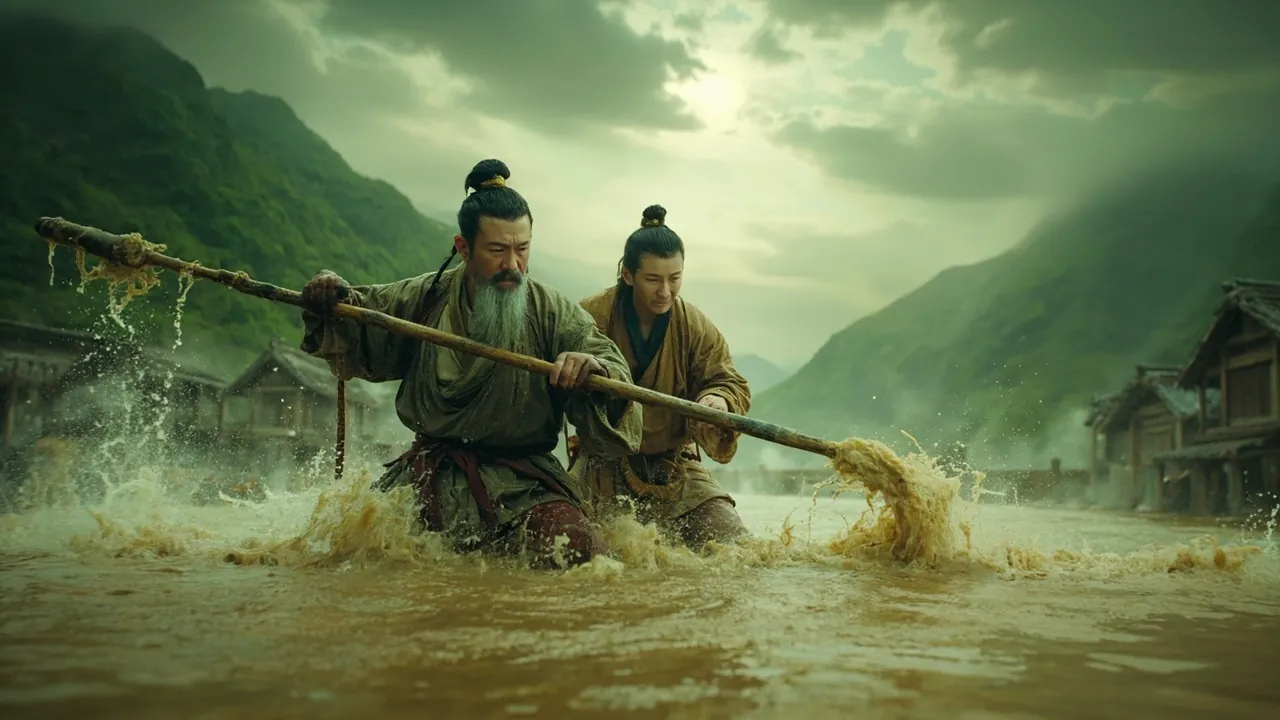
Yu was a different kind of man. The key innovation of his approach was the rejection of his father’s strategy. Where Gun had tried to block the floods, Yu decided to 疏导 — dǎshū, to dredge and channel. He would not wall off the rivers. He would guide them. He would dig canals to give the floodwaters somewhere to go, deepen riverbeds so the waters could move through them rather than over them, and work with the natural shape of the landscape rather than against it. The change in approach was a conceptual revolution: the traditional way of dealing with floods in much of the ancient world was to build higher walls, but Yu saw that the wall itself was the problem — that water, when confined, became more destructive than it would have been if allowed to flow along its natural path.
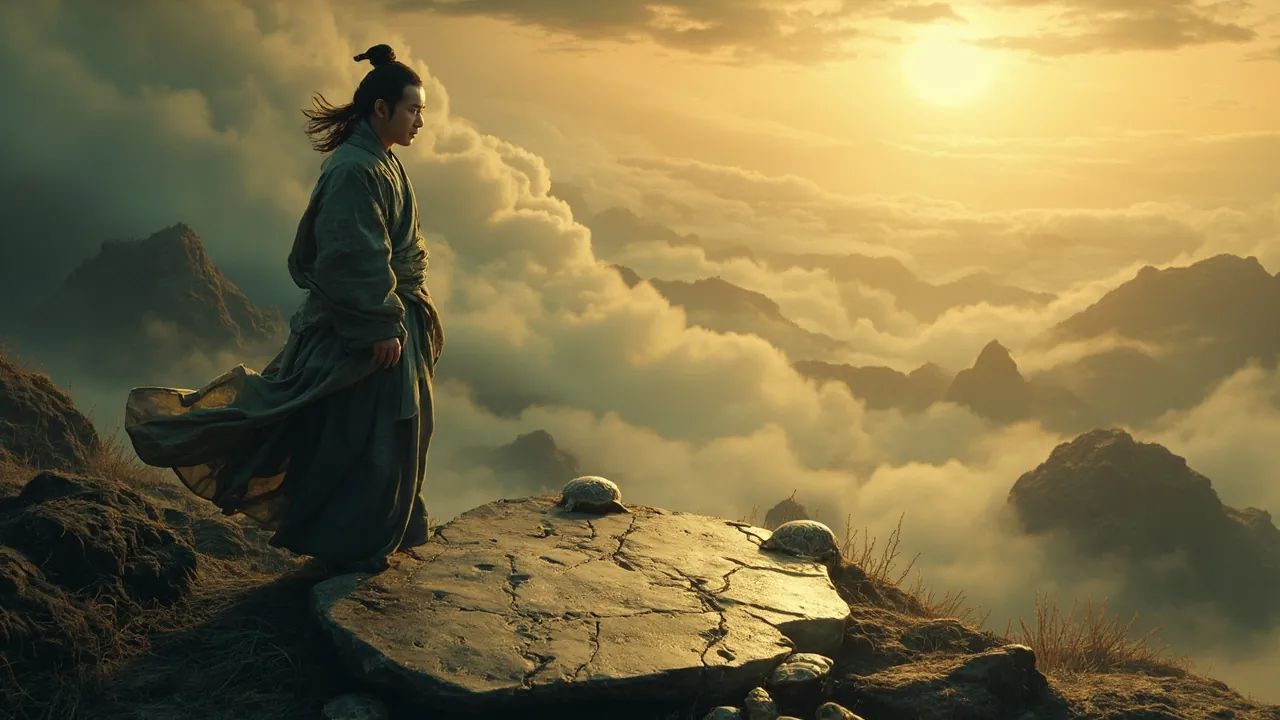
The work took thirteen years. Yu lived in the flooded plains, slept in the open, ate the rough food of the workers, and directed crews who dug channels, deepened riverbeds, and cut through hills that blocked the natural flow. The texts say he developed calluses on his hands so thick he could not feel the tools he held, and that he lost so much weight his bones showed through his skin. The most famous passage in the legend is when he passed his own home three times without entering — 三过家门而不入 — san guo jia men er bu ru — an idiom that has entered the Chinese language as a description of single-minded dedication to a public task. He did not finish alone: a divine dragon-tortoise rose from the 洛河 — Luo He, the Luo River — and presented him with markings on its back that became the basis for the 洛书 — Luoshu, the River Diagram, one of the foundational cosmological diagrams of the Chinese tradition. But Yu did the work himself.
When the thirteen years ended, the rivers had channels, the plains had paths for the water to follow, and the people could live and farm again. Yao’s successor, 舜 — Shun, rewarded Yu with the throne. When Yu passed the throne to his own son 启 — Qi, he did something no previous sage-king had done: he passed it to his son rather than to a minister chosen for merit. Qi founded the 夏 — Xia, the Xia Dynasty, traditionally dated to roughly 2070–1600 BCE and considered by historians, despite ongoing debate about whether it was a real polity, as the first dynasty of China. The Xia is the bridge between the legendary era of the sage-kings and the historical dynasties that began with the Shang — the moment in the Chinese tradition where myth gives way to history. The phrase 父死子继 — fù sǐ zǐ jì, “father dies, son continues” — captures the principle of dynastic succession Yu established, the rule that defined Chinese political life for the next three thousand years. But the principle of working with nature has shaped Chinese thought about governance, agriculture, medicine, and personal cultivation just as durably.
The Philosophy of Working With Nature
The contrast between Gun and Yu has been read in Chinese tradition as a parable about the difference between two ways of approaching a problem.
Gun tried to fight the water. He built walls. He used miraculous materials. He pushed against the natural order of things with all his strength, and the natural order pushed back. He lost.
Yu worked with the water. He studied the shape of the land. He dug channels where channels needed to be dug. He accepted the river as a river rather than treating it as an enemy to be defeated. He won.
This is the principle of 顺势而为 — shùn shì ér wéi, “going with the grain of things” — which has become one of the foundational concepts of Chinese philosophy, particularly in the Daoist tradition but also in Confucian and military thinking. The idea is that effective action comes from understanding the natural shape of a problem and working in harmony with it, rather than from imposing one’s will on a situation that does not want to be imposed upon.
Modern water management has vindicated Yu’s approach. The great flood-control projects of the twentieth and twenty-first centuries — from the levees of the lower Mississippi to the Three Gorges Dam on the Yangtze — have generally followed Yu’s logic. They have accepted that rivers will flood, and have tried to give the floodwater places to go, rather than trying to wall it off completely. Gun’s method has been tried. It has been found wanting. The history of flood control, in this sense, has been a long argument between Gun and Yu, with Yu gradually winning.
The Inheritance That Outlasts the Flood
The legend of Gun and Yu is also a parable about inheritance, and one that continues to shape the way Chinese readers think about rivers that are still running today.
Gun failed. He left behind an unfinished task. He also left behind a son who grew up in the shadow of that failure, watching his father work and watching his father die. Yu could have refused the burden. He could have said the floods were too large, the work too hard, his father’s example a warning about what happened when people tried. He did not. He took up the task, spent thirteen years of his life on it, and sacrificed his own comfort and family life for the work. The Chinese tradition has honored this kind of inheritance for thousands of years: the descendants of great ministers, the students of great teachers, the children of great artists are understood to carry the unfinished work of those who came before them.
The rivers that Yu tamed are still running. The Yellow River still floods its banks in catastrophic years. The Yangtze still threatens the cities along its banks. The work of flood control that Yu is said to have begun is, in the twenty-first century, still not finished. Place names along both rivers still commemorate the channels Yu is said to have dug. Temples to Yu the Great are still maintained in several provinces. Schoolchildren still learn the story of 三过家门而不入 as part of their introduction to the classical tradition.
The most important reason to keep the legend alive is the one that the legend itself suggests. Some problems are too large for any single person to solve. They require inheritance. They require patience. They require the willingness to work with the grain of the world rather than against it. Gun failed because he tried to fight the river. Yu succeeded because he tried to understand it. Three thousand years later, that distinction is still one of the most useful in the Chinese tradition of governance and engineering — and, perhaps, one of the most useful distinctions anywhere.