High Mountains, Flowing Water: The Guqin Legend of Boya and Ziqi
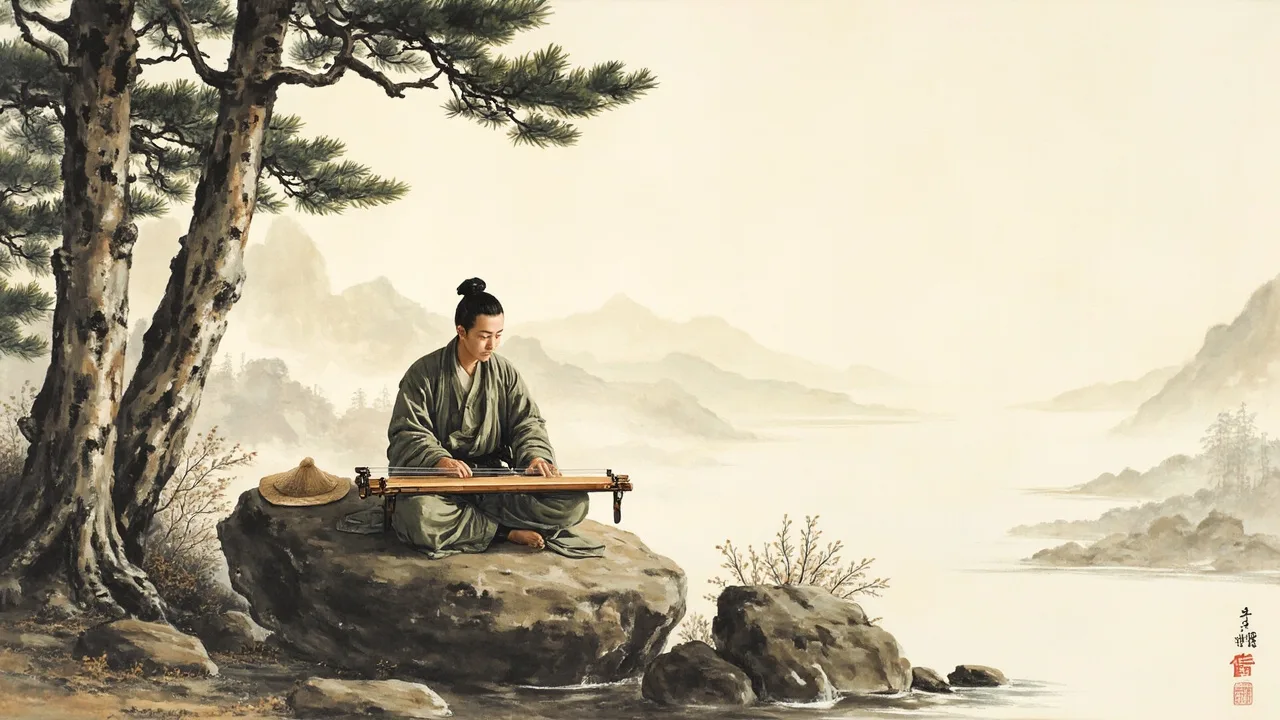
The story of Boya and Zhong Ziqi is one of the most beloved friendship stories in Chinese culture. Boya plays the guqin, an ancient seven-string zither. Ziqi listens and recognizes what Boya is trying to express: sometimes high mountains, sometimes flowing water. When Ziqi dies, Boya breaks his instrument and refuses to play again. He has lost the one person who truly understood his music.
The tale gives Chinese the word 知音, zhiyin, often translated as “a friend who knows your music” or “a true understanding friend.” English has phrases such as kindred spirit and someone who gets me, but zhiyin carries a particular image. Understanding is not abstract. It happens through attention. Ziqi does not merely praise Boya’s technique. He hears intention in the sound.
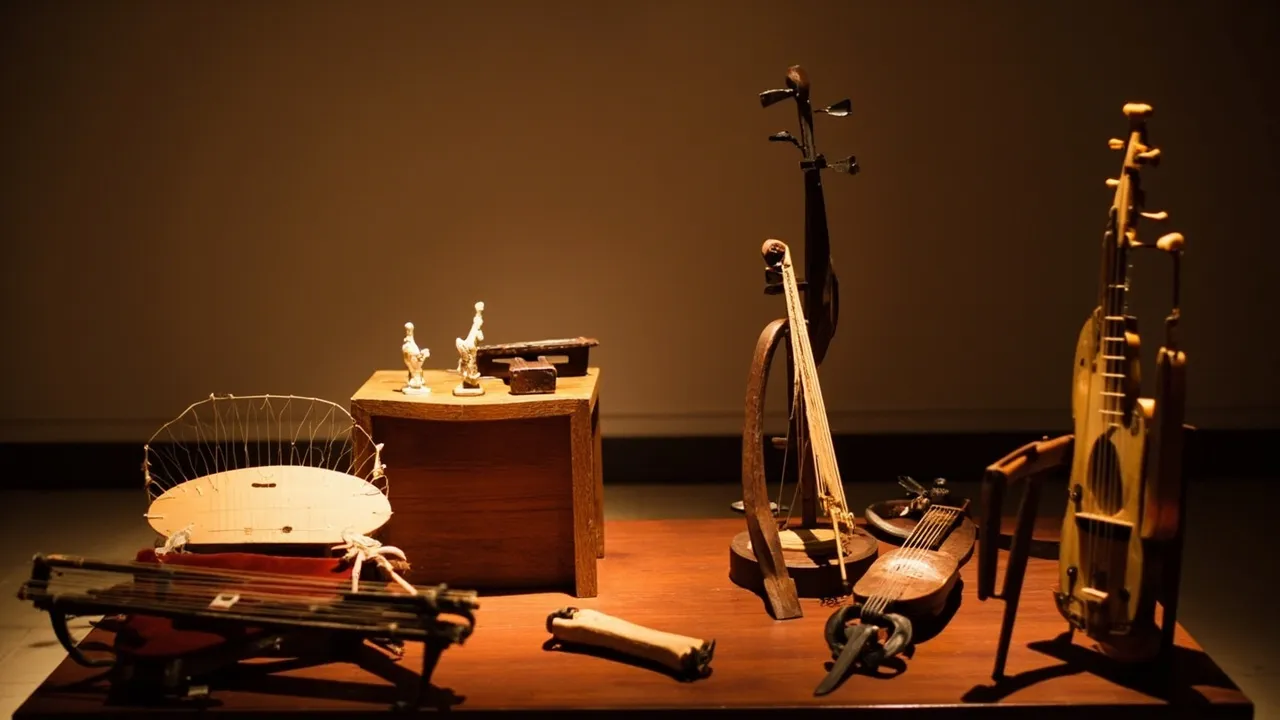
The guqin itself belongs to the classical education of the scholar. Along with calligraphy, painting, and the game of go, it was counted among the Four Arts. Learning it involved music, posture, literary allusion, self-discipline, and the shaping of a private inner life. You can hear why the instrument attracted scholars who wanted music to be thoughtful rather than flashy.
The guqin and the Four Arts
The guqin is a long, fretless zither with seven strings. It lies horizontally on a table, and the player plucks with the right hand while the left hand presses, slides, and touches the strings. The instrument’s sound is usually quiet. It does not try to fill a stadium or overpower an orchestra. You lean toward it.
Its history stretches back more than two thousand years, although surviving instruments and written traditions come from many different periods. Ancient texts connect the qin with sages and rulers, while archaeological finds and later manuals show changing construction and practice. The modern name guqin, “ancient qin,” helps distinguish it from other instruments that also use qin in their names.
The strings were traditionally silk, though many contemporary instruments use metal-nylon strings because they are durable and project more strongly. Silk has a softer, textured sound and reacts to climate. The choice affects technique, touch, and the noise of sliding fingers. Neither choice turns a beginner into a scholar. Careful listening matters more than romantic equipment.
Guqin notation records fingering instructions rather than ordinary Western staff notation. The player reads which string to touch, where to press, which finger to use, and what movement to make. Rhythm is not always fixed in the modern bar-line sense, so oral teaching and interpretation remain important. Two players can perform the same piece with noticeably different timing.
The instrument belonged to the Four Arts of the cultivated scholar: qin, qi, shu, hua, meaning guqin, the strategy game go, calligraphy, and painting. These were not simply hobbies collected to decorate a résumé. They trained attention, judgment, restraint, and taste. A scholar did not need to become a public concert virtuoso. The ideal often favored private practice among friends or alone.
That ideal should not be mistaken for the complete social history of music. Professional musicians, court performers, women, religious practitioners, and local communities also made music. The scholar’s guqin became prestigious partly because elite writers preserved its literature. It is one strand of Chinese musical culture, not the only authentic one.
Boya and Ziqi: what zhiyin really means
Versions of the story appear in early Chinese texts, and details change with retelling. Boya is the skilled player. Zhong Ziqi is the listener who understands. In a common version, Boya thinks of lofty Mount Tai while playing, and Ziqi exclaims that the music rises like the mountain. Boya then thinks of flowing water, and Ziqi hears a rushing river.
The important action belongs to the listener. Ziqi does not name the images by luck. The story imagines a level of attention so exact that one person’s inward intention becomes audible to another. Boya’s skill matters, but the miracle is shared. Music succeeds because performance and listening meet.
After Ziqi dies, Boya believes no one else can understand him. He breaks the strings or smashes the qin, depending on the version, and stops playing. Modern readers sometimes find the response excessive. Why destroy a cherished instrument after losing a friend? The story’s answer is severe: without the right listener, the music’s purpose has vanished.
Zhiyin literally combines “know” and “sound.” Today it can refer to a person who understands you deeply, even outside music. A close friend may know your strengths, recognize what you cannot say directly, and hear the intention behind clumsy words. The term is warm, but it carries sadness because the original story includes loss.
A zhiyin is different from an admirer. Praise can be shallow. Ziqi identifies meaning. He pays enough attention to distinguish mountain from water, stillness from motion. That distinction makes the story useful in a noisy age. Many people can react to what you post. Far fewer listen long enough to understand what you meant.
The legend also complicates the idea of artistic independence. Modern culture often celebrates the artist who creates without caring what anyone thinks. Boya’s story suggests that creation can depend on recognition. The right audience need not be large, but it matters. One attentive listener can justify years of practice.
How mountains and water became musical images
“High Mountains, Flowing Water,” or Gaoshan Liushui, is associated with the Boya and Ziqi legend, but the relationship between ancient story and present musical repertory is not a simple unbroken recording. Guqin pieces developed, changed, and circulated through written handbooks and teaching lineages. Titles and interpretations accumulated over time.
Mountain and water are central images in Chinese art. The term shanshui, “mountain-water,” is used for landscape painting. Mountains can suggest height, stillness, endurance, or the cultivated retreat. Water can suggest movement, change, continuity, and responsive flow. These meanings are flexible, not a code where one image always equals one idea.
On the guqin, a player can create open-string tones, pressed notes, and harmonics. Harmonics have a clear, bell-like quality. Pressed tones can bend and slide. A left-hand slide may continue after the plucked sound begins to fade, making motion itself part of the phrase. Silence between gestures is also active. The listener follows the sound into quiet.
That sonic world suits the mountain-water imagery. A strong open note can feel grounded. A series of moving figures can suggest current and spray. Yet the music does not imitate nature in a literal sound-effects way. The player uses learned gestures to invite an association, and the listener completes it.
This is why recordings can sound confusing at first to someone expecting a strong beat and immediate melody. Give the music a quiet room. Listen for changes in tone color and for the scrape or whisper of a sliding finger. Those noises are not necessarily flaws. They can reveal the physical contact between hand, string, and wood.
The legend encourages active listening. Before reading a program note, see what motion you hear. Does the phrase feel spacious, compressed, steady, hesitant, or rushing? You do not need to guess the “correct” image. Ziqi’s perfect recognition is an ideal. Real listening can begin with honest uncertainty.
Listening, making, and carrying the legend forward
The guqin survived through teachers, handbooks, instruments, recordings, and communities of practice. In 2003, UNESCO proclaimed guqin music a Masterpiece of the Oral and Intangible Heritage of Humanity, later incorporated into its intangible heritage framework. International recognition brought attention, but the tradition did not begin with UNESCO and cannot be preserved by a label alone.
A living musical tradition needs players, instrument makers, teachers, listeners, and places to practice. It also needs room for disagreement. Some musicians favor historically informed approaches, silk strings, and older interpretations. Others use new strings, concert amplification, contemporary compositions, or collaborations. Preservation and experiment do not have to be enemies, but each should be described honestly.
If you want to learn, begin with a teacher if possible. Guqin posture and right-hand technique can look simple while hiding habits that cause tension or weak sound. Online videos help with vocabulary, but they cannot always correct the angle of a finger or the timing of a slide.
Listening is a valid form of participation. Put away your phone for ten minutes and follow one recording. Notice the beginning, the spaces between phrases, and the moment the final sound disappears. The Boya and Ziqi story says listening is creative work. Ziqi completes the music by hearing it well.
The story continues in modern books, television, paintings, school lessons, friendship messages, and business names. “High mountains and flowing water” can signal refined music or rare mutual understanding. Familiarity sometimes turns a complex story into a decorative slogan. Returning to the loss at the end restores its weight.
Boya does not break the instrument because music failed. He breaks it because the friendship succeeded so completely that its absence became unbearable. You do not need to agree with his choice to understand the feeling. Anyone who has lost the one person they wanted to call after hearing a song knows something about that silence.
A few useful ways to keep learning
A well-recorded guqin album with liner notes is the easiest first purchase. Choose one that names the player, instrument, strings, pieces, and lineage. A bilingual book on Chinese music can explain notation and philosophy without forcing you to rely on vague “meditation music” labels. If you plan to study, a beginner guqin finger-technique manual and a stable low instrument table are practical additions. These are affiliate recommendations; a retailer may pay a small commission without changing your price.
Do not buy the cheapest decorative guqin online and expect a playable instrument. Ask a teacher or reputable maker about setup, string height, surface condition, and shipping. A humidity monitor and instrument cloth are useful accessories once you own one. For readers, a Chinese mythology and philosophy anthology can put the Boya story beside other early texts.
You can also start free. Listen to several players perform pieces associated with mountains and water. Write down what changes. One may emphasize pulse, another silence, another the roughness of sliding tones. Difference is evidence of a living tradition.
Listening to High Mountains, Flowing Water Today
Centuries after Boya set down his broken qin, the legend is louder than ever. Search any streaming platform and you will find dozens of recordings titled “High Mountains, Flowing Water” by different players, in different lineages, on silk strings and on metal. Concert halls outside China occasionally program guqin recitals, and UNESCO’s recognition of guqin music as intangible cultural heritage brought more international attention than any single conservatory could have. The piece has migrated from private scholar studies to small concert venues, museum installations, and yes, even meditation playlists, though the originals are far stranger and less ambient than most people expect.
If you have never heard guqin music, start in a quiet room, not on background shuffle. A good first recording names the player, the instrument maker, the string material, and the year. Sit with headphones if you can. The piece is short, often under ten minutes, and rewards attention the way the legend describes: you may not immediately hear the mountains, but listen for changes in tone color, the whisper of a sliding finger, and the spaces where the player lets the sound decay on purpose. The famous Gaoshan Liushui is usually performed as two connected sections, one suggesting height and stillness, the other current and flow, but experienced players emphasize that those images are invitations rather than instructions.
The most accessible places to encounter the piece in person are cultural museums with classical Chinese music exhibits (the Nanyue King tomb museum in Guangzhou has a dedicated guqin room, and many provincial museums rotate guqin collections) and occasional performances at Chinese cultural centers in cities like San Francisco, Vancouver, London, or Sydney. If you cannot attend a recital, video archives from major conservatories and broadcasting networks let you watch the player’s hands, which change how the music reads entirely. The left-hand slides are not noise to be edited out; they are part of how the qin “speaks.”
Meanwhile, zhiyin has stayed remarkably alive in modern Chinese usage. You will hear friends refer to each other as 我的知音 (“my zhiyin”) with a smile that crosses generations. The phrase appears in pop song lyrics, drama titles, novel subtitles, and usernames. It shows up in greeting cards and in startup pitches about partnership. The word has even crossed into Korean and Japanese cultural contexts with similar meaning. “High mountains and flowing water” has become a compliment for rare understanding between people who otherwise have very different daily lives, and internet users post it as a caption beneath unexpectable friendships.
That popularity is both encouraging and slightly dangerous. When a serious idea becomes a slogan, it can lose its teeth. The original story is not about two pleasant people enjoying each other’s company; it is about what happens when that recognition disappears. Returning to Boya’s grief, to Ziqi’s absence, recovers the weight of the word. A zhiyin is not just someone who likes you; it is someone whose absence would leave your best efforts without an audience.
A few small rituals can keep the listening practice honest. Brew a simple pot of tea. Sit near a window, not a screen. Choose one piece. After it ends, write two sentences about what you actually heard, not what you expected to hear. If the words surprise you, you are doing it right.
If you want one practical gift tied to this listening ritual, a quality pu’er or oolong tea set turns the act of paying attention into a small ceremony. A beginner’s guqin study book with notation explanations and historical context also anchors listening in something more durable than a playlist. Avoid the cheapest bamboo tea trays and the thinnest printed guides; modest investment shows in every use.
Closing thoughts
The Boya and Ziqi legend survives because it gives friendship a sound. A true friend is someone who hears the mountain and the water inside your music. The guqin makes that idea especially powerful because its quiet tones demand attention. You do not have to play the instrument to practice the lesson. Listen closely, resist easy praise, and treasure the rare person who understands what you were trying to say.