Hakka Cuisine: The Mountain Food of China’s Wandering Clan
If you’ve ever stood in a Guangdong noodle shop and watched an old woman wrap pork paste into cubes of tofu with mechanical precision, you were probably watching a Hakka grandmother at work. The Hakka (客家, literally “guest families”) are China’s most widely dispersed ethnic subgroup — a people defined by movement, by the stubborn habit of keeping their own language and foodways wherever they end up, and by an uncanny talent for turning harsh terrain into something delicious.
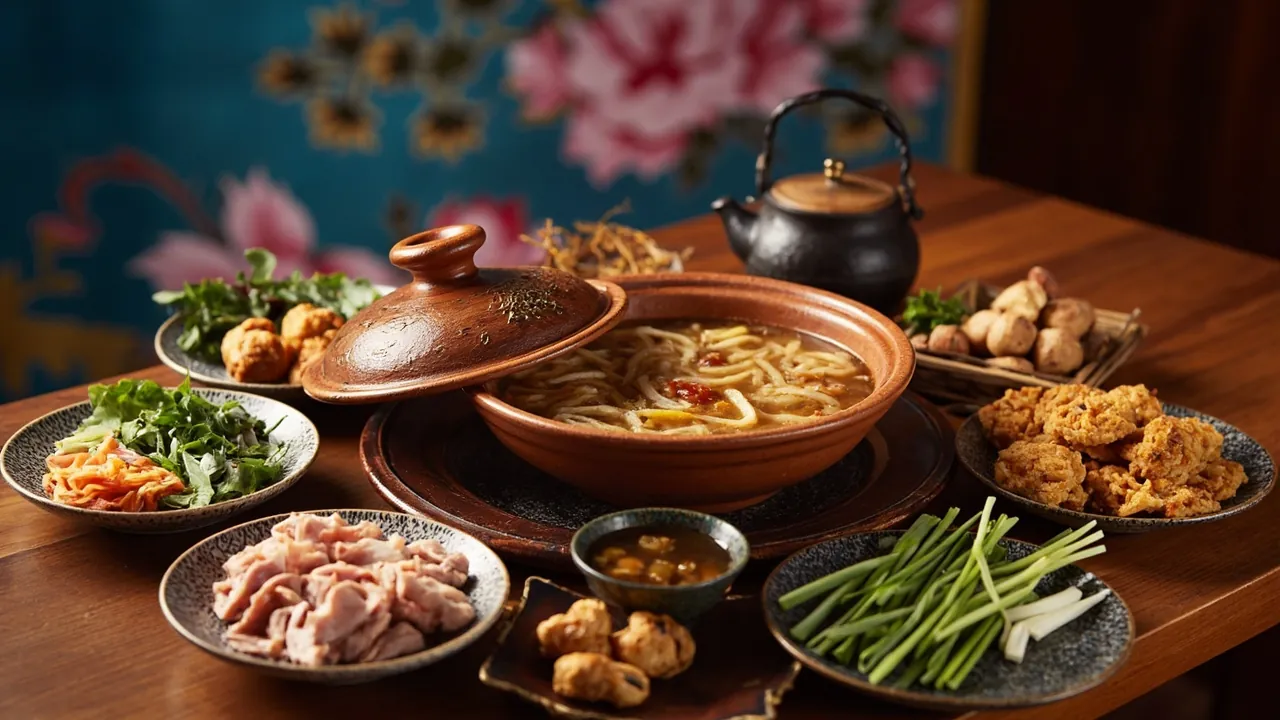
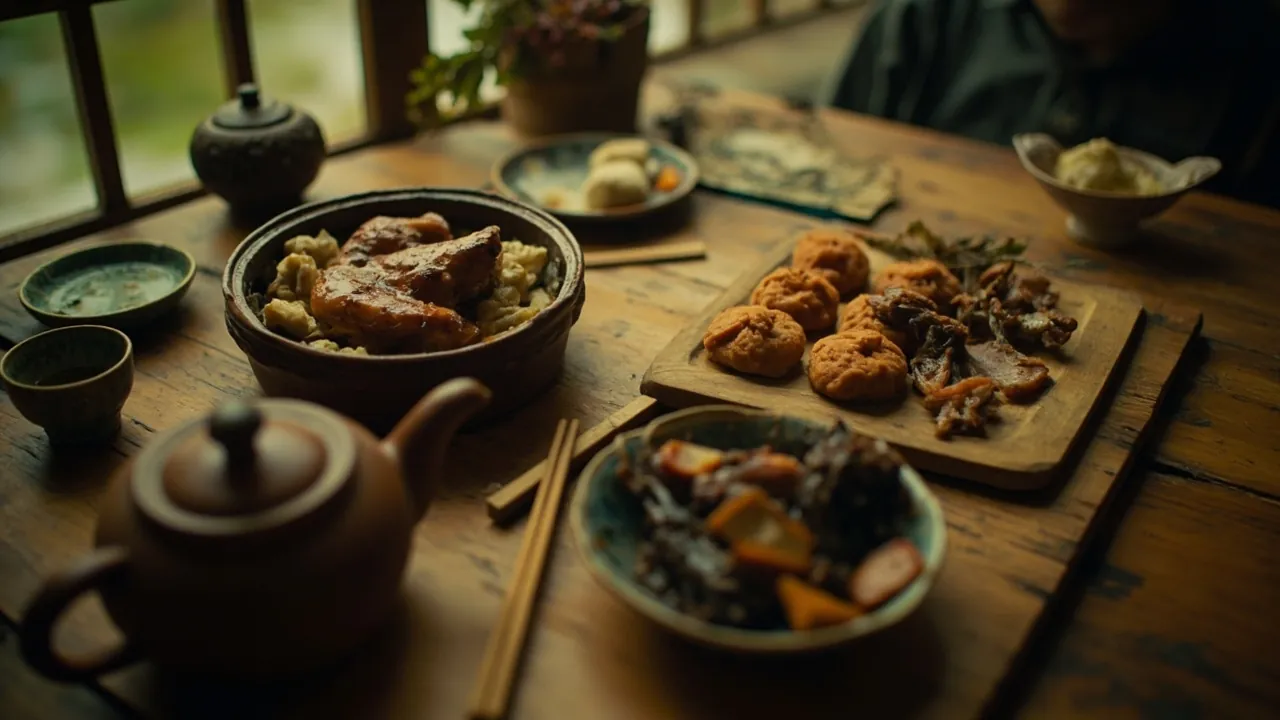
Hakka food is the quiet workhorse of Chinese regional cooking. It doesn’t shout like Sichuan, doesn’t dazzle like Cantonese, doesn’t travel internationally the way dim sum does. But sit down with a clay pot of salt-baked chicken over rice, a steaming plate of pork belly under preserved mustard greens, and a bowl of green pounded tea, and you’ll understand why a people who lost their homeland more than a thousand years ago kept their kitchens intact on the road.
Who Are the Hakka, and Why Does Their Food Taste Like Mountains?
To understand Hakka food you have to understand Hakka history, because the cuisine is essentially a survival strategy that got refined over centuries of migration. The Hakka are Han Chinese whose ancestors moved south from the central plains — the same ancestral homeland as most Han people — but did so in waves, starting as early as the fourth century CE and continuing through the Ming and Qing dynasties. They arrived in places already settled, often by rival clans, and got pushed into the worst land: steep hillsides, rocky valleys, the kind of terrain nobody else wanted.
So the Hakka learned to farm where the soil was thin, conserve what they had, and preserve everything they could. They built fortified villages (the famous tulou, or earthen roundhouses, but more on those in another piece). And they cooked with a discipline that says: nothing goes to waste, nothing gets thrown out, every jar on the back shelf matters.
That history is why Hakka food is characterized by what scholars sometimes call “three treasures”: preserved mustard greens (梅菜, méicài), sun-dried radish (菜脯, càipú), and cured pork. To these I’d add a fourth: the relentless Hakka preference for keeping dishes in a single pot from start to finish.
If you’re an American cook, that last part should feel familiar. A Hakka one-pot meal has a lot in common with a New England boiled dinner, a southern braise, or the kind of big Sunday dish your grandmother would put on low before church and expect to feed a working family. The parallels aren’t coincidence. Whenever people had to stretch resources and feed many mouths on rugged land, they invented very similar foods.
Salt-Baked Chicken (盐焗鸡): The Hakka Signature
Ask a Hakka person what their national dish is, and they’ll almost always say salt-baked chicken, or yanju ji (盐焗鸡). It’s the single best ambassador for everything Hakka cooking is trying to do: simple ingredients, slow patient cooking, no fancy sauce, and a finished product that hits harder than you’d expect from a recipe that looks like a science experiment.
The traditional method is genuinely weird by Western standards. You take a whole chicken, rub it with a thin layer of salt and a little shaoxing wine, wrap it tightly in oiled paper (originally, sometimes parchment these days), and bury it in a wok or clay pot absolutely packed with coarse salt. The whole thing goes in the oven or over a fire for an hour and a half or so. Then you dig the chicken out, peel off the paper, and eat it. That’s it.
What you get is something that confounds anyone who has only ever had roast chicken or grilled chicken. The meat is incredibly juicy — almost poached in its own juices inside that paper — and the skin has a savory, slightly cured quality from sitting against the salt all that time. The flavor isn’t “salty” in the way that a heavily brined turkey is salty. It’s more like the salt has pulled out everything extraneous and left you with pure, concentrated chicken.
Modern home cooks in China often use a simplified version: a salted-wok-bake shortcut that uses preheated rock salt in a wok on the stove and cooks the bird in thirty minutes flat. The flavor is slightly less complex but still miles away from anything you’d get out of an oven bird. If you’re stateside, salt-baked chicken kits are now common in Chinese online markets — the kit handles the salted clay pot method with a smaller portion.
The genius of salt-baked chicken is that it works as both a centerpiece dish and a way to use leftovers. The next day, the cold shredded meat gets tossed with cucumber, scallion, ginger, and a slick of sesame oil for one of the great summer salads of southern China.
Meicai Kou Rou (梅菜扣肉): Pork Belly, Earth, and Time
If salt-baked chicken is the Hakka dish that impresses outsiders, meicai kou rou (梅菜扣肉) is the one that explains them to themselves. It’s pork belly — three whole layers of fat, meat, and skin — that’s been slowly stewed with preserved mustard greens, then pressed and steamed, then served upside down so the dark greens drape over glistening layers of pork.
The pork is cooked twice. First, it’s gently simmered in seasoned water with ginger, scallions, and a generous splash of soy sauce until the meat is tender but still holds its shape. Then it’s cut into thick rectangles and stir-fried briefly to color the edges. The preserved mustard greens — meicai — get a quick rinse and a chop, then get cooked with garlic, ginger, sugar, and a little more soy.
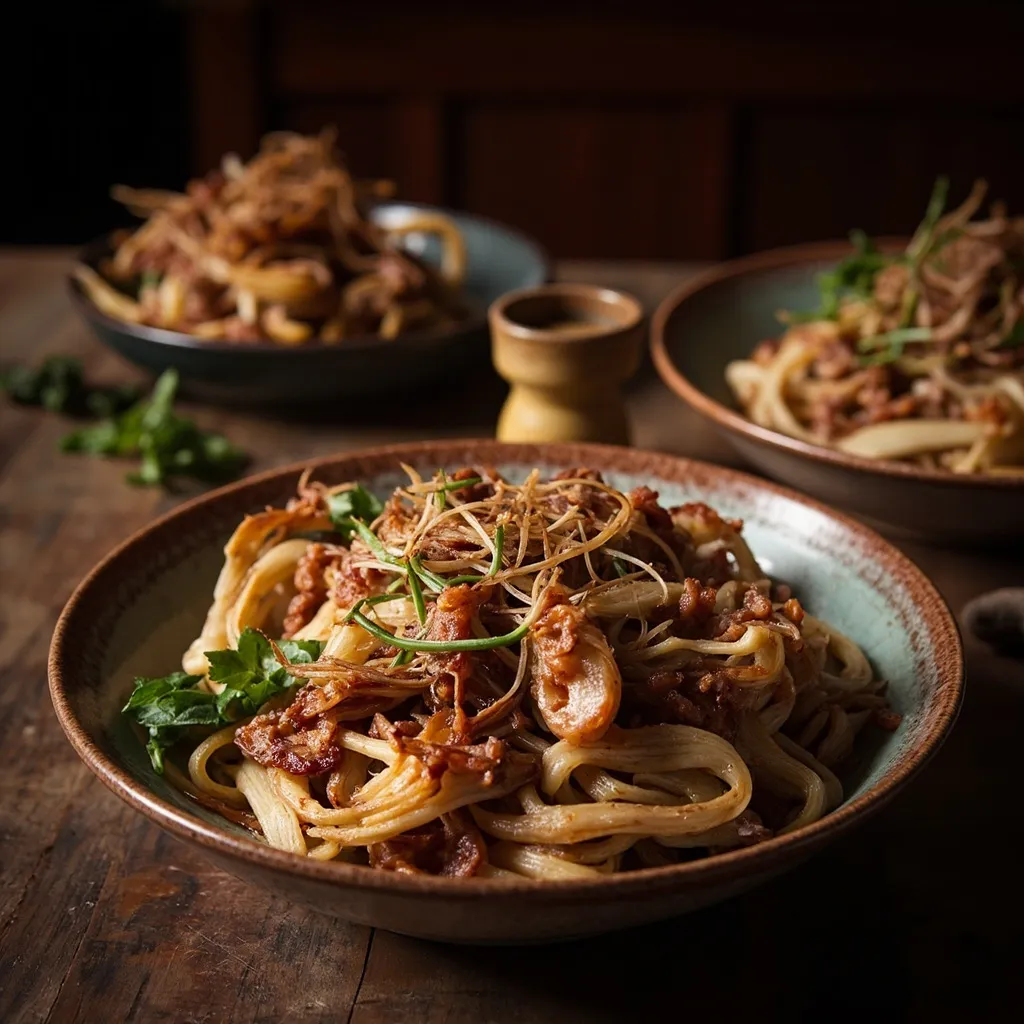
Now the assembly: in a deep bowl, line up the pork slices skin-side down, pack the meicai in around and on top, then turn the whole thing upside down onto a serving plate. Steam it again for an hour. When you lift the bowl, the result is a kind of architectural pork tower: each slice a glossy, mahogany-edged layer of meat, topped with a tangle of dark greens soaked in pork fat and salt.
The taste is unlike anything in American comfort food canon. The meat has gone beyond tender into something almost silken — the fat has melted into the muscle fibers but the form remains. The greens are salty, slightly sweet, deeply funky in a way that you only get from food that’s been slowly cured. You scoop a bit of meat and greens over rice, and the rice itself is transformed by what pools at the bottom of the plate: a thin layer of pure pork essence that will haunt you for weeks afterward.
For an American cook, meicai kou rou is harder to make from scratch than salt-baked chicken. You need access to good meicai — preserved mustard greens, dry-fried Sichuan style if you can find them, otherwise the sweeter Hakka-style variety in vacuum packs. Once you have those, the technique is forgiving. The pork belly steers the entire dish; even mediocre pork becomes interesting given enough time in the steamer.
The leftover pork is famous in its own right. Cold, the slices become a Hakka breakfast meat, eaten congee-style with rice porridge, or tucked into a sandwich with chili crisp for a Chinese take on a braised-pork sandwich that absolutely runs circles around a ham-and-cheese.
Stuffed Tofu (酿豆腐) and Lei Cha (擂茶): The Everyday Hakka Table
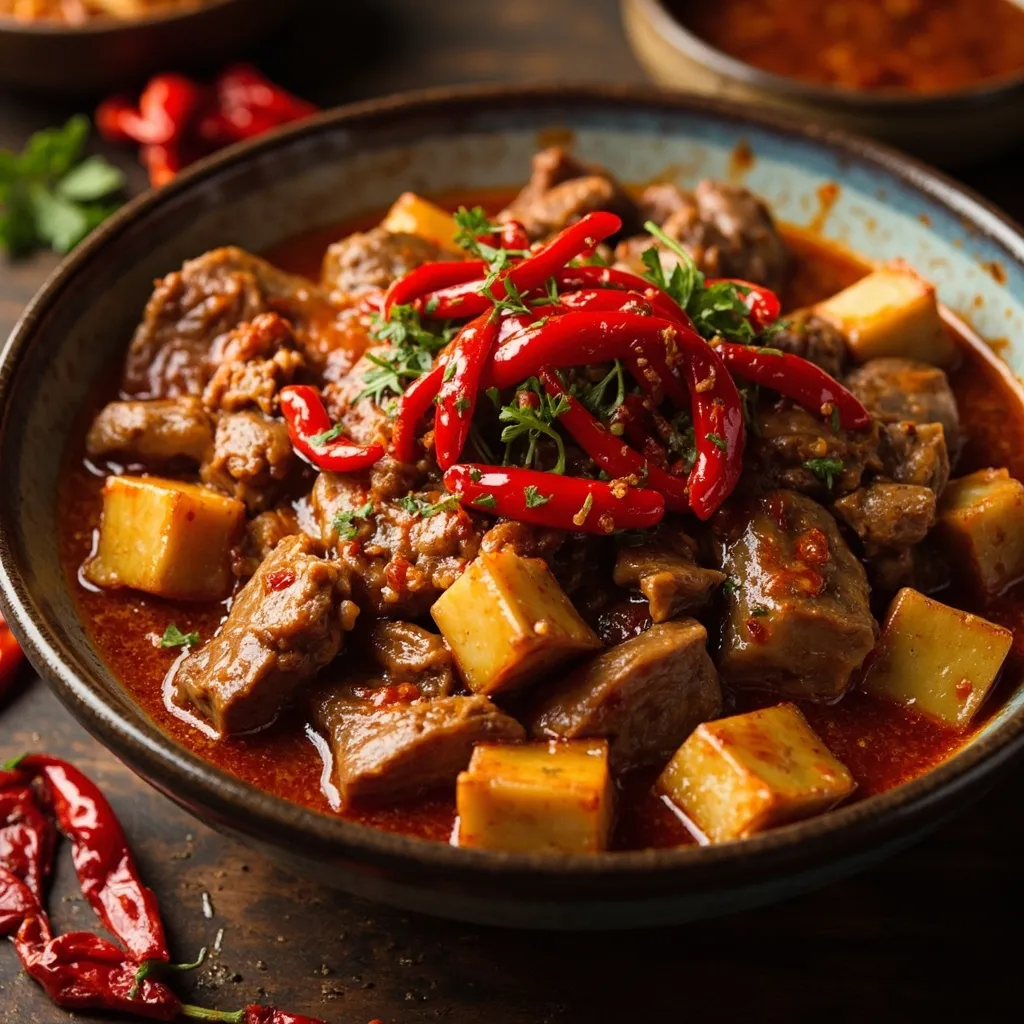
Two other dishes complete the Hakka everyday repertoire. Stuffed tofu, called nian doufu (酿豆腐), is what most Hakka families eat when they want a quick family meal. The technique is simple and weirdly meditative: you take firm cubes of tofu, hollow them with a small spoon, and stuff the cavity with a seasoned pork paste (ginger, scallion, soy, a little sesame oil, sometimes chopped water chestnut for crunch). Then you pan-fry the stuffed cubes until the pork is cooked through and the tofu has a golden crust.
At this point a sauce goes in — typically a mix of soy, oyster sauce, and broth, sometimes thickened with cornstarch — and the whole thing simmers until the tofu has soaked up most of the liquid. Served with rice and greens, it’s the kind of dish you make when there’s nothing in the fridge except a block of tofu and a small bowl of leftover ground pork. Almost every Hakka cook can pull it out in under thirty minutes.
Once you understand the concept of nian — “stuffing” — a whole world opens up. Hakka cooks stuff peppers, eggplant, bitter melon (especially bitter melon), mushrooms, sometimes even fish. Nian doufu is the ur-recipe; everything else is variation on the theme of “fill a vegetable with seasoned pork and cook it nicely.”
Lei cha (擂茶, literally “pounded tea”) is the most distinctive drink in the Hakka pantry and one of the most unusual drinks anywhere in China. In a Hakka village, making lei cha is a small ceremony. You take a clay mortar, add toasted rice, peanuts, sesame seeds, salt, and tea leaves, and you pound it all together with a wooden pestle — really pound it, the way a Mexican cook does for molcajete salsa — until it forms a coarse, fragrant paste. Then you add hot water and stir. The result is a thick, greenish-brown savory drink with the texture of a coarse soup.
Hakka lei cha is not sweet, and it’s not really what Americans think of as tea. It’s closer to a savory porridge in liquid form. The toasted rice gives it a toasty depth, the peanuts thicken it slightly, and the green tea cuts through. Some makers add herbs like mugwort or perilla. You drink it with small plates of pickled vegetables, rice crackers, peanuts, and other condiments, and it functions as a light meal or an afternoon pick-me-up.
There are Hakka villages in Taiwan and around the South China coast that hold lei cha festivals, where dozens of families bring their mortars and pestles outdoors and pound tea together in a kind of communal kitchen. It’s one of the most hopeful things in Hakka culture — a people defined by exile making one of their strangest traditions into a public party.
Hakka Food and the American Pantry
Here’s the part that matters most for an American reader. Hakka cooking isn’t exotic in the way some Chinese regional cuisines are exotic. The toolkit is forgiving, the ingredients are increasingly available, and the philosophy maps almost perfectly onto a certain strain of American home cooking that values frugality, one-pot meals, and food that improves on the second day.
Preserving is your friend. The Hakka obsession with preserved greens and cured meats is essentially the same instinct that gave us American jerky, sauerkraut, and salt pork. If you can find a Chinatown market, look for bottles of pickled mustard greens (梅菜, sometimes labeled “meicai” or “mui choi” in Cantonese-speaking stores), dried radish, and cured pork belly. They’ll keep in your pantry for months and turn a dull Tuesday stir-fry into something serious.
Buy a carbon steel wok and use it. Hakka cooking relies on the wok in the same way southern barbecue relies on the smoker. Get a 14-inch carbon steel wok from a restaurant supply store, season it properly (yes, you actually do need to do this), and let it get uncomfortably hot before you add oil. Stir-fries will go faster, taste better, and last longer than anything you’ve made in a nonstick skillet.
Embrace the clay pot. A sand pot, or sha guo (砂锅), is the Hakka cooking vessel of choice. It holds heat like a Dutch oven and produces the kind of slow-simmered dishes that are pure cold-weather comfort. Look for a sand pot online or in any Chinatown kitchen-supply store; they’re cheap, decorative on the table, and they’ll change the way you think about stews.
Keep meals one-pot when you can. Hakka cuisine is unusually good at delivering whole meals from a single vessel. Stuffed tofu in sauce with vegetables. Salt-baked chicken with greens underneath. Pork belly and preserved greens stacked together. American cooks often overthink Chinese food by trying to make three separate side dishes. Trust the pot.
Where to Find Hakka Food in America
If reading all this has made you hungry, good news: Hakka restaurants exist, especially in California, New York, New Jersey, and Toronto, and they’re usually excellent and absurdly underpriced. Look for signs in Hakka neighborhoods, particularly in cities with deep Guangdong and Fujianese diaspora populations. A handful of flagship Hakka restaurants in San Gabriel (California), Edison (New Jersey), and Manhattan’s Chinatown are widely credited with helping introduce American diners to dishes beyond dim sum and kung pao chicken.
The dishes to order first, in this order: salt-baked chicken, a Hakka side or two if they’re doing lunch specials (the stuffed tofu and bitter melon always tell you whether a Hakka kitchen is taking itself seriously), meicai kou rou if it’s on the menu, and a tea or drink alongside. If they have lei cha, get it; ordering it in a Hakka restaurant is the rare cooking move of buying time, because you’ll almost certainly talk to your server about it.
Recommended Products
For cooks ready to try Hakka at home, these are the tools and ingredients that get you closest to the real thing.
- salt-baked-chicken-kit — A traditional Hakka clay pot set with coarse rock salt for the one-pot method; works on a stovetop and gives a juicier bird than oven roasting.
- meicai-ko-product — Vacuum-packed Hakka-style preserved mustard greens, the ingredient that makes meicai kou rou worth eating.
- wok-carbon-steel — A 14-inch carbon steel wok, flat-bottomed for American stoves; the essential vessel for stuffing-frying, stir-frying, and quick simmers.
- bamboo-steamer — A two-tier bamboo steamer that fits inside a wok or pot; perfect for the second steaming of stuffed tofu and pork belly.
- preserved-vegetable — A mixed assortment of Chinese preserved vegetables (mei cai, ya cai, radish) to keep on hand for Hakka and broader Chinese cooking.