The Han Dynasty: How China’s Greatest Imperial Age Shaped a Civilization
Every time someone refers to Chinese people as “Han Chinese,” they are invoking the legacy of one of history’s most consequential dynasties. The Han Dynasty, which ruled China from 206 BCE to 220 CE, was so influential that the majority ethnic group of China still bears its name nearly two millennia after the dynasty itself faded into history. This wasn’t simply because the dynasty lasted a long time — though four centuries is nothing to dismiss — but because the Han period established institutions, cultural patterns, and territorial boundaries that would define China for generations to come.
The dynasty was founded by Liu Bang, a man whose journey from peasant farmer to emperor seems almost too dramatic to be true. His story, and the stories of the emperors, scholars, merchants, and common people who lived during the Han period, reveal a civilization at the height of its creativity and confidence. The Han Chinese didn’t merely inherit their name — they inherited a vision of what China could be.
Liu Bang and the Founding of an Empire
The end of the Qin Dynasty, that first unified Chinese empire, came in chaos. The tyrant Emperor Qin Shihuangdi had died in 210 BCE, leaving behind a vast empire built on forced labor, harsh laws, and the suppression of intellectual freedom. His successors were incompetent, and within two years the empire had collapsed into civil war. Two major contenders emerged for control: Xiang Yu, a nobleman of extraordinary military talent and aristocratic bearing, and Liu Bang, a former village officer whose forces had occupied the Qin capital before Xiang Yu’s armies could arrive.
The contrast between these two men could hardly have been sharper. Xiang Yu was tall, handsome, and brilliantly talented — a warrior of legendary prowess who seemed born to rule. Liu Bang was described by contemporary sources as less impressive physically, with a character that combined common sense with a certain opportunism and charm. Yet it was Liu Bang who won. The reasons illuminate much about the nature of Han rule.
Where Xiang Yu sought to restore the old feudal order, dividing his empire among loyal nobles, Liu Bang recognized that China needed something different. After his victory, he established a centralized government that drew on Qin institutions while moderating their harshness. He reduced taxes, lightened the burden of conscription, and showed a willingness to work with rather than destroy the scholarly class that the Qin had persecuted. His famous statement upon taking the throne — that he would rather have a capable minister than desire the world himself — captured this pragmatic, results-oriented approach.
Liu Bang ruled as Emperor Gaozu from 202 to 195 BCE, establishing the template for Han governance. His successors would refine and expand this model, but the basic character of the dynasty was set: strong central authority balanced by attention to practical governance, cultural patronage, and an openness to diverse viewpoints within the scholar-official class.
The Golden Age: Wenjing Era and Imperial Expansion
The early decades of the Han Dynasty were spent consolidating power and rebuilding after the chaos of the Qin collapse. The reigns of Emperor Hui, Empress Dowager Lü, and Emperor Wen represented a careful period of recovery, with reduced taxation, amnesty for political prisoners, and diplomatic marriages to keep nomadic tribes peaceful on the northern frontier. By the time of Emperor Wen and Emperor Jing in the mid-second century BCE, the dynasty had achieved a degree of prosperity and stability that contemporaries called the Wenjing era — an age of cultural refinement and peaceful governance that demonstrated how well China could prosper when ruled with restraint.
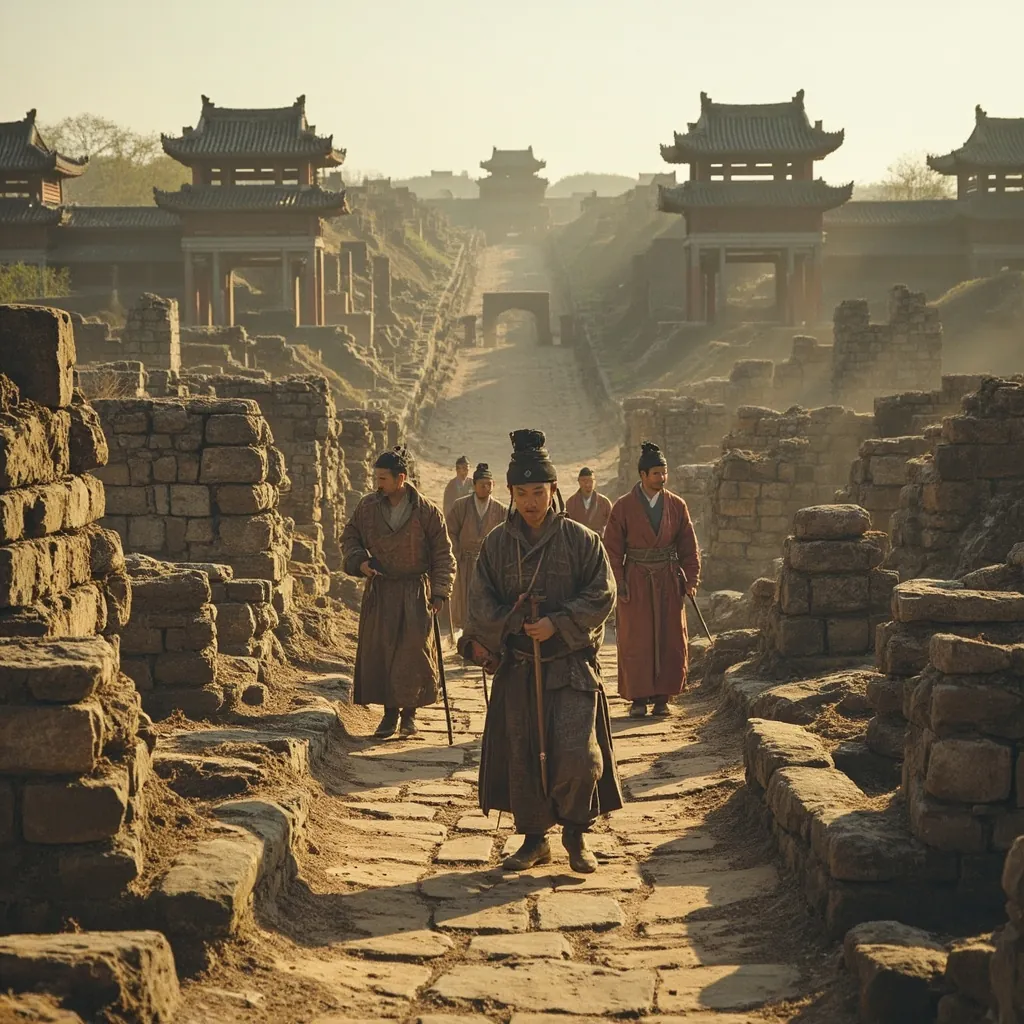
Emperor Wen, who reigned from 180 to 157 BCE, is remembered as one of China’s most exemplary rulers. His reign emphasized moral example over legal coercion, and he famously reduced criminal punishments, remitted taxes during difficult years, and treated his officials with courtesy rather than the suspicion that had characterized Qin rule. The historical record portrays him as genuinely concerned with his people’s welfare, a quality that earned him the respect of later generations. His tomb, near modern Xi’an, was built without the massive forced labor projects that had marked Qin construction — he specifically instructed that his burial not burden the people.
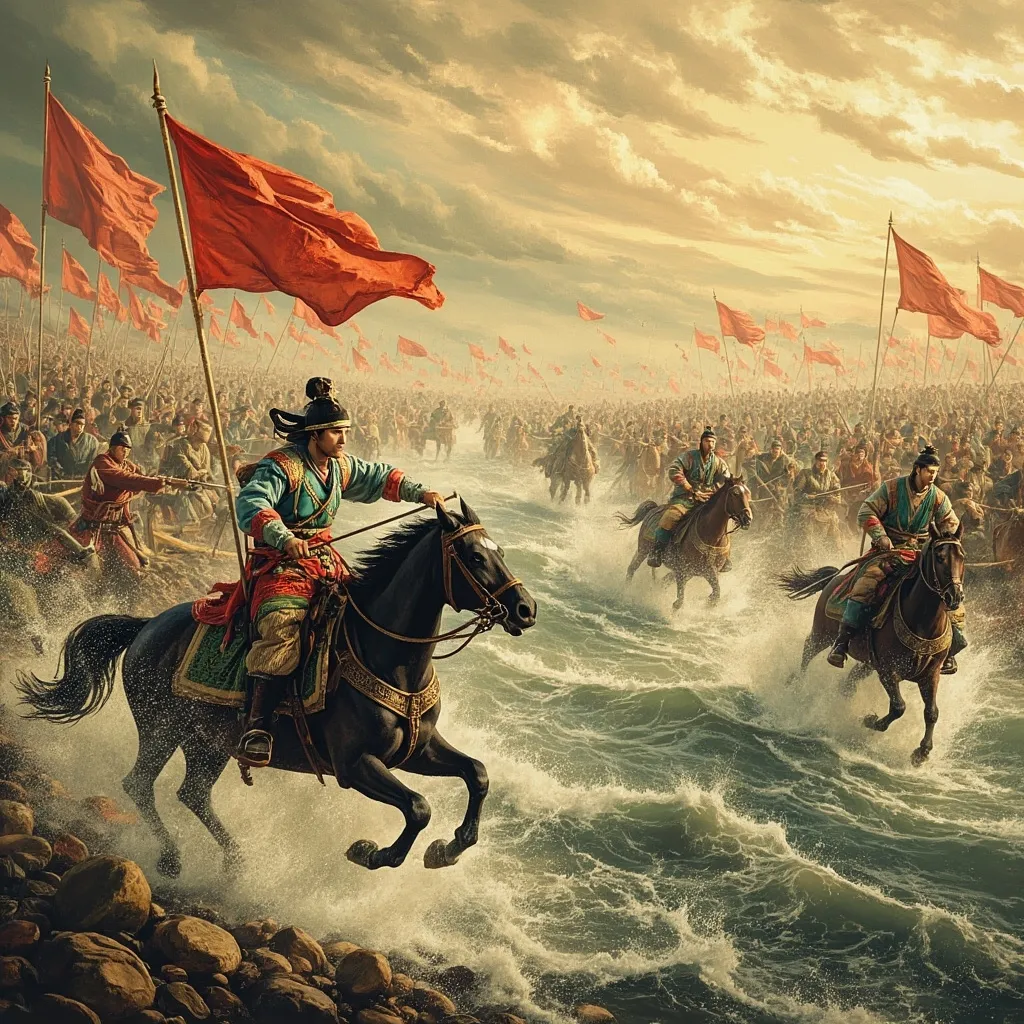
Yet the Han also faced a persistent threat from the nomadic Xiongnu confederation to the north. The Xiongnu were masterful horsemen whose raids had troubled the Qin as well, and the Han’s early emperors had bought peace through tribute and marriage alliances. This policy of appeasement, while avoiding expensive wars, carried its own costs — it implied Chinese weakness and drained imperial resources. Emperor Wu, who came to the throne in 141 BCE, was determined to change this arrangement. His reign, though marked by some costly military adventures, transformed the Han from a cautious, inward-looking state into a confident imperial power that projected force across Central Asia.
The campaigns against the Xiongnu, led by generals like Wei Qing and Ban Chao, pushed Han power deep into the steppes and established Chinese influence along the trade routes that would become the Silk Road. Wei Qing’s campaigns in the 129-119 BCE period achieved remarkable success, breaking Xiongnu military power and opening the way for Chinese diplomatic and commercial expansion westward. Ban Chao’s later campaigns in the first century CE extended Han control into the Tarim Basin, securing the trade routes that linked China to Parthia and Rome. These weren’t merely military expeditions — they opened channels of communication and commerce that would shape Eurasian history for over a millennium. Chinese silk found its way to Rome, while glassware, horses, and new crops flowed eastward. Buddhism would later travel this same route from India to China.
Emperor Wu also extended Han authority into southern China, Vietnam, and Korea, creating administrative structures that would persist for centuries. The conquest of the Yunnan region brought diverse peoples under Chinese control, establishing patterns of governance and cultural assimilation that continued through subsequent dynasties. In Korea, Han influence produced the kingdom of Buyeo, which claimed descent from the ancient state of Ji and maintained close cultural ties with China. These expansions created a geopolitical space that Chinese rulers would continue to claim and contest for the next two thousand years.
The Silk Road: Ancient China’s Connection to the World
Perhaps no aspect of the Han Dynasty’s legacy has had more global impact than the establishment of the Silk Road — a network of trade routes linking China to the Mediterranean world through Central Asia. While the term “Silk Road” wouldn’t be coined until the nineteenth century, the routes themselves flourished during the Han period, carrying not just silk but technologies, religions, diseases, and ideas across the breadth of Eurasia.
The immediate cause of the Silk Road’s opening was the Han’s campaign against the Xiongnu. In 139 BCE, Emperor Wu sent the diplomat Zhang Qian westward to seek alliances with peoples who might also oppose Xiongnu power. Zhang Qian’s mission failed in its military objectives but succeeded spectacularly in another direction: he returned to China with detailed knowledge of the civilizations of Central Asia and the possibility of trade with distant lands. The emperor who had spent so much blood and treasure fighting nomads suddenly saw a new avenue for Chinese influence.
Within decades, Han merchants were traveling to Central Asian cities like Kashgar and Samarkand, trading silk for horses, glass, and exotic goods. The demand for Chinese silk in the Roman Empire was particularly intense — Roman aristocrats wore it as a status symbol despite laws trying to ban it as decadent and a drain on imperial gold. The Romans never quite figured out how the Chinese made silk (the secret involved silkworm moths and mulberry leaves, jealously guarded by the Chinese), which kept China at a trade advantage for centuries.
The Silk Road carried far more than material goods. Buddhism traveled from India through Central Asia to China along these routes, as did Islam, Christianity, and other religions that would eventually find Chinese adherents. Chinese inventions like paper and gunpowder moved westward, transforming European civilization. In the other direction, new crops — grapes, alfalfa, walnuts, carrots — entered China and transformed Chinese agriculture. The peoples of the steppes served as intermediaries, profiting from the trade while maintaining their pastoral way of life.
The Invention of Paper and Other Innovations
The Han Dynasty wasn’t merely a period of political consolidation and trade expansion — it was also an age of remarkable technological innovation. While the invention of paper is the most famous Han achievement, the period produced advances in metallurgy, agriculture, medicine, and astronomy that laid the groundwork for Chinese technological superiority for centuries to come.
Cai Lun, a court official during the Eastern Han period (the dynasty’s second phase after a brief interruption), is traditionally credited with inventing the modern papermaking process around 105 CE. While earlier forms of paper-like materials existed, Cai Lun’s method — using bark, hemp, rags, and other fibers processed into a usable sheet — produced a cheap, practical writing surface that eventually replaced bamboo strips and silk in most applications. The impact of this innovation on the spread of literacy and knowledge cannot be overstated.
Paper allowed ideas to be recorded and transmitted more easily than ever before. Schools could obtain textbooks, government announcements could reach remote regions, and individuals could keep personal records without enormous expense. When paper eventually traveled westward along the Silk Road, it transformed Islamic and European civilizations as well, contributing to the medieval cultural flourishing that eventually produced the Renaissance.
Other Han innovations proved equally significant in their domains. The invention of the seismometer by Zhang Heng in 132 CE could detect earthquakes from considerable distances and indicate their direction — an astonishing application of acoustic and mechanical principles. Han metallurgists developed techniques for producing steel and cast iron that wouldn’t be matched in Europe until the Industrial Revolution. The Han medical text Shang Han Lun established diagnostic and treatment frameworks that would influence Chinese medicine for two thousand years.
Agricultural improvements during the Han period included the widespread adoption of iron plows, the development of crop rotation systems, and the introduction of new irrigation techniques. These advances increased food production enough to support a population that reached approximately sixty million — a level that wouldn’t be exceeded until the Song Dynasty eight centuries later. The connection between agricultural surplus, population growth, and the ability to fund military campaigns and cultural achievements underscores how technological innovation supported Han power in concrete ways.
The Formation of the Han Ethnic Identity
Beyond its political and technological achievements, the Han Dynasty played a crucial role in defining what it meant to be Chinese. The term “Han” as an ethnic designation emerged during this period, building on earlier cultural identities while synthesizing them into something new. This wasn’t a process of simple assimilation but of active cultural creation — the Han identity that emerged during this period incorporated elements from diverse peoples across the empire’s territories while maintaining a distinctive character that persists today.
The Han Dynasty’s territorial expansion brought previously independent peoples under Chinese administration. The peoples of southern China, the Yunnan plateau, and the northern frontier gradually absorbed Chinese language, customs, and political structures while contributing their own elements to the resulting culture. The development of a standardized written Chinese language, based on Classical Chinese used by the educated elite, provided a medium of communication across the empire’s vast distances and linguistic diversity.
Confucianism, which had been marginalized during the Qin, experienced a remarkable revival during the Han. Emperor Wu established an Imperial Academy where thousands of students studied Confucian classics, and the civil service examination system that developed during this period ensured that government officials shared a common cultural foundation. This created an educated elite whose identity transcended regional, clan, or religious affiliations — they were bound together by their mastery of the classical texts and their service to the emperor.
Yet Han ethnic identity was never purely linguistic or cultural. It also had a strong political dimension — to be Han meant to belong to the civilization centered on the emperor, to participate in the tribute system that ordered relations between China and its neighbors, and to acknowledge the superiority of Chinese culture while nonetheless benefiting from its richness. This complex identity allowed for considerable flexibility in how people could be “Chinese” while maintaining a core set of practices and values.
The fall of the Han Dynasty in 220 CE, following decades of political decay and the Yellow Turban Rebellion, initiated a period of fragmentation known as the Three Kingdoms period. Yet the Han identity persisted through the centuries that followed, surviving dynastic changes, foreign invasions, and the profound transformations of modern history. When Chinese people today refer to themselves as Han, they are invoking this ancient identity, modified by countless subsequent changes but still carrying the imprint of that formative era.
Recommended Reading and Study Resources
If you’re interested in learning more about the Han Dynasty, these resources offer valuable perspectives:
“The Early Chinese Empires” by Mark Edward Lewis — Part of the Penguin History of Ancient Civilizations series, this book provides an excellent overview of the Qin and Han dynasties, including political structures, social life, and cultural achievements.
“The Cambridge History of Ancient China” — A comprehensive scholarly reference covering the entire span from the Shang to the Han, with contributions from leading experts in Chinese archaeology and history.
“The Search for Modern China” documentary series — Though covering a broader span, this documentary series includes excellent sections on the Han Dynasty’s foundations and their lasting influence on Chinese civilization.
Affiliate Product Recommendations
Looking to explore the Han Dynasty and ancient Chinese culture more deeply? These products can support your journey:
Complete Han Dynasty History Collection — A comprehensive multi-volume set covering the political history, cultural achievements, and archaeological discoveries of the Han period. Includes detailed maps, timelines, and scholarly essays by leading Sinologists.
Replica Han Dynasty Bronze Mirror — Hand-crafted replica of a Han Dynasty bronze mirror, featuring the intricate geometric and mythological designs characteristic of the period. Each piece is individually cast using traditional techniques and includes a display stand and historical information booklet.
Silk Road Documentary Series on DVD — A visually stunning documentary exploring the trade routes that connected Han China to the Roman Empire, featuring reconstructions of ancient cities, interviews with archaeologists, and footage of Silk Road sites across Central Asia.
Ancient Chinese Inventions Encyclopedia — A richly illustrated reference covering the technological innovations of the Han Dynasty and their global impact, from paper and the seismometer to agricultural advances and metallurgical techniques.
Traditional Chinese Writing Set - Rice Paper and Brush — A beautiful set for practicing traditional Chinese calligraphy, the art form that unified the literate elite across the Han Empire and remains central to Chinese cultural identity today.
This article is part of our series exploring the foundational periods and cultural achievements of Chinese history.