悬梁刺股:古代学者用生命求学的传奇故事
Every year, millions of Chinese students encounter the idiom 悬梁刺股 (xuán liáng cì gǔ) while studying classical literature. The four characters pack an incredible amount of meaning into such a small phrase — and the story behind it is even more remarkable. This isn’t just a tale about studying hard. It’s a story about what human beings are willing to endure in pursuit of knowledge, and whether that kind of extreme dedication still has relevance in our modern age of smartphones and distraction.
In this article, we’ll walk through the full story, explore what it meant historically, and consider what lessons emerge for anyone trying to take their education or career to the next level today.
The Origin: Two Scholars, Two Extreme Methods
The phrase 悬梁刺股 actually combines two separate stories that happened roughly a century apart, both from the Han Dynasty period.
The first part — 悬梁, meaning “hang from the beam” — belongs to a scholar named Su Jin (苏秦). Su Jin was originally from what is now Henan province, born into a relatively poor farming family. Like many young men of his era, Su Jin harbored grand ambitions. He wanted to enter government service, make something of himself, and lift his family out of poverty. But the path wasn’t easy. Without family connections or wealth, his only real currency was his knowledge and his ability to persuade others.
Early in his career, Su Jin traveled from court to court, trying to convince various rulers to hire him as an advisor. He failed. Repeatedly. According to historical records, he returned home after one particularly devastating rejection to find his family treating him with open contempt. His wife didn’t even look up from her weaving loom. His parents didn’t bother speaking to him. His sister-in-law served him cold leftovers and wouldn’t meet his eyes.
That kind of rejection would break most people. But Su Jin was different.
He picked himself up, bought a stack of books, and got to work. The problem was obvious: he was exhausted. Every time he sat down to read, sleep would overtake him within minutes. His body simply couldn’t keep up with the demands he was placing on it.
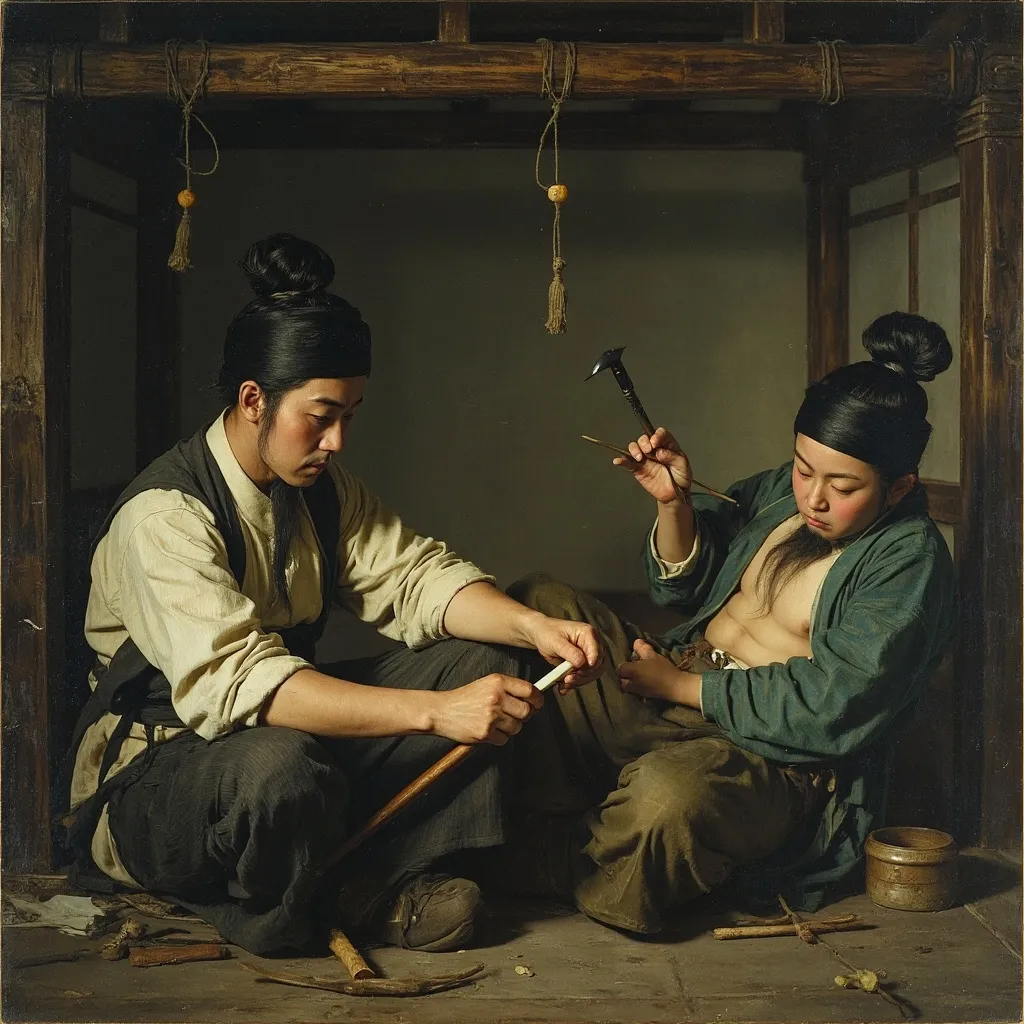
So Su Jin invented a solution that sounds almost medieval in its brutality. He took a behavioral hook — a common thing in ancient Chinese homes — and hung it from the ceiling beam directly above where he sat to study. Then he tied his own hair to the hook. When he felt drowsiness coming on, his head would droop, the rope would pull taut, and the pain in his scalp would snap him back to alertness. He repeated this process dozens, sometimes hundreds, of times each night.
It worked. Su Jin managed to accumulate enormous amounts of knowledge through sheer persistence. Within a few years, he re-entered public life and eventually became one of the most celebrated political strategists of the Warring States period, serving as Prime Minister to multiple kingdoms simultaneously. When he traveled in state, even kings would come out to greet him and hold banquets in his honor.
His own family heard about his success and changed their tune completely. According to the original text, his wife stared at him in awe, his parents sent out musicians to celebrate, and even his sister-in-law who had once scorned him now trembled with deference. Su Jin reportedly laughed and said something to the effect of: “If I had relied on the land, I would still be a farmer.”
The second part of the idiom — 刺股, meaning “stab the thigh” — belongs to a different scholar named Sun Jing (孙敬), though some versions of the story attribute it to other figures. Sun Jing was known for being even more intense about his studies. He would stay awake for days on end, reading everything he could get his hands on. Eventually, his body rebelled. He kept falling asleep at his desk.
Sun Jing’s solution was characteristically extreme. He took an awl — a sharp metal tool used for boring holes — and kept it next to his reading table. Whenever drowsiness struck, he would jam the awl into his own thigh. The pain was immediate and jarring. It also left scars. But it kept him awake, kept him reading, and kept him advancing toward his goals.
The combination of these two stories — hanging from a beam and stabbing one’s own thigh — gave us the idiom we know today: 悬梁刺股, a phrase that has come to symbolize extraordinary dedication to study, no matter the cost.
Why This Story Still Resonates Thousands of Years Later
It’s natural to ask whether a story this extreme has any real relevance to modern life. After all, most of us aren’t trying to become prime ministers. We face different kinds of challenges — information overload, constant notifications, easy access to entertainment that makes studying feel punishing by comparison.
But here’s the thing: the underlying problem hasn’t changed at all. Human beings have always struggled with procrastination, laziness, and the seductive pull of immediate comfort over long-term gain. The ancient Chinese scholars understood something fundamental about the nature of discipline: it often requires more than good intentions. It requires mechanisms — external interventions that override our body’s desire to take the easy path.
Think about it from a practical standpoint. When Su Jin tied his hair to the ceiling, he wasn’t just creating a punishment system. He was building a failsafe. He recognized that when he’s exhausted, his willpower drains to nearly nothing. So instead of relying on willpower alone, he built a system that made sleep literally impossible without pain.
Modern psychology has a term for this: commitment devices. Researchers and self-improvement experts talk about them all the time. The idea is simple: create a situation where the desired behavior becomes the path of least resistance, or where failure carries an automatic cost. Tech entrepreneurs use them when they give equity vesting schedules to co-founders. dieters use them when they pay money upfront that they only get back if they hit their weight goals.
Su Jin and Sun Jing were using commitment devices thousands of years before the concept had a name. They understood intuitively that discipline isn’t about motivation — it’s about design.
The Darker Side: When Dedication Becomes Destructive
Of course, we have to be honest about the flip side. 悬梁刺股 represents an approach to study that most modern experts would consider unhealthy and unsustainable.
The physical toll these scholars imposed on themselves was severe. Su Jin’s method meant enduring constant minor scalp injuries. Sun Jing deliberately wounded his own legs repeatedly. Neither man was likely to win any awards for self-care. And while they did achieve their goals — both eventually passed imperial examinations and entered government service — we have no way of knowing what long-term health consequences they suffered.
There’s a tension here that deserves acknowledgment. The same drive that pushed these scholars to excel also pushed them toward self-destruction. At what point does dedication become self-harm? Where do we draw the line between “pushing yourself” and “punishing yourself”?
These aren’t just philosophical questions. They have practical implications for anyone trying to build a sustainable learning practice today. The research on deliberate practice — the kind of focused, challenging effort that leads to mastery — consistently shows that rest and recovery are essential parts of the equation. Elite performers in every field, from musicians to athletes to academics, emphasize the importance of sleep, downtime, and mental health. Burning yourself out with extreme methods might produce short-term results, but it rarely leads to long-term excellence.
So what should we take from 悬梁刺股? Not the literal practice of harming ourselves to stay awake. Instead, we should focus on the underlying spirit: the recognition that meaningful achievement requires sacrifice, that comfort and excellence are often in direct tension, and that designing our environment and habits deliberately can help us overcome our own worst tendencies.
Modern Applications: Building Better Learning Habits
The principles behind 悬梁刺股 can be adapted to modern life without anyone needing to take an awl to their own leg. Here are some strategies inspired by these ancient scholars that actually work in the 21st century.
First, remove the possibility of failure. Su Jin’s ceiling hook was effective because it eliminated the choice. When drowsiness hit, he didn’t have to decide whether to keep reading — his body made the decision for him. You can do something similar by creating an environment where the alternative to studying is genuinely uncomfortable. Some successful people, for example, study in dedicated spaces that are only for work. They don’t allow themselves to watch Netflix in those spaces. When they sit down at that desk, their brain knows exactly what’s expected.
Second, build accountability into your routine. Sun Jing’s stabbing method worked partly because it created a direct, immediate consequence for falling asleep. In modern settings, accountability partners serve a similar function. When you know someone is waiting to hear about your progress, you’re much less likely to let yourself slide. This is why study groups, writing accountability partnerships, and coaching relationships remain so popular despite all our technological advances.
Third, align your environment with your goals. Both scholars succeeded because they surrounded themselves with the tools they needed and removed everything that might distract them. Today, that might mean keeping your phone in another room while you study, using website blockers during work hours, or setting up a workspace that is physically separate from where you relax.
The Role of Cultural Values in Educational Success
It’s worth taking a moment to appreciate how deeply 悬梁刺股 is embedded in Chinese cultural values. The story has been taught to children in China for over two thousand years. It appears in textbooks, motivational posters, and parenting discussions. When Chinese parents want to encourage their children to study harder, they often invoke this idiom.
This reflects a broader cultural emphasis on educational achievement as the primary path to social mobility and personal fulfillment. In a society where the imperial examination system — which formally began during the Sui Dynasty but built on earlier traditions — created a meritocratic pathway to power and prestige, stories that celebrated extreme dedication to study served an important social function. They modeled what was possible for anyone willing to put in the work.
The Confucian emphasis on self-cultivation also runs through these stories. In Confucian thought, improving yourself — through education, moral development, and disciplined practice — isn’t just personally beneficial; it’s a moral obligation. The scholar who refuses to study is shirking their duty to family, community, and society. The scholar who studies with extraordinary dedication is fulfilling the highest human purpose.
This is a worldview that sees learning not as a chore or a means to an end, but as an expression of one’s fundamental humanity. It’s a perspective that has driven generations of Chinese families to invest enormous amounts of time and resources in their children’s education, and it’s one reason why Chinese and East Asian students consistently perform at the highest levels on international academic assessments.
Whether you share those cultural values or not, there’s something genuinely admirable about the ethos behind 悬梁刺股. These scholars weren’t studying to pass the time or to seem impressive at dinner parties. They were studying because they believed — with every ounce of conviction they possessed — that knowledge was the key to a better life and a better world.
Final Thoughts: What Will You Sacrifice for Your Goals?
The story of 悬梁刺股 challenges us to ask a uncomfortable question: How badly do we actually want the things we say we want? Su Jin and Sun Jing were willing to endure physical pain and long-term injury in pursuit of their educational dreams. Most of us won’t need to go that far. But the underlying principle remains valid. Real achievement requires real sacrifice. Comfort is the enemy of excellence. And the people who change the world are often the ones who refuse to accept comfortable limitations on their potential.
The idiom reminds us that the path to mastery is rarely glamorous. It involves late nights and early mornings, boredom and frustration, moments when quitting seems like the most sensible option in the world. But it’s precisely during those moments that the difference between those who succeed and those who don’t becomes clearest.
So the next time you find yourself reaching for your phone instead of your textbook, or choosing Netflix over that online course you signed up for, remember the scholars who hung themselves from ceiling beams. They found a way. And so can you.
Recommended Reading and Study Tools
1. Classic Chinese Literature Collection — A beautifully bound collection of essential Chinese texts including the original historical records that document stories like 悬梁刺股. Perfect for students of Chinese culture and classical literature.
2. Premium Bamboo Desk Organizer — Inspired by traditional Chinese scholarly workspaces, this elegant organizer helps you keep your study materials tidy and focused, just as ancient scholars kept their writing desks organized.
3. Premium Chinese Calligraphy Set — Practice the art of brush calligraphy that Su Jin and Sun Jing would have used. Studying Chinese idioms becomes even more meaningful when you write them in their classical form.
4. Noise-Canceling Headphones for Deep Study — Create your own focused study environment with premium noise-canceling headphones. Remove distractions and commit to your learning goals with full auditory isolation.
5. Academic Journal Subscription: Journal of Chinese Studies — For readers who want to dive deeper into the academic study of Chinese idioms, their historical context, and their role in modern education. Expert-reviewed scholarship on traditional Chinese culture.