Heavenly Match: The Fairy and the Mortal Who Dared to Love
There is a story that Chinese mothers have told their daughters for over two thousand years. It begins in the heavens, where a weaving maiden works at her loom, creating the clouds and the sunset colors that paint the sky. It ends in the mortal world, where a poor cowherd tends his animals and dreams of something more. Between those two points lies one of the most heartbreaking love stories in all of mythology — a story about the boundaries we think are unbreakable, and what happens when two people decide to break them anyway.
The legend of Tian Xian Pei (天仙配), often translated as “Heavenly Match” or “The Weaver’s Gift,” is sometimes conflated with the more famous Qixi Festival story of the Weaver Maiden and Cowherd, but the two tales have distinct origins and different details. Where the Qixi story focuses on the star-crossed lovers separated by the Milky Way, the Heavenly Match legend is a more extended narrative that follows a fairy named Zhinü (织女) as she descends to earth, falls in love with a mortal woodcutter named Niukui (牛郎), and must face the consequences of that choice.
This is a story about class, about the distance between heaven and earth, and about whether love is strong enough to bridge a gap that the gods themselves declared uncrossable. Pull up a seat — it’s quite a ride.
The Weaving Maiden in the Sky
In the beginning, according to this legend, there was a weaving maiden in the heavens. Her name was Zhinü (织女), and she was one of the daughters of the Heavenly Mother (王母娘娘), the supreme goddess of the western heavens. Unlike the other celestial maidens, who spent their days in idle luxury, Zhinü was known for her extraordinary industriousness. She worked at her celestial loom from dawn to dusk, weaving the clouds that decorated the sky, creating the delicate colors of sunrise and sunset, and crafting the star patterns that guided mortals through the night.
Zhinü was skilled, dedicated, and deeply content with her work. She had everything a heavenly being could want — immortality, beauty, the respect of her divine sisters, and the approval of her powerful grandmother. There was only one thing she lacked, and that was something she hadn’t yet realized she was missing.
One summer day, Zhinü and several of her heavenly companions decided to descend to the mortal world for a recreational excursion. They had heard that there was a beautiful lake not far from a small mountain village, where the water was crystal clear and the surroundings were peaceful — a perfect place for a group of young women to bathe and relax away from the constant surveillance of the celestial court.
What Zhinü didn’t know was that this wasn’t an ordinary mountain village. It was home to a young man named Niukui (牛郎), who, through circumstances that varied depending on which version of the story you read, was either a poor orphan raised by his brother and sister-in-law, or a social outcast living on the margins of village society. Niukui was kind, honest, and deeply lonely — a young man who had been given a crummy deal by life and had responded by becoming gentler rather than harder.
The Meeting at the Azure Cloud Lake
The story’s crucial moment comes when Niukui, while going about his daily work, happened upon a group of young women bathing in the lake. The women were actually the weaving maiden Zhinü and her divine companions, who had taken mortal form for their excursion. Niukui, depending on the version, was either hiding in the bushes trying to get a better look (less romantic but more realistic) or simply happened upon them by accident while taking his cows to water.
What happened next differs significantly between versions, but the core elements are consistent. Niukui saw the most beautiful woman among the group — Zhinü, obviously — and was immediately struck by her. He wanted to approach her, but he was also painfully aware of the gap between them: she appeared to be a noblewoman, while he was a dirt-poor woodcutter with nothing to his name.
The supernatural element enters the story through Niukui’s companion: an old cow. In most versions of the tale, this was no ordinary cow but a divine beast, often identified as the celestial ox (天牛) who had been banished from the heavens for some transgression and was now living on earth in animal form. The old cow could speak, and it offered Niukui advice on how to win the weaving maiden.
The cow’s advice, essentially, was to steal the clothes of whichever woman Niukui wanted to marry while she was bathing. Without her celestial garments, the woman wouldn’t be able to return to the heavens — she’d be trapped in mortal form and would have to remain on earth. It’s a somewhat dubious romantic strategy by modern standards, but the legend was written a long time ago, and the values it assumes are different from our own.
Niukui, against all odds, took the cow’s advice. When Zhinü emerged from the lake and found her celestial robes missing, she was trapped. She couldn’t fly back to the heavens, couldn’t return to her duties at the celestial loom, and had no choice but to remain in the mortal world.
A Marriage Across the Cosmic Divide
What happens next is, in its own way, rather sweet. Niukui, far from being a predator, was genuinely kind to Zhinü. He gave her his own clothes to wear, fed her, and treated her with a respect and gentleness that the weaving maiden, for all her centuries of heavenly existence, had never quite experienced from anyone. The other celestial maidens eventually returned to the heavens without her, leaving Zhinü alone in a world she didn’t fully understand.
Over time, however, Zhinü came to appreciate Niukui’s qualities. He was honest, hardworking, and genuinely good. He didn’t try to take advantage of her vulnerability, and he didn’t demand anything from her that she wasn’t prepared to give. Slowly, Zhinü began to fall in love with him — not the infatuation of a moment, but a genuine affection that grew out of respect and shared experience.
Eventually, the two decided to marry. They had a traditional Chinese wedding ceremony, and for a time, they were genuinely happy. Zhinü, who had spent centuries weaving for an audience of gods, now wove clothing and household fabrics for her husband and their growing household. Niukui, who had always worked alone, now had a partner to share his life with. They were poor by the standards of the world, but they were content.
The legend suggests that Zhinü, in her love for Niukui, gradually forgot about her former life in the heavens. She stopped missing her divine sisters, stopped pining for the celestial court, and instead threw herself into her new mortal life with the same dedication she had once brought to her heavenly weaving. For a brief, shining period, the cosmic gap between them seemed to have been successfully bridged.
The Punishment for Crossing the Divide
But the heavens, as it turned out, did not approve of this arrangement.
When the Heavenly Mother (王母娘娘) learned that her granddaughter had not only fraternized with mortals but actually married one, she was furious. This was exactly the kind of boundary-crossing that celestial law was designed to prevent — the pollution of divine bloodlines by mortal contact, the dilution of heavenly purity by earthly attachment. Zhinü’s marriage to Niukui was not just a personal choice; it was a transgression against the cosmic order itself.
The Heavenly Mother descended to earth to retrieve her granddaughter personally. She found Zhinü at home with Niukui, surrounded by the modest domestic happiness they had built together. Without a word of explanation or a moment’s hesitation, the Heavenly Mother seized Zhinü and began dragging her back toward the heavens.
Niukui, desperate and heartbroken, tried to follow. He grabbed a wooden pole and threw it into the sky, climbing it like a ladder, trying to reach his wife before she disappeared forever. The pole — sometimes described as a magic pole that Niukui’s cow had instructed him to keep, sometimes just an ordinary pole — extended toward the heavens, allowing Niukui to climb higher than any mortal could normally reach.
But the Heavenly Mother was more powerful than any wooden pole. As Niukui climbed, she drew her hairpin — a divine hairpin of extraordinary magical power — and swept it across the sky behind her. The hairpin created a great chasm in the heavens, a silver river that hadn’t existed before. This was the Milky Way (银河), which, in Chinese mythology, became the permanent barrier between the lovers.
Niukui and Zhinü stood on opposite sides of this newly created cosmic river, unable to reach each other. Their two children — twins born of their union, whom Zhinü had given birth to before the Heavenly Mother’s intervention — stood with their father on one side, while Zhinü stood alone on the other, weeping.
The Magpies and the Once-a-Year Crossing
The story might have ended there, with two lovers permanently separated by a river of stars. But something about this particular tragedy moved even the gods.
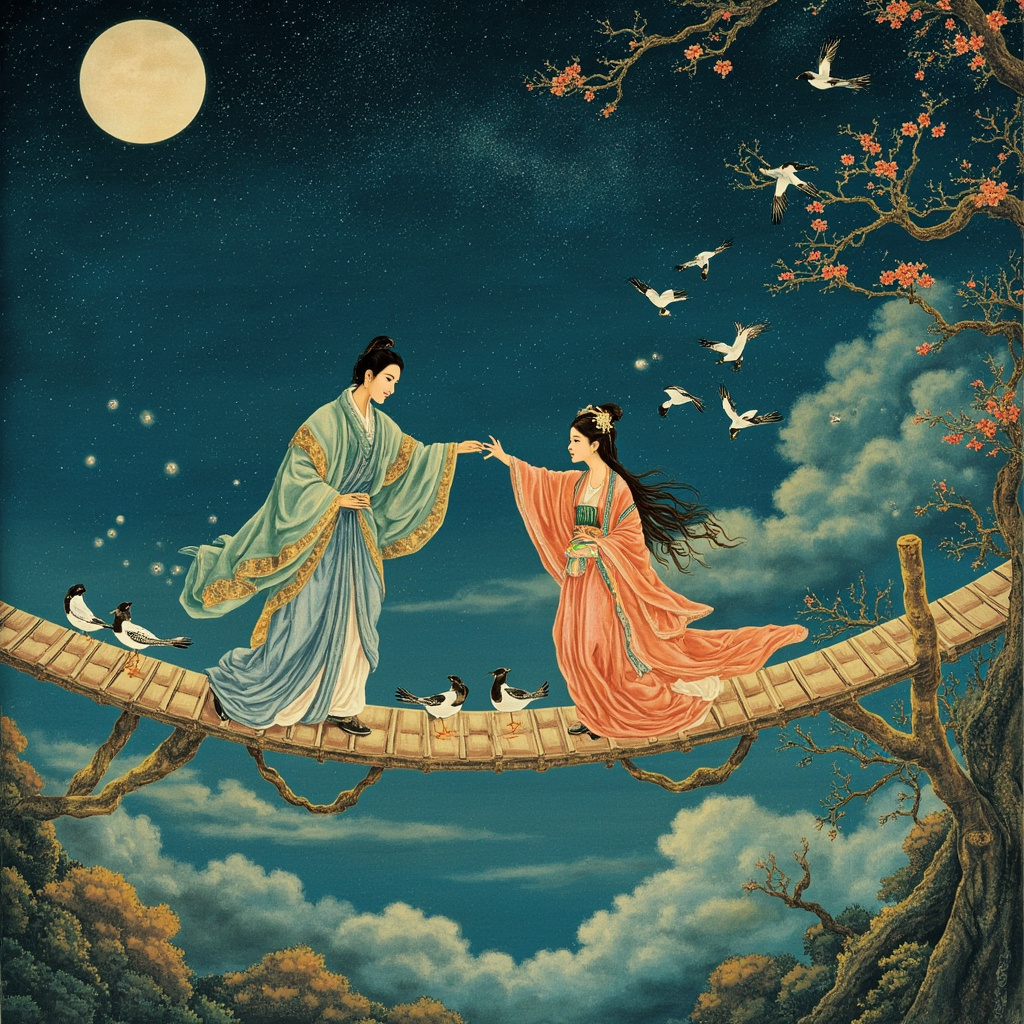
According to the legend, the magpies (喜鹊) of the world were so touched by the fate of Niukui and Zhinü that they decided to do something about it. Every year, on the seventh day of the seventh lunar month, the magpies would gather in their thousands and form a living bridge across the Milky Way, allowing the two lovers to cross and reunite for a single night.
This annual reunion became the basis for the Qixi Festival (七夕节), also known as Chinese Valentine’s Day, which is still celebrated today. On this day, young women would traditionally pray to Zhinü for skill in needlework and weaving, while couples would make offerings to the star deities who controlled their fate. The image of the two lovers meeting across a bridge of magpies became one of the most enduring icons in Chinese visual culture.
In some versions of the story, the magpie bridge was a temporary reprieve that lasted only until the Heavenly Mother decided to separate the lovers again. In other versions, it was a permanent arrangement, a compromise that allowed the couple to see each other once a year while maintaining the cosmic order that required them to live in separate realms. Either way, the image was the same: two people who loved each other enough to bend the rules of the universe, getting one night a year to be together.
The Symbolism of Heaven and Earth
The Heavenly Match legend is, on one level, a straightforward romance — boy meets girl, boy loses girl, boy gets girl back (sort of). But the story’s enduring popularity suggests that it operates on a deeper symbolic level as well.
The gap between the heavens and the earth is, in Chinese mythology, one of the most fundamental divisions in existence. Heaven is the realm of the gods, where immortality, purity, and order reign supreme. Earth is the realm of mortals, where suffering, impermanence, and chaos are the normal conditions of existence. The boundary between them is not just a physical distance but a cosmic one — a difference in kind, not just degree.
When Zhinü crosses that boundary, she is making a statement: she is choosing the messy, painful, impermanent world of human experience over the perfect but emotionally sterile world of the divine. She is choosing to feel things deeply even if those feelings will eventually lead to heartbreak. She is choosing mortality over immortality, change over stasis, love over safety.
This is why the story resonates so strongly across centuries and cultures. Everyone knows what it feels like to want something you’re not supposed to want, to love someone you’re not supposed to love, to reach for something that the rules say you shouldn’t have. Zhinü’s story gives voice to that universal human experience in a mythological register that makes the stakes as large as possible while keeping the emotions relatable.
The magpies, in this reading, represent hope — the possibility that even the most immovable barriers can be overcome if enough beings are willing to work together. The annual reunion is not just a plot device but a statement about the power of collective action and the stubbornness of love.
The Legacy of the Heavenly Match
Today, the Heavenly Match legend lives on in Chinese culture in multiple forms. The Qixi Festival, which falls on the seventh day of the seventh lunar month, is celebrated as Chinese Valentine’s Day, and couples exchange gifts and make wishes for happiness in their own relationships. The story of Niukui and Zhinü is told to children as a lesson about the dangers of forbidden love and the importance of respecting social boundaries — but also, more hopefully, as a lesson that true love is strong enough to transcend those boundaries, at least for one night a year.
The legend has also inspired countless works of art, literature, and performance. Operas, Peking opera productions, television dramas, and films have all told the story in their own ways, updating the characters and situations for new audiences while keeping the core emotional truth intact. The image of the two lovers separated by the Milky Way has become one of the most recognizable icons of Chinese romantic imagery, as instantly recognizable in Chinese culture as Romeo and Juliet is in the West.
Products Related to the Heavenly Match Legend
If this story has inspired you, here are some products that celebrate the romance and mythology of the Heavenly Match:
1. Chinese Fairy Tales and Legends — A beautifully illustrated collection of classic Chinese stories, including the Heavenly Match, the White Snake, and dozens of other tales from the Chinese mythological tradition.
2. Weaving Maiden and Cowherd Gift Set — A romantic gift set featuring imagery of the star-crossed lovers, perfect for couples celebrating Qixi Festival or Chinese Valentine’s Day.
3. Chinese Silk Romance Scarf — A luxurious silk scarf featuring traditional Chinese patterns inspired by celestial imagery, weaving motifs, and romantic symbolism.
4. Traditional Chinese Love Poetry Collection — An anthology of classical Chinese poems about love, longing, and separation, including verses that reference the Niukui and Zhinü legend.
5. Chinese Valentine’s Day Decorations — Traditional decorations for celebrating Qixi Festival, including magpie imagery, celestial motifs, and romantic ornaments.
Last updated: 2026-01-15