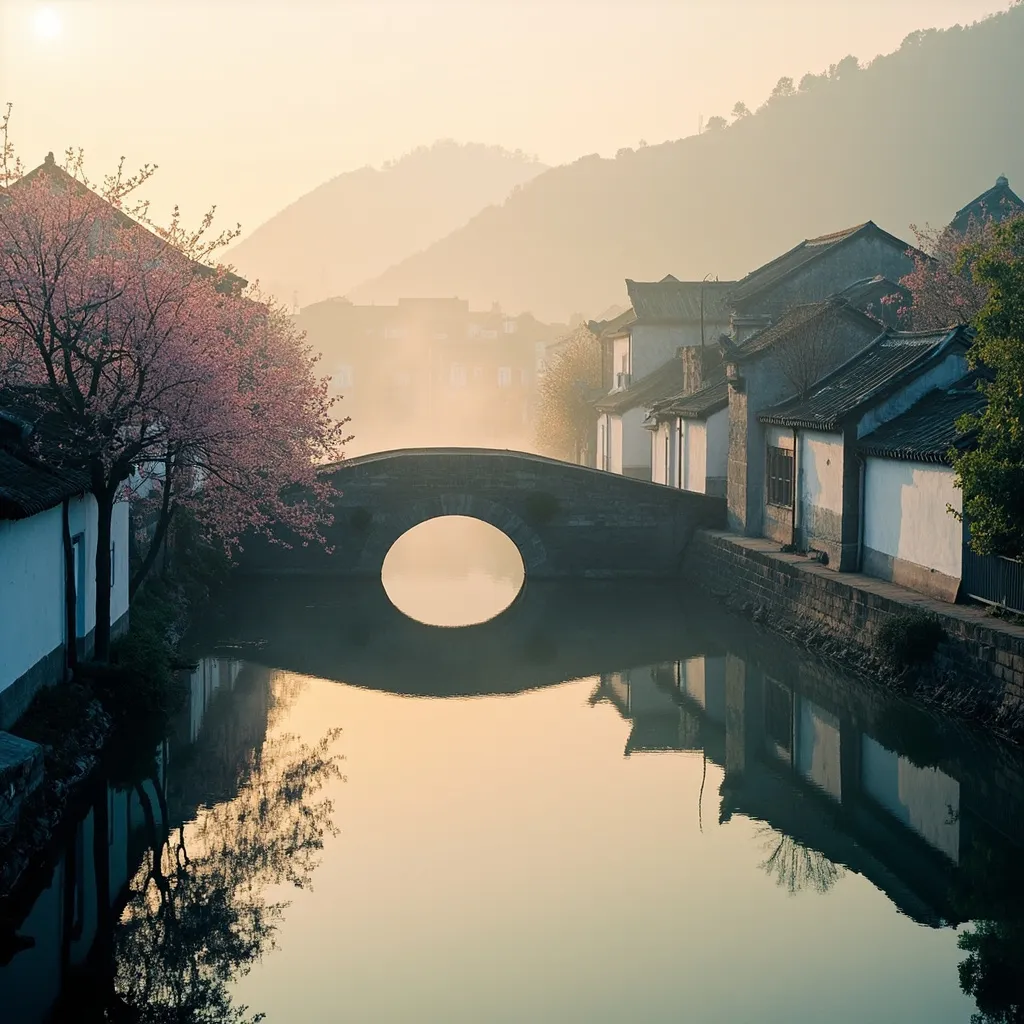
The reflection appears before the village does. You’re walking down a country road in southern Anhui Province, past rice paddies and duck ponds, and suddenly the road opens onto a lake — perfectly still, perfectly rectangular, fringed by whitewashed buildings and arched bridges — and in the water, everything is doubled. The buildings hang upside down in the surface of the lake with a clarity that makes you wonder for a moment which world is the real one. This is the Moon Pond (月沼), and it’s the moment that tells you you’re somewhere that was designed with an almost theatrical awareness of how it would look from outside.
Hongcun (宏村) is a village in Yi County, Anhui Province, about 60 kilometers northwest of Huangshan (the mountain that gives the region its name). It was founded in 1131 during the Southern Song Dynasty and has been continuously inhabited ever since — nine hundred years of unbroken Chinese village life, through Mongol conquest, Ming consolidation, Qing prosperity, Republican upheaval, war, revolution, and the current tourism boom. What makes Hongcun extraordinary is that it was designed. Not in the sense that every building was planned from scratch — villages don’t work that way — but that its most distinctive feature, the water system that gives it its character and its living quality, was conceived and built as an integrated system in the 14th century by a village committee acting with the kind of coordinated purpose that most modern cities would envy.
In 2000, Hongcun was designated a UNESCO World Heritage Site, recognized alongside its neighbor Xidi as an outstanding example of traditional Chinese Huizhou architecture and urban planning. The designation was controversial — locals worried about the restrictions it would bring, and some worried it would turn the village into a museum piece. Those concerns were partly justified, but the designation also saved Hongcun from the wholesale demolition that consumed thousands of similar villages during China’s rapid urbanization of the 1990s and 2000s. Today Hongcun faces a different challenge: managing the tens of thousands of Chinese and international tourists who come each year to see the village that appeared in Crouching Tiger, Hidden Dragon (the famous bridge fight between Yu Shu Lien and Jen was filmed at the Chengzhi Bridge over the Moon Pond), while preserving the quality of life for the several thousand villagers who still live there year-round.
The Ox: Village as Living Creature
The key to understanding Hongcun’s layout is the famous water system, which villagers describe in terms of an animal. The layout is often called “the ox” — the village’s streets and canals form the body, the Moon Pond is the belly, the narrow outlet stream is the intestines, the bridge at the south end of the village is the head, and two wells outside the village are the eyes. This organic metaphor isn’t just decorative. It reflects the fact that the water system was designed as a unified whole, with water flowing through the village in a controlled circuit, entering from a spring in the southeast, passing through the village, and exiting to the south, with storage ponds along the way to regulate flow and provide water for daily use.
The water system was laid out in 1405, during the early Ming Dynasty, by the village’s elder and scholar-official Wang Xi (汪息). According to local records, Wang spent years studying the topography of the site — the natural streams, the elevation changes, the way water moved through the valley — before designing the system. He understood that a village depending on fire for cooking and heating needed reliable water access for both practical and aesthetic reasons, and that water moving through a village could be made to serve multiple purposes simultaneously: drainage, fire control, irrigation of the gardens behind each house, and aesthetic enhancement.
The system works through gravity. Water enters the village from the Chengzhi Spring (承志泉) in the southeast, passes through a covered canal running beneath the main street, and flows into the Moon Pond in the center of the village. From the Moon Pond, the water continues south through a narrower channel that runs behind the houses on the west side of the village, feeding a series of smaller ponds and garden wells, before exiting through the “intestines” — a series of narrow drainage channels — to the southern outlet. This design means that the water is always moving, even slowly, which keeps it from becoming stagnant. The houses along the water channels have stone steps leading down to the water, used historically for washing clothes, vegetables, and the rice that was the staple of the local diet.
The Moon Pond itself is what draws most visitors’ photographs. The pond is roughly rectangular, about 120 meters long and 80 meters wide, and its surface perfectly reflects the buildings on its north and west sides — including the notable Chengzhi Hall, a large ancestral hall that forms the pond’s western boundary. The reflection effect is most dramatic in the early morning, when mist rises from the water and the buildings are silhouettes against a brightening sky. The village charges a modest entry fee, but the hours before 7:00 AM, before the tour groups arrive, offer something close to the experience Wang Xi would have recognized.
Huizhou Architecture: The Merchant’s Aesthetic
Hongcun is a Huizhou village, and to understand why the buildings look the way they do, you need to understand the Huizhou people. Huizhou (徽州) was a historical region encompassing parts of modern Anhui and Jiangxi provinces, characterized by a distinctive culture built around merchant families and scholarly achievement. Huizhou people were famous throughout Chinese history for their combination of commercial success and cultural refinement — they made money through trade, and they used that money to build beautiful houses, educate their sons in the classical tradition, and acquire the artifacts and art that marked a family as cultivated. The result was an architectural tradition that is simultaneously ostentatious and restrained: the facades of Huizhou houses are famously plain (whitewashed walls, no external decoration), while the interiors are extravagantly carved, painted, and detailed.
The plain exterior was partly a matter of social convention. Ming and Qing sumptuary laws restricted elaborate external decoration to certain classes of official families; wealthy merchants were officially barred from building elaborate facades even if they had the money. Huizhou architects therefore channeled their decorative energy inward, into the interior courtyards, the wooden screen doors, the window latticework, the marble inlay, the painted ceilings, and the elaborately carved wood and stone that fill every surface of a Huizhou house that a visitor is actually meant to see.
The Chengzhi Hall (承志堂) in Hongcun is the finest example and the one most visitors tour. Built in 1855 by the merchant Xi Keke (奚克 ke), it’s one of the largest and most elaborate Huizhou merchant houses surviving in the region. The hall has 60 rooms across three courtyards, with carved wooden screens between rooms, painted ceiling panels, and marble inlay in the floors. The carvings are remarkable: a scene of fish and water on one screen (symbolizing prosperity), a scene of lions playing with a ball on another (symbolizing continuity of family), and a series of narrative carvings depicting scenes from popular novels. Every surface has been considered. Xi Keke spent an enormous amount of money on this house, but because the decoration was interior-facing, it didn’t violate the sumptuary conventions that restricted visible external display.
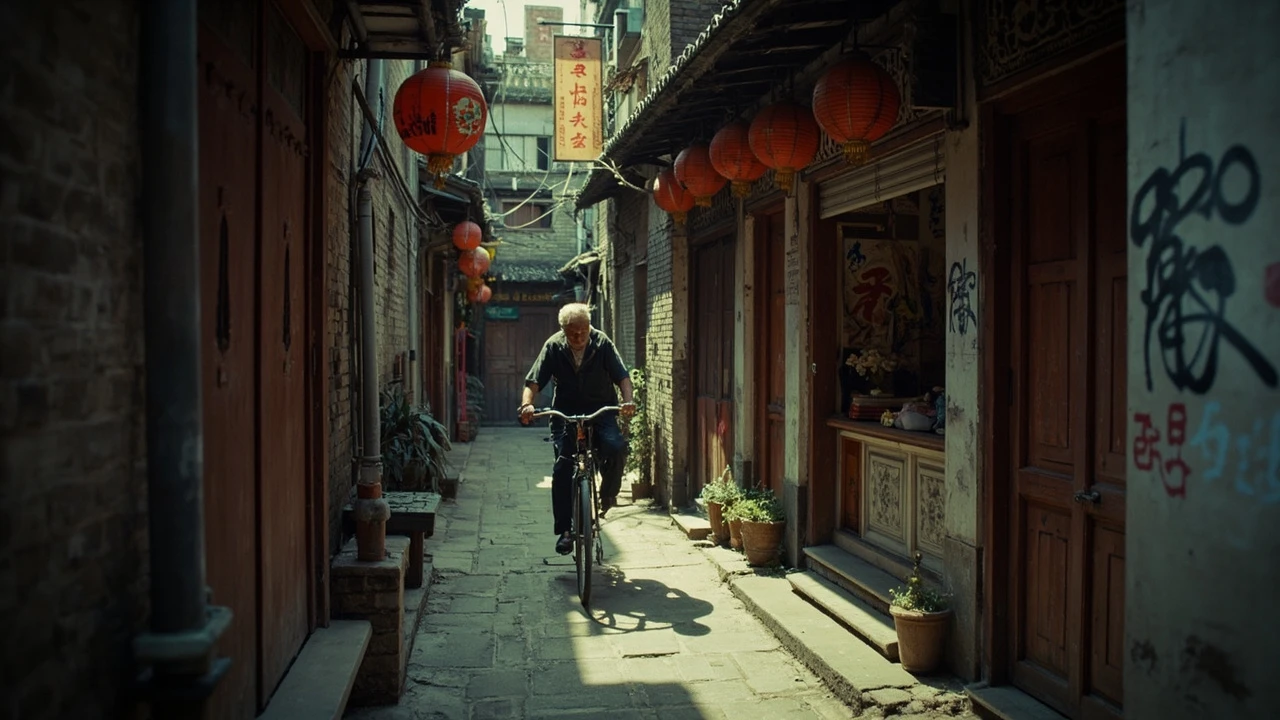
The village has about 160 surviving Ming and Qing buildings, of which about 20 are open to visitors as part of the village’s tourism operation. The houses range from modest two-room structures to the sprawling Chengzhi Hall. Most are still lived in by villagers, which means that the village is a living museum rather than a fully restored one: you may find laundry drying on carved wooden screens, bicycles leaning against marble doorframes, and the smell of cooking rice drifting from courtyards that are also tourist attractions. This is simultaneously the village’s greatest charm and its most contentious management challenge.
The Hui Merchants: How the Village Got Rich
The prosperity that built Hongcun’s beautiful houses came from the Hui merchants (徽商), the trading families from the Huizhou region who became one of the most powerful commercial networks in Ming and Qing China. The Hui merchants operated primarily in salt, tea, and木材 (timber), building trading networks that stretched from the Anhui hills where they were born to the coastal cities of Yangzhou, Shanghai, and Hangzhou where they made their fortunes.
The Hui merchant culture had a distinctive character shaped by the environment. The Huizhou region was mountainous and not especially suited to rice agriculture — there wasn’t enough flat land for large-scale cultivation. What the region had instead was a tradition of literacy (Huizhou was known for producing scholars at a rate disproportionate to its population) and a culture that valued education as the path to official positions. The combination meant that Hui families had literate members who could manage accounts, navigate bureaucratic systems, and negotiate trade agreements — skills that were harder to find among competing merchant groups from more purely agricultural regions.
Salt was the most profitable commodity. Salt merchants in Ming and Qing China operated under a state license system, and the most successful Hui families obtained salt trading rights that gave them monopolies over distribution in large regions. The Xi family that built Chengzhi Hall, for instance, made their fortune in salt. The wealth flowed back to Huizhou, where it was invested in houses, land, education, and the cultivation of literary and artistic pretension that marked a family as respectable rather than merely wealthy.
This connection between commerce and culture is visible in Hongcun’s layout. The village was designed by scholars and built by merchants, but it was always intended to project an image of cultivated refinement rather than crass commercial success. The Moon Pond was not just a water storage facility — it was a carefully composed view, designed to be beautiful from the elevated perspective of the ancestral halls that faced it. The narrow lanes were designed to channel pedestrian movement in a controlled pattern, creating a sense of intimacy and enclosure rather than the chaotic bustle of a market town. Everything was arranged to suggest that the people who lived here were interested in the finer things — which, given that they were financing this with salt and timber profits, was a deliberate act of social repositioning.
The Village Today: Preservation and the Tourism Question
UNESCO World Heritage designation brought Hongcun both protection and problems. On the protection side: the designation came with funding for restoration of the most historically significant buildings, and it created strong incentives for the local government to resist the kind of wholesale demolition and redevelopment that destroyed so many similar villages in the 1990s. Several historic buildings that were deteriorating have been restored, and the overall urban fabric of the village has been maintained in a condition that gives visitors a genuine sense of historical continuity.
On the problem side: the designation, combined with Hongcun’s appearance in Crouching Tiger, Hidden Dragon (which won the Academy Award for Best Foreign Language Film in 2000, the same year as the UNESCO designation), turned the village into a major tourism destination. On peak days — national holidays, particularly the May Day and National Day weeks when Chinese domestic tourism surges — Hongcun receives 20,000 or more visitors per day. The narrow lanes that were designed for a few thousand pedestrians are overwhelmed. The restaurants and souvenir shops that have opened to serve visitors have displaced some of the village’s traditional small businesses. The entry fee, which supports restoration work, is a point of ongoing tension with villagers who feel that their own village has been taken from them.
The village has tried various management strategies over the years.限制 (restrictions) on commercial activity inside the core tourist area have been implemented and relaxed. Separate ticket prices for different parts of the village have been introduced to spread visitors across the site rather than concentrating them at the Moon Pond. Day-trip visitors are encouraged to arrive in the afternoon rather than morning to smooth out the peak. These measures have had mixed success.
The most honest advice for visiting: go early, go in the shoulder season (late autumn or early spring), and stay at one of the small family-run inns inside the village if possible. Waking up in Hongcun before the tour buses arrive is a different experience entirely from visiting during peak hours. You can have the Moon Pond almost to yourself at 6:00 AM in October, with mist rising off the water and a few villagers sweeping the stone paths before the day begins. That’s the village that UNESCO was trying to preserve.
How to Visit Hongcun
Hongcun is best combined with a visit to Huangshan (Yellow Mountain), which is the major tourist destination in the region and is about 80 kilometers from the village. Most visitors make a two- to three-day trip: one day on Huangshan itself (which requires its own full day, and a night on the mountain if you want to see the famous sunrise), and a half-day visiting Hongcun and the nearby village of Xidi, which is also a UNESCO site and has a similar character with slightly fewer tourists.
Getting there: the nearest major city is Huangshan City (黄山市), formerly known as Tunxi, which has an airport with connections to Beijing, Shanghai, Guangzhou, and other major Chinese cities. From Huangshan City, buses run to Hongcun and to Huangshan itself. The bus journey from Huangshan City to Hongcun takes about 90 minutes on a good day, longer during holiday traffic. The village is also accessible by car if you’re driving in the region.
For those interested in the Huizhou architectural tradition more broadly, Hongcun and Xidi are the most famous examples but are by no means the only ones. The region has dozens of villages with Ming and Qing architecture, many of them much less visited. Xiong (雄), Guan (关), and Tang (唐) villages in the same Yi County area are worth seeking out for travelers with more time. The Huizhou Cultural Museum in Huangshan City provides an excellent introduction to the cultural context before visiting the villages in person.