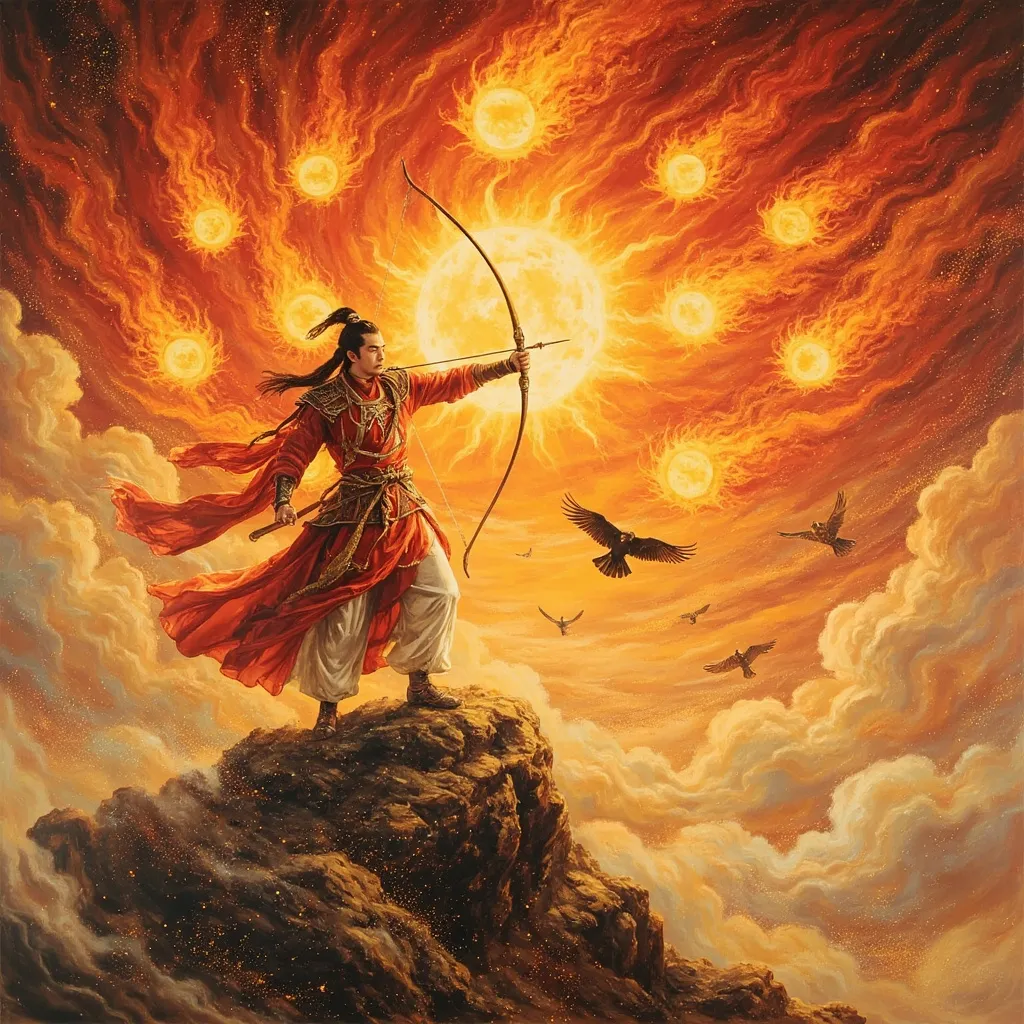
Imagine the sky filled with not one, but ten suns. Sounds like a beautiful summer day? Think again. According to an ancient Chinese legend, this nightmare scenario once threatened to burn the entire world to a crisp — and only one man had the skill to stop it.
That man was Hou Yi, and his story is one of the most dramatic tales in Chinese mythology.
The Ten Suns in the Sky
Long ago, in the earliest days of the world, the sky held ten suns instead of one. These weren’t ordinary suns — they were the ten sons of the Supreme Emperor (Di-Jun), the ruler of the heavens in ancient Chinese cosmology.
Each sun lived in a giant sacred tree called the Fusang (扶桑), a cosmic mulberry tree that grew from the eastern horizon. The suns took turns traveling across the sky, bringing light and warmth to the earth one at a time. It was a perfect system, carefully designed by the gods to keep the world warm but not scorching.
But one day, something went terribly wrong.
All ten suns decided to rise together. Ten suns in the sky at once — imagine the temperature! The earth below began to crack and dry up. Rivers boiled away. Crops withered in the fields. Forests turned to tinder, and massive wildfires spread across the land. The heat became so unbearable that people couldn’t go outside. They hid in caves and under rocks, desperate for shade.
The Supreme Emperor watched in horror as his sons’玩耍 (wánshuǎ — play) threatened to destroy everything. But what could he do? These were his own children. He needed someone with extraordinary skills — someone who could shoot a bow better than anyone alive.
That’s when Hou Yi entered the picture.
The Great Archer Appears
Hou Yi was no ordinary archer. He was a legendary marksman whose skill with the bow was unmatched throughout the land. Stories say he could hit a moving target at a thousand paces, split a hair in mid-air, and pierce a falling leaf before it touched the ground.
But before he became a hero, Hou Yi was just a humble hunter. He lived in a small village with his beautiful wife, Chang’e (嫦娥). She was said to be the most beautiful woman in all the land — gentle, kind, and deeply in love with her husband. Together, they lived simply, content with their modest life.
That all changed when the ten suns rose together.
The Supreme Emperor sent his messengers down to earth, searching for the greatest archer in the land. When they found Hou Yi, they offered him a deal: save the world from the burning suns, and he would be rewarded beyond his wildest dreams. The Emperor even offered to make Hou Yi immortal — a god among mortals.
Hou Yi looked at the suffering people, at the cracked earth, at the dying crops. He couldn’t say no. He took up his legendary bow — the Starbow, made from the bones of a divine dragon — and set out to climb the highest mountain in the world.
That mountain was Mount Kunlun (昆仑山), a sacred peak that touched the heavens itself. It was said to be the place where the gods lived, far above the mortal world. Hou Yi climbed for days, his determination burning hotter than the suns above. When he finally reached the summit, he stood face to face with the source of the problem: the ten suns, blazing in the sky like ten angry eyes.
Shooting Down the Suns
The heat at the mountaintop was unbearable, but Hou Yi did not waver. He nocked an arrow to his bow — a special arrow forged in celestial fire, capable of piercing even the sun itself.
He drew the bowstring back. His arms trembled with the effort, but his aim was steady. He breathed in, held his breath, and let the arrow fly.
The first sun exploded in a shower of golden sparks. A raven — the sacred bird that carried each sun across the sky — fell from the heavens. One down, nine to go.
The other suns panicked. They tried to hide behind the Fusang tree, but Hou Yi’s arrows found them anyway. One by one, the suns fell from the sky, their light dimming as they plummeted toward the earth. Each arrow struck true, each sun burst into golden flames.
Eight arrows. Eight suns. Eight ravens tumbling from the sky.
But as Hou Yi drew his ninth arrow, he hesitated. He looked at the last sun — the youngest of the ten brothers — and saw fear in its blazing light. This sun was just a child, barely old enough to take his turn in the sky. If Hou Yi killed him, there would be no more light, no more warmth, no more day.
The Supreme Emperor, watching from heaven, breathed a sigh of relief. He had hoped that Hou Yi would show mercy. With one sun remaining, the world would be saved but not destroyed. There would be day and night, summer and winter. The balance would be restored.
Hou Yi lowered his bow. The last sun tremulously rose alone in the sky, its light softer now, gentler. It would travel across the sky alone, bringing light to a world that was finally cooling down.
The earth rejoiced. The rivers flowed again. Crops began to grow. People emerged from their hiding places, weeping with joy and gratitude. They looked up at the single sun and knew they owed their lives to the great archer on the mountaintop.
The Wife Who Followed the Arrow
Hou Yi returned to his village as a hero. The Emperor kept his promise — he made Hou Yi immortal, granting him a place among the gods. But there was a catch. Hou Yi could not stay in heaven as a full god; he had to ascend to the Moon Palace, the cold and lonely realm where the moon lived.
Wait, the moon? That sounds like Chang’e’s story, right? Here’s where things get complicated.
There are actually several different versions of what happened next, and Chinese mythology is famous for having multiple, sometimes contradictory stories about the same characters.
In one version, Hou Yi became a god and was invited to live in heaven. But he missed his wife so much that he stole the elixir of immortality from the Queen Mother of the West (Xi Wang Mu) — a magical potion that could make anyone immortal. He planned to share it with Chang’e so they could be together forever.
But one of his disciples, named Pengmeng, tried to steal the elixir for himself. In the chaos, Chang’e swallowed the entire potion to keep it from falling into the wrong hands. She immediately floated up to the moon, where she still lives today — the Moon Goddess, forever separated from her husband.
In another version, Hou Yi really did become a god, and Chang’e ascended to the moon because she accidentally took the elixir. Either way, the result was the same: the great archer and his beloved wife could never be together again.
Every year, on the 15th day of the eighth month, when the moon is at its fullest and brightest, Chinese people celebrate the Mid-Autumn Festival. They look up at the moon and tell the story of Chang’e, floating alone among the stars, longing for her husband. It’s one of the most beautiful and bittersweet stories in all of mythology.
Some say Hou Yi still lives today, tending to the sun in the western sky. Others say he became the god of the sun itself, forever watching over the world he once saved.
The legend’s legacy
The story of Hou Yi shooting down the suns carries deep meaning for Chinese culture and continues to resonate thousands of years later.
First, there’s the theme of balance. The ancient Chinese believed deeply in harmony — between hot and cold, light and dark, too much and too little. Ten suns would have destroyed the world, but one sun alone would have left it in eternal darkness. Hou Yi didn’t just shoot down the suns; he restored balance.
Then there’s the idea of sacrifice. Hou Yi could have killed all ten suns and become the sole ruler of light. Instead, he showed mercy to the youngest sun, choosing the greater good over personal glory. This lesson — that true heroism means knowing when not to fight — remains a core value in Chinese culture.
The story also reflects humanity’s relationship with nature. The suns represent the raw power of the natural world — powerful enough to destroy, but also necessary for life. Hou Yi didn’t destroy the suns; he tamed them, making them servants of humanity rather than its destroyers.
Today, you can see references to Hou Yi everywhere in Chinese culture. He’s a popular character in operas, paintings, and video games. His bow and arrows appear in martial arts imagery. The Mid-Autumn Festival celebrates his wife’s story every year. Children grow up hearing about the great archer who saved the world.
In Western culture, we have our own stories of heroes who save the world — think of Perseus slaying Medusa or Apollo driving the sun chariot across the sky. But Hou Yi’s tale has a unique flavor, blending cosmic stakes with intimate human drama. It’s both grand and personal, mythic and relatable.
The next time you watch a sunset and see the single sun dipping below the horizon, spare a thought for Hou Yi. Without his quick aim and wise heart, there might not be a world left to watch.
📚 Recommended Reading & Products
Disclosure: This article contains affiliate links.
Have you heard other versions of the Hou Yi story? Share your thoughts in the comments below!