slug: houyi-shooting-suns description: “Discover the legend of Hou Yi, the heroic archer who shot down nine of the ten suns that were scorching the earth, and learn about this fascinating Chinese myth about heroism and sacrifice.” keywords: [‘Hou Yi’, ‘shooting suns’, ‘Chinese mythology’, ‘archer’, ‘Ten Suns’, ‘Chinese legend’, ‘ancient China’] categories: [‘Chinese Mythology’, ‘Legendary Heroes’] tags: [‘mythology’, ‘hero’, ‘archer’, ‘sun’, ‘ancient china’] image: “/images/houyi-shooting-suns.jpg” alt_text: “Heroic archer Hou Yi shooting down suns with bow and arrow” author: Jaie affiliate_products:
- name: “Traditional Chinese Archer Bow Set” url: “https://example.com/chinese-bow-set" description: “Authentic reproduction of classical Chinese archery equipment”
- name: “Jade Immortality Elixir Pendant” url: “https://example.com/jade-pendant" description: “Handcrafted jade pendant inspired by the Elixir of Immortality”
- name: “Ancient China: Myths and Legends Book” url: “https://example.com/ancient-china-myths" description: “Comprehensive guide to Chinese mythology and folklore”
- name: “Calligraphy Brush Set - Sun Theme” url: “https://example.com/calligraphy-brush" description: “Premium brush set featuring sun and moon motifs”
Hou Yi Shooting Down the Suns: The Archer Who Saved the World
In the earliest ages of Chinese civilization, when the world was young and magic still flowed freely through the mountains and rivers, ten suns rose together in the sky instead of one. This was no blessing—it was a catastrophe that threatened to scorch the earth and destroy all life. The sky itself seemed to crack under the weight of so much fire, and the people despaired of ever seeing rain again.
When Ten Suns Razed the Earth
The ancient texts tell us that during the reign of the legendary Emperor Yao, the world suffered under an unbearable curse. Ten suns appeared in the sky simultaneously, their combined heat turning rivers to steam, cracking the earth, and causing crops to wither in the fields. The people cried out in desperation as the world teetered on the edge of annihilation.
The suns rose together like ten blazing eyes, each one competing to burn brighter than the last. Mountains melted. Forests became ash. The great rivers that had sustained civilizations for generations now ran hot and bitter, poisoning the land. Starvation spread across the kingdom, and the people could find no respite from the relentless heat.
Emperor Yao, burdened by the suffering of his people, made a desperate plea to the heavens. He called out to the gods, begging them to end this terrible plague of suns. The gods heard his cry and answered in an unexpected way—they sent a hero.
But the suns had grown arrogant. For generations, they had risen one at a time, each taking its turn to warm the earth before setting for the next to rise. Somewhere along the way, they had forgotten their proper order. Perhaps they grew bored with the routine, or perhaps they simply didn’t understand the consequences of their actions. Whatever the reason, the ten suns decided to rise together one morning—and the world caught fire.
The Rise of Hou Yi, the Divine Archer
Hou Yi was no ordinary mortal. He had descended from the heavens bearing a gift from the gods themselves: a sacred bow and celestial arrows imbued with the power to strike down even the mightiest of targets. His mission was clear—reduce the ten suns to a single sun, restoring balance to the world.
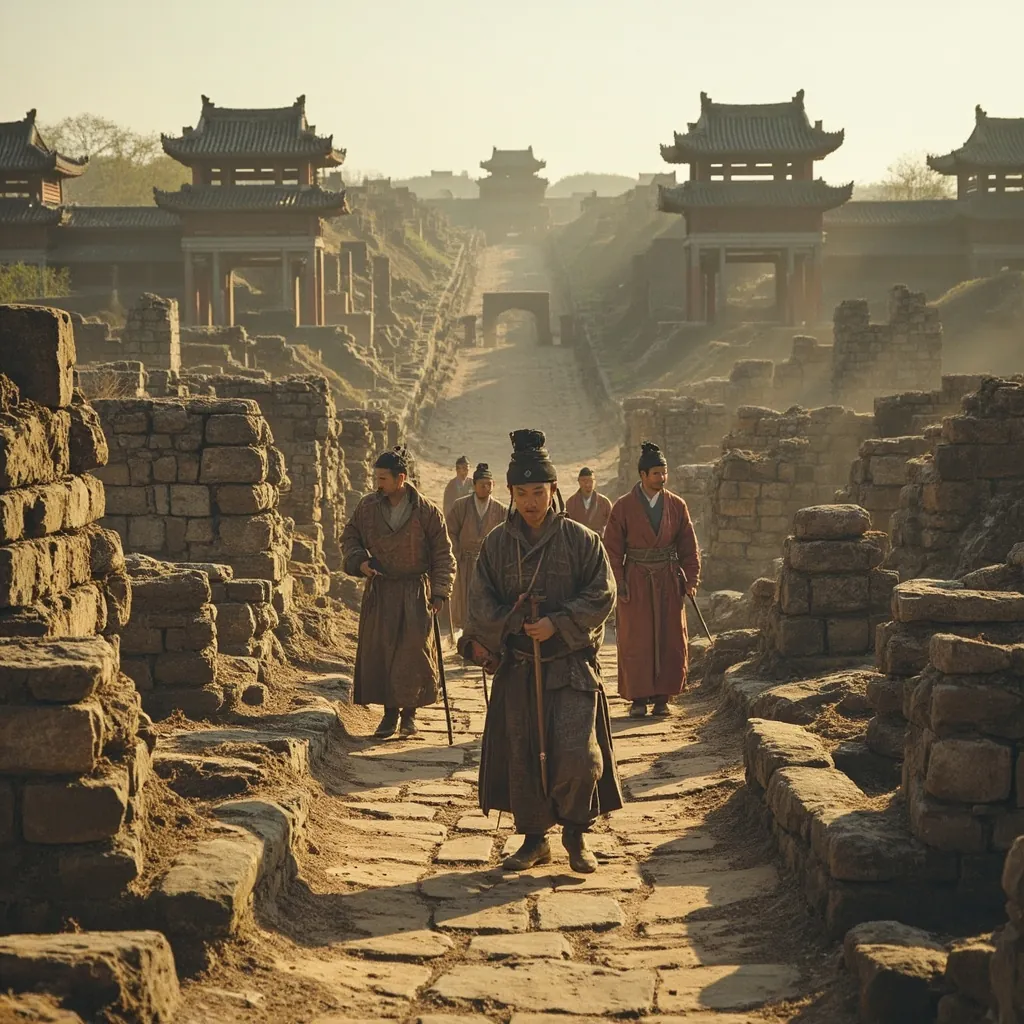
Hou Yi traveled across the scorched land, witnessing firsthand the devastation the suns had wrought. He saw villages reduced to rubble, fields turned to dust, and people collapsing from the unbearable heat. The sight filled him with determination. He would not fail.
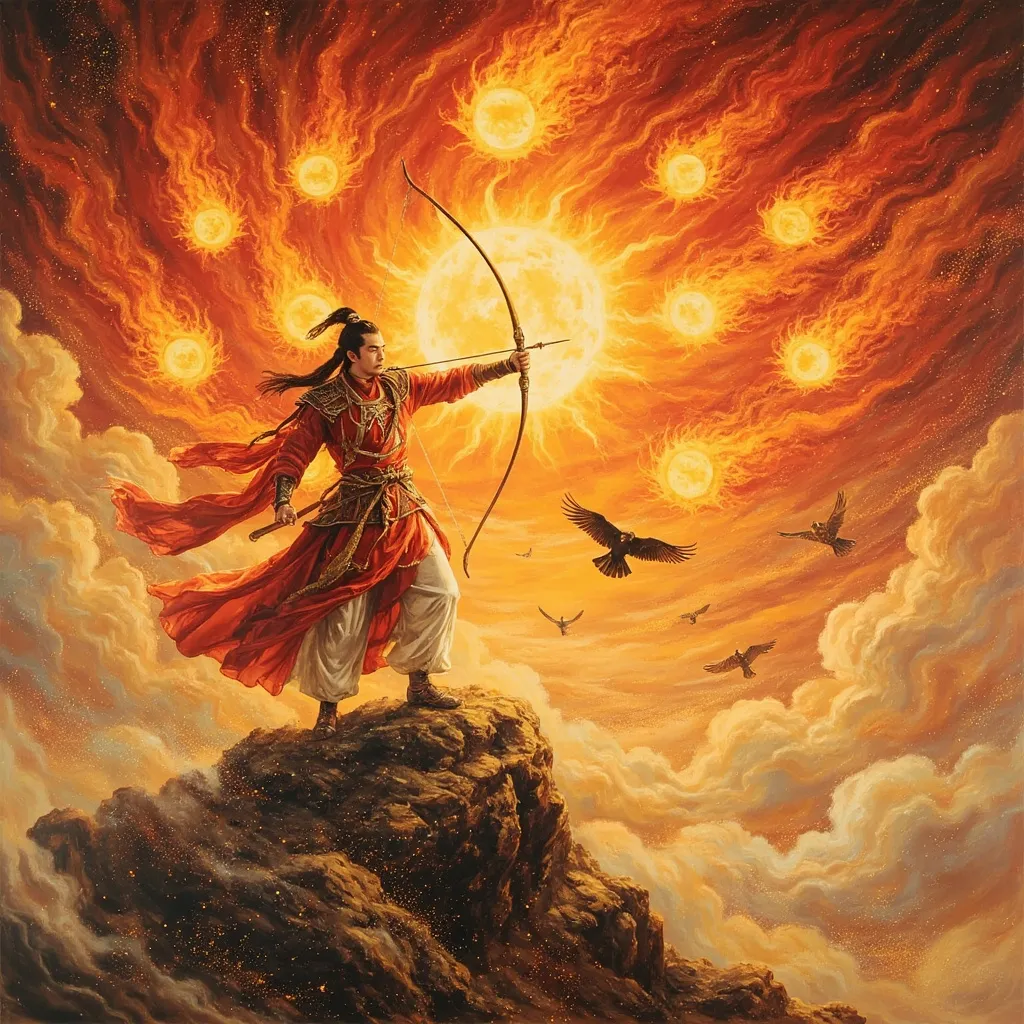
Standing atop the highest mountain, Hou Yi raised his bow toward the heavens. The suns, arrogant in their power, did not take him seriously. They had burned everything else—what could one archer do against such cosmic fire?
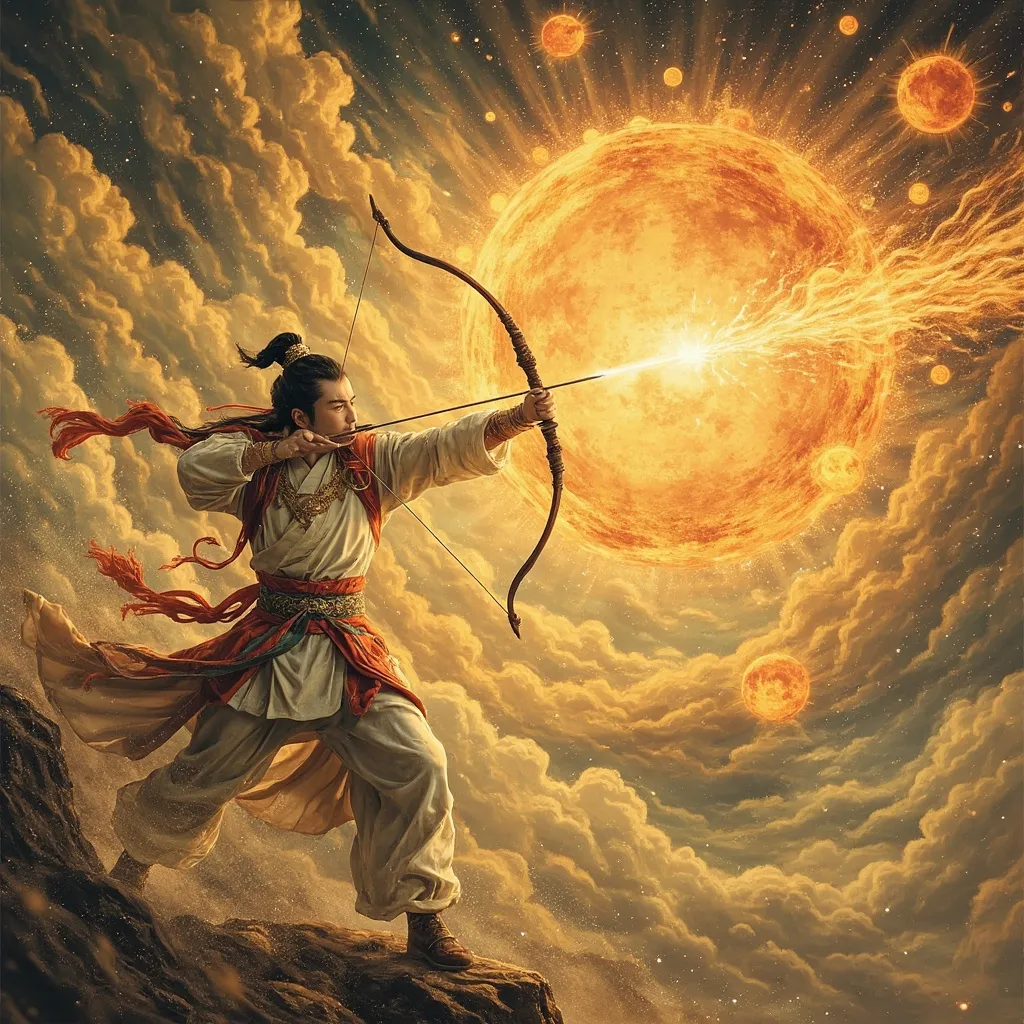
But Hou Yi was no ordinary archer. His first arrow flew true, striking down the first sun with a thunderous crack. The celestial body shattered like glass, its light scattering into a thousand sparks before fading to nothing. One sun fell.
The remaining suns panicked and tried to flee, but Hou Yi was relentless. One by one, his arrows found their marks. Nine suns fell from the sky, each impact sending shockwaves through the heavens. When it was over, only one sun remained—the one we see guiding our days to this very day.
The gods were impressed by Hou Yi’s skill and resolve. They had given him an impossible task, and he had accomplished it through sheer determination and supernatural talent. But the heavens were not finished testing this remarkable archer.
The Divine Elixir and Chang’e
With his mission complete, Hou Yi was celebrated as a hero across the land. The people built temples in his honor and offered sacrifices to thank him for saving their world. But the gods were not finished with Hou Yi—they had one more gift for him, and one more test.
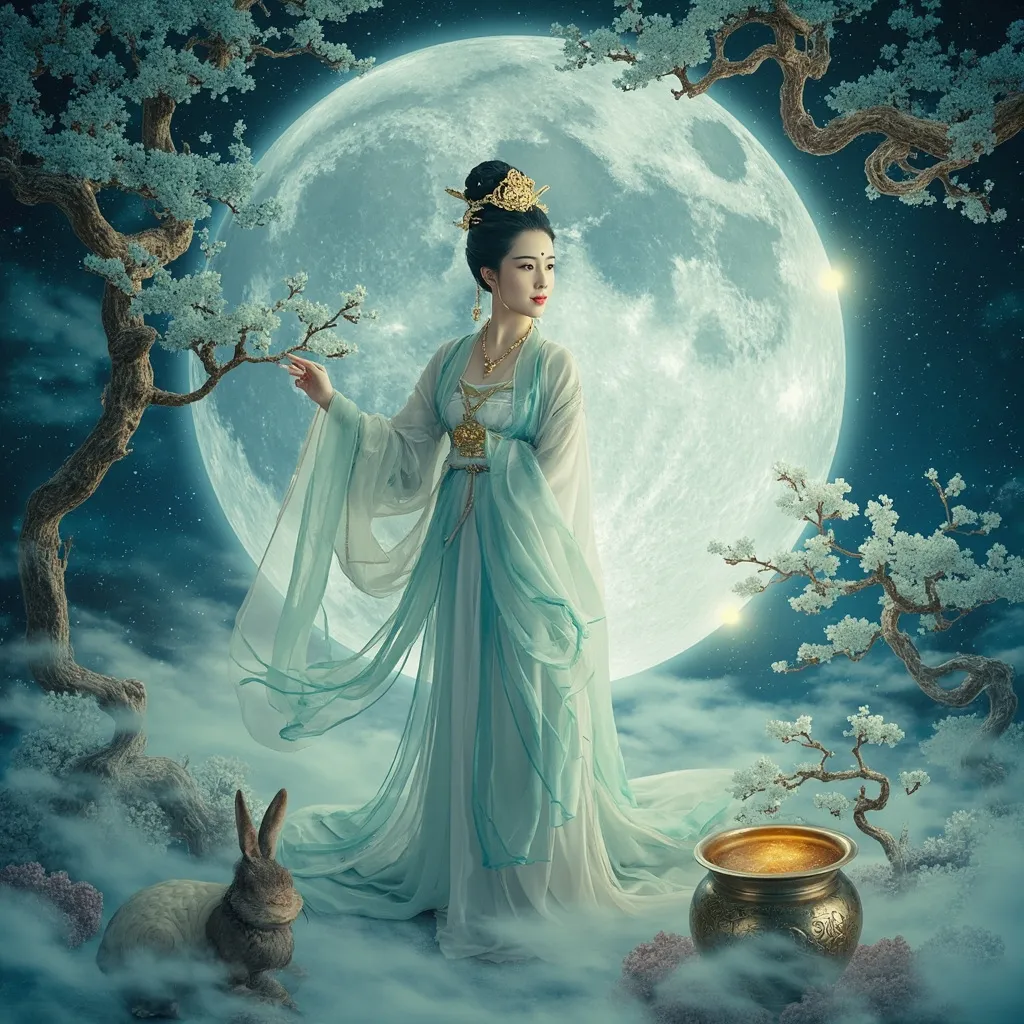
The Queen Mother of the West, a powerful goddess, presented Hou Yi with the Elixir of Immortality. This precious gift would allow him to ascend to the heavens and live among the gods forever. But the elixir was meant for one person only, and Hou Yi faced a difficult choice.
He chose to remain on earth, unwilling to leave his beloved wife Chang’e behind. Together, they lived in peace, tending to their modest home. But Hou Yi’s student, Peng Meng, became greedy when he learned of the elixir. One night, while Hou Yi was away, Peng Meng broke into their home and demanded Chang’e give him the elixir.
Faced with no other choice, Chang’e drank the entire elixir herself. The liquid burned through her veins, lifting her toward the heavens. She landed on the moon, where she has lived ever since, the Moon Goddess, forever separated from her husband but eternally remembered.
This tragic turn reminds us that heroism carries costs that heroes themselves often don’t anticipate. Hou Yi saved the world, but he couldn’t protect his own wife from the greed his fame would attract. The elixir that was meant to reward his heroism instead became the instrument of their separation.
The Symbolism of Nine Suns
In Chinese culture, the number nine holds special significance—it represents completeness and eternity. The fact that Hou Yi shot down nine suns, leaving exactly one, carries deep symbolic meaning. Just as there is one sun to guide the day, there should be one natural order to the world.
This balance, or yin and yang, forms the foundation of Chinese philosophy. Too much of anything disrupts the harmony that sustains the universe. Nine suns represented an imbalance, a catastrophe that could only be resolved through decisive action. Hou Yi’s role was to restore that balance.
The story also warns against arrogance. The suns, drunk on their collective power, forgot their proper place in the cosmos. Their punishment was swift and absolute. In Chinese thought, this serves as a reminder that even celestial bodies must follow the laws of moderation and balance.
Interestingly, the number nine appears repeatedly in Chinese cultural symbolism. The nine-tiered pagoda, the nine sons of the dragon, the nine sections of the classical poem—nine represents not just completeness but also spiritual attainment. Hou Yi shooting down nine suns thus represents the restoration of cosmic order, returning the universe to its proper state.
The Psychology of Heroism and Sacrifice
The legend of Hou Yi raises fascinating questions about heroism and what it truly means to save others. Hou Yi possessed extraordinary abilities—the divine bow and arrows were powerful tools, but they were meaningless without his courage to use them.
Psychologists have long studied what drives people to act heroically. Research suggests that true heroism isn’t about seeking glory or recognition. Hou Yi could have used his powers for personal gain, could have claimed godhood and abandoned the suffering masses. Instead, he chose to risk everything for strangers.
This selfless heroism resonates deeply in Chinese culture. The concept of ren ai—humanity and compassion—teaches that true nobility lies in serving others. Hou Yi embodied this principle. He saw suffering and acted, not because he would receive rewards, but because action was simply the right thing to do.
Modern research supports the idea that heroism is often a response to immediate crisis. In the face of overwhelming challenges, some people find extraordinary reserves of strength they never knew they possessed. Hou Yi, facing the impossible task of shooting down suns, didn’t hesitate or make excuses. He simply did what needed to be done.
The story also speaks to the psychology of sacrifice. Hou Yi’s choice to stay with Chang’e rather than ascend alone demonstrates that true heroism extends beyond single acts of bravery. It’s a lifestyle, a commitment to putting others before oneself, even when it means giving up immortality itself.
Hou Yi’s Legacy in Modern China
Today, the legend of Hou Yi continues to inspire millions. The story is retold during festivals, performed in operas, and depicted in countless works of art. Children grow up hearing about the brave archer who saved the world, learning that even the most powerful forces can be overcome through courage and determination.
The tale has also influenced modern media. Video games feature Hou Yi as a powerful character. Television dramas dramatize his adventures. The image of the heroic archer, bow raised against impossible odds, has become an iconic symbol of Chinese mythology.
More importantly, the story serves as a moral compass. When Chinese people face challenges—whether personal struggles or collective crises—they often think of Hou Yi. The lesson is clear: no matter how overwhelming the odds, ordinary people can accomplish extraordinary things when they act with courage and conviction.
In the business world, Hou Yi’s story has inspired entrepreneurs to take bold risks for the greater good. In education, it teaches students that intelligence and ability mean nothing without discipline and moral character. In family life, it reminds us that true love sometimes requires sacrifice.
The Archer’s Archetype in World Mythology
Hou Yi is not alone in world mythology as a heroic archer who shot down celestial bodies. Similar figures appear in Greek mythology, where Apollo drives the sun chariot across the sky, and in Norse mythology, where the god Ullr travels on a solar sled. But Hou Yi’s story stands apart for its focus on balance and restraint—he shot down nine suns, not all ten, understanding that the world needed at least one sun to survive.
This nuance reflects a distinctly Chinese approach to heroism. Where Western heroes often triumph through overwhelming force, Chinese heroes like Hou Yi succeed through precise, calculated action. The goal is not destruction but restoration—bringing the cosmos back into harmony rather than simply defeating an enemy.
Comparative mythology reveals interesting parallels. The Greek legend of Icarus, who flew too close to the sun and fell, represents the danger of hubris. Hou Yi’s suns represent the same danger on a cosmic scale—too much of a good thing becomes catastrophe. Both stories warn against excess, against forgetting our proper place in the order of things.
Scientific Perspectives on Multiple Suns
Modern astronomy adds an intriguing layer to Hou Yi’s story. While we know today that ten suns rising simultaneously is impossible in our solar system, scientists have discovered planetary systems with multiple stars. Some planets orbit binary or trinary star systems, experiencing two or three sunrises in a single day.
The habitability of such worlds becomes a fascinating question. Too much radiation would sterilize the surface, much like the ten suns scorched ancient China. Scientists have identified a “habitable zone” around stars—not too hot, not too coldwher life can thrive. Hou Yi’s ancient story captures this principle intuitively: balance is essential for life to flourish.
The legend also resonates with concerns about climate change. Just as ten suns would overheat the earth, human activity has increased greenhouse gases, raising global temperatures and disrupting natural cycles. Hou Yi’s message—that excessive force disrupts harmony—speaks to contemporary environmental challenges.
Cultural Festivals Honoring the Solar Event
Several Chinese festivals maintain connections to Hou Yi’s legend. The Mid-Autumn Festival celebrates Chang’e’s flight to the moon but also honors the balance between sun and moon, light and dark. Lantern festivals light up the darkness, representing the single sun’s daily journey and the hope that light will always return.
In some regions, archery competitions are held in Hou Yi’s honor, testing the skills of young people and reminding them of the hero who once saved the world with a bow. These festivals keep the legend alive, passing it from generation to generation as both entertainment and moral instruction.
The timing of these festivals often corresponds to agricultural cycles, reinforcing the connection between the sun’s balance and human flourishing. Too much sun destroys crops; too little stunts their growth. Hou Yi’s story encodes this agricultural wisdom in mythic form.
Conclusion
The legend of Hou Yi shooting down the suns remains one of China’s most beloved mythological tales. It speaks to fundamental human values—courage in the face of disaster, selfless service to others, and the importance of maintaining balance in all things.
When we look at the night sky and see the single sun that guides our days, we can appreciate the ancient story that explains its singularity. And when we face our own impossible challenges, we might remember Hou Yi, the divine archer who proved that heroism isn’t about being extraordinary—it’s about doing what needs to be done, no matter the cost.
The next time you see a beautiful sunset or sunrise, think of Hou Yi. Think of the courage it took to challenge the heavens themselves, and let his story inspire you to face your own challenges with the same determination and selflessness. For in the end, we are all capable of shooting down our own suns—we need only find the courage to raise our bow.