- “Chinese Martial Arts Training Gear”
- “Hua Mulan & Historical Warriors Books”
- “Traditional Chinese Armor Replicas”
- “Chinese Sword Collection”
- “Women’s History in Asia Books”
Hua Mulan: The Legendary Woman Who Became a Warrior
When Disney released its animated film in 1998 and later its live-action remake in 2020, millions of people around the world were introduced to the story of a young Chinese woman named Mulan who disguised herself as a man to fight in war. But the legend of Hua Mulan (花木兰, Huā Mùlán) is far older than any Hollywood adaptation—it dates back to the Northern Wei Dynasty in the fifth century, preserved in a folk ballad called “The Ballad of Mulan” (木兰辞, Mùlán Cí) that Chinese schoolchildren have memorized for over a thousand years. The original poem is brief, just thirty-one lines, yet it contains an entire epic of courage, sacrifice, and the questioning of rigid social expectations. Mulan is not merely a Disney character or a feminist icon. She is a mirror held up to every society that has ever told women they cannot do something simply because they were born female.
The Ballad of Mulan begins not with fanfare or battle, but with a quiet domestic scene: a young woman sitting at her loom, working quietly, when suddenly the sound of military drums breaks the peace. The Khan has called for an army to march against the Rouran nomads from the north, and every family with sons must send one male relative to serve. Mulan’s father, an aging soldier whose legs were wounded in wars past, is too frail to fight. Her younger brother is too young. And so Mulan makes a decision that will change everything: she will go in their place.
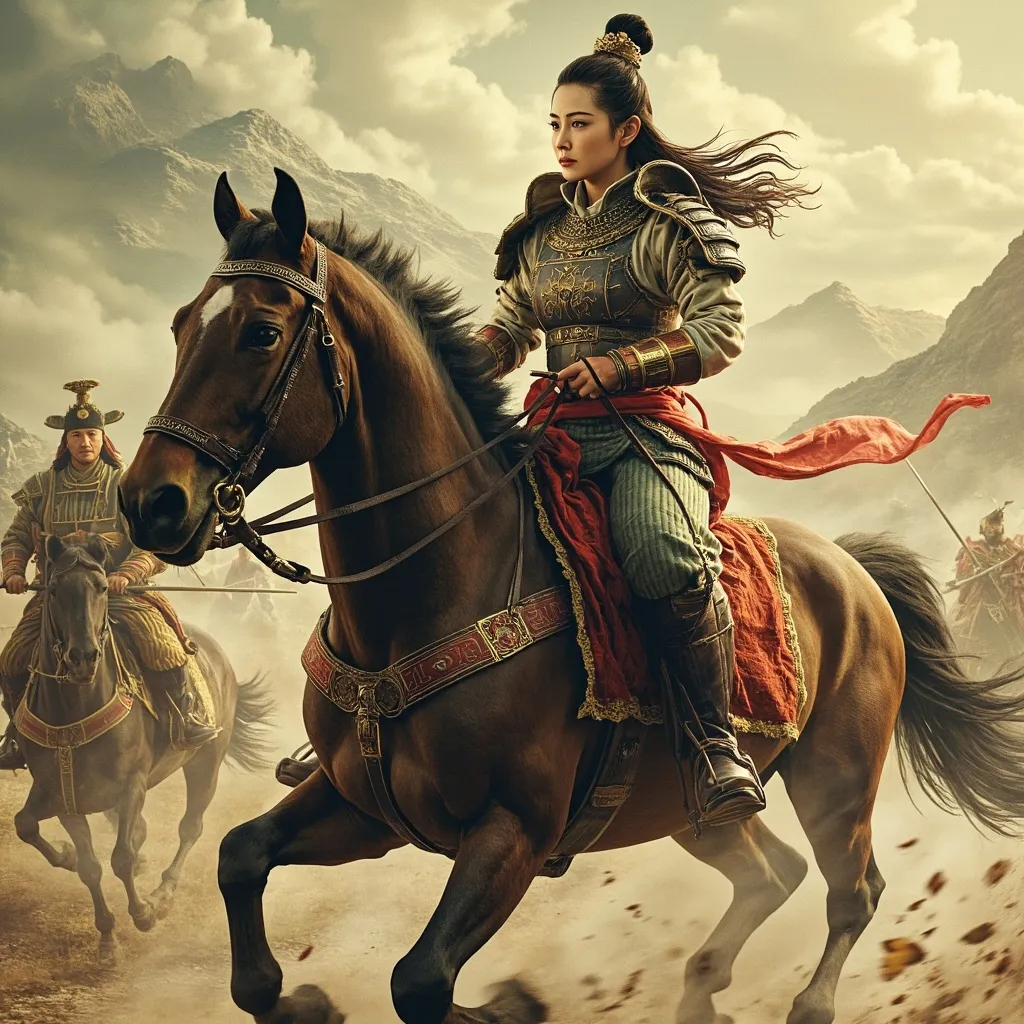
This is the moment at which the entire legend pivots. Mulan does not debate politics, does not question the war’s necessity, does not make grand speeches about equality. She simply looks at her family, assesses the situation with clear eyes, and acts. There is no army that will accept women soldiers. There is no system in place that would allow her to serve openly as a daughter, a sister, a woman. So she does the only thing she can do—she cuts her hair, binds her chest, puts on her father’s armor, picks up his sword, and rides to war in his place. The transformation is practical, not political. And that practicality is, in its own way, what makes the story so radical.
A Woman in a Man’s Armor
What follows in the ballad is a decade-long chronicle of military service that Mulan endures while hiding her true identity. She rides across the vast northern frontier, crossing mountains and rivers, sleeping in tent camps, eating rations alongside other soldiers, fighting in battles where the difference between life and death is measured in inches. For ten years, she is not Mulan the daughter, the sister, the woman—she is simply another soldier in the army, indistinguishable from the men around her, known by her father’s name and rank, praised for her courage and skill.
The original poem is notably vague about Mulan’s specific battlefield accomplishments. The Ballad of Mulan does not record that she killed a particular enemy general or won a particular famous battle. What it emphasizes instead is her survival, her endurance, and her ability to navigate an impossible situation without detection. For ten years, she fooled everyone—fellow soldiers, commanders, the enemy, perhaps even herself at times. The constant vigilance required to maintain a secret identity in such close quarters, under such intense pressure, is its own form of heroism. Every day that she did not get caught was a small victory, and ten years of small victories add up to something extraordinary.
When the war finally ended and the army was discharged, Mulan returned home to her family. The poem tells us that she sat with her father and mother in the family courtyard, surrounded by siblings who had waited for her return. And then, in a moment that is both anticlimactic and deeply human, Mulan shed her armor, put on women’s clothing, fixed her hair, and emerged as the woman she had always been—revealing to the shocked eyes of former comrades that their brave fellow soldier had been a woman all along.
The reaction of her fellow soldiers is one of the most striking and often overlooked aspects of the story. The original poem records that twelve years have passed (some versions say ten), and that Mulan has fought in “twelve battles”—a phrase that has passed into common usage in Chinese to describe something that is numerous or difficult to count. When her former comrades see her in women’s clothing, they are stunned into incomprehension. They had lived beside her, fought beside her, slept beside her, and never suspected. The revelation makes no sense to them—this is a world in which women do not become soldiers, and so a woman becoming a soldier is simply unthinkable, even when it is happening right in front of their eyes.
The Question of Gender and Heroism
The legend of Mulan raises questions that have fascinated readers and scholars for centuries. How did she hide her identity for so long? How did she manage the physical challenges of military life while concealing a body that was biologically different from her fellow soldiers’? The original ballad offers no answers to these questions, and the mystery is part of what makes the story so enduring. Mulan’s success in passing as a man depends on the assumption that gender is, at least in part, a performance—that if a woman binds her chest, cuts her hair, and adopts masculine habits and clothing, she can be perceived as a man by others who are not looking for evidence to the contrary.
This insight is profoundly modern, even though the story is ancient. Contemporary readers often see Mulan as an early feminist hero, a woman who broke barriers and proved that gender should not determine what a person can or cannot do. And there is truth in this interpretation. Mulan did do something extraordinary, something that challenged the fundamental assumptions of her society about what women were capable of. She fought in wars, she earned the respect of her fellow soldiers, she survived battles that killed many other men, and she returned home victorious—having succeeded in every way that a soldier could succeed.
But it is also worth noting that Mulan’s heroism was not primarily about proving anything to anyone. She did not go to war to make a political statement or to challenge gender norms. She went because there was a need, because her family was in danger, and because she was the only person available to meet that need. Her disguise was practical, not ideological. She did not ask for recognition or reward. When she returned home, she did not become a general or a political leader. She simply resumed her life as a woman in her family home, presumably returning to the weaving loom and the domestic duties that had been waiting for her all along.
In this sense, Mulan’s story is both radical and deeply traditional. It challenges gender expectations in the most concrete and visceral way possible—a woman doing a man’s job—but it does not ultimately question the social order itself. The society that said women could not be soldiers remained intact after Mulan’s service. She was an exception, not a rule-changer. The systems that had created the problem in the first place—the expectation that families would supply soldiers, the lack of any alternative for families without able-bodied men—remained unaltered by her actions.
The Warrior Woman in Chinese Culture
Despite the traditionally conservative nature of the legend’s ending, Mulan became one of the most celebrated figures in Chinese cultural history. Temples were built in her honor. Poets wrote verses about her courage. Operas dramatized her story. She was invoked as a model of filial piety—a daughter willing to risk her life for her elderly parents—as well as a model of bravery and skill in battle. In a culture that emphasized women’s domestic virtues above all else, Mulan stood out as proof that those virtues were not mutually exclusive with martial prowess and battlefield courage.
The ambiguity of Mulan’s identity also opened the door to various interpretations of what happened after her military service. In some versions of the story, an emperor, impressed by Mulan’s service, offered her a high position in the government. In others, she retired quietly to domestic life. In still others, she died in battle or took her own life rather than face the dishonor that might come from her secret being exposed. The original poem is silent on these matters, which gave later storytellers enormous freedom to shape Mulan’s story according to their own values and narrative needs.
One particularly popular version, which emerged in later dynasties, had Mulan’s secret discovered not by her comrades but by a curious princess who noticed certain feminine characteristics while they bathed together. Rather than exposing Mulan, the princess fell in love with her and proposed marriage—a twist that added both romantic and queer dimensions to a story that had previously been about combat and duty. Other versions had Mulan marry a fellow soldier who had fought beside her for years without any suspicion of her true identity. Still others had her return home to find that her father had died during her absence, and she spent the rest of her life caring for her mother and younger siblings.
Mulan’s Modern Legacy
The global popularity of Mulan—through Disney’s adaptations and the countless Chinese films, television series, operas, and novels that have retold her story—has made her one of the most recognizable Chinese figures in the world. But the legend’s appeal extends far beyond its entertainment value. Mulan’s story resonates because it speaks to something fundamental about human courage: the willingness to do what needs to be done, regardless of the personal cost, and regardless of whether society approves or not.
She is also, it must be said, a figure who has been shaped and reshaped by each generation to reflect contemporary concerns. The Northern Wei original ballad was primarily about filial piety and military service—central values of the society that produced it. The Disney version was updated in 1998 to include themes of self-discovery, female empowerment, and resistance to conformity. The 2020 live-action film added elements of witchcraft and supernatural powers, reflecting contemporary fantasy storytelling conventions. Each retelling makes Mulan new while preserving the essential core: a woman who refused to be limited by what others told her she could be.
In the end, what makes Mulan enduring is not any particular interpretation or adaptation, but the simple power of the original image: a woman sitting at her loom, hearing the call to arms, and making a choice that changed her life forever. She did not know, when she cut her hair and bound her chest, whether she would survive the war, whether she would be discovered, whether she would ever return home. She knew only that her family needed her, and that was enough.
For a thousand years, Chinese readers have closed the Ballad of Mulan with a lingering question: Mulan, Mulan, what have you done with your ten years? The answer is always the same: she did what needed to be done. And that answer, simple as it is, has been enough to keep her story alive for a millennium and counting.
Recommended Reading & Products
Affiliate products for this article:
Chinese Martial Arts Training Gear & Equipment - Amazon US Search - Honor Mulan’s warrior spirit with martial arts training equipment inspired by traditional Chinese combat practices. From practice swords to training uniforms, find gear for beginning your own martial journey.
Hua Mulan & Historical Warriors Biography Books - Amazon US Search - Dive deeper into the historical context of Mulan’s era and the Northern Wei Dynasty with scholarly and popular histories of China’s legendary women warriors.
Traditional Chinese Armor Replicas & Collectibles - Amazon US Search - Own a piece of history with beautifully crafted replicas of traditional Chinese warrior armor, inspired by the protective gear that Mulan would have worn in battle.
Chinese Sword Collection & Display Pieces - Amazon US Search - Add to your collection of traditional Chinese weapons with handcrafted sword replicas suitable for display, martial arts practice, or as unique home decor pieces.
Women’s History in Asia Books Collection - Amazon US Search - Explore the stories of other remarkable women throughout Asian history who challenged expectations and made their mark on civilization, paralleling Mulan’s inspiring legacy.
Disclosure: This article contains affiliate links. We earn a commission on qualifying purchases.