In 1955, a twenty-two-year-old actress named Yan Qiqiang received a letter that would change her life. The Shanghai Film Studio was casting for a new movie, and they wanted her to play the lead role in a film adaptation of a traditional opera called The Heavenly Match. There was just one problem: Yan had never acted in a film before. She had spent her entire career performing on small stages in rural Anhui province, singing for farmers who had never seen a movie and could not afford to travel to the city.
But the film studio had noticed something that millions of Chinese people would soon discover: Yan Qiqiang had a voice and a presence that transcended the boundaries of her modest origins. When The Heavenly Match was released the following year, it became a cultural phenomenon. Audiences who had never seen an opera performance were moved to tears by the story of a fairy princess who falls in love with a mortal scholar. The soundtrack sold millions of copies. Yan Qiqiang became a household name overnight.
The opera she starred in was called Huangmei Opera — and the story of how it rose from the tea fields of Anhui to become one of China’s five great opera traditions is one of the most remarkable cultural transformations of the twentieth century.
Where It All Began: Tea-Selling Songs in the Anhui Hills
To understand Huangmei Opera’s appeal, you have to start in the place where it was born: the hilly region along the border between Hubei province and Anhui province, in central eastern China. This area has been famous for its tea for more than a thousand years. The mist-shrouded mountains, the terraced tea gardens, the farmers who spend their lives cultivating and harvesting the leaves — these images have inspired Chinese poets and painters for centuries.
It was among these tea farmers that a distinctive form of folk singing developed. Called cha jia gequ, or “tea-picking songs,” these were simple melodies that workers sang while they picked tea. The songs had no formal structure, no instruments, no elaborate costumes. They were just voices — high and clear, carrying across the hillsides, expressing the joy and exhaustion and longing that came with the harvest season.
Over time, these tea-picking songs absorbed influences from other local traditions: the narrative singing of the Huangmei area, the folk ballads of the Yangtze River valley, the religious chants of local temple festivals. A distinctive musical style emerged, characterized by a lilting rhythm, a five-note scale that felt both familiar and slightly melancholy, and lyrics that dealt with everyday themes — love, marriage, the changing seasons, the humor and tragedy of rural life.
This was not the opera of the imperial court or the theaters of Beijing and Shanghai. It was music made by ordinary people for ordinary people — sung in the local dialect, performed in village squares, fueled by the same community spirit that organized harvest celebrations and temple fairs. It had a spontaneity and directness that more formal art forms lacked.
The Transformation: From Village Square to National Stage
The transformation of Huangmei Opera from a rural folk art to a nationally recognized art form happened in stages, and it required the intervention of people who saw potential where others saw only simplicity.
The first major figure in this transformation was a woman named Cheng Yichun, who is sometimes called the “Mother of Huangmei Opera.” Born in 1901 in a poor farming village in Anhui, Cheng showed an extraordinary singing voice from childhood. She began performing at local festivals at the age of twelve, and by her twenties she was the leading female performer in the region.
What made Cheng different from most folk singers was her ambition. She understood that Huangmei Opera’s melodies were beautiful but that its stories were limited — they tended to focus on the same themes of romantic love and family drama that had sustained village storytelling for generations. She began recruiting scholars to write new scripts, bringing in musicians who could add harmonic complexity to the simple melodies, and training young performers in the basics of dramatic acting.
The results were uneven at first, but the direction was clear. Cheng was trying to elevate the art form without destroying what made it distinctive: its accessibility, its emotional directness, its connection to the rhythms of rural life. She wanted farmers to recognize their own experience on stage while also feeling that they were witnessing something refined and sophisticated.
The decisive moment came in the 1950s, when the Chinese government began a systematic effort to catalog, preserve, and promote traditional folk arts.huangmei Opera caught the attention of cultural officials who saw it as a perfect example of what they were looking for: a genuinely indigenous art form with deep roots in popular culture, capable of being developed into something that could represent Chinese culture on the national and international stage.
The 1955 film adaptation of The Heavenly Match was the culmination of this effort. The movie preserved the essential elements of Huangmei Opera’s musical style while adding the production values and distribution reach of the Chinese film industry. Overnight, the melodies that had once echoed only in the Anhui hills were playing on radios across the country.
The Five Great Traditions: Where Huangmei Opera Fits
Chinese opera is not a single art form but a family of related traditions that have developed in different regions over several centuries. The most widely recognized classification identifies five major traditions, each with its own distinctive musical style, vocal technique, stage conventions, and repertoire.
Beijing Opera (Jingju) is the most famous internationally — the elaborate costumes, the stylized martial arts, the high-pitched singing that can shatter glass. It developed in the imperial capital and was shaped by the tastes of the court and the urban gentry. Beijing Opera tends to emphasize historical and political themes, and its performance conventions are highly codified, with specific gestures and movements corresponding to specific emotional states.
Kunqu is the oldest of the major traditions, with roots in the Yuan dynasty (thirteenth century). Known for its lyrical beauty and sophisticated poetry, Kunqu was the preferred opera of scholars and literati. It is performed at a slower pace than other traditions, with elaborate staging and a focus on subtle emotional nuance. UNESCO designated it as an Intangible Cultural Heritage of Humanity in 2001.
Yue Opera comes from Zhejiang province, in the Yangtze River delta south of Shanghai. It is sometimes called “Chinese ballet” because of its emphasis on dance and physical grace. Yue Opera traditionally features all-female casts and focuses on romantic and emotional themes rather than historical or martial subjects.
Yu Opera (Yuju) originates in Henan province, in central China. It is known for its powerful, direct vocal style — singers produce a strong, penetrating sound that can fill large outdoor spaces without microphones. Yu Opera draws heavily on folk traditions and tends to feature stories about ordinary people rather than emperors and nobles.
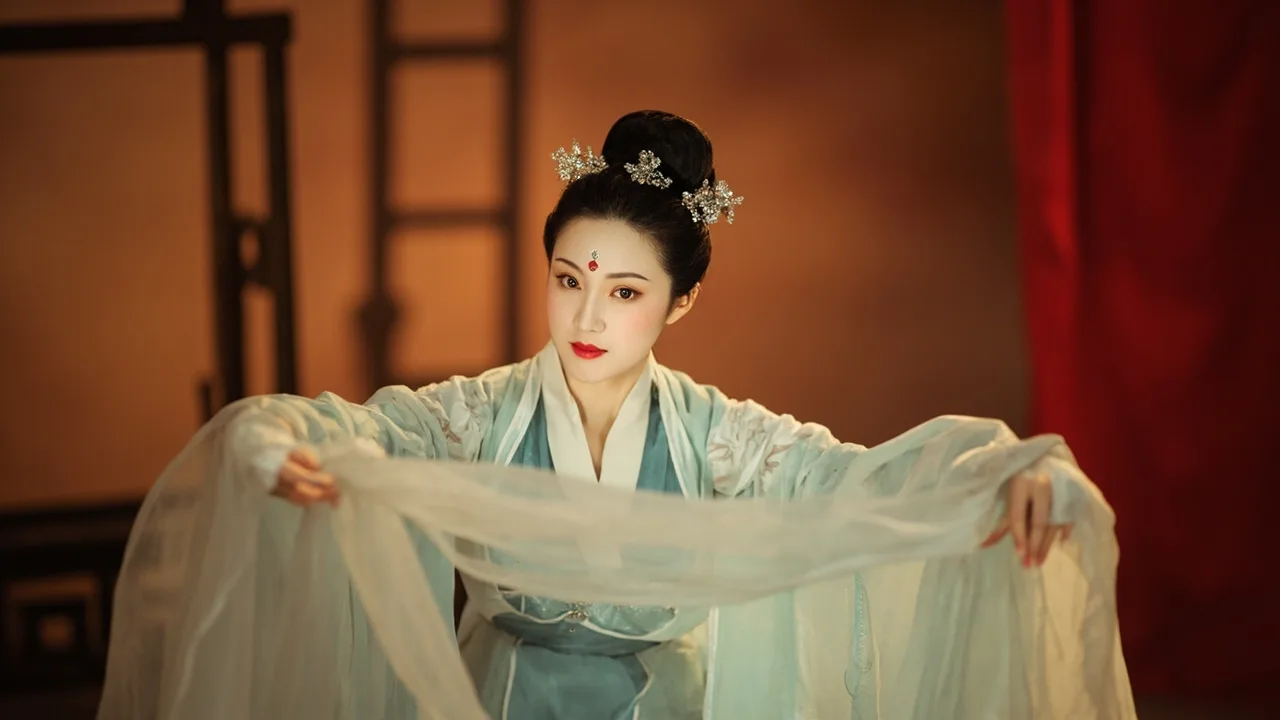
And finally, Huangmei Opera, which occupies a unique position among the five. It is the most “recent” of the major traditions to achieve national recognition, the most directly connected to rural folk culture, and the most explicitly associated with a particular geographic region (the Anhui-Hubei border). Its signature feature is what performers call shuixiu, or “water sleeves” — long flowing sleeves attached to the costume that performers manipulate with extraordinary skill to express emotion, creating the impression of water flowing or waves rippling.
The Heavenly Match: The Opera That Changed Everything
No discussion of Huangmei Opera is complete without a close look at The Heavenly Match, the opera that launched it to national fame.
The story is based on a Chinese fairy tale about a fairy maiden named Qiongxian who escapes from the heavenly palace, where the rules are too strict and the life too cold. She falls in love with a poor scholar named Huangmei and chooses to live with him in the mortal world, accepting the hardships and uncertainties of human life in exchange for the warmth of genuine love and companionship.
The opera explores themes that resonate deeply with Chinese audiences: the tension between duty and desire, the fear of divine retribution for breaking rules, the courage required to choose happiness over safety. Qiongxian is not a passive heroine waiting to be rescued — she makes a deliberate, fully-informed choice to abandon heaven, and the opera treats that choice with great seriousness.
What makes the opera specifically “Huangmei” is the way these themes are expressed through the music. The melodies draw directly on the tea-picking songs of Anhui, giving the story a warmth and earthiness that contrasts sharply with the cold celestial imagery of the opening scenes. The shift from heavenly to earthly music is not subtle — audiences immediately feel that Qiongxian has found the right world to live in, even before the plot confirms it.
The shuixiu (water sleeves) technique reaches its highest expression in this opera. In the famous “Sighing Over the Flowers” scene, the performer uses the flowing sleeves to evoke a sense of grief and longing so intense that it seems to fill the entire theater. The technique has been analyzed by dance scholars as a masterpiece of nonverbal communication — a system of expressive movement that communicates specific emotional states with a precision that rivals language.
What Makes Huangmei Opera Different from Beijing Opera
Visitors to China who attend their first opera performance often assume that all Chinese opera is like Beijing Opera — the form they have seen in photographs, with the elaborate face-painting, the martial combat, the high-pitched vocal style. It is a reasonable assumption, given how dominant Beijing Opera has been in international representations of Chinese performing arts.
But Huangmei Opera could not be more different in both appearance and spirit. Where Beijing Opera emphasizes spectacle and technical virtuosity, Huangmei Opera prioritizes emotional truth and melodic beauty. Where Beijing Opera performers train for years in highly specialized skills — voice control, martial arts, acrobatics — Huangmei Opera performers tend to come from musical backgrounds and emphasize singing ability as their primary artistic tool.
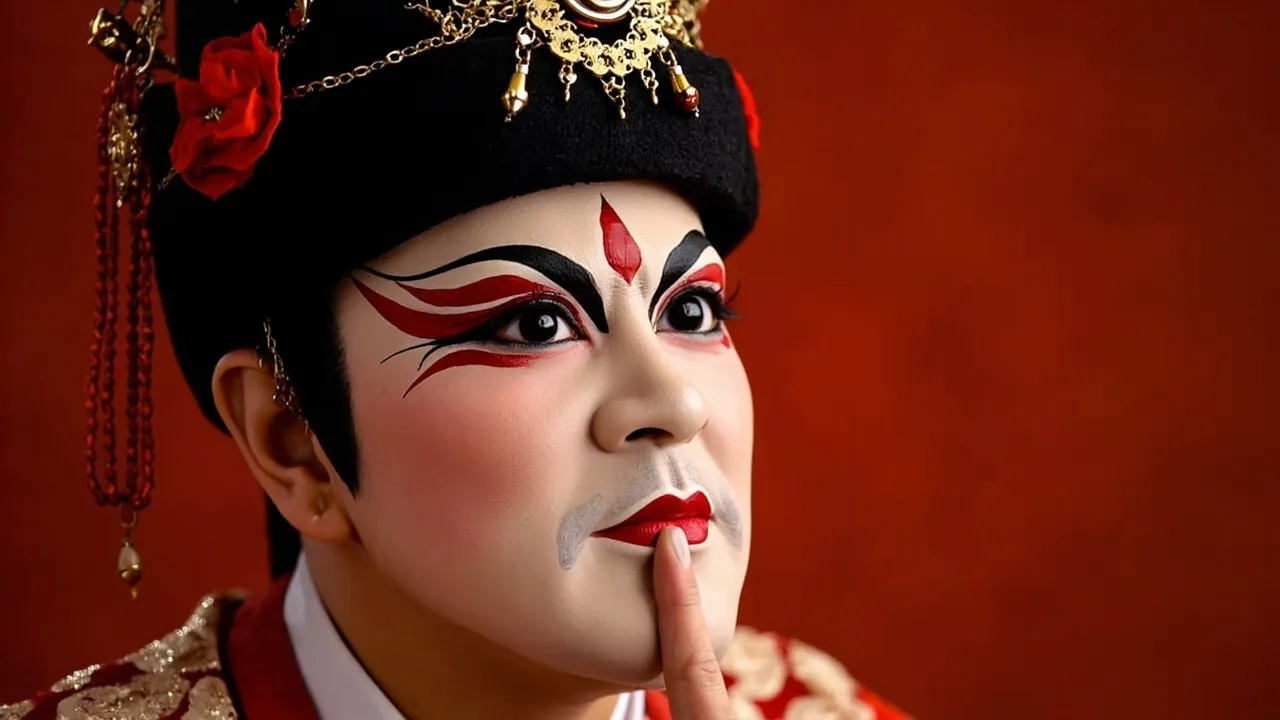
The costumes in Huangmei Opera are also distinct. Rather than the elaborate embroidered robes and towering headpieces of Beijing Opera, Huangmei performers typically wear simpler, more naturalistic costumes that suggest historical period without the heavy symbolism. The famous “water sleeves” are the most visually distinctive element, but they are used expressively rather than decoratively.
The vocal style reflects the rural origins of the tradition. Huangmei Opera singers produce a warm, rounded tone that is closer to folk singing than to the sharp, projecting style of Beijing Opera. The music uses a pentatonic scale (five notes per octave) that gives it a distinctive flavor — neither Major nor minor in the Western sense, but something else entirely, a sound that Chinese audiences immediately recognize as belonging to the Yangtze River valley.
For Americans familiar with the distinction between Broadway musical theater and opera, the parallel is imperfect but helpful. Beijing Opera is more like opera — demanding, formal, technically demanding, accessible primarily to trained audiences. Huangmei Opera is more like musical theater — emotional, melodic, story-driven, accessible to general audiences. Both are valid artistic traditions; neither is inherently superior. The point is that Chinese opera is not a monolith.
The Art Form Today
Huangmei Opera has experienced periods of decline and revival since its national breakthrough in the 1950s. During the Cultural Revolution (1966–1976), many traditional operas were banned as “feudal artifacts,” and Huangmei Opera narrowly survived. The art form bounced back in the 1980s, when a new generation of performers revived the classic repertoire and began experimenting with new subjects and styles.
Today, Huangmei Opera faces the same challenges as most traditional performing arts worldwide: competition from film, television, and streaming media; shrinking audiences; difficulty attracting young performers who can commit to the years of training required. The number of professional Huangmei Opera troupes has declined from a peak of about sixty in the 1980s to fewer than twenty today.
But there are reasons for optimism. The Chinese government has designated Huangmei Opera as a National Intangible Cultural Heritage item, which brings funding for preservation and training programs. A new generation of performers is finding creative ways to modernize the art form — some companies are experimenting with multimedia staging, contemporary themes, and collaborations with other musical traditions.
Yan Qiqiang, the actress who starred in the 1956 film, lived to see Huangmei Opera become a respected national institution. She continued performing and teaching until her death in 2008, and her students now form the core of the current generation of Huangmei Opera artists. Her life story — from tea fields to national stage — remains the most powerful symbol of what this art form represents: the belief that authentic rural culture can speak to universal human experiences, and that the most profound artistic traditions often begin in the most unexpected places.