The Huli Jing: China’s Most Fascinating Fox Spirits
A Complete Guide to the Huli Jing for Americans
There is a creature in Chinese mythology that has haunted, fascinated, and terrified Chinese storytellers for over 2,000 years. It can appear as a beautiful woman, a fox with nine tails, an old man selling pancakes, or a glowing orb drifting through a graveyard at midnight. It can bless a family with good fortune or destroy a man’s sanity with a single glance. It is the huli jing — the fox spirit.
Unlike the qilin (a gentle celestial creature associated with virtue) or the pixiu (a wealth guardian with a bathroom problem), the huli jing is morally complex. Fox spirits in Chinese folklore are not simply good or evil — they are beings of extraordinary power who can choose to use that power for good or ill. Some fox spirits marry humans and live harmonious lives for centuries. Others seduce men and drain them of their life energy. The difference, in Chinese folklore, lies not in the fox’s nature but in the fox’s character — and in the humans who attract them.
This ambiguity makes the huli jing one of the most compelling figures in all of Chinese mythology. And in the West, the huli jing has found new life — in the form of Ms. Ma, the manipulative villainess of the Netflix series “The Crown,” and in popular video games from “Genshin Impact” to “Zenless Zone Zero.” This guide will introduce you to everything you need to know about China’s most intriguing supernatural being.
What Is a Huli Jing?
The term “huli jing” (狐狸精) literally means “fox spirit” in Mandarin. The first character, hu (狐), means fox. The second, jing (精), means spirit, essence, or supernatural creature. The term has been in use since at least the Han Dynasty (206 BCE – 220 CE), appearing in early texts like the Shanhai Jing (Classic of Mountains and Seas), which describes foxes with multiple tails that could possess supernatural powers.
Foxes in Chinese folklore are different from foxes in American or European folklore. Western fox mythology tends to treat foxes as clever tricksters (like Reynard the Fox in medieval European literature) or as simply mundane animals. Chinese fox mythology treats foxes as spiritual beings — creatures that can accumulate power over centuries and eventually become supernatural entities capable of shapeshifting, prophecy, and sorcery.
The process is gradual. A fox that lives for 50 years becomes a spirit. After 100 years, it can shapeshift into a human. After 1,000 years, it becomes a celestial fox with nine tails and supernatural sight — able to see into the heavens and the underworld. The more tails a fox spirit has, the more powerful it is.
The Shapeshifting: How Fox Spirits Appear
Fox spirits are famous for their ability to shapeshift into human form. According to Chinese folklore, they do this by covering their fox faces with a human face — or, more accurately, by projecting a human illusion over their true fox body. The shapeshift is not perfect. Observant humans can detect a fox in human form by looking for subtle signs:
- The fox spirit’s shadow does not match its human form (a fox’s shadow is always fox-shaped)
- Fox spirits cast no reflection in mirrors
- Fox spirits are said to walk without touching the ground, floating slightly above it
- A fox spirit in human form sometimes has feet that point backward
- In bright moonlight, the fox spirit’s human face might flicker, revealing the fox beneath
One of the most famous fox spirit stories involves a scholar who was being seduced by what appeared to be a beautiful woman. He became suspicious and scratched the woman’s back while she slept. His fingernail drew blood — but the blood was the color of fox blood (reddish-yellow, like a real fox’s). The woman woke, revealed herself as a fox, and fled. The scholar was shaken but unharmed. He had been tested, and he had passed.
The Fox Wife: Benevolent Fox Spirits
Not all fox spirits are dangerous. One of the most beloved subgenres of Chinese folklore is the fox wife story — in which a fox spirit chooses to marry a human man and lives with him faithfully for decades, bearing children and maintaining a harmonious household.
These stories follow a consistent pattern. A young man — usually poor, scholarly, or lonely — encounters a beautiful woman. They fall in love. The man either knows she is a fox (and accepts it) or discovers it later (and must decide whether to stay). If he accepts her fox nature, the marriage is typically happy. The fox wife uses her supernatural abilities to help the husband’s career, protect the family from misfortune, and maintain household harmony. The couple grows old together, and when the fox wife dies (or chooses to reveal herself), the husband is left with children and a life that would not have existed without her.
There is a famous Qing Dynasty story called “The Fox Wife of Qingtian County” in which a poor scholar named Wang lives alone in a mountain village. A beautiful woman appears and offers to be his wife. Wang accepts, and their life together is prosperous and happy. Years later, Wang’s friend visits and notices that Wang’s wife never eats with the family. Confronted, the fox wife admits her nature, explains that she has been helping Wang precisely because she loves him, and then vanishes — but not before ensuring that Wang’s fields are blessed and his future is secure. She loved him, she says, precisely because he was lonely and kind. Her fox nature did not make her love less real.
The Fox as Seductress: The Darker Side
The other face of the fox spirit is far more ominous. In these stories, the fox spirit is a seductress who targets vulnerable men — usually scholars living alone, merchants away from home, or young men consumed by lust — and drains them of their qi (life energy). The process is gradual: the man becomes enchanted, neglects his work, grows pale and thin, until finally he dies — or worse, becomes the fox’s permanent servant.
These stories served a moral function in traditional Chinese society. They were warnings about the dangers of lust, idleness, and being seduced by appearances. But they also reflect something genuinely interesting about gender and power in traditional China: the idea that the most dangerous threats to men came not from enemies or rivals but from beautiful women who were not what they appeared to be.
The fox as seductress also reflects a strand of anxiety in Chinese patriarchal culture about female power. The fox wife who subverts the household is a specter that haunted the imagination of male scholars who wrote these stories. The “fox spirit” label was historically applied to real women who were considered dangerously attractive or sexually transgressive — a usage that survived into the 20th century and is still considered offensive today.
Nine-Tailed Foxes: The Most Powerful Spirits
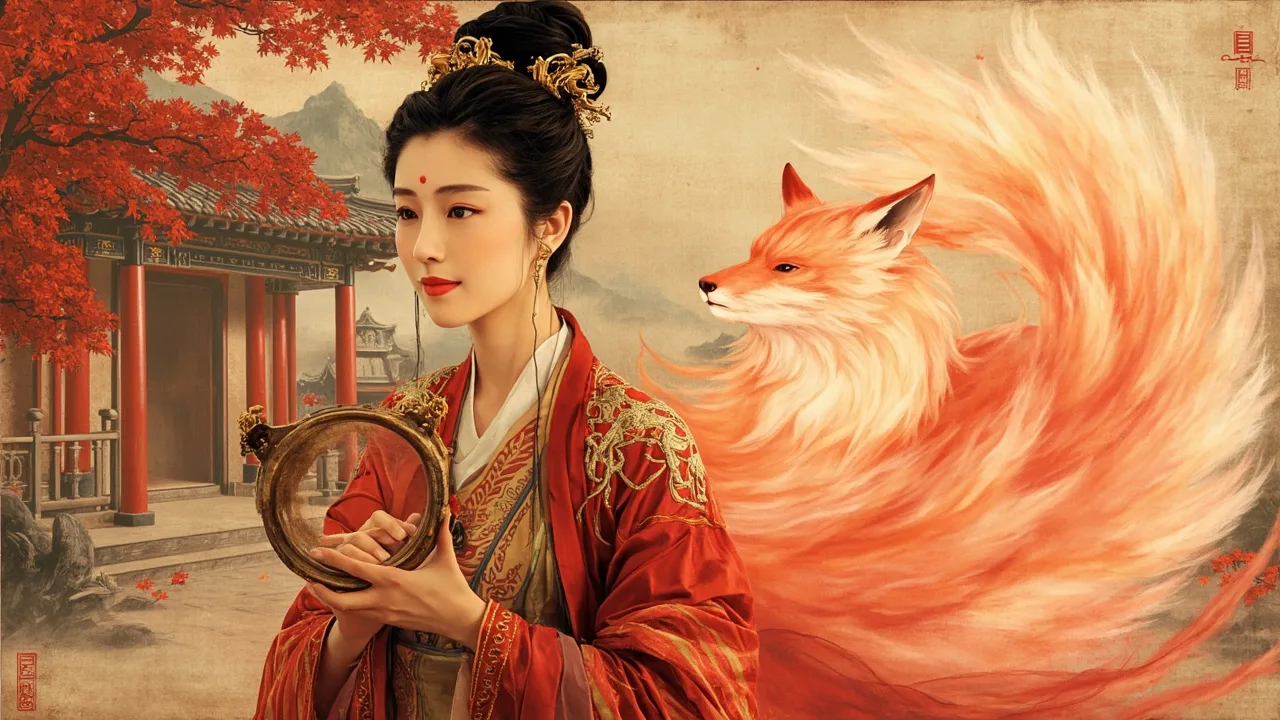
The nine-tailed fox (九尾狐, jiu wei hu) represents the pinnacle of fox spirit evolution. After 1,000 years of cultivation, a fox spirit grows nine tails and achieves celestial status. Nine-tailed foxes appear in some of the most dramatic stories of Chinese mythology.
In the Shanhai Jing, the nine-tailed fox is described as appearing in a specific region of China and is considered an omen — if a nine-tailed fox appeared, it meant that “the emperor’s virtue extends to animals.” This is an example of how fox spirits were incorporated into state cosmology: a nine-tailed fox appearing was a sign of good governance, just like the qilin.
But the nine-tailed fox could also be dangerous. In Korean folklore (where the same mythology exists as gumiho), the nine-tailed fox is unambiguously malevolent — it must consume human liver to survive and cannot be redeemed. In Japanese folklore (where the fox is called kitsune), the nine-tailed fox is so powerful that it can rival the gods.
Chinese culture occupies an interesting middle position: the nine-tailed fox can be either auspicious or dangerous, depending on the story. This ambiguity is characteristic of Chinese mythology’s refusal to simplify moral categories.
The Fox Spirit and the White Snake: A Comparison
Chinese folklore features another famous female shapeshifter: the White Snake (Bai She), a spirit who transforms into a beautiful woman and marries a scholar, only to be trapped beneath a pagoda by a Buddhist monk. Both the White Snake and the fox spirit are female shapeshifters who seduce human men. But the comparison reveals a key difference:
The White Snake is fundamentally good — she loves her husband and fights to protect him. Her “punishment” by the Buddhist monk is seen as unjust in most retellings. The fox spirit, by contrast, is morally ambiguous — it may be good or bad, and the human who encounters it must be discerning enough to know which kind of fox he has found.
This is why the fox spirit is ultimately more disturbing than the White Snake: she cannot be known simply by her appearance. A beautiful woman might be a fox. You must look at her shadow, her reflection, her habits. The fox spirit forces you to be perpetually suspicious of appearances — which is, of course, exactly what Chinese moralists wanted.
Fox Spirits in Modern China: From Superstition to Pop Culture
Fox spirit mythology did not die with the arrival of modernity. It transformed.
In the early 20th century, Chinese intellectuals attacked fox spirit beliefs as superstition — part of the broader project of modernizing China. Maoist ideology further discouraged supernatural beliefs during the Communist period. But fox spirits survived in the Chinese countryside, where rural people continued to report fox sightings and fox possession phenomena well into the 1990s.
Then, in the 2000s, Chinese pop culture discovered fox spirits. TV dramas featuring fox spirit characters became enormously popular. The 2005 drama “The Fox Fairy” (a Hong Kong production) became a cult hit. The 2011 drama “The Legend of the White Snake” (different from the classic) featured fox spirit characters prominently. In the 2020s, fox spirit characters appear in nearly every Chinese fantasy TV drama — a reminder that the old mythology never really went away.
In video games, fox spirits are even more ubiquitous. “Genshin Impact” — the enormously popular Chinese-made game — features a character named Yae Miko, a kitsune (Japanese fox spirit) who is one of the game’s most beloved characters. “Zenless Zone Zero,” another Chinese game, features fox spirit characters as well. These modern fox spirits have inherited the full range of traditional powers and moral ambiguities — shapeshifting, seduction, magical ability, and a deep connection to both the natural world and the spirit world.
Fox Spirits in the American Imagination
For Americans, the huli jing is a gateway into understanding how different cultures imagine supernatural danger. The Western equivalent of the fox spirit might be the succubus or the femme fatale — but neither carries quite the same cultural weight as the fox spirit, which has been a central figure in Chinese storytelling for 2,000 years.
American popular culture has begun to absorb fox spirit mythology, mostly through anime and video games. But there is a deeper connection: the fox spirit is increasingly used as a metaphor for queer identity in Chinese-American literature. Writers like G.T. Wang and others have used the huli jing as a symbol of identity that must be hidden, revealed, or transformed — a figure of genuine power constrained by social norms. In this reading, the fox spirit’s shapeshifting becomes a metaphor for the experience of living between identities.
How to Protect Yourself from Fox Spirits (Just in Case)
Chinese folklore has no shortage of advice on how to detect and repel fox spirits. Most of it is, of course, superstition. But it is entertaining superstition:
Fox fire (huo hu): Fox spirits are said to emit fox fire — a glowing, ghostly light visible at night in cemeteries and abandoned villages. If you see fox fire, do not approach. You are seeing a fox spirit’s light, and it may lead you somewhere dangerous.
Mirrors: Carry a small mirror. If you suspect someone is a fox spirit, look at their reflection. Fox spirits cast no reflection in mirrors — they are essentially invisible to reflective surfaces.
Fox dungan (fox totem): Some households in rural China kept fox dungan — small clay or wooden statues of foxes — to attract good fox spirits and repel bad ones. It is a form of sympathetic magic: if you show respect to foxes, good foxes will come, and bad foxes will not dare enter.
Rosary beads and Buddhist sutras: Fox spirits are said to be repelled by Buddhist prayer beads and sutras. This is why Buddhist monks were often called upon to exorcize fox spirits in folklore. But it is important to note: a truly powerful fox spirit of 1,000 years or more is not afraid of Buddhist sutras. Only the weaker, younger foxes can be repelled this way.
Experiencing the Huli Jing Today
Fox spirits are everywhere in modern Chinese culture — you just have to know where to look.
Chinese historical dramas: Look for dramas set in the Tang or Qing dynasties that feature beautiful court women who may or may not be human. The fox spirit reveal is a popular plot twist.
Genshin Impact: The character Yae Miko is a kitsune (Japanese fox spirit) who serves as the Guuji (Chief Priestess) of the Grand Narukami Shrine. She is powerful, witty, and morally ambiguous — a perfect huli jing for the video game age.
Chinese internet culture: The term “huli jing” is used on Chinese social media to describe beautiful, seductive, or manipulative women — much as the term “fox spirit” was used pejoratively in the past. This usage is controversial.
Night tours of Chinese temples: Several temples in China — particularly the White Snake Temple near Hangzhou and the Fox Spirit Temple in Shandong — offer night tours that include stories of fox spirit encounters. They are essentially ghost tours with excellent historical context.