In the summer of 1571, a sixty-year-old man named Wang Xizhi sat down to write one last letter to the imperial court. He was resigning from his post as Assistant Minister of Rites in the Ming dynasty government, a respectable but exhausting position that had kept him away from his hometown of Suzhou for nearly two decades. His health was failing, his colleagues were plotting against him, and all he wanted was to return home, tend to his ancestors’ land, and build a garden where he could grow chrysanthemums and drink tea in peace.
What he built instead became the most celebrated classical garden in all of China — a 130,000-square-meter masterpiece of water features, pavilions, corridors, and carefully arranged rock formations that would eventually be called the Humble Administrator’s Garden, or Zhuozheng Yuan in Chinese. Today, it draws millions of visitors each year and stands as a UNESCO World Heritage Site, recognized as one of the finest examples of garden design ever created anywhere in the world.
This is the story of how one retired official’s personal retreat became a touchstone of Chinese culture, and why it still matters to anyone interested in how humans transform nature into art.
A Retired Official’s Final Project
To understand why Wang Xizhi’s garden became so famous, you first need to understand what it meant to be a scholar-official in Ming dynasty China. The civil service examination system had produced a class of men who spent their entire lives studying Confucian classics, mastering calligraphy and poetry, and competing for positions in the imperial government. It was an elite club — only about 1% of candidates ever passed the provincial-level exams — and the men who made it through were expected to devote themselves entirely to public service.
Wang Xizhi had risen through the ranks the hard way. He had no powerful family connections, no wealthy patrons. Everything he achieved came from his own intelligence and relentless study. By the time he reached middle age, he held a position that allowed him to live comfortably in the capital of Beijing. But the further he climbed, the more he saw how corrupt and petty court politics had become. The factional disputes, the constant need to watch your back, the endless banquets where nobody said what they really meant — it was exhausting for a man who had always valued honesty and simplicity.
When his mother died in 1569, Wang used the period of official mourning to reassess his life. He had been a dutiful son and a conscientious official, but he had missed decades of his family’s life. His ancestors’ property in Suzhou was falling into disrepair. His children were growing up as strangers to their own heritage. The garden plot that his grandfather had once tended was overgrown with weeds.
So when his period of mourning ended, Wang made a decision that would have shocked his contemporaries: he submitted his resignation. He was only sixty years old — an age when most officials were still fighting for their next promotion — but he was ready to leave. The emperor, impressed by his long service, granted his request with an unusual honor: a formal commendation for his integrity.
Wang returned to Suzhou and immediately began transforming his inheritance. He drained swampy areas, redirected water channels, brought in skilled craftsmen, and planted tens of thousands of trees and flowers. He consulted the great garden masters of his era and studied the latest theories of landscape design. Most importantly, he made sure that every element of the garden expressed his personal philosophy — a philosophy shaped by Daoist ideas about living in harmony with nature, Confucian values of humility and restraint, and the aesthetic principles of literati painting.
The name itself tells you everything: Zhuozheng Yuan translates as “Humble Administrator’s Garden,” a deliberate reference to a famous passage in the Book of Songs about a man who preferred the simple pleasures of gardening over the temptations of political power. Wang was signaling that he had chosen obscurity and contentment over ambition and glory. The name was an act of self-definition, a public statement of values.
Water, Architecture, and Plants: The Three Essentials
Classical Chinese gardens are built on a foundation of three essential elements: water, architecture, and plants. What makes the Humble Administrator’s Garden extraordinary is how perfectly these three elements are balanced and integrated — each one enhances the others, creating a space that feels both natural and carefully designed.
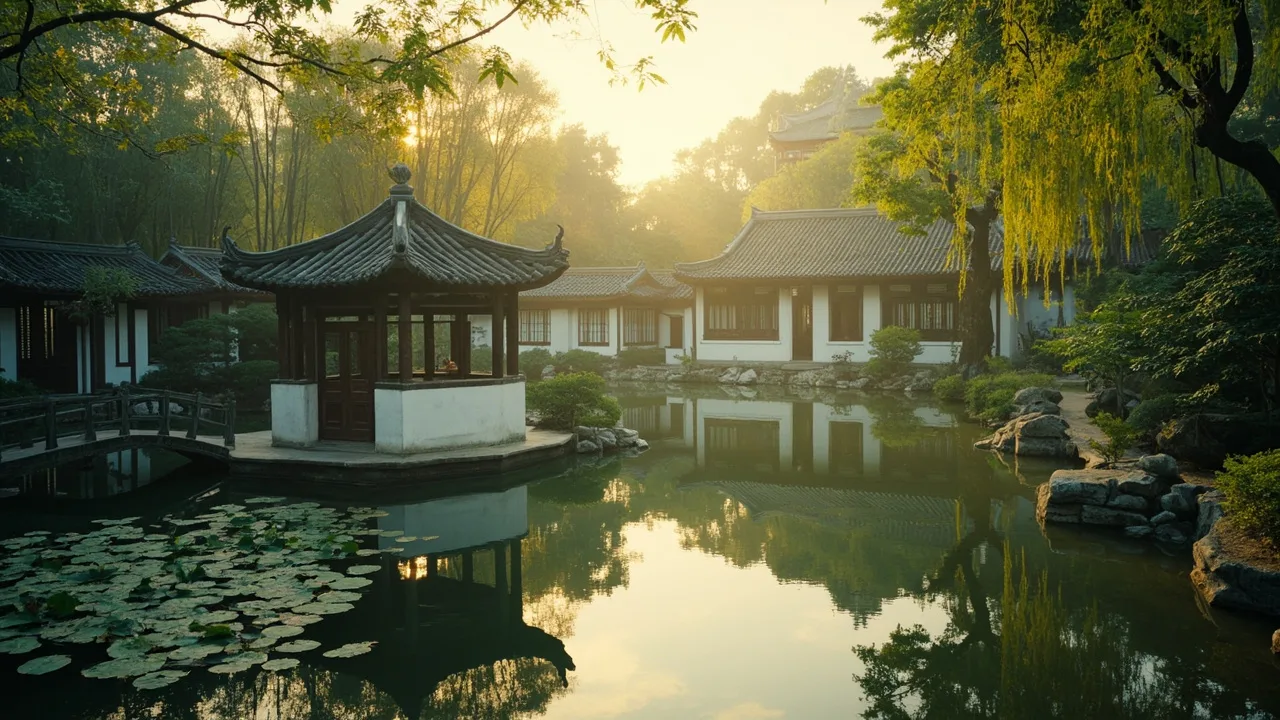
Water is the dominant feature of the garden, covering nearly three-fifths of the total area. This was not an accident. Wang Xizhi believed that water represented the flow of life itself, the Daoist concept of wu wei, or effortless action. Rather than imposing rigid geometric patterns, he worked with the natural topography of the land, creating a network of ponds, streams, and small waterfalls that connect different parts of the garden in a continuous, fluid composition.
The largest body of water, called the Yuanxiang Pond, occupies the center of the garden and is shaped to resemble a dragon — an ancient symbol of power and transformation. When you look at the pond from the elevated Qinghua Pavilion on its northern bank, the shape becomes clear: the dragon’s body curves gracefully toward the south, its head emerging near the Xieqiao (Xie Bridge), a slender stone arch that forms the dragon’s open mouth. This kind of symbolic landscape design, where natural forms evoke mythological creatures or auspicious patterns, is a hallmark of the finest Chinese gardens.
The second essential element is architecture, and the Humble Administrator’s Garden contains more than forty buildings — pavilions, halls, corridors, studios, and towers, each one positioned to frame a particular view or create a specific atmosphere. The Hanshan Hall is perhaps the most historically significant: it was here that Wang Xizhi received visitors, conducted business, and wrote the poems that would eventually be compiled into a celebrated literary collection. The hall is modest in size but perfectly proportioned, with curved eaves that echo the surrounding hills and a shaded terrace that catches the morning light.
The Wanjing Garden (which means “Looking at the Bay Garden”) is one of the most photographed spots in the entire complex. Its covered walkway extends along the water’s edge, lined with intricately carved windows that frame the pond like a series of living paintings. Each window has a different cutout pattern — bamboo, lotus, coin, scholar’s rock — so that as you walk through, the view constantly changes. It is a master class in the Chinese idea that a garden should reward slow, attentive wandering.
The third essential element is plants, and here Wang Xizhi showed both botanical knowledge and poetic sensibility. He selected species that would create a different mood in each season: plum trees for winter’s stark beauty, peonies for spring’s extravagant bloom, lotus for summer’s cool serenity, and chrysanthemums for autumn’s quiet dignity. Bamboo was planted in dense groves along the garden’s eastern edge, not only for its aesthetic appeal but also for the delicate rustling sound it makes in the wind — a natural music that adds another layer to the garden’s atmosphere.
The Art of “Borrowing Scenery”
One of the most distinctive techniques used in the Humble Administrator’s Garden is called jie jing, or “borrowing scenery.” This means incorporating elements from outside the garden — distant mountains, city walls, neighboring buildings, even the sky — into the garden’s composition so that the boundary between inside and outside seems to dissolve.
The most famous example is the view from the garden’s western section toward the Beisi Pagoda, a fifty-meter Buddhist pagoda that stands about a kilometer away. The pagoda is not part of the garden; it is a completely separate structure in the city of Suzhou. But the garden’s designers positioned a viewing platform called the Fanghua Pavilion so that when you stand there and look westward, the pagoda appears to rise above the garden’s rock formations as if it were part of the landscape. The effect is startling — a moment where the distinction between the cultivated and the wild, the local and the distant, collapses entirely.
This technique requires careful calculation. The height of the viewing platform, the placement of trees and rocks in the foreground, the angle of the line of sight — everything must be precisely arranged to create the illusion. It is an architectural illusion, a bit like a forced perspective in Renaissance painting, except that Chinese gardeners were practicing it several centuries before Brunelleschi designed the dome of Florence’s cathedral.
Jie jing also works vertically. The garden’s rock mountains, particularly the impressive formations in the Lion Grove area (which was actually built by Wang’s brother but is often discussed alongside the Humble Administrator’s Garden), are designed to be climbed. From their peaks, you gain a completely different perspective on the garden below — suddenly the orderly ponds and pathways reveal themselves as a miniature landscape, like a scroll painting come to life.
UNESCO Recognition and Survival: From Imperial Garden to World Heritage
In 1997, the Humble Administrator’s Garden was inscribed on the UNESCO World Heritage List as part of the “Classical Gardens of Suzhou” designation. It was the first time that China’s gardens received international recognition at this level, and it sparked a renewed global interest in Chinese landscape design.
Suzhou has been called the “Venice of the East” for its network of canals and waterways, but it is equally famous for its gardens. At its peak in the Ming and Qing dynasties, the city contained more than 200 private gardens, though only about 70 survive today. The four most famous — the Humble Administrator’s Garden, the Lingering Garden, the Master of the Nets Garden, and the Garden of the Master of the Nets — are all within the historic city center and can be visited in a single day by determined travelers.
What sets the Humble Administrator’s Garden apart from the others is its scale and its narrative completeness. It was designed from scratch by a single vision (Wang Xizhi’s), whereas many of the other gardens were created by multiple owners over generations and underwent significant changes.
Perhaps the most remarkable chapter in the garden’s history is not its creation but its survival. In the nearly 450 years since Wang Xizhi first laid out his grounds, the garden has been divided, abandoned, sold, flooded, rebuilt, burned, and restored more times than almost any other cultural monument in China.
It was split in two after Wang’s death, when his descendants could not agree on how to maintain such a large estate. During the Taiping Rebellion in the 1860s, when rebel forces occupied Suzhou, the garden suffered extensive damage. In the early twentieth century, it was used as a military barracks by warlord forces, then as a factory during the Japanese occupation in the 1930s. The original plants died. The pavilions crumbled. The water channels clogged with silt.
The restoration that began in the 1950s under the new Chinese government was a massive undertaking. Teams of scholars and craftsmen spent decades researching Ming dynasty garden design, consulting old paintings and written accounts, and gradually rebuilding the garden to its original configuration. They consulted the only surviving visual record of the garden from Wang’s era — a handscroll painting attributed to Wang’s grandson that shows the garden in its prime. Using this as a guide, they replanted the trees, re-excavated the ponds, and rebuilt the pavilions stone by stone.
For American visitors, there is an unexpected point of connection. The principles that guided Wang Xizhi’s design — creating distinct zones for different activities, framing views through architectural elements, using water to connect different areas of a property — have echoes in American landscape traditions from Frederick Law Olmsted’s Central Park to the gardens of Thomas Jefferson’s Monticello. The Humble Administrator’s Garden pushes these ideas to their ultimate expression.
Why It Matters Today
Standing in the Humble Administrator’s Garden on a quiet autumn morning, listening to the wind in the bamboo and watching the lotus pads drift on the still water, it is easy to forget that you are in the middle of a city of more than ten million people. The noise of traffic, the hum of construction, the announcements on the public address system — all of it seems to disappear, replaced by a sense of calm that is genuinely difficult to describe.
This is what Wang Xizhi was reaching for when he resigned from the government and devoted himself to his garden. He was not trying to escape from life but to create a space where life could be lived more fully — where a man could watch the seasons change, compose a poem about the moon, share a pot of tea with a friend, and feel that these small moments were enough. The garden was his answer to a question that every person asks at some point: what is the good life, and how do I make room for it?
The fact that this question still resonates across nearly five centuries is a testament to the power of good design and clear intention. The Humble Administrator’s Garden is not a monument to a dead official or a relic of a vanished dynasty. It is a living answer — a place where the conversation between human beings and the natural world continues, one visitor at a time.
If you ever find yourself in Suzhou, do not rush through the garden in an hour. Find a bench near the Yuanxiang Pond, order a cup of jasmine tea from the small café near the south gate, and spend an afternoon doing absolutely nothing. Wang Xizhi would have approved.