If you have ever looked at the full moon through a pair of binoculars, you may have noticed that the dark patches on the lunar surface do not really look like a man. They look more like a rabbit.
You are not alone in noticing this. Humans all over the world, in completely separate traditions, have looked at the moon and seen a rabbit. The Aztecs saw a rabbit. The Japanese saw a rabbit pounding rice cakes. The Celtic traditions saw a rabbit or a hare. The North American Indigenous peoples saw a rabbit. And the Chinese, who may have been the first to systematize the image, saw a white hare pounding the elixir of long life with a mortar and pestle.
This is the Jade Rabbit (玉兔, Yutu). It is one of the most widely shared lunar myths in human history, and it has been doing cultural work in China for at least two thousand years.
Where the Rabbit Comes From
The earliest references to a rabbit or hare on the moon appear in Chinese texts from the Warring States period (475-221 BCE), and the image was well developed by the Han dynasty (202 BCE - 220 CE). The Shanhaijing (山海经, Classic of Mountains and Seas), that encyclopedia of impossible geography that is the source for so many Chinese mythical creatures, mentions a rabbit-like creature associated with the moon, though the famous “mortar and pestle” version of the story comes from slightly later texts.
The most commonly told version of the legend goes like this.
There were once three animals who lived together in a forest: a fox, a monkey, and a rabbit. One day, an old beggar came through the forest, hungry and weak. The three animals brought him food. The fox caught a fish. The monkey gathered fruit. The rabbit had nothing to give but grass, which the beggar could not eat. So the rabbit asked the beggar to build a fire. When the fire was lit, the rabbit jumped into the flames, offering himself as food. The beggar, who was not actually a beggar but an immortal disguised as one, was so moved by the rabbit’s self-sacrifice that he raised the rabbit up to the moon, where the rabbit would live forever as the Jade Rabbit, a companion to the moon goddess Chang’e.
A few things are worth noticing about this story.
The first is that the rabbit does not earn immortality by cleverness or by getting a magic potion. The rabbit earns immortality by sacrificing itself for another being. This is one of the central moral motifs of the Chinese tradition: the rabbit’s quiet, almost passive generosity is what marks it for transformation.
The second is that the rabbit’s immortality is also a kind of solitary confinement. The rabbit lives on the moon forever, which means the rabbit is forever separated from the forest, from the fox and the monkey, and from any mortal life it might have had. The immortality is real, but it is also lonely.
The third is that the rabbit has a job. The rabbit is not just placed on the moon as a memorial. The rabbit is given the work of pounding the elixir of long life - the changsheng buxi yao (长生不死药), the drug of long life and non-death - in a mortar with a pestle. The rabbit pounds the elixir for the immortals and for the goddess Chang’e, who lives on the moon as a kind of solitary immortal in her own right.
Chang’e, Hou Yi, and the Rabbit on the Moon
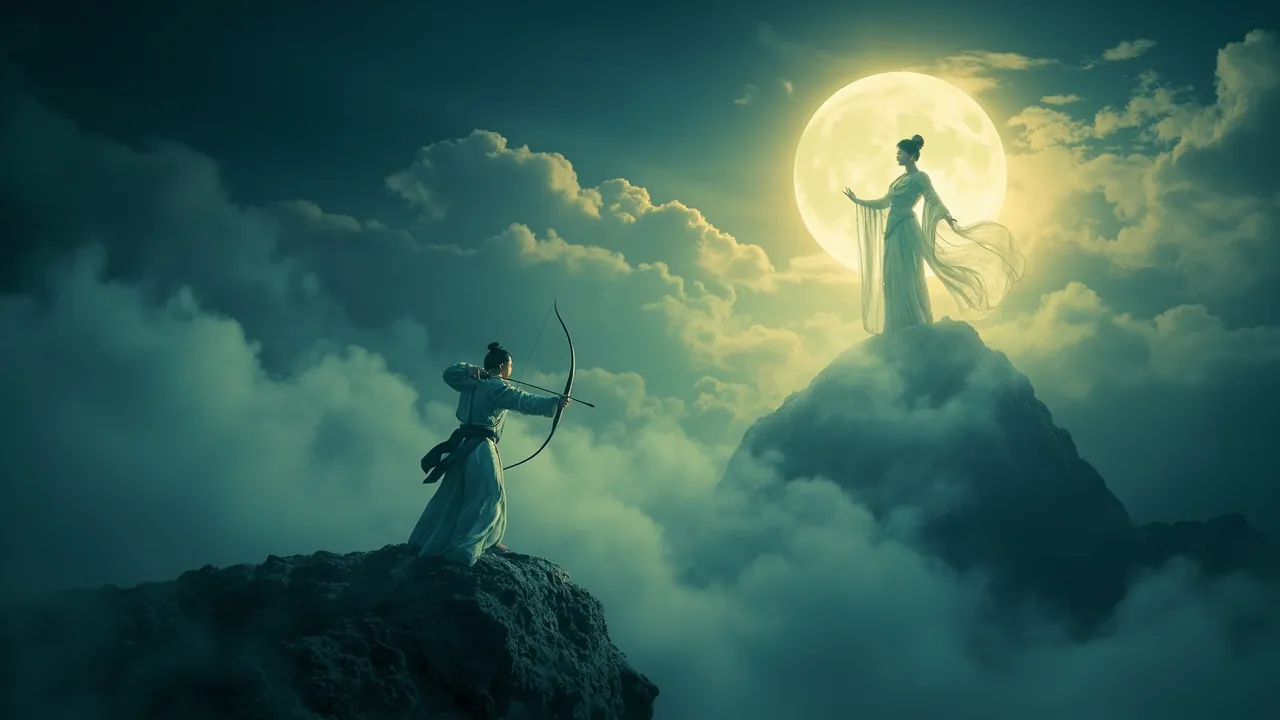
The Jade Rabbit is, in most versions of the legend, the companion of Chang’e - the moon goddess who stole the elixir of long life from her husband Hou Yi and fled to the moon to escape his anger (or, in some versions, his jealous apprentice). The story of Chang’e is told in a separate legend, but the two stories are tightly linked in modern Chinese festival iconography.
In the most commonly told version, after Chang’e arrives on the moon, she finds it cold and lonely. The Jade Rabbit is there to keep her company. They share the work of preparing the elixir. They share the long lunar night. The Jade Rabbit, in this version, is a kind of lunar companion - a working partner who shares the goddess’s solitude.
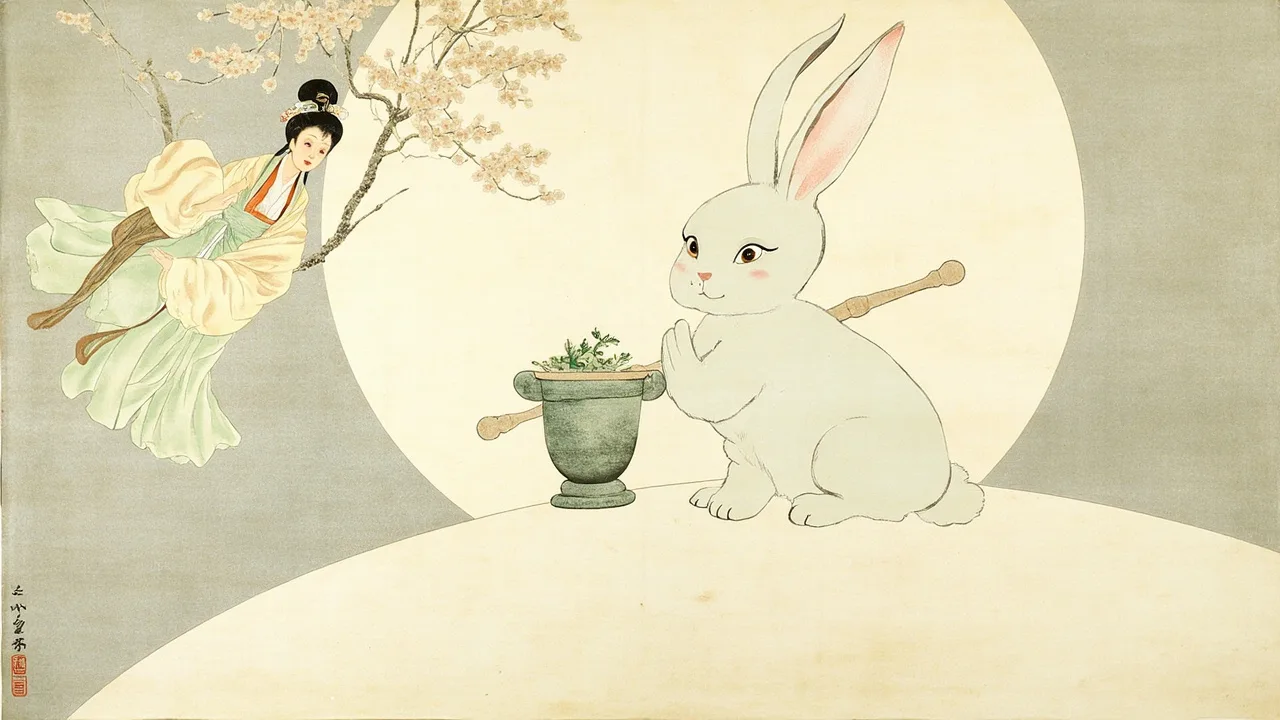
The composition of the moon scene in Chinese art is remarkably stable across two millennia. It includes:
- Chang’e, usually in flowing robes, often with a long-sleeved silk garment that floats around her.
- The Jade Rabbit, usually white, often standing upright, with the mortar and pestle.
- The cassia tree (桂树, guishu), usually depicted as a tall tree on the moon’s surface.
- Sometimes a three-legged toad (蟾蜍, chanchu), a much older lunar symbol than either Chang’e or the rabbit.
The cassia tree is a particularly interesting feature. In the legend, the cassia tree grows on the moon, and it is constantly being cut down by a man named Wu Gang (吴刚) who is being punished for a transgression against the gods. Wu Gang cuts the tree. The tree grows back. He cuts it again. He will cut it forever. The tree is sometimes interpreted as a symbol of the endless labor of penance, and sometimes as a symbol of the impossibility of completing any task in eternity.
The Jade Rabbit and the cassia tree together form the dominant visual iconography of the Mid-Autumn Festival, which falls on the fifteenth day of the eighth lunar month (usually September or early October in the Gregorian calendar). The festival is one of the two or three most important traditional Chinese holidays, alongside the Lunar New Year and the Winter Solstice.
The Mid-Autumn Festival
The Mid-Autumn Festival (中秋节, Zhongqiu Jie) is the festival that has the strongest connection to the Jade Rabbit story.
The festival has older roots than the Jade Rabbit legend. It began as a harvest festival celebrating the full moon of the eighth lunar month, when rice and millet were being brought in from the fields. The festival has been celebrated, in some form, since at least the Zhou dynasty (1046-256 BCE). The connection to Chang’e and the Jade Rabbit was made later, but by the Tang dynasty (618-907 CE) it was the dominant folk-religious association.
The festival’s central food is the mooncake (月饼, yuebing). Mooncakes are dense, sweet pastries, typically round, with a thick outer crust and a sweet filling - the most traditional fillings are red bean paste, lotus seed paste, and mixed nuts, but modern mooncakes also include savory fillings, ice cream fillings, and even chocolate variants.
The mooncake’s roundness is the symbolic center of the festival. The round mooncake represents the round moon. The round moon represents family completeness. Family members gather to share mooncakes under the full moon, with the unspoken prayer that the family will remain complete - that no one will be separated, that everyone will return home.
The Jade Rabbit is stamped or molded onto the top of many traditional mooncakes. The most traditional designs include the Jade Rabbit with mortar and pestle, Chang’e flying toward the moon, the cassia tree with the moon behind it, the full moon with toad and rabbit silhouette, and the character “longevity” (寿) in seal script.
In modern commercial mooncake production, the Jade Rabbit motif is one of the most common designs, particularly for mooncakes sold to children and to families with young children.
The festival also includes the lighting of lanterns (especially in southern China and in Chinese communities in Southeast Asia), the burning of incense at home altars, and - in some regions - the building of clay or brick moon towers. In Vietnam, where the festival is called Tết Trung Thu, the festival has a particularly strong children’s component, including processionals of children carrying star lanterns.
The Rabbit and the Elixir
The most distinctive feature of the Jade Rabbit’s iconography is the mortar and pestle. The rabbit stands upright, holds the pestle in its paws, and pounds something inside the mortar. The something is the elixir of long life - the drug that, in the Chinese tradition, grants either immortality or extreme longevity to those who drink it.
The elixir of long life is one of the central objects of Chinese mythology and Chinese religious history. The pursuit of the elixir - xiandan (仙丹) - was one of the main motivations for the development of what we now call Chinese internal alchemy (内丹, neidan) and its earlier form external alchemy (外丹, waidan). The external form involved trying to brew the elixir from physical substances - cinnabar, jade, mercury, lead. The internal form involved trying to brew it inside the body through breathing exercises, meditation, and sexual cultivation.
The Jade Rabbit’s role in the lunar mythology is to prepare the elixir - either the external version (a physical substance pounded in a mortar) or the internal version (a spiritual practice that takes the rabbit’s lunar solitude as a metaphor for the seclusion needed for inner cultivation). In Tang and Song dynasty Daoist paintings, the rabbit is often shown with a jade mortar and pestle, pounding a glowing substance that looks more like liquid light than any particular physical drug.
The rabbit’s task is repetitive. It pounds and pounds. The elixir is never finished, or it is finished and immediately consumed and immediately needs to be made again. The rabbit’s eternal work is a metaphor for the endless work of spiritual cultivation - the same practice repeated until it becomes effortless, the same drug made until it becomes the maker.
The Rabbit, the Toad, and the Moon
The Jade Rabbit is not the only creature associated with the moon in the Chinese tradition. An older, more primitive lunar symbol is the three-legged toad - the chánchú (蟾蜍) or jinxia chan (金蟾, “golden toad”). The toad appears in the lunar myth before Chang’e and before the Jade Rabbit, and it is the creature most often identified with the dark patches on the moon’s surface.
The three-legged toad has its own mythology, which includes a famous story about Liu Haichan, a Tang dynasty Daoist adept who taught the technique of “spitting the golden toad” - a meditation in which the practitioner visualizes a golden toad in the mouth and then “spits” it out to attract wealth. The golden toad is, in modern Chinese folk religion, one of the most popular wealth-creatures - usually depicted with a coin in its mouth and a third leg kicking in the air. You can buy golden toad statues at any feng shui supply shop.
In modern Chinese art, the Jade Rabbit and the toad are sometimes shown together on the moon, sometimes separately. The rabbit is the more gentle, more domestic symbol - the moon companion of the goddess. The toad is the older, more powerful, more fearsome symbol - the moon’s primitive inhabitant.
The Western reader may also notice that the Chinese lunar toad, the Aztec lunar rabbit, and the European “man in the moon” are all visual interpretations of the same dark patches on the moon’s surface. Different cultures, looking at the same moon, have seen different things in those patches. The fact that so many cultures have seen a rabbit is one of the more interesting cross-cultural observations in comparative mythology.
The Apollo Comparison
Western readers will recognize Yutu as the name of the Chinese lunar rover. The first Yutu rover landed in December 2013 aboard Chang’e 3; Yutu 2 landed on the moon’s far side in January 2019 with Chang’e 4 - the first soft landing ever made on the far side.
The naming is deliberate. China’s lunar missions are explicitly named after Chang’e and the Jade Rabbit, putting the ancient mythology directly into space exploration. The Yutu rovers are, in a sense, the modern form of the ancient rabbit: they move slowly across the lunar surface doing patient work, much as the rabbit pounds the elixir at the mortar.
The Apollo parallel is worth a moment. Apollo was a sun god with only loose lunar ties through his sister Artemis. The Chinese program has named missions after a goddess who is specifically lunar, which makes the mythological framing more culturally coherent than the American program’s was.
The Rabbit in Modern Culture
The Jade Rabbit is everywhere in modern Chinese cultural life.
In Mid-Autumn Festival iconography, the Jade Rabbit is one of the three or four most common visual motifs, alongside Chang’e, the cassia tree, and the mooncake.
In children’s culture, the Jade Rabbit is one of the most popular mythical creatures. Children’s books about the Jade Rabbit are standard Mid-Autumn Festival gifts. Cartoon and animated versions of the Jade Rabbit are common on Chinese television.
In the confectionery and bakery industry, the Jade Rabbit motif is one of the most commonly used designs for Mid-Autumn mooncakes. Modern mooncake boxes often feature a Jade Rabbit silhouette in gold or silver foil.
In cosmetics and skincare, “Jade Rabbit” is used as a brand name for a number of Chinese beauty products, particularly those marketed with traditional lunar or jade associations.
In toys and gifts, Jade Rabbit plush toys are a standard Mid-Autumn Festival item for children. The Jade Rabbit is, for many Chinese children, their first introduction to Chinese mythology.
The Jade Rabbit has also become a fixture of Chinese internet culture. There are animated GIFs of the Jade Rabbit pounding the mortar. There are emoji of the Jade Rabbit. There are Jade Rabbit stickers for chat applications.
A Few Things Worth Noting
A handful of details about the Jade Rabbit are easy to get wrong, so it is worth saying them plainly.
- The Jade Rabbit is white. The color links it to jade, milk, the lunar surface, and purity.
- The Jade Rabbit stands upright. The posture distinguishes it from a normal rabbit, which runs on all fours.
- The Jade Rabbit carries a mortar and pestle, with the pestle in its paws and the mortar at its feet.
- The Jade Rabbit is not the Western Easter Bunny. The Easter Bunny is a spring-and-fertility hybrid from Christian-pagan roots. The Jade Rabbit is lunar, tied to longevity and gentle self-sacrifice.
- The Jade Rabbit is related to, but not the same as, the Japanese Tsuki no Usagi, who pounds rice cakes rather than an elixir.
- The Korean tokki moon rabbit is a separate tradition as well.
What the Jade Rabbit actually is, more than anything else, is one of the most successful pieces of long-term visual branding in human history. The same image - a white upright rabbit with a mortar and pestle on the moon - has been reproduced with almost no change for at least two thousand years. Few modern logos or mascots survive that long. The Jade Rabbit has. It is still doing its work.
Recommended Products for Jade Rabbit Mythology and Mid-Autumn Festival
If this article has made you want to bring a small piece of the Jade Rabbit tradition into your home, here are a few items that hold up.
- Traditional Mooncake Gift Box (Mixed Flavors) - Mooncakes are the central food of the Mid-Autumn Festival. A mixed-flavors gift box (red bean, lotus seed, mixed nuts) is the classic way to share the festival with family or friends.
- Jade Rabbit Pendant (Jade or Jade-Look) - Jade rabbit pendants are popular Mid-Autumn gifts and personal amulets. Jadeite (Burmese green jade) is the most traditional; nephrite and jade-look materials are more affordable.
- Mid-Autumn Festival Paper Lanterns (Set) - Paper lanterns for the festival are standard decorations in southern Chinese and Southeast Asian Chinese communities. A set of small hanging lanterns with the Jade Rabbit motif is a good entry point.
- Chinese Mythology: A Source Book - The standard English-language sourcebook on Chinese mythological creatures, including the Jade Rabbit, Chang’e, the cassia tree, and the three-legged toad.
- Moon-Observing Tea Set (Gongfu Style) - The Mid-Autumn Festival is, traditionally, a tea-drinking holiday. A small gongfu tea set - a clay teapot, a few small cups, a tea tray - is the right tool for the festival’s quiet evening tea ceremony.
The Jade Rabbit has been pounding the elixir on the moon for a long time. There is no hurry. The rabbit will still be there next Mid-Autumn Festival, and the one after that, and the one after that. Watch the full moon when it comes. Say hello.