The Jade Rabbit: China’s Moon Messenger and Companion to Chang’e
A Complete Guide to the Jade Rabbit for Americans
On a clear night, if you look at the full moon, you can see it. Not the “man in the moon” that American children imagine — but the dark markings on the lunar surface that Chinese children are taught represent a rabbit, standing at a mortar and pestle, eternally grinding the elixir of life.
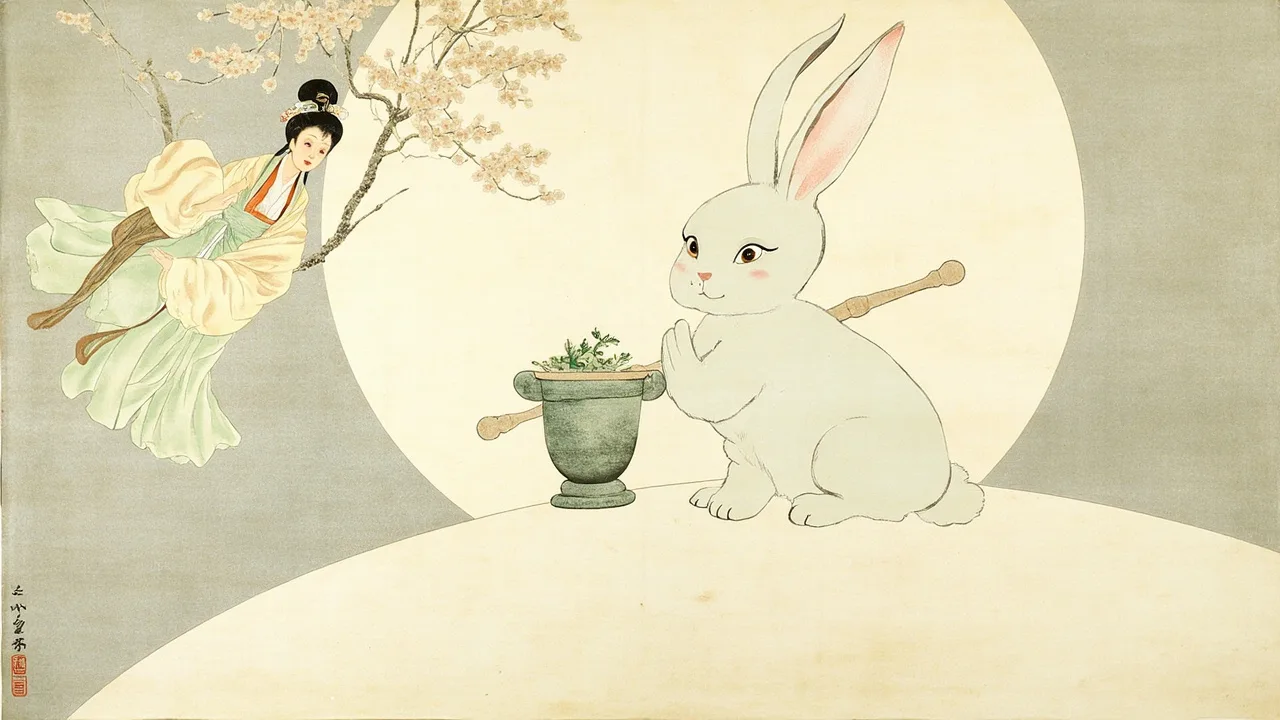
This is the Jade Rabbit (玉兔, Yutu), one of the most beloved figures in all of Chinese mythology. Unlike the imperial majesty of the dragon or the cosmic scale of the kunpeng, the Jade Rabbit is intimate and warm. It is a small creature — a humble rabbit who earned its place on the moon through kindness and selflessness.
The story of how a rabbit ended up on the moon is not a story of power or prophecy. It is a story about what happens when you are kind to strangers — and how the universe remembers.
The Origin Story: Kindness to a Stranger
The oldest version of the Jade Rabbit story appears in Buddhist texts from India, which may have traveled to China along the Silk Road and merged with local folklore. Here is how the story goes:
One day, a monkey, an otter, a jackal, and a rabbit were wandering through a forest when they encountered an old man who was starving. The man was not really a man — he was a deity in disguise, testing the animals’ characters. He asked them to find him food.
The monkey went and returned with fruit and nuts. The otter waded into the river and returned with fish. The jackal found a lizard and some milk. But the rabbit — the rabbit had nothing to offer. It had no nuts to gather, no fish to catch, no milk to give.
So the rabbit did the only thing it could. It offered itself. It told the old man to build a fire, and then it leaped into the flames, sacrificing its own body to feed the stranger.
The old man — the deity — was deeply moved. He retrieved the rabbit from the fire, unmarked and unharmed. Then he did something extraordinary: he painted the rabbit’s image on the moon, where it would live forever, a visible reminder to all who looked up of what kindness can earn.
The rabbit stands on the moon to this day, grinding the elixir of immortality with a mortar and pestle — a reward for the kindness that cost the rabbit everything it had.
Chang’e and the Rabbit: A Love Story on the Moon
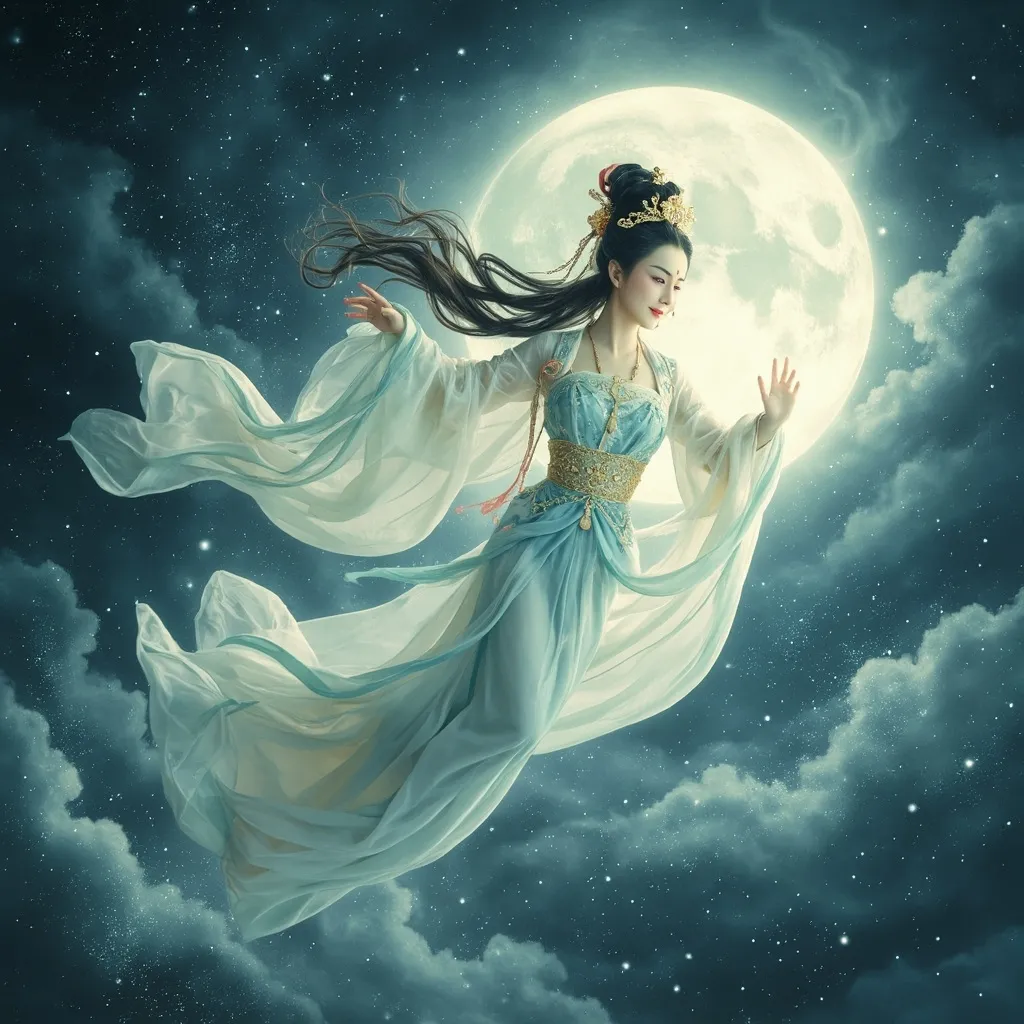
In Chinese mythology, the Jade Rabbit is inseparable from Chang’e (嫦娥), the Moon Goddess. Chang’e is one of the most famous figures in Chinese legend, and her story involves rocket ships, immortality pills, and a very lonely husband.
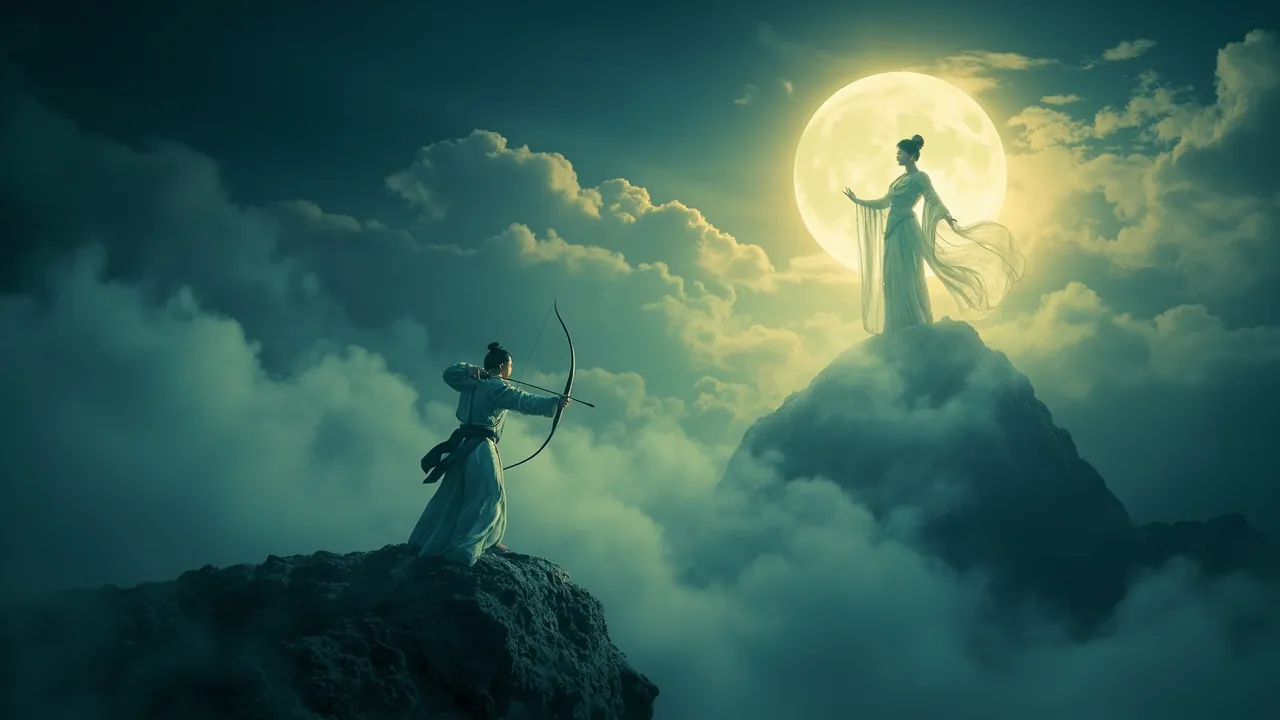
The most common version of the story involves Hou Yi (羿), a legendary archer who is said to have shot down nine of the ten suns that once blazed in the sky, saving humanity from a world scorched by heat. For this feat, Hou Yi was granted immortality by the gods — but his wife Chang’e drank his immortality elixir anyway and floated up to the moon, unable to return.
Another version says that Hou Yi’s student, Peng, tried to steal the elixir from Hou Yi, and Chang’e swallowed it to prevent Peng from gaining immortality. In this version, Chang’e’s choice was heroic — she sacrificed her life on earth to prevent a bad person from gaining eternal life.
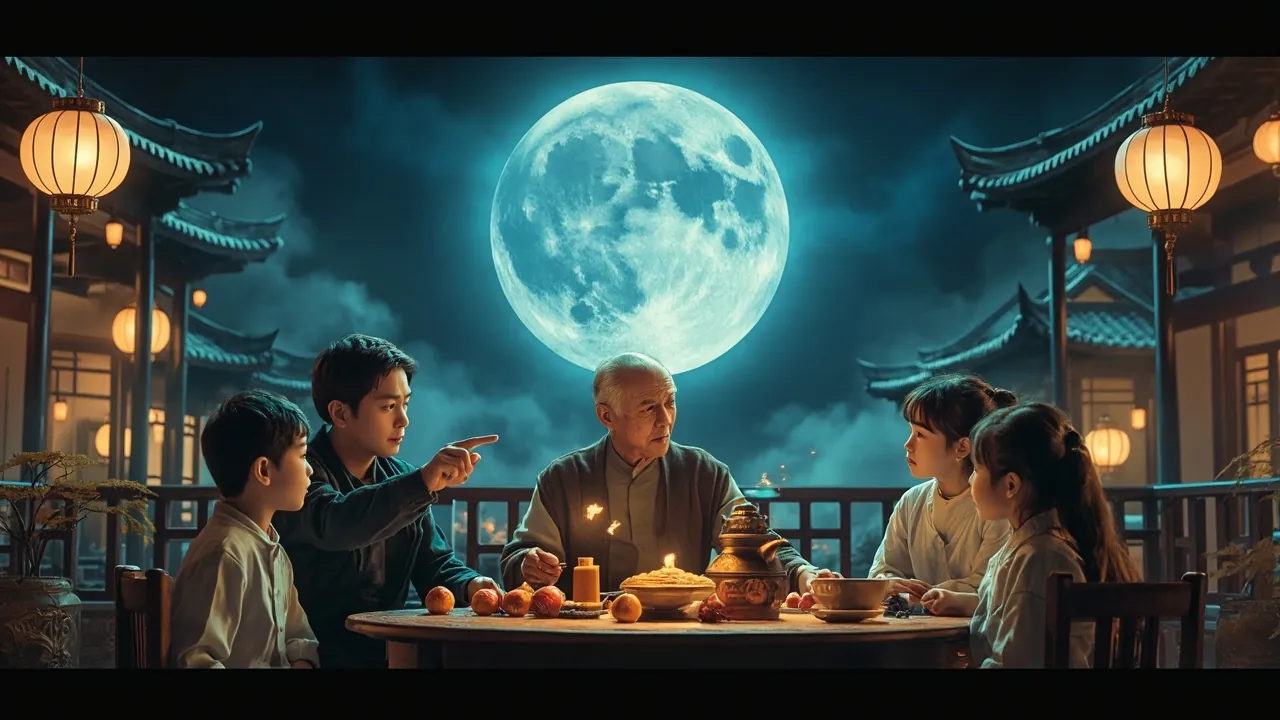
However the story is told, the result is the same: Chang’e lives on the moon, in a crystal palace, accompanied only by the Jade Rabbit. Every Mid-Autumn Festival, Chinese families gaze at the moon and try to see both of them — Chang’e’s palace and the rabbit standing beside her.
The Mid-Autumn Festival (Zhengqiu Jie) is one of the most important holidays in the Chinese calendar — comparable to Thanksgiving in America in its emphasis on family reunion and giving thanks. And the rabbit is right there at the center of it, a symbol of the kindness that earns cosmic reward.
The Rabbit in the Moon: A Chinese-American Comparison
Here is something that will surprise American readers: the “man in the moon” that Americans see is the “jade rabbit” that the Chinese see. The dark markings on the moon — called “maria” or “seas” by astronomers — are visible to the naked eye and have inspired rabbit-spotting traditions across Asia, from China to Japan to Korea.
In Japan, the rabbit is not grinding elixir — it is making mochi (rice cakes). In Korea, the rabbit is also making rice cakes. In Vietnam, there is a frog, not a rabbit. In Native American traditions across the Americas, the moon rabbit appears in the folklore of the Maya, the Aztec, the Lakota, and dozens of other indigenous peoples — a striking example of parallel imagination.
The American “man in the moon” is a European tradition, probably derived from Norse mythology (the god Mani, who was pulled across the sky in a chariot). But the lunar rabbit tradition ispan-cultural across Asia and the Americas, making the Jade Rabbit one of the most globally widespread mythical animals on earth.
The Rabbit as Immortality: The Elixir of Life
The Jade Rabbit’s primary occupation on the moon is grinding the elixir of life (不死药, bu si yao) with a mortar and pestle. This elixir grants immortality to whoever drinks it. The rabbit has been grinding for thousands of years, and will grind for thousands more.
This is why the rabbit, not a dragon or a phoenix, became the symbol of longevity in the Chinese tradition. The rabbit achieves immortality not through power or cunning but through self-sacrifice. It gave its body to a stranger, and the universe responded with eternity.
In Taoist alchemy — the ancient Chinese science of seeking immortality through inner cultivation — the Jade Rabbit became a symbol of the “white tiger” phase of alchemy, when the practitioner transforms base energies into pure spirit. Taoist monks who practiced meditation techniques would visualize the rabbit on the moon, sending down immortalizing energy as they breathed.
The Rabbit in Chinese Horoscopes: Years of the Rabbit
In the Chinese zodiac, the rabbit is one of the twelve animals — and one of the most beloved. People born in the Year of the Rabbit are said to be kind, artistic, quick-minded, and fortunate. They are said to avoid conflict, preferring peace to confrontation. Rabbit years come every twelve years: 1927, 1939, 1951, 1963, 1975, 1987, 1999, 2011, 2023.
The 2023 Year of the Rabbit was particularly significant in China, as it was associated with hopes for a year of peace and recovery after the COVID-19 pandemic. The phrase “rabbit year jump” (tu niao) became a popular internet meme referring to the rapid economic rebound China hoped to achieve.
Mooncakes and the Rabbit: The Mid-Autumn Connection
The Mid-Autumn Festival, which falls on the 15th day of the 8th lunar month (usually September or October), is inseparable from the Jade Rabbit in Chinese cultural tradition. Three things define the holiday: the full moon, the reunion dinner, and the mooncake.
Mooncakes are dense, round pastries filled with lotus seed paste, red bean paste, or (in modern versions) everything from chocolate to ice cream. They are printed with intricate designs on top — and one of the most common designs is the Jade Rabbit, standing beside a mortar and pestle beneath a pagoda and a full moon.
The mooncake itself is a cosmological object: round like the moon, symbolizing reunion and completeness. The act of sharing a mooncake is an act of communion — a family or group acknowledging their shared wholeness. The fact that the rabbit is present on the mooncake and in the sky simultaneously makes it the invisible guest at every Mid-Autumn reunion.
In Chinese-American communities, the Mid-Autumn Festival is widely celebrated alongside Thanksgiving — both holidays are about family, gratitude, and the harvest. Chinese-American families who celebrate both often note the parallels: gathering around a table, sharing symbolic foods, giving thanks for what we have.
The Rabbit in Modern China: Space Exploration and National Pride
Here is a fact that bridges ancient mythology and modern science in a way that is uniquely Chinese: in December 2013, China landed a rover on the moon called Yutu — Jade Rabbit. The China National Space Administration named the rover after the mythological creature, and when it experienced a mechanical failure (it could not move after the second night), Chinese internet users expressed genuine grief and concern, as if a real rabbit were stranded on the moon.
The Yutu rover even had a social media account, posting messages in the first person as if it were the actual Jade Rabbit: “The thing I fear most is not failure. The thing I fear most is staying alone on the moon.” The Chinese public responded with thousands of messages of support.
This is the power of the Jade Rabbit: even in the age of space exploration, even when Chinese scientists know exactly what the moon is made of, the mythology remains alive. The rover is called Yutu not as a joke but as a tribute — an acknowledgment that the ancient story still has something to say to modern China.
The United States put men on the moon; China put a rabbit there. And somehow, that feels right.
Experiencing the Jade Rabbit Today
Visit the Moon: Okay, not literally. But the most direct way to experience the Jade Rabbit is to attend a Mid-Autumn Festival celebration. In Chinatown in San Francisco, New York, or Los Angeles, you can watch lantern processions, eat mooncakes, and see the full moon rise over the city with thousands of Chinese-Americans who grew up hearing the story.
See Yutu: The original Yutu rover is on the moon. But scale models of it are on display at the China Science and Technology Museum in Beijing, and at major science museums in Hong Kong and Shanghai.
Eat mooncakes: Available at any Asian supermarket in the United States. Look for the ones with the rabbit design on top. Traditional lotus seed paste mooncakes are an acquired taste (very sweet, very dense) but worth trying at least once. The modern snow skin mooncakes (ice cream filling) are more accessible for Western palates.
Read “The Moon Lady”: The short story collection by Amy Tan, author of “The Joy Luck Club,” includes a retelling of the Chang’e and Hou Yi story. It is a Chinese-American interpretation that provides fascinating insight into how the mythology travels.