玉台阶故事:贫寒少年如何用品德和学问登上高位
In the grand palaces of ancient China, the materials used to construct a building communicated volumes about the wealth and status of its occupant. Jade — smooth, translucent, and hauntingly beautiful — was reserved for the most sacred and prestigious spaces. So when an ancient text described a young man ascending jade stairs to meet the emperor, everyone who heard the story understood exactly what had happened: this was a person who had risen from the humblest origins to the highest reaches of power.
The story behind the idiom 玉台阶 (yù tái jiē) — sometimes referred to as the Jade Staircase Story — is one of the most celebrated narratives of social mobility in Chinese cultural history. It’s a story about how a boy from absolute poverty, through some combination of talent, virtue, and circumstance, managed to cross the nearly impossible gulf between his starting point and the pinnacle of society.
But the story is more than just a fairy tale about upward mobility. It carries complex messages about the relationship between moral character and worldly success, about whether virtue is its own reward or merely a stepping stone to material achievement, and about what society owes to those born at the bottom and what those people owe, in turn, to the society that lifted them up.
The Story: A Poor Boy Catches the Emperor’s Eye
The most famous version of the Jade Staircase story is set in the Han Dynasty, during the reign of Emperor Wu, one of the most powerful and accomplished Chinese emperors in history. The young man at the center of the story has several names depending on the source — some texts call him Han Jianshu (韩信书), others refer to him simply as “the poor boy” without naming him — but the essential details remain consistent across versions.
This boy came from nothing. His family was so poor that they struggled to afford basic necessities like food and clothing. He had no connections, no patronage, and no realistic prospect of improving his situation through ordinary means. In the rigid social hierarchy of the Han Dynasty, a person born to poverty was expected to remain in poverty, and the only reliable exceptions were military valor or, more rarely, exceptional scholarly achievement.
The boy, as the story goes, was caught stealing food from a market. In ancient China, theft was a serious crime, and the market vendors were fully within their rights to haul the boy before a magistrate. Instead, something about the boy impressed the market vendor — perhaps his appearance, his manner, or simply the vendor’s own caprice. Rather than reporting him to authorities, the vendor let him go with nothing more than a beating.
This incident could have ended the boy’s story right there. A criminal record, even an informal one, would have been enough to exclude him from civil service, official positions, and any hope of respectable employment. But the vendor’s mercy, however small, kept the door open.
As the boy grew older, he demonstrated two qualities that would eventually change his fate: exceptional intelligence and exceptional virtue. He studied whenever he could find the opportunity, often in the margins of whatever labor he was performing to survive. He treated others with kindness and integrity, even when they gave him no reason to do so. He impressed everyone who encountered him with both his ability and his character.
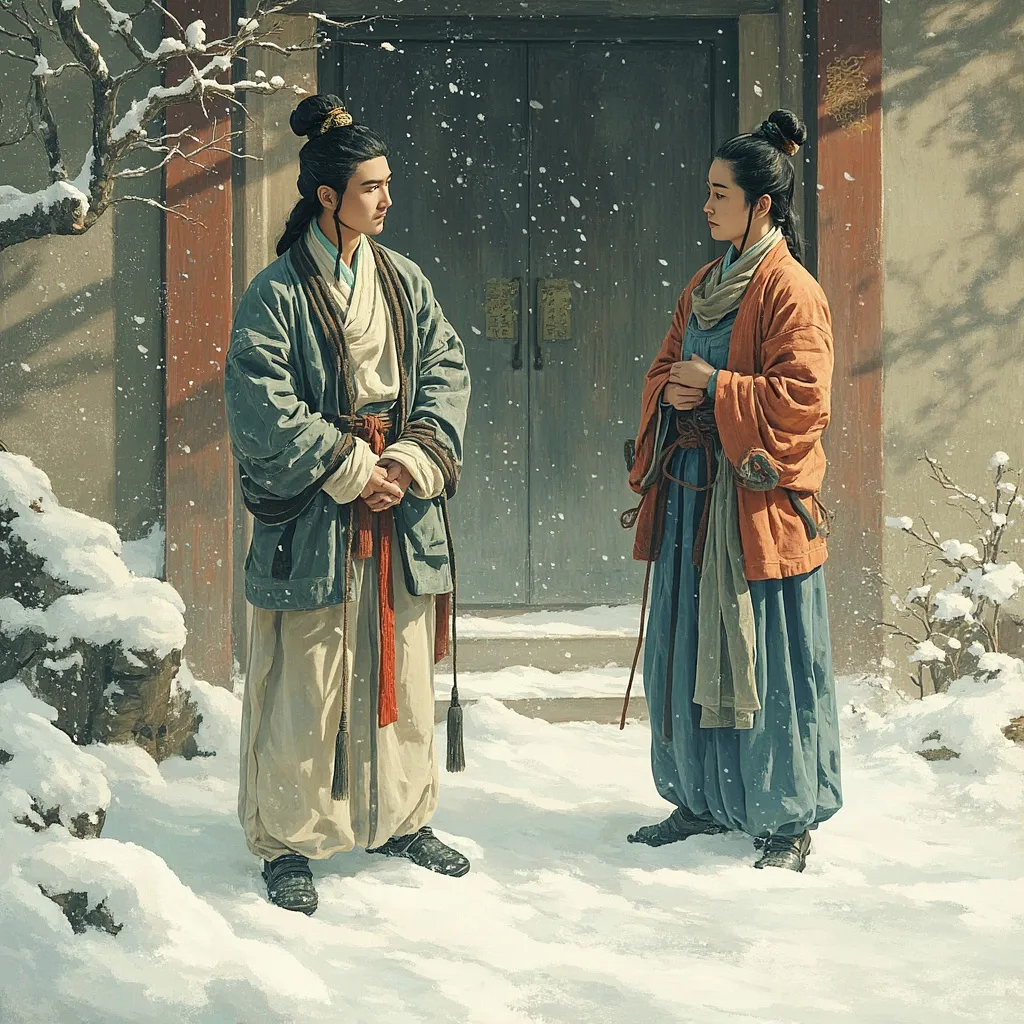
Eventually, his reputation reached the imperial court. Emperor Wu, known for his willingness to promote talented individuals regardless of their background, summoned the boy to appear before him. According to the traditional account, when the boy entered the palace and began ascending the jade stairs that led to the throne, the entire assembly was struck by the improbability of what they were witnessing. A boy who should have been sweeping floors or begging for scraps was walking toward the emperor, and no one could deny that he belonged there.
The phrase 玉台阶 entered the language as a symbol of this kind of extraordinary social ascent — the moment when someone from the lowest station rises to the highest through a combination of merit and virtue.
The Broader Theme: Can You Really Rise From Nothing?
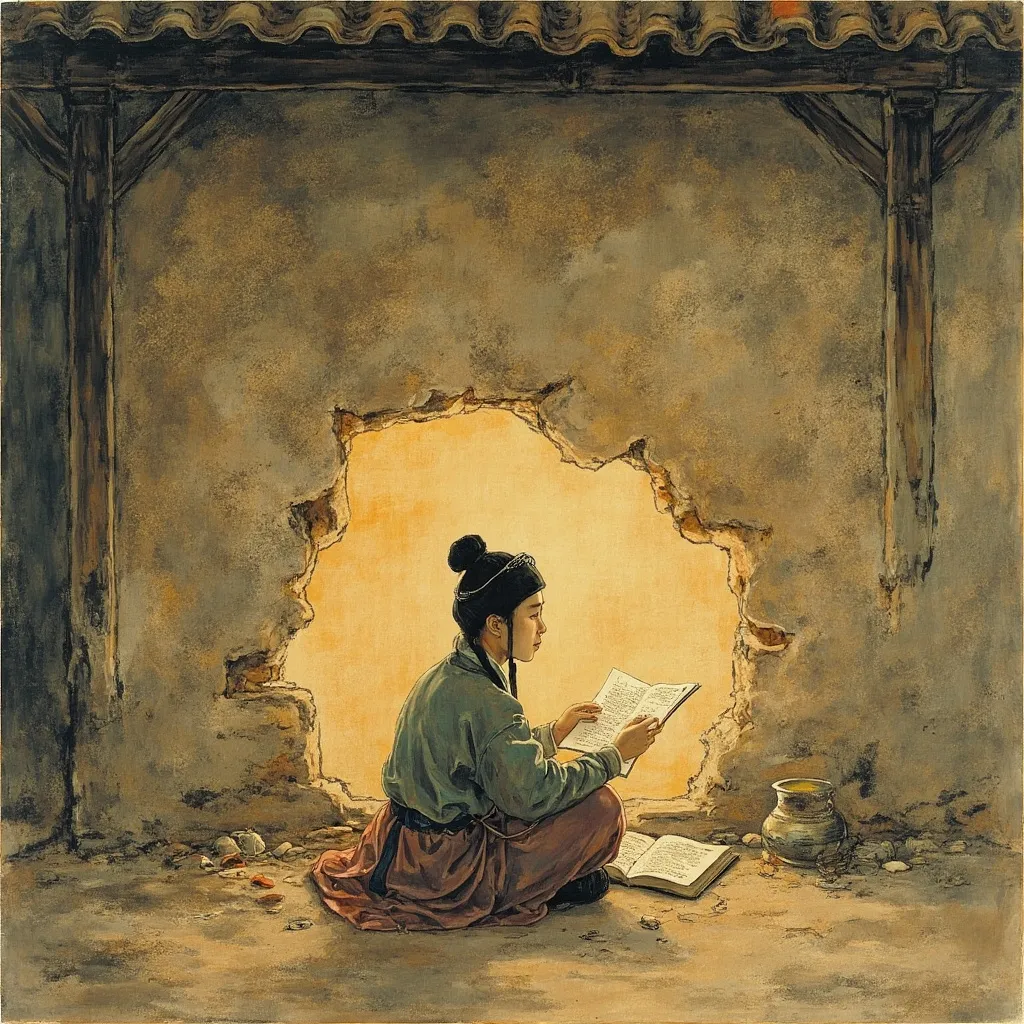
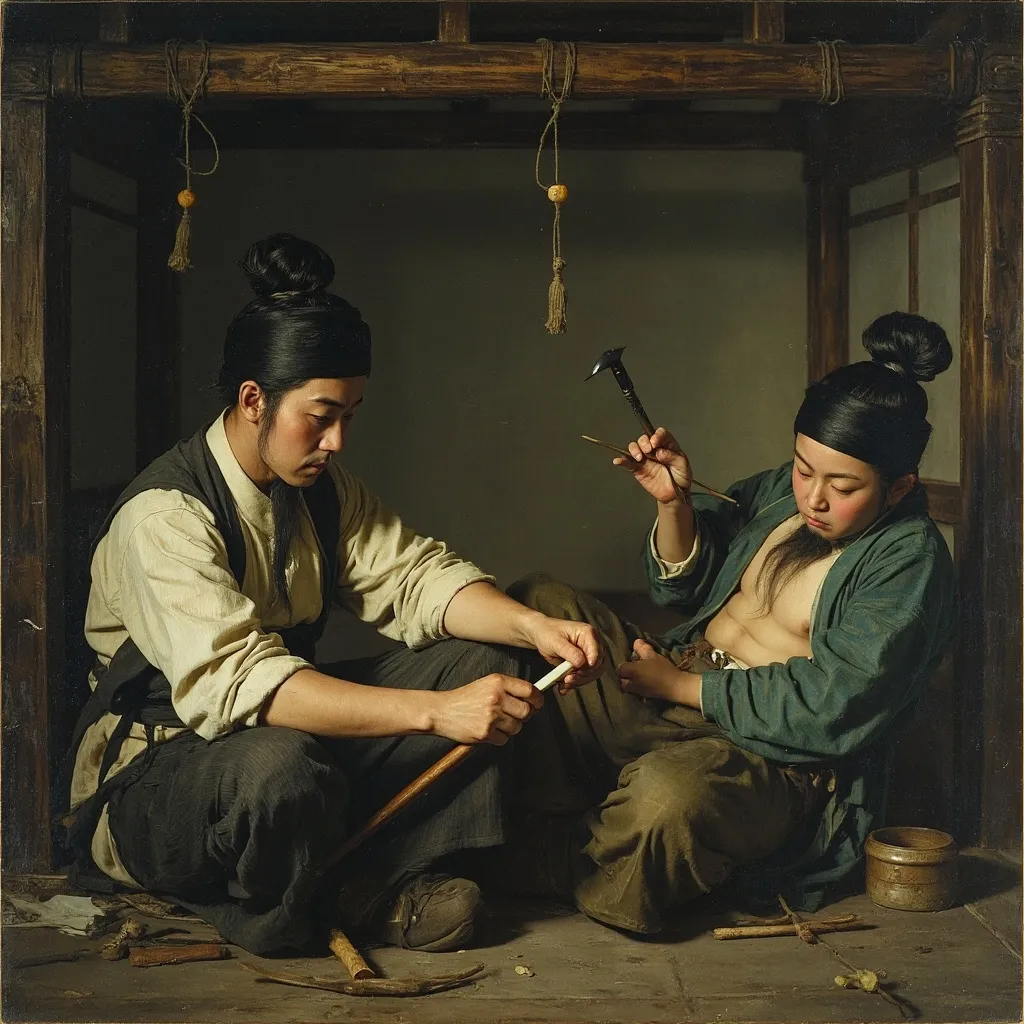
The Jade Staircase story is part of a larger tradition of Chinese narratives about social mobility. Stories like 悬梁刺股 (studying until your hair is hung from the ceiling and you stab your own leg to stay awake) and 凿壁偷光 (boring a hole in the wall to steal light from your neighbor’s lamp) all share a common narrative structure: a person of humble origin overcomes extraordinary obstacles to achieve educational and professional success.
These stories were more than mere entertainment. They served an important social function in a society that was technically meritocratic but in practice heavily influenced by family connections, wealth, and social status. By celebrating individual achievement against the odds, these stories kept alive the possibility — however rare in reality — that talent and virtue could actually be recognized and rewarded.
This was a powerful message in a world where most people never left the social station into which they were born. For the farmer’s son who dreamed of becoming a scholar, or the merchant’s daughter who hoped to marry into the gentry, these stories offered something precious: hope. Not the hope that anything is possible, but the more modest and defensible hope that the system, while imperfect, was not entirely closed to those who excelled.
The Jade Staircase story goes beyond simple meritocracy, though. It emphasizes not just the boy’s intelligence but his moral character. He was not merely clever; he was kind. He was not just ambitious; he was virtuous. The message seems to be that the kind of rise depicted in the story is not just about raw talent — it’s about the integration of talent with goodness. The jade stairs don’t open to everyone who is smart; they open to those who are smart and good.
This reflects deeply held Confucian values about the relationship between personal cultivation and public office. In the Confucian worldview, becoming a government official was not just a career but a moral calling. The person who enters public service should do so not for personal gain but out of a desire to serve the people and promote the common good. Only someone who has cultivated virtue in private life is fit to wield power in public life.
The Jade Staircase story, in this reading, is not just about social mobility. It’s about the correct reasons for social mobility. The boy rises because he is genuinely good, and his rise is a sign that the system is working as it should — identifying and promoting people who will use power wisely.
The Darker Side: What the Story Doesn’t Tell Us
It’s worth noting that the Jade Staircase story, like most stories of extraordinary success, leaves out a great deal. We don’t hear about the countless others who tried to rise from similar circumstances and failed. We don’t learn about the structural barriers — the corruption, the favoritism, the simple prejudice against people of low birth — that made success rare enough to be remarkable.
The celebration of individual achievement in stories like this one can obscure the fact that the system itself was deeply unequal. A society that produces a few inspirational stories of upward mobility is not necessarily a just society. It may simply be a society that grants enough exceptions to maintain the illusion of meritocracy while keeping the vast majority of people in their assigned places.
This tension is visible in the story itself, if we look closely. The boy is caught stealing. He is let off with a beating only because a vendor chooses mercy over justice. What would have happened if the vendor had been less compassionate, or if the boy had been caught again, or if any one of a dozen things had gone differently? The jade stairs would have remained forever out of reach, not because the boy lacked talent or virtue, but because the system gave him no room to demonstrate either.
This is the uncomfortable truth hidden inside inspirational stories: they often tell us more about what we want to believe about meritocracy than about how meritocracy actually functions. We want to believe that talent and virtue are enough, that the system is essentially fair, that the stories of exceptional success reflect something true about how the world works. Stories like the Jade Staircase feed that desire.
None of this means the stories are worthless. They capture something real about the possibility of change, even if that possibility is rare and contingent. And they articulate an ideal — that those who rise should rise because of merit, not merely because of inherited privilege — that can serve as a standard against which real institutions can be measured.
Modern Parallels: Social Mobility Then and Now
The Jade Staircase story resonates across centuries because the tension it addresses — between birthplace and destiny, between merit and opportunity — remains as live today as it was in ancient China. We still tell stories about people who overcame humble origins to achieve extraordinary things. We still hold up these stories as evidence that the system works, that anyone can make it if they try hard enough.
And we still grapple with the same uncomfortable questions. Is social mobility really possible for everyone, or only for a lucky few? Do inspirational stories help or hurt by implying that failure to rise is a personal rather than a systemic problem? What do we owe to those who don’t make it — and what do they owe to themselves?
Modern research on social mobility suggests that the reality is complicated. In most societies, including contemporary China and the United States, rates of upward mobility are lower than most people assume and are heavily influenced by factors outside any individual’s control — family wealth, geographic location, quality of local schools, and simple luck. The people who rise from poverty to wealth and status, like the boy in the Jade Staircase story, are real but uncommon.
This doesn’t mean individual achievement is illusory. It means that focusing exclusively on individual achievement as the solution to systemic inequality lets systemic inequality off the hook. We can celebrate the boy who climbs the jade stairs while also working to ensure that the stairs aren’t locked to everyone else.
There’s also something to be said for the story’s emphasis on character as a prerequisite for success. Not character in the narrow sense of following rules, but character in the broader sense of developing genuine virtues — honesty, kindness, perseverance, humility — that make someone not just successful but good. The Jade Staircase story suggests that the real purpose of rising is not personal enrichment but the opportunity to serve others more effectively.
This is a countercultural message in an age that often celebrates success without asking what someone did to achieve it or what they plan to do with it. The boy in the story didn’t climb the jade stairs so he could live in a palace and enjoy luxuries. He climbed them because his virtue and ability qualified him to serve, and serving was what he was meant to do.
Applying the Lesson: Virtue as the Foundation of Achievement
What can we take from the Jade Staircase story that applies to our own lives and goals? Here are a few thoughts.
First, recognize that genuine achievement requires more than talent. The boy in the story was smart, but so are lots of people who never climb anywhere near jade stairs. What distinguished him was his character — his kindness, his integrity, his refusal to let hardship make him bitter or dishonest. These qualities opened doors that intelligence alone could not have opened.
Second, remember that how you treat people matters more than you might think. The story begins with the boy’s encounter with the market vendor. A single act of mercy — the vendor’s decision not to report the theft — set the boy’s life on a different trajectory. In the same way, our own interactions with people can have consequences we can’t foresee. Being kind to someone who can’t do anything for you might be one of the most important things you ever do.
Third, use whatever platform you earn for the benefit of others. The jade stairs weren’t an end; they were a beginning. The boy’s rise to power gave him the opportunity to serve, and that opportunity was the real reward. If you ever find yourself ascending — in your career, your education, your community influence — remember that the ascent is valuable only insofar as it enables you to contribute something larger than yourself.
The Story’s Place in Chinese Cultural Memory
The Jade Staircase story has been retold, adapted, and reinterpreted countless times over the past two millennia. It appears in collections of moral tales for children, in historical commentaries, in literature, and in visual art. Like all enduring cultural narratives, it has been shaped by each era that has transmitted it, acquiring new layers of meaning as social conditions changed.
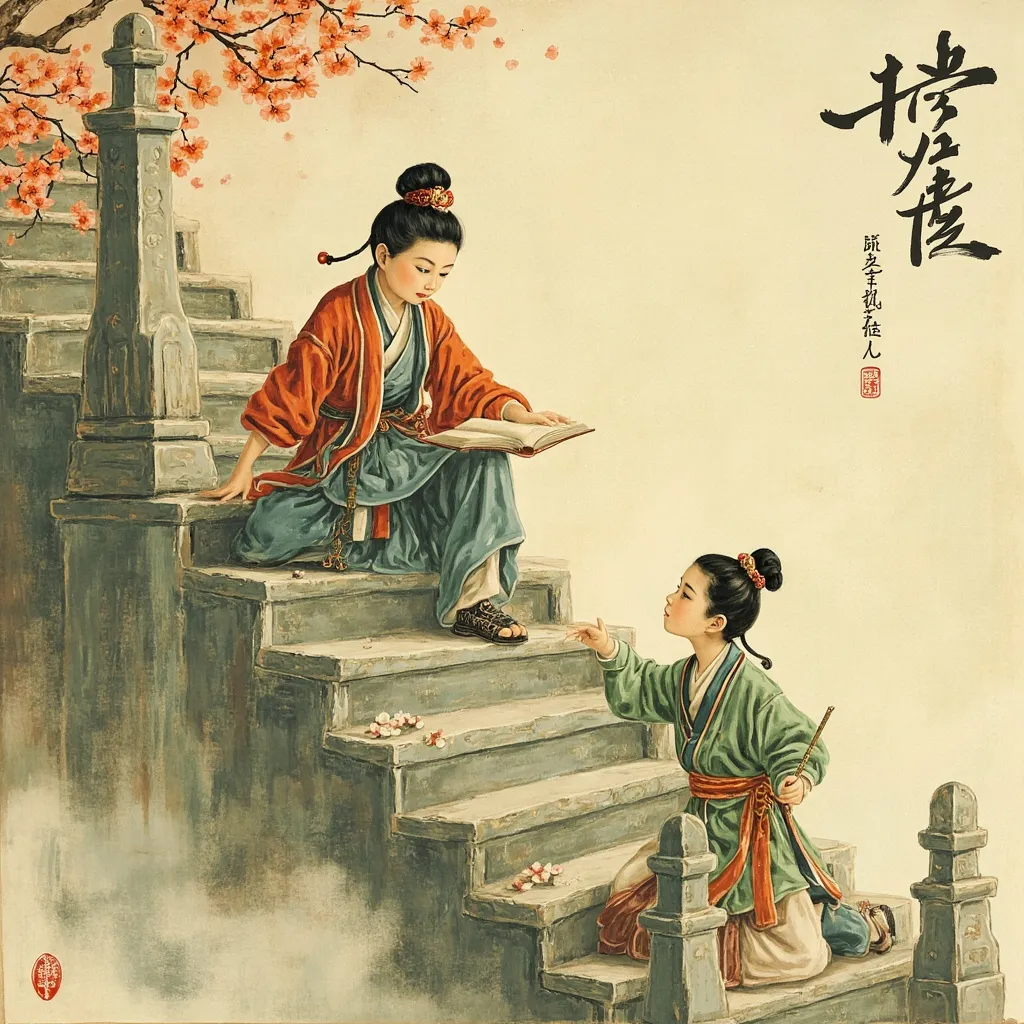
In modern China, the story continues to be taught in schools and cited in discussions of education and social policy. It sits alongside other classic stories of self-improvement — 悬梁刺股, 凿壁偷光, 程门立雪 — as part of a shared vocabulary for discussing the relationship between effort and achievement.
This is appropriate, because all these stories share a common insight: that the path from obscurity to prominence is rarely easy, rarely fair, and rarely open to everyone who deserves to walk it. But they also share the conviction that it should be open, that merit should be recognized wherever it appears, and that those who are given opportunity have an obligation to honor the trust placed in them.
The jade stairs remain a powerful symbol in Chinese culture — not just of what can be achieved, but of what should be possible. Every child who hears this story learns something about what the ideal society would look like: a place where the good and the talented can rise, regardless of where they start.
Whether that ideal has ever been fully realized is another question. But the story keeps it alive, reminding each new generation that the stairs don’t have to be locked, that the doors don’t have to be closed, and that possibility — however rare — is still possibility.
Recommended Resources for Self-Education and Character Development
1. Biographies of Self-Made Scholars and Leaders — Explore the lives of individuals who rose from humble origins to great heights, including stories like the Jade Staircase and similar narratives of overcoming adversity through virtue and determination.
2. Confucian Classics: Recordings of Lectures on the Great Learning — The principles of self-cultivation that guided the Jade Staircase boy are explored in depth in classical Confucian texts. These lecture recordings make ancient wisdom accessible to modern readers.
3. Leadership Development Collection: Serving Others Through Power — Ascending to positions of influence carries responsibilities. These books explore how to wield power ethically and use achievement to serve others rather than just yourself.
4. Classic Chinese Stories of Virtue and Perseverance — The Jade Staircase story is part of a rich tradition of moral tales. This collection brings together similar stories from Chinese history and folklore, offering hours of inspiring reading.
5. Premium Writing Set for Journaling Your Own Journey — Record your own path of growth and development. Like the scholars of ancient China who kept detailed records of their self-cultivation, maintaining a personal journal helps you track your progress and reflect on your character.