Jasmine Tea: China’s Most Beloved Fragrant Tea
Every culture has its entry point tea — the one that introduces people to the idea that tea can be something more than a bag in hot water. In the United States and Europe, that role is often played by Earl Grey (though that’s a Western invention built on Chinese black tea). In Russia, it’s a strong, sweet brew served with jam. In Morocco, it’s mint tea poured from height with theatrical flair. In China, if there is a single tea that has introduced more people to the world of fine tea than any other, it is jasmine tea — and not because it’s exotic or fashionable, but because it is genuinely, universally delicious.
Jasmine tea occupies a unique position in the Chinese tea landscape. It is not made from a special tea plant or grown in a particular microclimate that produces uniquely flavored leaves. Instead, it is a transformation — a careful marriage of ordinary green tea with the extraordinary fragrance of jasmine blossoms. The result is something that transcends its components: a tea that is floral without being perfumy, sweet without being cloying, and accessible without being ordinary. It manages to be both the people’s tea and a tea that serious enthusiasts return to throughout their lives.
I have a particular fondness for jasmine tea, probably because it was my own gateway into serious tea drinking. Years ago, in a cramped apartment in Beijing, a Chinese colleague brewed me a pot using nothing more than a ceramic pot, a few grams of jasmine pearl tea, and water from a thermos. The fragrance that rose from that pot was one of those sensory moments you don’t forget — sweet, heady, immediate, and somehow deeply calming at the same time. I drank cup after cup, and by the end of the evening I had bought my first proper tea set and was already planning my next purchase. That colleague, now a close friend, still laughs about how easy it was to get me hooked on this particular tea.
A History Spanning a Thousand Years
The origins of jasmine tea trace back to the Song Dynasty (960-1279 CE), when the practice of scenting tea with flowers was first systematically developed. Early practitioners used a variety of flowers — gardenia, magnolia, even pear blossom — but jasmine gradually emerged as the favored medium due to its strong, sweet fragrance and the sheer abundance of the blossoms available during the harvest season. The jasmine plant (Jasminum officinale) proved to be remarkably well-suited to the climate of southern China, and cultivation spread quickly.
For centuries, jasmine tea was primarily a Fujian specialty, where tea production and jasmine cultivation developed in close proximity. The coastal Fujian climate, with its warm summers and mild winters, proved ideal for growing both tea and jasmine. The tradition of scenting tea with fresh jasmine flowers became deeply embedded in local tea culture, and the region remains the spiritual home of jasmine tea production to this day. Fajian has maintained its reputation for the highest quality jasmine scenting, though production has spread to other provinces over the centuries.
During the Ming Dynasty (1368-1644), jasmine tea began to spread beyond Fujian as a luxury product. It was traded along the same routes that carried porcelain and silk westward, and it developed a reputation among foreign merchants as THE distinctive Chinese scented tea — the one that Westerners ordered by name when they encountered Chinese tea for the first time. By the time European traders arrived in significant numbers in the 17th and 18th centuries, jasmine tea was already well established as China’s most famous scented export, a reputation it has never lost.
The modern era brought significant changes. In the 20th century, tea production became more industrial, and jasmine tea production scaled up dramatically to meet domestic demand. What was once a specialty consumed primarily by the wealthy became an everyday beverage available to all Chinese. Today, jasmine tea is consumed in vast quantities throughout China — in homes, in restaurants, in teahouses, and in offices. It is the default tea in many households, the one that grandparents drink and children grow up knowing. Its status as China’s most consumed tea is not a marketing claim; it is a reflection of genuine, widespread affection that has been built up over centuries.
The Multiple Scenting Process: How Jasmine Tea Gets Its Fragrance
The technique that makes jasmine tea extraordinary is called “scenting” or “puffing” — and it is far more labor-intensive than most people imagine. The process transforms a base green tea through repeated contact with fresh jasmine blossoms, each round adding layers of fragrance that build on the previous ones in a way that cannot be rushed or shortcuts.
The base tea used for jasmine tea is almost always a green tea — typically aGunpowder (珠茶), a strip-style tea like Zhenjiang (珍眉), or a bud-heavy white tea base like Yin Zhen (银针). The quality of the base tea matters enormously: a premium jasmine tea will use a base that is itself excellent, with good structure and flavor that can support the floral additions without being overwhelmed. The base tea is the canvas; the jasmine is the paint. Both must be quality.
The scenting process itself is seasonal and timing-dependent in ways that make it genuinely challenging to execute well. Jasmine blossoms only open fully during the heat of the day, typically between 2pm and 4pm. The flowers are picked in the morning when they’re still closed — green, tight buds — and kept cool until the afternoon when they begin to open and release their fragrance. It is at this point that they are mixed with the base tea. Timing is everything: too early and the blossoms haven’t opened enough; too late and they’ve already released their best fragrance.
In traditional production, the tea and fresh jasmine blossoms are layered together in large, shallow containers: tea on the bottom, blossoms on top. As the blossoms open throughout the night, they release their aromatic compounds, which are absorbed by the surrounding tea leaves. The tea is periodically turned and agitated to ensure even distribution of fragrance. In the morning, the now-wilted jasmine blossoms are removed, and a fresh layer of fresh blossoms is added for the next round. This requires fresh jasmine every single night of the process.
This process is repeated between three and seven times, depending on the desired intensity of the final product. Premium jasmine teas — those labeled “seven-times scented” or even “nine-times scented” — have undergone this cycle nearly every night for a week or more. Each round adds subtlety and depth; repeated scenting produces a fragrance that is integrated into the leaf rather than sitting on the surface, which is why properly made jasmine tea retains its scent through multiple steeps. The lowest quality jasmine teas are scented only once and taste flat and one-dimensional.
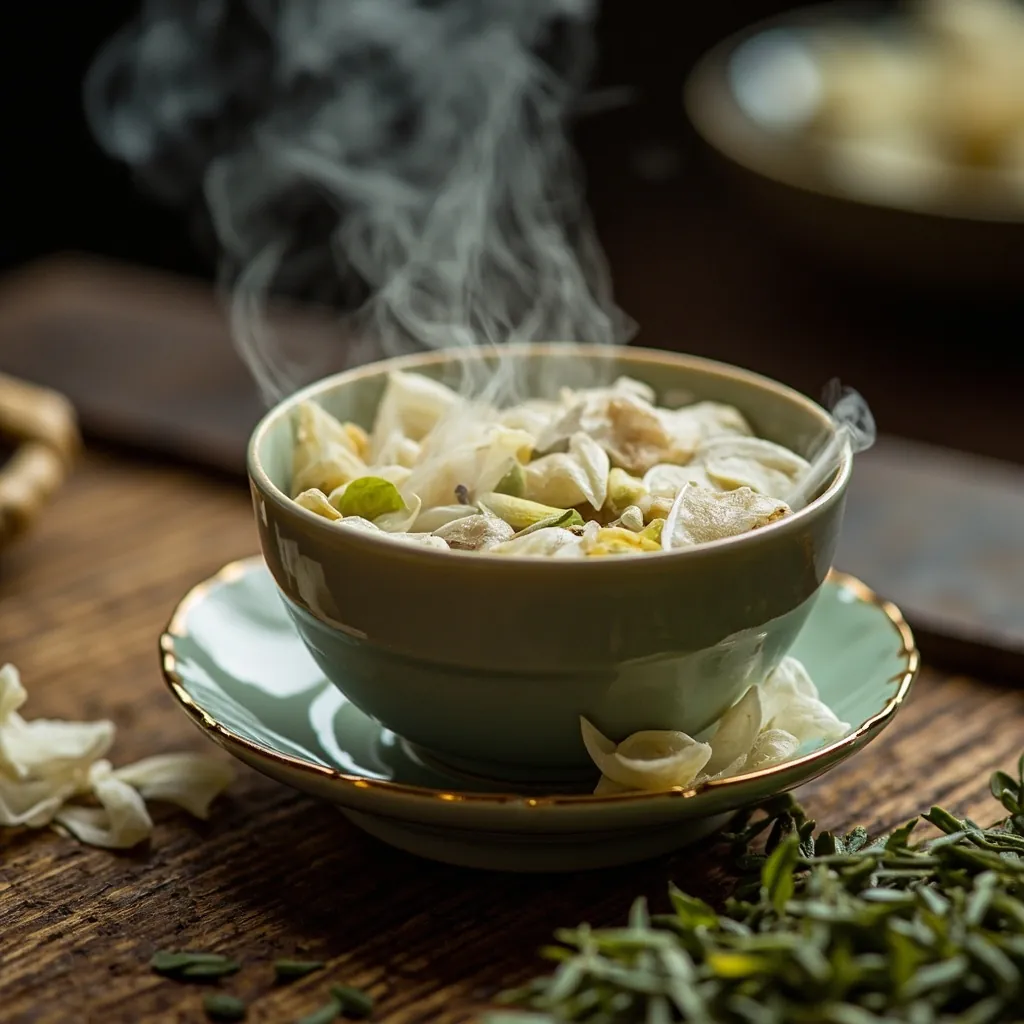
The result is a tea that smells intensely of jasmine on the dry leaf, releases floral notes immediately upon contact with hot water, and continues to express jasmine character throughout the drinking experience. A truly excellent jasmine tea will be fragrant in the cup but not at all soapy or synthetic — it smells and tastes like actual jasmine blossoms, not jasmine flavoring. The difference between natural scenting and artificial flavoring is immediately apparent to anyone with a functioning nose.
Popular Varieties of Jasmine Tea
The jasmine tea category encompasses a surprising range of styles, defined primarily by the base tea used and the number of scenting rounds. Understanding these varieties helps you navigate the market and find the styles that best match your preferences.
Jasmine Dragon Pearl (茉莉龙珠) is perhaps the most beautiful to watch being brewed. The tea consists of hand-rolled balls of green tea — each ball containing a bud or leaf twist — that unfurl dramatically in hot water. The scenting process fills these pearls with jasmine fragrance, and when they open in a glass pot, they’re genuinely pretty — like tiny green flowers blooming in your cup. The flavor tends toward sweet and mellow, with a clean finish. Dragon pearl varieties from Fujian are considered the gold standard, though the style is now produced in many provinces.
Jasmine Gunpowder (珠茶) uses the same pellet-shaped green tea base as regular gunpowder tea. The pellets hold the jasmine fragrance well and produce a slightly more structured, full-bodied cup than dragon pearls. The name comes from the way the leaves are rolled into tiny pellets that resemble gunpowder granules. High-quality jasmine gunpowder from Zhejiang province is widely available and represents excellent value for everyday drinking. It’s also very forgiving in brewing, making it a good choice for beginners.
Jasmine银针 (Yin Zhen) uses a white tea base — exclusively buds from the white tea plant — scented with jasmine. The result is exceptionally smooth and delicate, with the floral notes playing against a subtly sweet, almost honey-like white tea base. It’s more expensive because white tea buds are labor-intensive to harvest, but it’s a legitimately luxurious experience that even discerning tea drinkers appreciate.
Jasmine Iron Buddha (茉莉铁观音) is a more recent combination that pairs the partial-oxidation oolong processing of Tieguanyin with jasmine scenting. The result is a tea with more body and complexity than green-tea-based jasmine varieties, exhibiting both the orchid notes of the oolong base and the floral jasmine character. This hybrid style has developed its own following among enthusiasts who appreciate the added dimension.
Jasmine Dragon Well (茉莉龙井) combines Hangzhou’s famous Longjing green tea with jasmine scenting. This is a more unusual combination — Longjing is prized for its subtle, toasty character, and some argue that jasmine overwhelms it. But well-made jasmine Longjing exists and has its enthusiasts, particularly among those who want the nutty Longjing flavor with a floral lift. It’s less common but worth seeking out if you appreciate both teas.
Brewing the Perfect Cup of Jasmine Tea
Jasmine tea is forgiving in some respects and demanding in others. The fundamental rule is: don’t use boiling water. Green tea bases — and white tea bases — are damaged by water that’s too hot, resulting in bitterness and astringency that overwhelm the delicate floral notes. For most jasmine teas, a water temperature of 80-85°C (175-185°F) is ideal. If your kettle doesn’t have temperature control, let boiling water cool for a few minutes before pouring.
For the amount of tea, use slightly more than you might with a less-fragrant tea — about 3-4 grams per 150ml. The jasmine fragrance is volatile enough that you want sufficient leaf mass to carry it through multiple infusions. Quality jasmine tea should yield at least three good steeps, with the character evolving each time: early infusions more floral, later infusions revealing more of the base tea’s character beneath the jasmine.
The vessel matters less than the technique, though glass has certain advantages. A simple glass pot is actually my preference for jasmine tea, because you get to watch the leaves unfurl and dance, and because glass doesn’t retain scent the way clay or porcelain might over time. That said, a simple porcelain teapot or gaiwan works perfectly well. If you’re using a gaiwan, use the same parameters as for green tea: short first infusion (rinse of just a few seconds, discarded), then 20-30 seconds for the first real steep, adding time incrementally for subsequent steeps.
One thing many people don’t realize: jasmine tea improves significantly with a brief “awakening” rinse. Pour a small amount of hot water over the dry leaves, let them sit for 10-15 seconds, then discard. This rinse opens the leaves, removes any dust, and preps the fragrance for the actual brewing. It’s a small extra step, but it makes a measurable difference in the quality of the first cup.
Why Jasmine Tea Remains China’s Most Consumed Tea
There are teas with more prestige (Longjing, Tieguanyin, pu-erh), teas with more complex flavor profiles (high-mountain oolongs, aged pu-erhs), and teas with more passionate enthusiast communities (almost every other category). And yet jasmine tea remains China’s most consumed tea by volume, year after year, decade after decade. The question is worth asking: why does this particular tea, which some snobs dismiss as “beginner’s tea” or “grandmother’s tea,” maintain such enduring dominance?
I think the answer is partly about accessibility and partly about something deeper. In terms of accessibility: jasmine tea is affordable at every quality tier, it is reliably good (the flavor profile is less affected by storage variations than pu-erh or green teas), and it is immediately pleasing to nearly everyone who tries it. You don’t need to develop a palate for it; it doesn’t require education or context or special equipment. The floral sweetness hits right away, immediately and without complication. In a country where tea has been a daily staple for centuries, this instant gratification matters.
But there’s also the matter of what jasmine tea represents emotionally. In Chinese culture, jasmine is associated with purity, simplicity, and a certain kind of gentle femininity — and the tea has absorbed these associations over centuries. It is the tea served to welcome guests in many households, the tea offered to a sick relative, the tea drunk quietly in the evening after a long day. It carries a comforting, domestic quality that more assertive or complex teas don’t quite match. There’s a reason it’s been China’s daily-drinking tea for generations, and it’s not because people haven’t tried the alternatives.
For anyone beginning their tea journey, jasmine tea is a genuinely wonderful starting point. And for experienced tea drinkers who may have moved on to more challenging varieties, returning to jasmine tea after a few years often reveals qualities that weren’t apparent before — a subtlety in the fragrance, a craftsmanship in the scenting process, a genuine pleasure in simplicity. It’s a tea that rewards attention at every level of experience, from the casual drinker to the most demanding connoisseur.