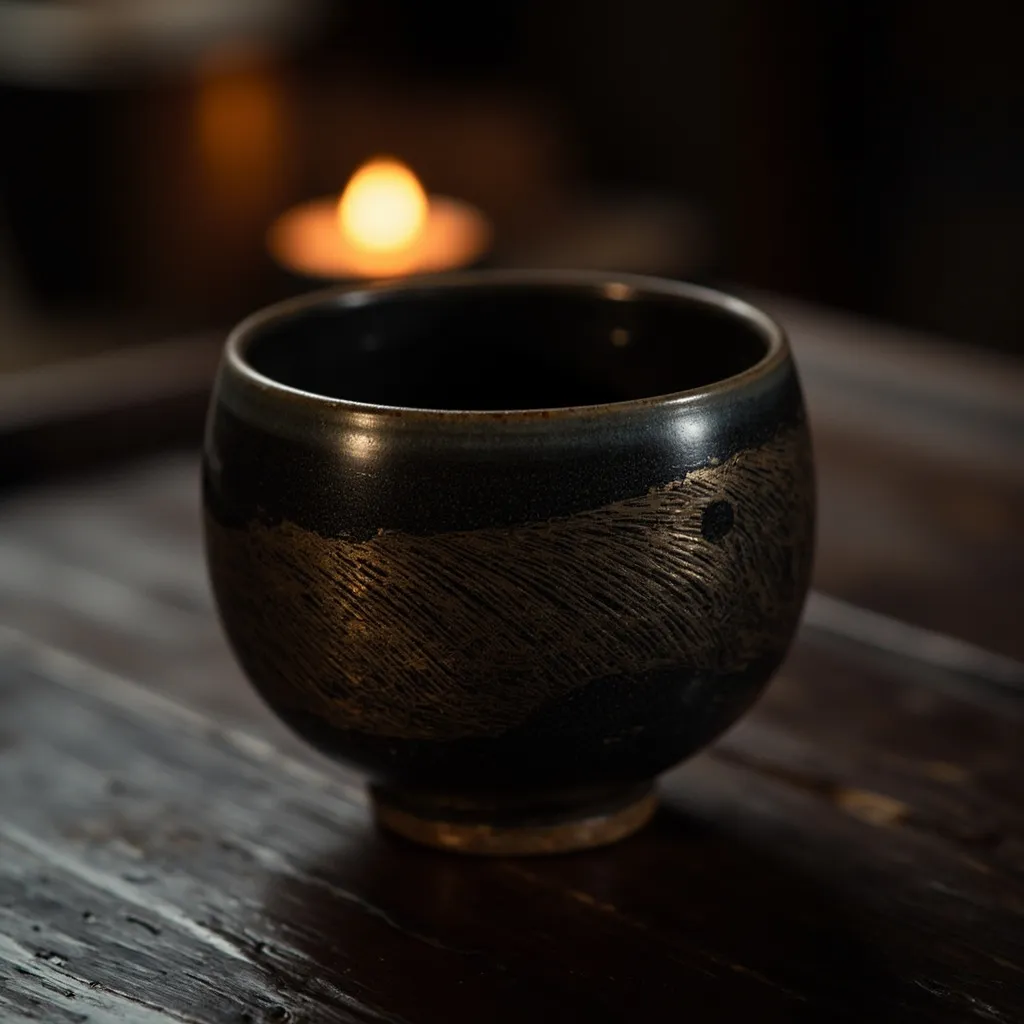
There is a particular kind of beauty to a Jian ware tea bowl that you only notice when you actually use one. The bowl is heavy for its size, dense in the hand, with walls about as thick as your little finger. The glaze on the inside is the deep black-brown of dried blood or, depending on the angle of the light, the dark blue-black of a crow’s wing. Look more closely and the surface is alive: silvery streaks radiating from the center, or scattered flecks of rust-colored iron that catch light like distant galaxies, or — in the rarest cases — a constellation of iridescent crystals that seem to glow from within the glaze itself. The bowl was meant to hold powdered tea whipped with a bamboo brush into pale green foam, and the foam against the dark glaze was supposed to look, the Song dynasty aesthetic manuals tell us, like clouds against a night sky.
The name most Western tea drinkers know is “tenmoku,” a Japanese pronunciation of the Chinese Tianmu (天目), referring to the Tianmu Mountains where Japanese monks first encountered the bowls during their studies in China in the 12th and 13th centuries. The original Chinese name is jian zhan (建盏), literally “Jian [prefecture] cup,” after the kiln complex at Jianyang in northern Fujian where they were made. The two names refer to the same object, but they carry different cultural weights: tenmoku is the export-market name, popularized by Japanese tea masters; jian zhan is the home name a Chinese tea drinker would actually use.
What makes these bowls extraordinary is partly technical virtuosity — Song dynasty kilns achieved something with iron-saturated glazes that no other ceramic tradition has reliably reproduced — and partly the historical accident of their rediscovery. By the 14th century, Jian ware had largely vanished from Chinese production. The whipped powdered tea ceremony had been replaced by loose-leaf tea drinking, and the heavy dark bowls were no longer needed. The kilns went cold. For roughly six hundred years, antique Jian bowls survived as museum pieces and tea-ceremony heirlooms, mostly in Japan, while the technique of making them was effectively lost. Revival only began in the 1970s and 80s, when a handful of Chinese potters, working from archaeological finds and historical texts, started trying to make the bowls again. By the 1990s the technique had been substantially recovered, and by the 2010s a new generation of kilns was producing jian zhan in commercial quantities.
The Three Glaze Patterns: Hare’s Fur, Oil Spot, and Yohen
What Westerners call “tenmoku” is actually a family of related glaze effects, all produced from the same basic recipe of iron-rich stoneware clay but with subtle variations in kiln atmosphere, firing temperature, and cooling schedule. Three patterns dominate the tradition, each with a distinctive character.
Hare’s fur (兔毫, tuhao) is the most common and the easiest to recognize. The glaze is dark brown to black, with fine streaks of lighter color — usually a warm rust-brown or amber — radiating from the rim of the bowl down toward the center, like the fur of a rabbit laid flat. The streaks are iron crystals that have precipitated out of the glaze during cooling, and they form in patterns governed by the way the molten glaze flowed and crystallized during firing. No two hare’s fur bowls are identical; the fur patterns are essentially fingerprints of the specific firing cycle. The best Song dynasty hare’s fur bowls have long, slender, evenly distributed streaks with a subtle silvery iridescence at their edges; the streaks should look almost as though they were brushed on by hand.
Oil spot (油滴, youdi) is rarer and more difficult to achieve. Rather than streaks, the glaze is dotted with discrete circular spots of iron crystals, ranging from pinhead size to perhaps half a centimeter across. The spots are typically silver, gold, or rust-colored, and against the deep black ground they look uncannily like droplets of oil floating on dark water — which is exactly what the name means. Oil-spot glazes were the great technical achievement of the late Northern Song period (roughly 1100–1125 CE), and surviving examples from this era are among the most prized pieces in Chinese ceramic history. Firing oil-spot reliably requires controlling the kiln atmosphere with unusual precision: too oxidizing and the spots burn out; too reducing and they fail to form. The kiln masters who got it right were working at the edge of what the technology of the time could do.
Yohen or “ten thousand changes” (曜变, yaobian) is the rarest and most legendary of the three. The name translates roughly as “phantom transformation” or “transcendent change,” and refers to bowls whose glaze contains iridescent crystals arranged in halos or constellations around small dark spots. The crystals refract light in shifting colors — gold, blue, purple, silver — depending on the angle of viewing. Yohen glazes are extraordinarily rare in any period, and the three or four surviving Song dynasty examples are Japanese national treasures held in museum collections. Most modern yohen bowls on the market are fakes or approximations; authentic pieces command prices that put them beyond almost any private collector.
A few rare bowls combine more than one of these effects — hare’s fur that develops oil spots along the streaks, for instance, or oil spots that take on iridescent qualities. These are anomalies that experienced collectors prize but that most buyers should approach cautiously.
How the Bowls Were Made
The technical heart of Jian ware is the iron. The clay used in Jianyang naturally contains iron oxide at concentrations around 7 to 10 percent, far higher than the clay used for most Chinese stoneware. Glaze recipes are also iron-heavy, with iron oxide content reaching 8 to 10 percent of the glaze mixture. When fired at the right temperature (around 1300°C / 2370°F) and cooled in the right atmosphere, this iron crystallizes out of the molten glaze in the patterns that make the bowls distinctive.
The kilns themselves were large wood-fired dragon kilns (long kilns built up a hillside), typically 50 to 100 meters long with multiple chambers. A single firing could take several days and consume enormous quantities of pine wood — the ash from the burning pine contributed trace minerals to the glaze and gave the bowls some of their subtle color variations. The kiln master had to control the fire temperature, the airflow, and the rate of cooling with extraordinary precision, all without modern instruments. The skill was partly empirical knowledge passed down through generations, partly artistic intuition. Bowls were stacked on top of each other in the kiln (which is why older Jian bowls sometimes have small unglazed rings where they sat during firing), and the position of a given bowl within the kiln affected its glaze dramatically. The best pieces came from specific locations within specific kilns, and potters competed fiercely for access to the most favored positions.
Firing a kiln was an expensive gamble. A single misjudged firing could ruin thousands of bowls. The accounts we have from Song dynasty sources suggest that even in the heyday of production, perhaps one bowl in twenty emerged from the kiln with the fine hare’s fur or oil spots that made it commercially valuable. Most bowls ended up as everyday ware, used by monks, scholars, and merchants and never specifically recorded. The small fraction of pieces that survived with extraordinary glazes were the ones that ended up as tribute gifts to emperors, treasures in Japanese monasteries, or — most fatefully — the small handful that ended up in museum collections after the kilns went cold.
The bowls themselves were thrown on a wheel and trimmed to a characteristic shape: relatively wide (8 to 12 centimeters across the rim), shallow (4 to 6 centimeters deep), with a small foot and walls that flare slightly outward toward the top. The interior glaze pools toward the center during firing, creating the gradual transition from a thin dark rim to a thicker, glossier center where the patterns are most vivid. The unglazed exterior and foot show the natural iron-brown color of the clay itself, sometimes with rough ash glaze drips where the heat pulled ash over the rim during firing.
The Tea Ceremony They Were Made For
A Jian zhan is not just a pretty object; it was designed for a very specific way of making tea that has been almost entirely lost in the modern world. The Song dynasty tea ceremony used powdered tea — typically a steamed and stone-ground green tea called tuocha or, in later periods, moyacha — that was whipped into foam with a bamboo brush. The tea was prepared in a larger vessel, then poured into individual bowls, where each drinker would continue whisking their own portion until it developed a thick pale foam on top. The aesthetic of the ceremony prized the foam itself: its color, its texture, its persistence.
This is why the bowl is dark. Against the pale green-white foam of the tea, the black glaze looked, in the dim light of a Song dynasty tea room, like a night sky with clouds drifting across it. The Song aesthetic manuals describe the ideal foam as having fine bubbles that take a long time to dissipate, and they recommend particular whisk speeds and water temperatures to achieve it. The bowls were not just receptacles; they were part of the visual experience. A light-colored celadon bowl would have spoiled the effect; only a deep, lustrous black worked.
The Daquan tea manual from the Northern Song, written by the Emperor Huizong himself (a passionate tea drinker and talented calligrapher who reigned 1100–1125), describes the ideal bowl in great detail. Huizong preferred bowls with deep black glazes, fine hare’s fur patterns, and walls thick enough to retain heat but not so thick that they felt clumsy. He listed the kilns at Jianyang among the best sources for his personal use, and a few imperial Jian bowls bearing the imperial seal still survive. The aesthetic standards he articulated remained influential through the Southern Song and into the Yuan period, after which the powdered tea ceremony gradually fell out of use in China — replaced by the simpler practice of steeping loose leaves in hot water, which most modern tea drinkers would recognize.
This is part of why Japanese tea culture became the custodian of Jian ware aesthetics for several centuries. Japanese monks traveling to China in the Kamakura period (1185–1333) brought back both the powdered tea ceremony and the dark bowls that served it. The bowls became prized in Japanese Zen monasteries, then in the secular tea culture that grew up around them. By the Edo period, jian zhan had become, in Japan, valuable enough that forgeries began to circulate. The Japanese term tenmoku itself was coined to describe the bowls acquired by monks at the Tianmu Mountains; it stuck, and eventually made its way back into international tea vocabulary.
The Modern Revival
The modern jian zhan revival began in the 1970s, when a small number of Fujianese potters, working with archaeologists and ceramic historians, started trying to reconstruct the lost techniques. The central figure is usually identified as Ke Xianfu (柯显甫) and later Xie Junxing (谢峻兴), both working from kiln sites in Jianyang that had been excavated in the 1950s and 60s. The early reproductions were disappointing: the iron glazes were difficult to control, and the resulting bowls often looked muddy or lifeless compared to the Song originals they were trying to emulate.
Two breakthroughs in the 1980s and 90s made the revival commercially viable. The first was a better understanding of kiln atmosphere control — using modern pyrometers and airflow management to replicate the conditions that the Song kiln masters had achieved by intuition and experience. The second was the discovery that small additions of wood ash or certain mineral pigments could produce more vivid patterns than the original iron-only recipes. These modifications are controversial among purists, who argue that they produce a different aesthetic from the Song originals, but they allowed the kilns to produce bowls with reliable, attractive patterns at a scale that supported a real market.
The industry that emerged is centered on Jianyang, where more than 200 kilns now produce jian zhan in some quantity. Prices range from a few dollars for mass-produced tourist bowls to several thousand dollars for artist-signed pieces with exceptional glazes. The Chinese government has designated Jianyang an “intangible cultural heritage” site for the craft, which has brought official support and tourist traffic but also some concern about commercialization. Vintage Song dynasty bowls occasionally appear at auction and command extraordinary prices — five- to seven-figure sums for the best examples.
For Western tea drinkers interested in jian zhan, the practical question is usually how to brew tea in one. The bowls were designed for powdered tea, but they work beautifully for modern gongfu-style steeping as well, particularly for high-roast oolongs, aged pu’er, or any dark tea whose flavor benefits from the heat retention of the thick walls. The bowls are also simply pleasant to drink from: the iron-rich clay and the slightly rough glaze give the tea a weighty, mineral mouthfeel that many drinkers find appealing. Modern jian zhan are made for everyday use, though a few pieces with very thin or crystalline glazes should be handled carefully.
Buying Jian Zhan Without Getting Burned
The single biggest issue with buying jian zhan today is fakery. The high prices commanded by genuine Song dynasty pieces have created a thriving market in reproductions, some of which are deliberately misrepresented as antiques and some of which are honest modern reproductions being passed off as older work than they are. A few rules of thumb:
Modern reproduction bowls are usually clearly marked or sold as such by reputable dealers. They are perfectly good tea bowls and represent excellent value for daily use. Look for kiln marks, artist signatures, and certification from recognized Chinese ceramics organizations.
Late Qing or Republican era pieces (roughly 1900–1949) are rarer and may or may not be authentic. Some revival attempts were made during this period, often in much smaller quantities than modern production.
Song dynasty pieces are exceptionally rare on the open market. The genuine ones are almost always in museum collections, and the few that do appear at auction command extraordinary prices (typically six figures or more). If a dealer is offering a “Song dynasty” bowl at a price that seems too good to be true, it almost certainly is.
Pattern verification is the most reliable test for an experienced eye. Song hare’s fur tends to have long, fine, evenly distributed streaks with subtle silvery edges; modern reproductions often have coarser, more irregular patterns. Song oil spots are typically small and uniform; modern oil spots are often larger and less refined. Yohen effects are essentially never authentic in modern pieces, despite frequent claims.
For collectors at any level, the practical advice is to buy from established dealers, ask for documentation, and — most importantly — develop your own eye by handling as many pieces as possible. The International Tenmoku Society and similar organizations publish guides and hold exhibitions where collectors can see reference pieces in person.