The assassin walked into the heart of the most powerful kingdom on earth carrying a small wooden box and a rotted head in a sealed casket. He had crossed two hundred miles of hostile territory to do it. He had practiced his bow-stance for years. He had memorized the floor plan of the palace. He had rehearsed, again and again, the moment when he would unroll a map of the enemy’s richest province and, somewhere along its length, the blade would appear.
The blade appeared. The king stumbled. Then the king survived. The assassin died on the spot. Two thousand three hundred years later, almost every Chinese-speaking person on the planet still knows the name Jing Ke (荆轲), and most of them can recite at least one line of the farewell poem he sang at the Yi River the morning he left. The plot failed. The story never did.
This is what happened in 227 BCE — and why it still matters.
The Year Before: How Yan Got Dragged Into a War It Could Not Win
To understand why Crown Prince Dan of Yan (燕太子丹) sent a killer to the Qin court, you have to rewind the Warring States period to its last decade. By the 230s BCE, the state of Qin — already the strongest of the seven surviving powers — had begun the methodical dismantling of its neighbors. In 230 BCE, Qin swallowed Han. In 228 BCE, it took Zhao by storm, capturing the royal city of Handan. Within months, the eastern kingdoms were staring at a slow strangulation.
Yan was small, poor, and exposed. Its capital, Yanjing — modern Beijing — sat barely a hundred miles from the Zhao heartland that Qin had just occupied. Geography was a death sentence. King Xi of Yan (燕王喜) wanted to grovel. Crown Prince Dan did not. The prince had spent years as a hostage in the Zhao capital of Handan as a young man, and during those years he had apparently befriended the future Qin king, Ying Zheng. (Qin hostages were routinely held in allied courts as collateral. Ying Zheng himself spent years as a boy hostage in Zhao — the boy who would later order the famous attack on Handan was, before that, a guest in the same city.) That friendship, if Sima Qian is to be believed, gave the prince an illusion of leverage.
The crown prince also knew, probably from his years in Zhao, just how personally Ying Zheng took betrayal. The Qin king had spent his childhood learning to distrust everyone. He had survived a half-brother’s palace coup in 238 BCE by crushing it with his own hands. He had watched his mother’s lovers get torn apart. By the time Jing Ke entered his court, the man on the throne was already the kind of ruler who remembered every face and every slight.
Crown Prince Dan’s plan was simple, and desperate. He would present Qin with something it wanted badly: the head of Fan Yuqi (樊於期), a Qin general who had recently defected to Yan after falling out with the king, plus a true-scale map of the Yan commandery of Duyang (督亢), a fertile and strategically vital district on Yan’s southern border. In exchange, he would ask for a peace treaty, with the assassin inside the delegation. The dagger was the real point.
To anyone reading the Shiji (《史记》, Records of the Grand Historian), Sima Qian’s account of this whole affair is striking for how clearly he tells you it was never going to work. Crown Prince Dan knew it. Jing Ke knew it. The plan was a gamble against astronomical odds.
If you’re tempted to dig into Sima Qian’s full account in translation, a [product_affiliate: Records of the Grand Historian Sima Qian — Burton Watson translation covering the Biographies of Assassins chapter] is the canonical English edition; the 刺客列传 chapter is short, vivid, and worth reading in full. For an archaeological companion that puts real artifacts in your hands, look for a [product_affiliate: Warring States bronze dagger replica with original lacquered scabbard design] — these short thrusting blades were the assassin’s weapon of the era and look nothing like the curved swords that came later.
The Man Who Said Yes: Who Jing Ke Actually Was
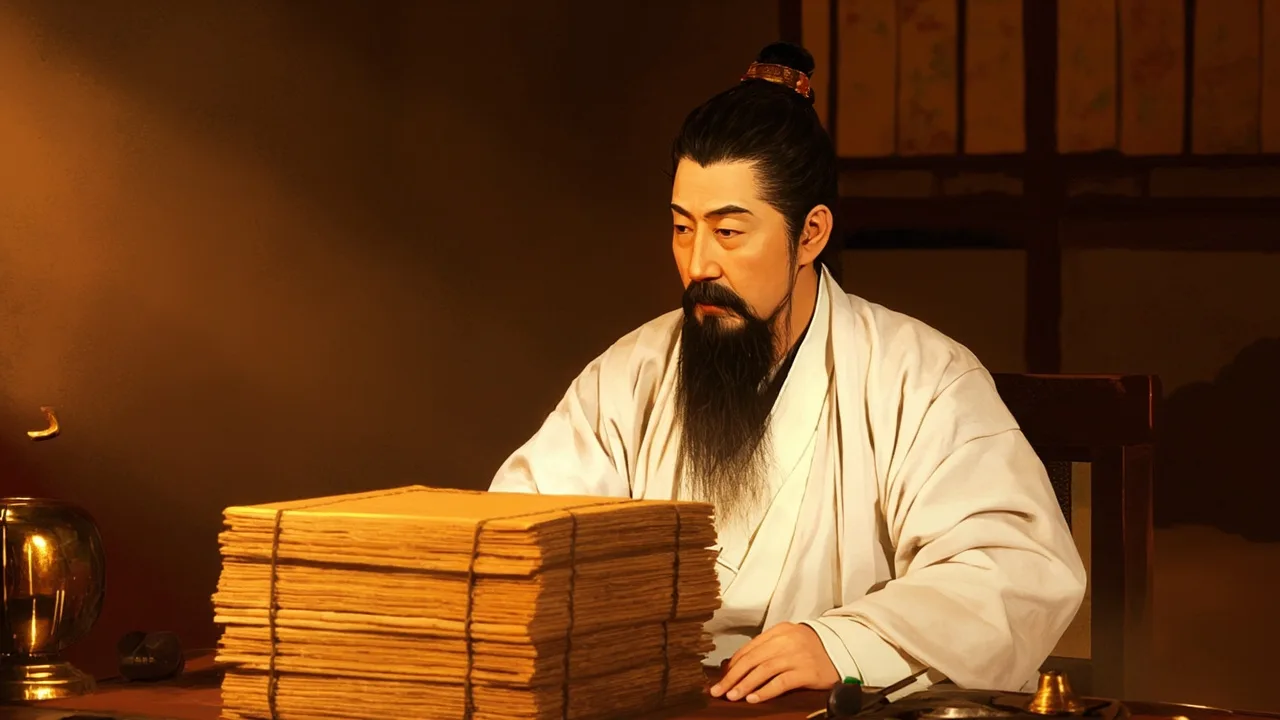
Sima Qian tells us very little about Jing Ke’s early life. We know he came from the state of Wei (卫), a small kingdom that had been absorbed into Qin in 254 BCE. We know he liked books and swordsmanship and that he had spent years drifting between minor courts and minor patrons, the kind of freelance scholar-assassin who was a familiar figure in the late Warring States. He was apparently quiet, fond of drink, capable of great patience, and not particularly impressive on first meeting.
What Sima Qian is most interested in is who refused the job first. Tian Guang (田光), an elderly Yanjun strategist, was the original choice. Tian Guang was too old to travel, so he recommended Jing Ke. Crown Prince Dan then asked Tian Guang to keep the plot secret. Tian Guang went home, slit his own throat, and died standing in his courtyard. The message was clear: secrets of this magnitude are not kept by living men.
Jing Ke was then brought in. He spent weeks preparing. He wanted two things: the head of Fan Yuqi (to make the bribe to Qin more credible), and a reliable assistant. The first he eventually obtained — Fan Yuqi, when told the plan, killed himself and donated his own head. The second caused his eventual undoing.
The assistant was Qin Wuyang (秦舞阳), the thirteen-year-old son of a Yan judicial official. He had a reputation for ferocity in the streets of Yanjing — apparently he would not flinch from killing a man in broad daylight. Sima Qian, who liked his assassins tragic, reports this with a gentle smirk. The choice of Qin Wuyang was a failure of nerve on Jing Ke’s part. He needed a partner who would not break. He got a child who had never been more than ten miles from home.
For readers who want to step into the moment, a [product_affiliate: Silk Scroll Reproduction of the Yi River Farewell — classical Chinese painting on hand-spun silk] captures the melancholy of the famous scene. And for hands-on students of the era, a [product_affiliate: Warring States Period reading set with Shiji, Strategies of the Warring States, and Zhuangzi] puts the right context on your shelf.
The Yi River Farewell: “The Wind Blows Cold on Yi”
In the autumn of 227 BCE, Jing Ke and Qin Wuyang set out from Yanjing, riding south toward Qin. They paused at the Yi River (易水), the border between Yan and the central plains. There, Crown Prince Dan and a crowd of well-wishers in white mourning robes gathered to see them off.
What happened next is one of the most quoted scenes in Chinese literature. The Shiji describes Jing Ke standing on the riverbank, raising his face to the sky, and singing:
风萧萧兮易水寒,壮士一去兮不复还。 Fēng xiāoxiāo xī yì shuǐ hán, zhuàngshì yī qù xī bù fù huán. “The wind blows bleak, bleak — the waters of Yi are cold. The hero goes once, and does not return.”
Sima Qian says the singer had not finished the second verse before the onlookers were too moved to look up. The line itself is the source of an idiom — 易水寒 (yì shuǐ hán), “the Yi River is cold” — used for any farewell from which there is no coming back.
The procession then turned south. Jing Ke did not look back.
Inside the Xianyang Palace: 图穷匕见 (Tú Qióng Bǐ Xiàn)
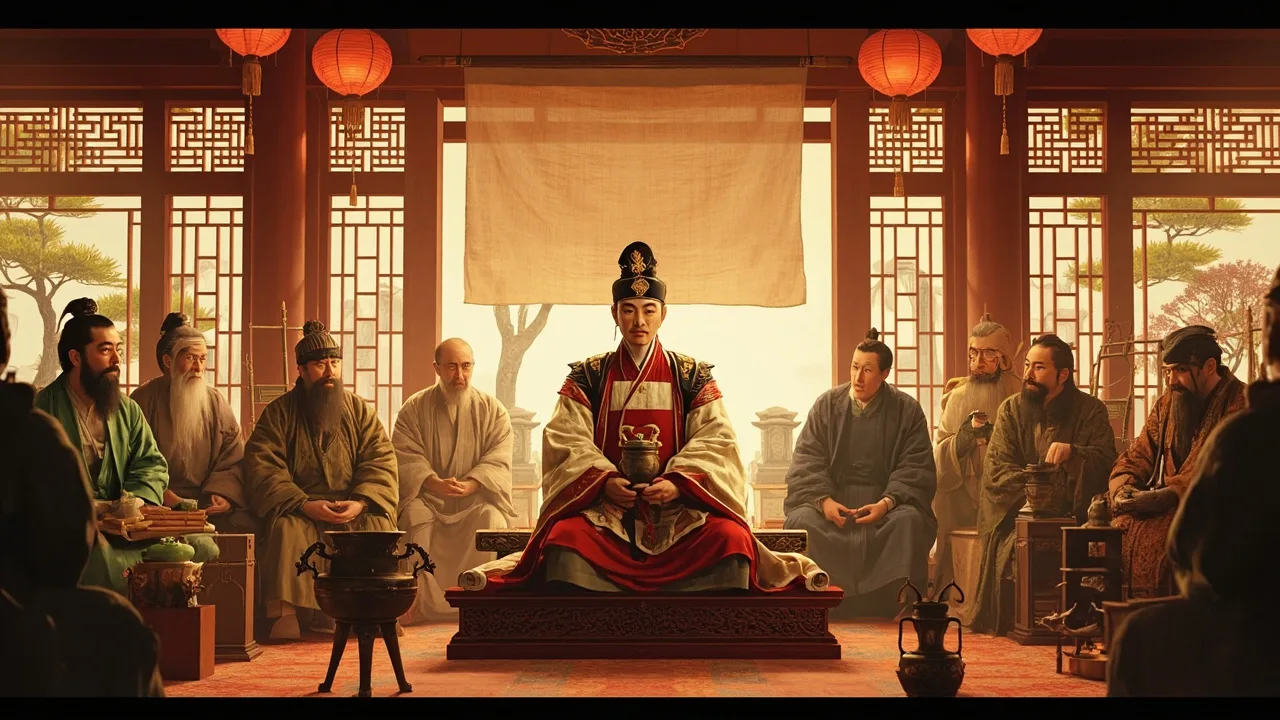
The Qin capital of Xianyang (咸阳), just northwest of modern Xi’an, was the largest palace complex in the world at the time. The diplomatic hall where Ying Zheng received foreign envoys was a long, formal chamber, lined with bronze ritual vessels and ranks of palace guards. The Qin king sat on an elevated dais at the far end.
By Sima Qian’s account, the moment Jing Ke and Qin Wuyang entered the gate, the boy broke. Palace protocol demanded that envoys present their credentials at a measured pace, with composure. Qin Wuyang’s face went the color of ash. The Qin courtiers noticed immediately. They began whispering to each other. Jing Ke, walking slightly behind, turned to look at his young partner and smiled — then, in a quick improvised gesture, set the sealed head-casket down and walked forward alone, blaming the boy’s “village rudeness” for any appearance of nerves.
This is the moment every Chinese student of history remembers. The king ordered the casket opened. It was indeed Fan Yuqi’s head, recognizable. The king was satisfied. He asked to see the map.
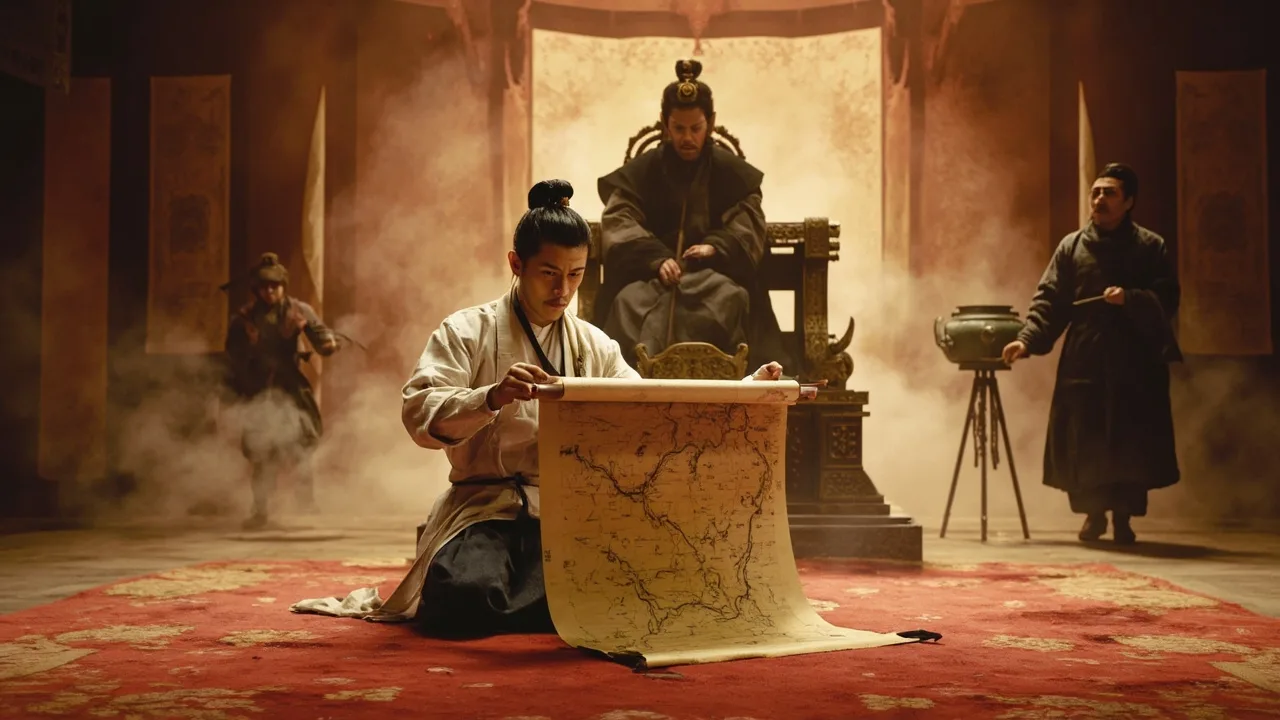
Jing Ke stepped forward. He presented the rolled map of Duyang with both hands. He began to unroll it slowly, inch by inch, presenting each section for inspection. The king leaned forward to look.
And at the end of the roll, where the wooden core of the scroll was, a poisoned dagger — its blade greased with淬 (the word is debated, but most likely refers to a fast-acting poison, possibly arsenic-based or a corrosive herb extract — Shiji simply says the blade was “tested” on a person beforehand) — fell into Jing Ke’s hand.
The idiom 图穷匕见 (tú qióng bǐ xiàn) — “the map ends, the dagger appears” — comes directly from this moment. It still means, in modern Chinese, a hidden intention finally revealed.
Jing Ke grabbed the king’s sleeve with his left hand and lunged. The king jumped back. Shiji says the king’s sleeve ripped off in Jing Ke’s hand. The king tried to draw the long sword he wore at his waist — and could not reach it. The Qin court used a sword hung at the back of the belt, drawn over the shoulder; Ying Zheng had no practice with the motion. The idiom 秦王负剑 (“the King of Qin wearing his sword on his back”) was born in that scramble.
What saved Ying Zheng was a palace physician named Xia Wuju (夏无且), who grabbed his medical satchel and threw it at Jing Ke. The bag hit the assassin in the ribs and bought the king half a second. Ying Zheng got his sword out. He swung. Jing Ke was wounded in the thigh. He dropped the dagger. He threw it instead — eight times, by Sima Qian’s count, all missing — at the king, who dodged.
Then the guards rushed in. Jing Ke, wounded, leaned against a pillar and began to laugh. Shiji quotes him as saying, “I failed because I wanted to capture you alive and extort a treaty from you. That was my mistake.” He was cut down where he stood. Qin Wuyang, by most accounts, was killed in the same room.
For collectors, a [product_affiliate: Warring States bronze ritual vessel replica — ding tripod] evokes the hall where this happened; the real ding tripods the Qin court displayed were enormous, and a tabletop replica gives a sense of their weight. For drama, the [product_affiliate: Three Kingdoms / Warring States illustrated historical novel collection in English translation] keeps the surrounding period alive in readable form.
What the Failure Changed — and Why the Idiom Outlasted the Empire
Two consequences followed Jing Ke’s death: a king’s psychology hardened, and a piece of language was born that the king would never outlive.
How the Attempt Shaped Ying Zheng
The conventional wisdom is that Jing Ke’s attempt hardened Ying Zheng into the emperor he became. The conventional wisdom is mostly right.
Within months of the assassination attempt, Qin turned its full military weight on Yan. In 226 BCE, Wang Ben (王贲) — the same general who had taken Zhao’s Handan — was sent north. Yan collapsed in a single campaign. King Xi of Yan fled the capital. Crown Prince Dan, by Sima Qian’s account, tried to hide in the Liaodong peninsula. King Xi, in a final act of paternal cowardice, sent soldiers to behead his own son and sent the head to Qin as a peace offering. It did not save Yan. The kingdom was formally extinguished in 222 BCE.
The psychological damage to Ying Zheng, however, is what accelerated the final unification. Shiji reports that after Jing Ke, the king became obsessed with personal safety in ways that shaped everything from his daily routines (he slept in different rooms every night) to his palace architecture (he eventually built the famous multi-palace road network connecting Xianyang to the eastern capitals, partly, historians argue, so that an assassin could never learn which building the king would sleep in). The famous underground palace complex at his later mausoleum — guarded by the famous terracotta army — was, in part, the architectural answer to a failed dagger thrust.
More broadly, Jing Ke’s attempt ended any hope of the eastern kingdoms mounting a coordinated resistance. If a determined assassin could walk into the Qin throne room with a poisoned blade, what chance did formal armies have? In 230 BCE, when Qin began its final round of conquests, the remaining kingdoms — Wei, Chu, Yan, Qi — were already negotiating with each other in panic. None of the alliances held. By 221 BCE, six years after Jing Ke’s death, Ying Zheng declared himself Shǐ Huángdì (始皇帝) — the First Emperor. The thousand-year imperial period of Chinese history had begun.
For the broader military and political arc, see the Bai Qi article — the Qin warrior sage whose campaigns a generation earlier had set the table for the final unification that Jing Ke tried to prevent. And for the figure who built the Great Wall and held the empire together after Jing Ke’s generation had passed, see Meng Tian, the Qin general who would face the Xiongnu on the new northern frontier.
How the Idiom Outlasted the Empire
图穷匕见 — the hidden dagger in the scroll — is still used in 2026 to describe any secretly hostile intent that finally emerges. 秦王负剑 — the king who could not reach his own sword — has become, of all things, a modern Chinese shorthand for awkward situations in which one’s own equipment works against one. 易水寒 — the cold waters of Yi — appears in elegies, songs, and film scores. The line 壮士一去兮不复还 has been quoted by every generation of Chinese writers since Sima Qian set it down.
In the 2002 Chen Kaige film The Emperor and the Assassin (《荆轲刺秦王》), the assassination attempt was reimagined as the centerpiece of an entire meditation on what kind of empire China was about to become. In Japanese, Kaikō (荆轲) is still a name that means “the man who tried.” In Korean historical fiction, he shows up as a figure of doomed honor.
Sima Qian, who wrote the account, lived a few decades after these events. He had his own reasons for being sympathetic to men who attempted impossible things and failed. The 刺客列传 — Biographies of Assassins — which includes Jing Ke alongside four other figures, is one of the most-read chapters in the most-read history book in East Asia.
For the modern reader, the story is more than a yarn. It is the question: what do you do when the cards are stacked against you, when the king is unbeatable, when the era is closing? Jing Ke’s answer — practice the bow stance, sing the farewell, walk in alone — was not wisdom. It was not even heroism in the strict sense. It was a man choosing the moment he wanted to be remembered for, knowing he would not be remembered for anything else.
He walked in. The blade appeared. The king survived. The empire came.
Two thousand three hundred years later, schoolchildren in Shanghai still know his name. The king they remember him by, Qin Shi Huang, did not even exist yet.