There’s something quietly devastating about small things refusing to be defeated by large ones. A toddler who keeps getting back up after falling. An ant carrying a crumb ten times its body weight. A songwriter who sends their demo to two hundred labels before one finally calls back. These moments grab us because they echo a story Chinese grandparents have been telling for thousands of years — the legend of Jingwei and her endless war against the sea.
The story goes like this. Once upon a time, the emperor of the Eastern Sea — a figure sometimes identified as the legendary ruler Shaodian — had a daughter. The texts don’t give us her name before the accident, just that she was young, curious, and apparently prone to wandering near dangerous places. One day, while playing by the shore of the Eastern Sea, she drowned. The currents were swift, the rocks were slippery, and before anyone could reach her, she was gone.
But this isn’t a story about grief, or at least not only about that.
From Princess to Bird
According to the version preserved in Shan Hai Jing (The Classic of Mountains and Seas), the girl’s spirit did not simply fade away. Instead, she transformed. Her soul took the form of a bird — most descriptions say it resembled a crow but with distinctive white markings and a red beak. The bird’s call sounded like its name: jingwei. People began calling it the Jingwei bird.
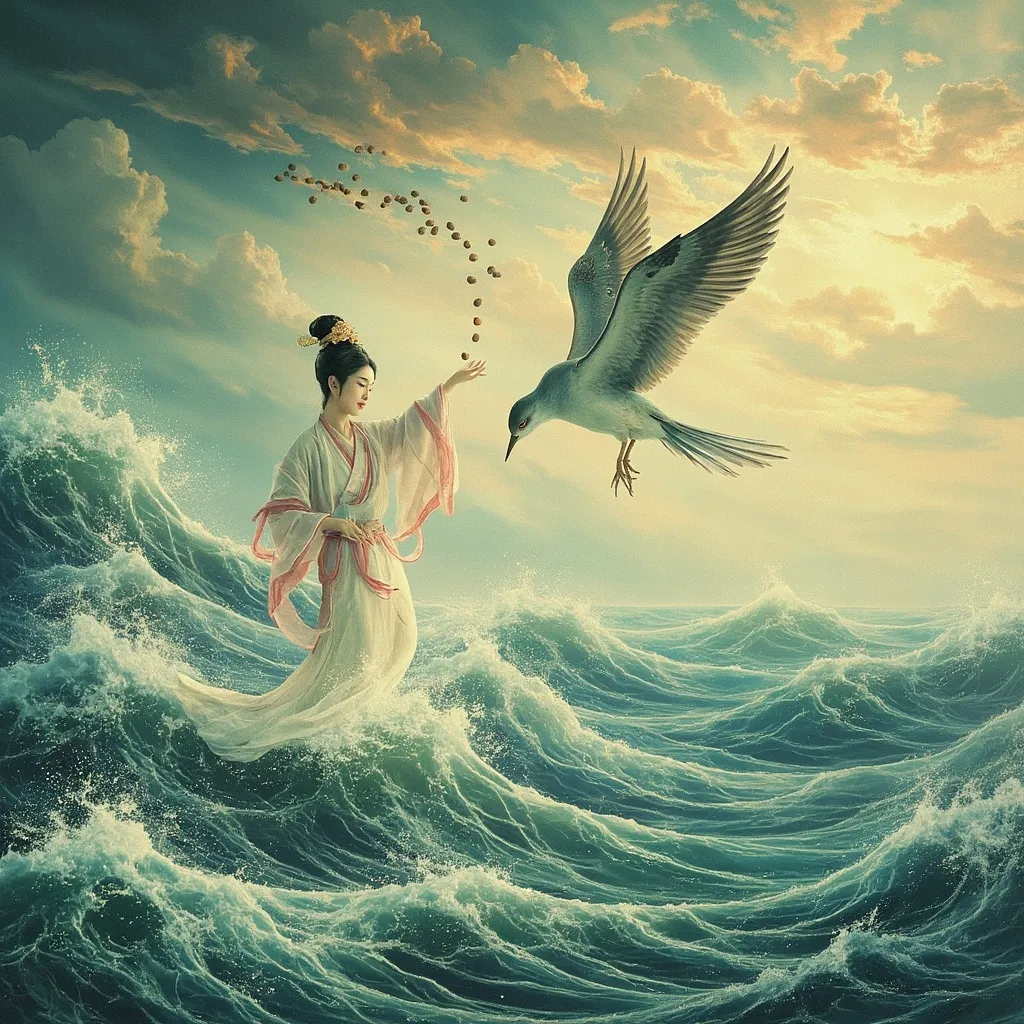
The transformation wasn’t just symbolic. The newly-raised Jingwei seemed driven by something that looked a lot like anger, or maybe purpose. Every day, she flew from her home in the mountains to the sea where she had died. In her beak, she carried twigs, leaves, pebbles, anything small enough to grip. She dropped these into the water. Then she flew back, found another piece, and did it again. And again. Every single day, for the rest of recorded time.
The sea, naturally, was not impressed. It didn’t shrink. The water didn’t part. No matter how many loads she carried, the vast eastern ocean continued doing what oceans do — rolling, swelling, swallowing everything she offered. By any rational measure, this was pointless. An insect trying to drain an ocean with a drinking straw would have made better progress.
But Jingwei didn’t stop.
The Logic of Impossible Tasks
What makes this story stick around for over two thousand years? I think it’s because it speaks to something we all recognize but rarely name: the experience of being overwhelmed by circumstances so much larger than yourself that action feels absurd, yet acting anyway feels like the only honest response.
The original Shan Hai Jing passage is brief — maybe a hundred characters. It doesn’t moralize or explain. It just states what happened: the girl drowned, became a bird, and now she fills the sea with pebbles and twigs. That’s it. The beauty is in the understatement.
Later retellings added texture. Some say Jingwei was the daughter of the sun-goddess or a river god, which adds cosmic stakes to the tragedy. Others focus on the bird’s appearance — its feathers were said to be a striking combination of black and white, or sometimes described as flame-red, depending on the region telling the story. The details vary, but the core image remains constant: a small bird, unending labor, a sea that doesn’t care.
The phrase jingwei tian hai (精卫填海) entered the Chinese vocabulary as an idiom for extraordinarily stubborn perseverance. It’s not a flattering, heroic image the way, say, slaying a dragon is. It’s smaller and more uncomfortable. It suggests someone who knows they cannot win but refuses to quit anyway. There’s something almost uncomfortable about admiring that, because it implies we should behave similarly in our own lost causes — and most of us don’t want to commit to that.
What the Sea Stood For
The Eastern Sea in ancient Chinese cosmology wasn’t just a body of water. It was the edge of the known world, a realm associated with immortals, strange creatures, and things that existed beyond human reach. The Shan Hai Jing describes it as a place where the sun bathed and the gulf between the living and dead felt thin. For a young girl to die there was particularly tragic — she hadn’t just drowned, she had crossed into a domain where human concerns meant nothing.
This context matters. Jingwei wasn’t just fighting water. She was fighting the indifference of a universe that had already taken everything from her. The pebbles and twigs were not going to win. But they were hers to offer, and offering them — day after day, century after century — was her way of saying the sea had not had the last word.
I find myself thinking about this story when I’m working on something that feels futile. Writing, for instance. You write something, you send it out, you get nothing back. You write again. You send again. The sea doesn’t notice. But you keep going, not because you believe you’ll drain the ocean but because stopping would mean accepting that it had won. The act of continuing is itself the point.
The Story in Art and Culture
Chinese painters have depicted Jingwei many times over the centuries, though the imagery is harder than you might expect. How do you paint determination? The traditional solution was usually to emphasize the scale differential — a tiny bird at the edge of an enormous sea, its small form dwarfed by the waves but somehow still present, still active. The bird is always shown flying, always shown carrying something. Resting would be out of character.
The earliest visual representations appear in tomb murals from the Han dynasty, where Jingwei is shown as a small bird near large waves, sometimes accompanied by text identifying the scene. These weren’t dramatic oil paintings — they were moral illustrations, meant to remind viewers that persistence in the face of impossible odds was a virtue worth cultivating. The bird’s smallness against the vastness of the sea was the entire point. It was supposed to make you uncomfortable.
Later painters took more liberties. Song dynasty artists depicted Jingwei with particular elegance, using the scene as an excuse to showcase technical skill in rendering water — crashing waves, frothy currents, the terrible beauty of the ocean that had killed her. Some of these paintings included miniature mountains in the background, suggesting the bird had traveled far from her home to reach this place of grief and purpose. The scale play became almost theatrical: a speck of life against an ocean that didn’t notice her.
In Japanese culture, which borrowed and adapted many Chinese mythological figures, Jingwei appears as a cautionary tale about pride and the limits of human ambition. The sea is vast; you are small; know your place. That’s one reading. But the Chinese version feels less moralistic to me. Jingwei isn’t prideful. She’s grieving. And she’s choosing to grieve by doing something, anything, rather than by surrendering to despair.
Regional Variations and the Bird’s Identity
One of the interesting things about this story is how much the bird itself varies by region. In coastal provinces like Fujian and Zhejiang, where fishing communities had direct relationships with the sea and its dangers, the Jingwei story was told with particular intensity. The bird was sometimes described as having magical properties — its calls were said to predict storms, its presence near a shore meant the waters were treacherous. Sailors watched for it. The bird that symbolized futile persistence was also, paradoxically, a navigational warning.
In northern China, far from the sea, the story took on different coloring. The bird was sometimes described as living near a particular mountain spring rather than the ocean, and the “sea” she sought to fill was interpreted more metaphorically — as a metaphor for loss that could not be reversed, a grief that could not be resolved. The physical specificity of the Eastern Sea gave way to something more abstract: the sea as the thing that takes people from you.
Some folk versions of the story add romantic or tragic details that don’t appear in the classical texts. A girl playing by the water. A sudden storm. A lover who drowned trying to save her. The bird’s persistence becomes an act of mourning that extends beyond death. These versions are harder to verify historically but feel emotionally true in ways the austere Shan Hai Jing passage does not. They add human stakes to what might otherwise read as a nature myth about a particularly stubborn bird.
The scholarly consensus is that the “original” story — if such a thing exists — is the one in Shan Hai Jing, and that later embellishments accumulated over centuries of retelling. But I find myself equally interested in both layers. The bare bones of Shan Hai Jing tell us something about what ancient Chinese people found worth preserving: the image of a bird that did not accept the finality of death’s domain. The later elaborations tell us what subsequent generations wanted to add: context, emotion, human names and faces, the specific textures of loss that the original author had left blank.
What We Leave Behind
The ending of the Jingwei story is unusual among mythological tales: it doesn’t have one. The bird is still flying. The sea is still there. The pebbles are still falling, one by one, into water that will never fill. This open-endedness bothered some later commentators, who felt that stories should resolve, that even myths needed conclusions. Some attempted to supply one — versions where the sea finally relented, where the bird succeeded, where the grief was somehow answered.
But these feel like comfortable lies we tell ourselves. The more honest version is the one that simply continues. Jingwei filling the sea is not a story with an ending. It is a picture of a way of being. You do the work. You make your small offerings to the indifferent vastness. You do not stop because stopping would mean something worse than failure.
I think about what we leave behind, all of us. Not in the sense of legacy or monuments, but in the sense of the small things we do that outlast us. The writer who spent decades on a book that sold five hundred copies. The teacher who taught the same lesson to fifteen-year-olds for forty years, most of whom forgot it the moment finals ended. The parent who raised children who grew up to make completely different choices than the ones they were taught. These things feel like pebbles dropped into an ocean. They don’t move the water. But they’re there, at the bottom, part of the seabed now.
Maybe that’s what Jingwei represents — not success, but presence. The refusal to be erased. The insistence on participating in a world that does not require our participation and would not miss us if we withdrew it. She could have dissipated after death, faded into whatever follows the end of consciousness. Instead, she chose to be a bird, and to fly, and to carry things, and to keep doing it.
That’s not nothing. That’s actually quite a lot.
The story also shows up in the modern Chinese internet as a symbol for people fighting against overwhelming systems — student activists, small businesses competing against giants, anyone who keeps pushing when the odds make it irrational. It’s a rare piece of ancient literature that still feels genuinely relevant to daily life, not because we believe in sun-goddesses or spirit-birds, but because we all know what it feels like to be the small thing refusing to be crushed by the large one.
Why It Still Resonates
There’s a version of the story where Jingwei eventually succeeds — or at least, the legends split. Some say the sea was eventually filled and became land, and this is why the eastern coast of China has the geography it does. Geologists would disagree, but that’s not really the point. The myth isn’t about literal truth. It’s about the shape of certain kinds of human experience.
We all face seas. Some of them we can swim across with enough skill and luck. Others — the ones that took someone we loved, the ones that swallowed our plans whole — we cannot cross and we cannot drain. The question the Jingwei story poses is simple: what do you do with that knowledge?
Most of us, honestly, do nothing. We grieve, we accept, we move on. These are sensible responses. But Jingwei suggests another option: pick up a pebble. Carry it to the water. Drop it in. Do it again tomorrow. Not because it will work, but because it is the only honest response to a universe that sometimes destroys innocent things for no reason.
It’s a grim story with a strange kind of hope buried inside it. Not the hope that says things will get better. The hope that says: I am still here, and I have not forgotten, and I will not pretend that what happened was acceptable. That feels like enough. It might even be everything.
Recommended Reading and Products
Disclosure: This article contains affiliate links. We earn a commission on qualifying purchases, at no extra cost to you.