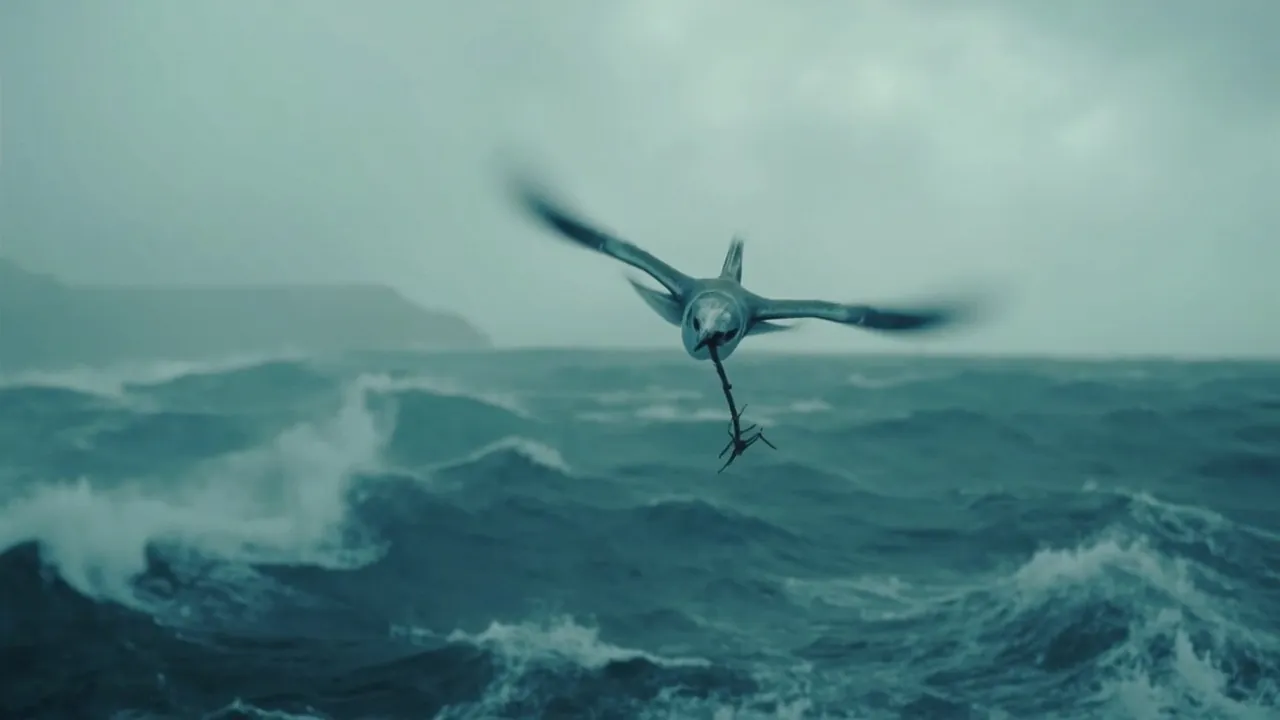
Among the great rivers and seas of the Chinese mythological imagination, no creature has ever chosen a more absurd task than the small bird called 精卫 — Jingwei. Every day, year after year, century after century, she flies from her mountain home down to the Eastern Sea, picks up a single twig or pebble in her beak, drops it into the water, and flies back to the mountain to begin again. The sea is enormous. She is tiny. The disproportion is absurd. And she has been doing it for over three thousand years without stopping.
The story of Jingwei filling the sea is one of the oldest and most loved myths in the Chinese tradition. It is also one of the most quoted. In modern China, on social media and in everyday speech, 精卫填海 — Jingwei filling the sea — has become a slogan for anyone taking on a task that looks impossible, especially young people working toward goals that older generations tell them are out of reach. The bird has become a patron saint of stubbornness in the face of overwhelming odds.
But to understand why Jingwei does what she does, you have to know what happened to her before she became a bird. And that story, like the bird’s task, is more complicated and more painful than it first appears.
The Girl Who Walked into the Sea
The original Jingwei was not a bird. According to the 山海经 — Shan Hai Jing, the Classic of Mountains and Seas, the ancient compendium of geography and mythology that records so many of the foundational Chinese myths, the bird we now call Jingwei was once a girl named 女娃 — Nüwa (not to be confused with the creator goddess of the same pronunciation but different characters). She was the daughter of 炎帝 — Yandi, the Flame Emperor, one of the legendary culture heroes said to have ruled China in the dim era before the historical dynasties.
The Shan Hai Jing tells the story in just a few sentences, but those sentences carry a lot of weight. Young Nüwa, the text says, went down to the 东海 — Dong Hai, the Eastern Sea — to play. The waters looked inviting. She waded in. She was small and the water was deep, and somewhere in the middle of a wave, she drowned.
This is, by the standards of Chinese myth, an unusually small event. Other legends in the same text involve cosmic confrontations and divine interventions. Nüwa’s drowning is just an accident. A child wandering into deep water. A death that, in any ordinary family, would simply have been mourned and remembered as a sad story.
But Nüwa was not an ordinary child. Her father was the Flame Emperor, and the family of the Flame Emperor did not lose children without response.
From Grief, a Bird
What happened next is recorded in one of the most haunting transformations in the Chinese mythological tradition.
The Flame Emperor, the legend says, transformed the soul of his drowned daughter into a small bird. The bird kept the shape of her cry — Jingwei, Jingwei, they named her, after the sound she made — and she carried, somewhere inside her tiny body, all the grief and rage that her father had poured into her when he brought her back.
According to the Shan Hai Jing, Jingwei’s plumage is distinctive: she has a pattern of blue-black markings on her head that resembles a coral formation, and her wings carry patterns of red and white that, in classical Chinese poetry, are sometimes compared to ornamental flowers. She is small enough to sit in a child’s cupped hands. She is also, in the language of the text, possessed of the will of a daughter who has lost everything.
What does a daughter who has lost everything do with the will of a daughter who has lost everything?
She goes back to the sea that killed her. And she begins the impossible task of filling it.
The Work That Cannot Be Finished
The image that the Shan Hai Jing gives us of Jingwei is striking in its stubbornness. She flies from her home at 发鸠山 — Fajiushan, Mount Fajiu (a mountain traditionally located somewhere in what is now Shanxi Province), down to the Eastern Sea. She picks up a small stone or a twig from the mountain. She carries it to the sea in her beak. She drops it into the water. She turns around. She flies back to the mountain.
And then she does it again.
Tomorrow. And the day after. And the day after that.
This is the whole of her labor. There is no clever strategy. There is no magical ability. There is no shortcut through the work. She is a small bird trying to fill an enormous sea with small stones and small twigs, one at a time, forever.
The Chinese readers who first heard this story would have understood immediately what makes it so striking. The Eastern Sea is not just any body of water. In Chinese cosmology, it is one of the four cardinal seas that bound the known world. To fill it is not like filling a pond. It is like trying to empty the ocean with a teaspoon. The disproportion between the laborer and the task is not a small detail. It is the entire point.
And yet Jingwei does not stop. She has been doing this for thousands of years and shows no sign of stopping. She will be doing it long after everyone alive today is dead. The work is not a project. It is a vocation.
The Myth of Small Efforts
The story of Jingwei has been told in China for at least two and a half thousand years. The Shan Hai Jing itself dates from approximately the fourth to first centuries BCE, although the stories it contains are much older. From the beginning, Chinese readers have recognized the myth as a parable about perseverance.
But perseverance is too simple a word for what Jingwei represents. What makes her story powerful is not just that she keeps going. Many figures in world mythology keep going in the face of difficulty. What makes Jingwei distinctive is that she keeps going in the face of obvious impossibility. She is not making progress. She is not getting closer to her goal. She is performing an act of defiance against a force that cannot, in any reasonable calculation, be defeated by the means she is using.
This is what makes the myth useful as a teaching story. The Chinese tradition has long valued the willingness to begin a task even when the task cannot be completed. The idiom 精卫填海 has been invoked in countless contexts: by scholars preparing for examinations that they knew they might fail, by officials trying to reform systems that seemed too entrenched to change, by parents trying to support children in the face of overwhelming social pressure. The message is not that the work will succeed. The message is that the work is worth doing because it is the right work to do, regardless of outcome.
There is something deeply Confucian about this framing. The Confucian tradition does not promise that virtue will be rewarded. It argues that virtue is the appropriate response to circumstance, and that the appropriateness of the response is what matters, not its consequences. Jingwei is the mythical embodiment of this principle. She is doing the right thing. The sea is not getting any smaller. She does it anyway.
Modern Jingweis
Perhaps the most striking thing about Jingwei in the twenty-first century is how widely the myth has been adopted by young Chinese people as a personal motto.
On the Chinese internet, especially among so-called 躺平 — tang ping, “lying flat” — and 摆烂 — bai lan, “letting it rot” — discussions about whether the relentless pressure of modern Chinese society is worth engaging with, Jingwei appears as a counter-symbol. She is the figure who refused to accept defeat, who refused to lie flat, who decided that the appropriate response to an overwhelming force was to push back against it, one small effort at a time.
The phrase “Jingwei filling the sea” has been used to describe students grinding through impossible exam preparations, young workers staying late on impossible deadlines, founders trying to build businesses in saturated markets, even ordinary people trying to maintain family relationships under the strain of modern life. In each case, the comparison is to a small bird who has decided that the appropriate response to an overwhelming force is to keep working.
There is also a darker reading. Some commentators point out that Jingwei’s task is, by any objective measure, futile. The sea will not be filled. The twigs and pebbles will not make a difference. The myth, in this reading, can be used to justify any amount of pointless suffering in the name of perseverance. A society that worships Jingwei, these critics suggest, is a society that has internalized the message that effort is its own reward, even when the effort accomplishes nothing.
The Chinese tradition has wrestled with this tension for centuries. The Confucian commitment to doing the right thing regardless of outcome has always had critics, including some within the Confucian tradition itself. The Daoist tradition, with its emphasis on working with the grain of the natural world rather than against it, offers a different model — one that would say Jingwei is fighting the wrong battle. The myth is rich enough to support both readings.
The Sea She Died In
What is sometimes forgotten in discussions of perseverance is the human story at the heart of the Jingwei myth.
A girl went down to the sea to play. She drowned. Her father, the Flame Emperor, transformed her into a bird rather than letting her go. The transformation is not a happy ending. It is an expression of grief so extreme that it changes the substance of what grief is acting upon. The bird is not a consolation for the dead girl. The bird is the dead girl, continuing to exist in a form that allows her to act, and the action she takes is shaped by the circumstances of her death.
Jingwei fills the sea because the sea killed her. She does it not because she believes she will succeed — the Chinese tradition never claims that she will succeed — but because the act of filling the sea is, in some profound way, the only thing she can do with the life that remains to her.
This is why the myth is not just a parable about perseverance. It is also a parable about grief, and about the strange forms that grief can take when it has no other outlet. Jingwei is, in a sense, the mythical figure of all those who have lost something that cannot be recovered, and who have responded by throwing themselves into the impossible task of recovering it anyway.
The twig in her beak is a small thing. The sea is enormous. The disproportion is the entire point.
Recommended Reading and Products
For readers who want to keep exploring the legend of Jingwei and the wider world of Chinese mythological birds, mountains, and seas, these resources are a good place to start:
- Chinese Mythology Comic — An illustrated comic-book retelling of major Chinese myths including the legend of Jingwei, the Flame Emperor’s family, and the strange creatures of the Shan Hai Jing; an accessible entry point for readers who enjoy visual storytelling.
- Sea Pebble Collection Set — A curated set of small smooth pebbles from coastal waters, the kind of object that evokes the tiny stones Jingwei carries one at a time to the Eastern Sea; a tactile reminder that even the smallest contributions can carry mythic weight.
- Calligraphy Set — A traditional Chinese calligraphy set with brush, ink stone, ink stick, and rice paper, suitable for writing out the Chinese characters 精卫填海 or one of the classical poems about Jingwei; a way of connecting the modern writer to the long tradition of keeping these myths alive through written language.
- Ancient China Story Collection — A curated anthology of the most loved legends from ancient China, including the myth of Jingwei, the story of Nüwa, and the tales of the legendary emperors who shaped the early Chinese world.
Disclosure: This article contains affiliate links. We earn a commission on qualifying purchases, at no extra cost to you.