Kong Rong Giving Up the Pear: Ancient Wisdom on Humility and Respect
There’s something about watching a young child demonstrate wisdom that adults struggle to muster that just stops you in your tracks. When I first read about Kong Rong and the pears, I found myself wondering how a child could possess such clarity about something that many of us spend entire lifetimes trying to learn. The story has been told in Chinese households for nearly two thousand years, and it still hits with the same force today as it did when it was first recorded.
Kong Rong lived during the late Eastern Han Dynasty, a time of considerable political turmoil and social upheaval in China. Born in 153 CE, he would go on to become one of the most celebrated scholars and officials of his age, known not just for his intellectual abilities but for his extraordinary moral character. And according to the historical record, that moral character was evident from the very beginning.
The Pear Incident: What Really Happened
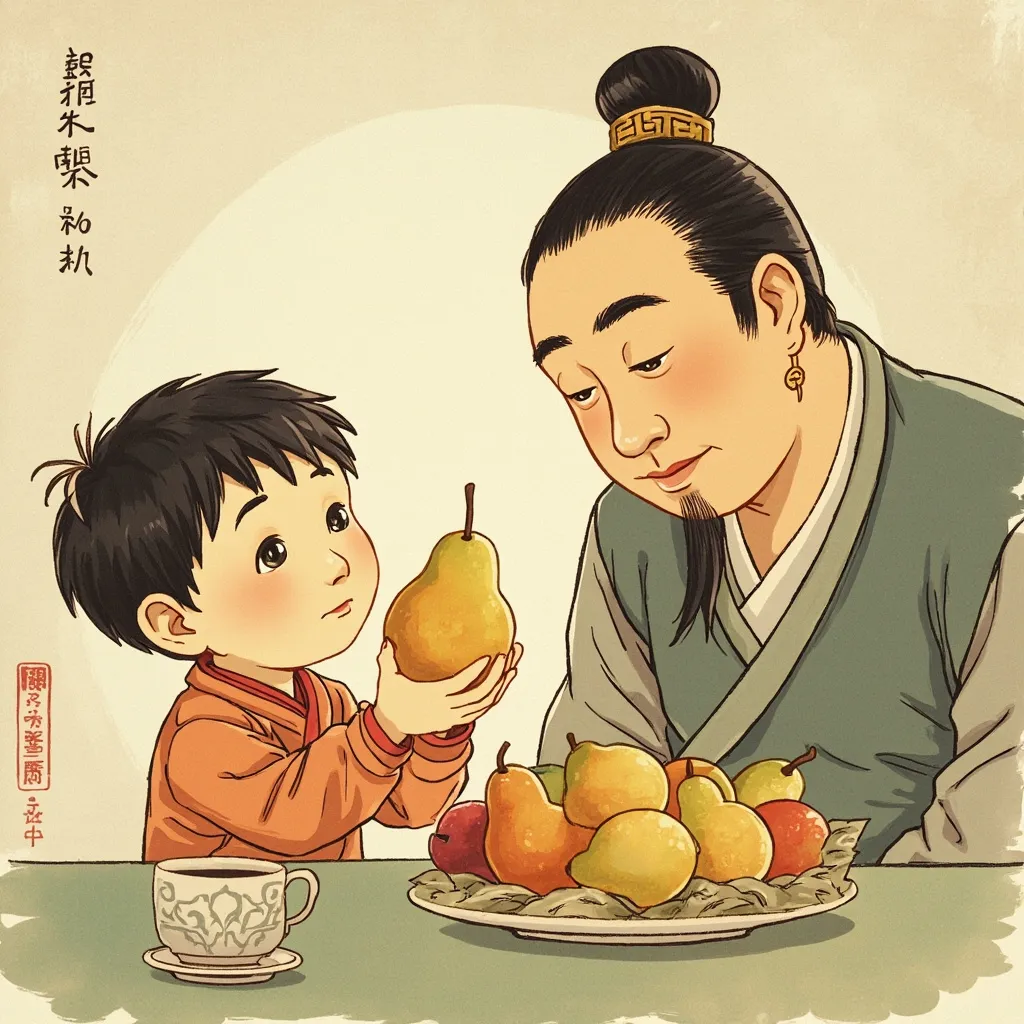
The story takes place when Kong Rong was just four years old—young enough that most children today are still learning basic coordination, yet Kong Rong was already demonstrating the kind of selflessness that would define his adult life.
One autumn day, Kong Rong’s father brought home some fresh pears from the market. These weren’t ordinary pears—they were large, fragrant, and clearly delicious. The kind of fruit that would have been a genuine treat in an era before global trade and year-round availability.
The family gathered to share the pears, and naturally, each of the children was given one to eat. Now, here’s where the story gets interesting. When the pears were distributed, young Kong Rong reached out and took the smallest pear for himself, leaving the larger ones for his older brothers.
At first glance, this might seem like a simple act of restraint or politeness. But in the context of traditional Chinese family dynamics and Confucian values, this was actually quite remarkable. The principle of respecting elders was (and remains) a cornerstone of Chinese society, but actually practicing it—especially when something as desirable as a fresh pear was at stake—required genuine moral effort.
When asked about his choice, Kong Rong reportedly said something to the effect that he was younger than his brothers and should therefore take the smallest portion. This wasn’t false modesty or an attempt to appear virtuous; it was a genuine expression of a value system that Kong Rong’s family had clearly instilled in him from an early age.
The Broader Context: Why This Story Resonated
The Kong Rong who emerged as an adult was a fascinating figure. He became a renowned scholar, famous for his literary talent and his mastery of the classical texts. He served in various governmental positions and was known for being outspoken about corruption and moral failings in the imperial court. This last characteristic would eventually cost him his life, but that’s a story for another day.
What I find most interesting about the story of the pears is that it represents a kind of moral intuition that Kong Rong possessed. He wasn’t thinking about the strategic benefits of appearing humble. He wasn’t calculating how this behavior would be perceived by adults. He simply saw the situation clearly for what it was—a chance to demonstrate respect for his elders—and acted accordingly.
In modern psychological terms, this is what researchers call “moral intuition.” It’s the ability to recognize what the right course of action is in a given situation and to act on that recognition without extensive deliberation. Moral philosophers have debated for centuries about whether virtue can be taught or whether it’s something you’re born with, but Kong Rong’s story suggests that at least some moral insight comes from proper upbringing and genuine understanding of one’s place within a larger social framework.
Confucian Roots: The Philosophy Behind the Gesture
To fully appreciate what Kong Rong did, you need to understand the cultural context in which he lived. The Eastern Han Dynasty was a time when Confucianism had become the dominant philosophical and ethical system in China. Its emphasis on proper relationships, social harmony, and moral cultivation had deeply influenced how families raised their children and how society expected individuals to behave.
Confucius himself had emphasized the importance of filial piety—the respect and devotion that children owe to their parents and elders. But Kong Rong’s gesture went beyond mere obedience. He was actively subordinating his own desires to the preferences of others, and he was doing so voluntarily and cheerfully.
This is a subtle but important distinction. Confucian ethics isn’t just about following rules; it’s about cultivating a genuine orientation toward virtue. The ideal is to be the kind of person who naturally gravitates toward the right action, not because of external reward or punishment, but because of an internalized sense of what is good and proper.
Kong Rong, at four years old, appears to have had this internalized sense to an unusual degree. His choice wasn’t reluctant compliance with an external demand; it was the natural expression of how he understood his relationship to his brothers and to his family as a whole.
What This Story Teaches About Modern Parenting
There’s a lot that contemporary parents can learn from the Kong Rong story, even though we’re living in a very different world from the one Kong Rong inhabited. Modern Western culture, in particular, tends to emphasize individual achievement and self-expression, sometimes at the expense of the kind of selflessness that Kong Rong demonstrated.
I’m not suggesting we should force our children to always give up the best things for others—that would be unrealistic and potentially harmful to their healthy development. But there is something valuable in teaching children that their choices have implications for others, and that considering others’ needs isn’t a form of weakness or self-denial but rather a mark of genuine strength and maturity.
The Kong Rong story also illustrates the importance of modeling behavior for children. Kong Rong didn’t learn humility and respect for elders from a textbook or a lecture; he learned it from observing how adults in his life conducted themselves and from being raised in an environment where these values were lived, not just proclaimed.
This is one of the oldest insights in educational psychology, and it remains as true today as it was two thousand years ago. Children are remarkably perceptive observers of adult behavior, and they tend to internalize what adults do far more readily than what adults say. If we want our children to be generous, we need to be generous. If we want them to be respectful, we need to demonstrate respect in our own interactions.
The Irony of Kong Rong’s Later Life
Here’s something that makes the Kong Rong story particularly poignant: the same integrity and moral courage that he demonstrated as a child ultimately led to his death. As an adult, Kong Rong served in the Han imperial court during one of its most corrupt periods. When warlords began to consolidate power and threaten the emperor, Kong Rong spoke out against the injustice he saw.
His blunt criticism of those in power made him many enemies, and he was eventually executed by the warlord Cao Cao in 208 CE. The boy who had given up the largest pear for the sake of harmony became the man who could not stay silent when harmony was destroyed by tyranny and corruption.
This ending might seem like a tragedy, but I think it actually deepens the meaning of the original story. Kong Rong’s childhood gesture wasn’t a performance of virtue that he would later abandon; it was the early expression of a character that would remain consistent throughout his life. The same impulse that led him to take the smallest pear—the desire to do what was right rather than what was advantageous—led him to speak truth to power even when it would cost him everything.
Applying Kong Rong’s Wisdom to Our Own Lives
So what does this ancient story have to say to us in the twenty-first century? I think there are several practical takeaways that can help us navigate our own challenges and relationships.
First, the story reminds us that true humility isn’t false modesty or self-deprecation. Kong Rong didn’t pretend to be worse than he was or pretend not to want the pear. He simply recognized that his position in the family—as a younger child—came with certain responsibilities and privileges, and he acted accordingly. Real humility is about accurate self-understanding: knowing your strengths without arrogance and your limitations without shame.
Second, the story suggests that our small daily choices matter. The Kong Rong incident was a minor event in the larger context of his life, but it revealed something fundamental about his character. The way we behave in small moments—when no one important is watching, when the stakes seem low—is often a reliable indicator of who we really are. Cultivating good habits in small things creates a foundation for virtue in larger ones.
Third, there’s something to be said for the courage it takes to be different. In a family where all the children presumably wanted the largest pear, Kong Rong’s choice to take the smallest was its own form of courage. It required him to go against the grain, to resist the pull of immediate gratification in favor of a higher principle. This kind of moral courage isn’t easy, even in small things, and acknowledging how difficult it is makes Kong Rong’s achievement all the more admirable.
Why Stories Like This Endure
I’ve been thinking a lot about why certain stories survive for millennia while others fade into obscurity. The Kong Rong story has been told in Chinese households for nearly two thousand years, and it shows no signs of losing its power. It has been adapted into plays, novels, children’s books, and animated films. Parents still use it as a teaching tool, and the phrase “Kong Rong giving up the pears” (孔融让梨) has become a common Chinese expression for showing consideration for others.
I think the story endures because it speaks to something universal in human experience. The tension between self-interest and generosity, between immediate gratification and long-term good—these are challenges that every human society has had to grapple with. The Kong Rong story offers a simple but powerful model for how to navigate this tension: with grace, with selflessness, and with a clear sense of one’s proper place in the social fabric.
There’s also something appealing about the story’s simplicity. It doesn’t require elaborate explanations of political context or philosophical nuance. Even a four-year-old can understand that taking the smaller pear for your elders is a good thing. This accessibility contributes to the story’s durability; it can be told and understood at multiple levels of sophistication, making it useful for everyone from young children to adult philosophers.
Conclusion: Lessons in Small Gestures
As I finish thinking about Kong Rong and his pears, I’m left with a sense of how much wisdom can be packed into a single small gesture. This boy, barely old enough to reach the table, managed to encapsulate principles that moral philosophers have spent lifetimes trying to articulate. His story reminds us that virtue isn’t necessarily complicated, that the small choices we make every day reveal and shape our character, and that true wisdom sometimes looks like simplicity.
The next time you’re in a situation where there’s not enough to go around, where someone has to give something up for others to benefit, remember Kong Rong. It doesn’t mean you always have to take the smallest portion or make yourself miserable for others’ sake. But it does mean pausing for a moment to consider the impact of your choices, to think about your place in the relationships and communities that give your life meaning, and to act with a generosity that comes from genuine self-understanding rather than mere calculation.
Two thousand years later, the boy who gave up the largest pear still has something to teach us.