Every culture has its stories about humans reaching for something beyond their grasp. The Greeks have Icarus, flying too close to the sun and falling. The Americans have the cowboys who ride into the sunset, knowing they’ll probably never make it but riding anyway. The Chinese have 夸父 — Kuafu — a giant who looked at the sun, decided it needed to be caught, and spent his entire life chasing it across the sky.
What makes Kuafu’s story different from Icarus isn’t just the scale — though the scale is staggering. What makes it different is what happens after. Icarus falls. That’s the story. Kuafu dies — but his death isn’t the end. It’s not even close to the end. And if you think about it long enough, Kuafu’s story might actually be the more hopeful one.
Because Kuafu teaches us something important about ambition: that the people who attempt impossible things, even when they fail, change the world in ways the cautious never could. And sometimes, the way they fail is itself a kind of victory.
The Giant Who Looked at the Sun and Wanted It
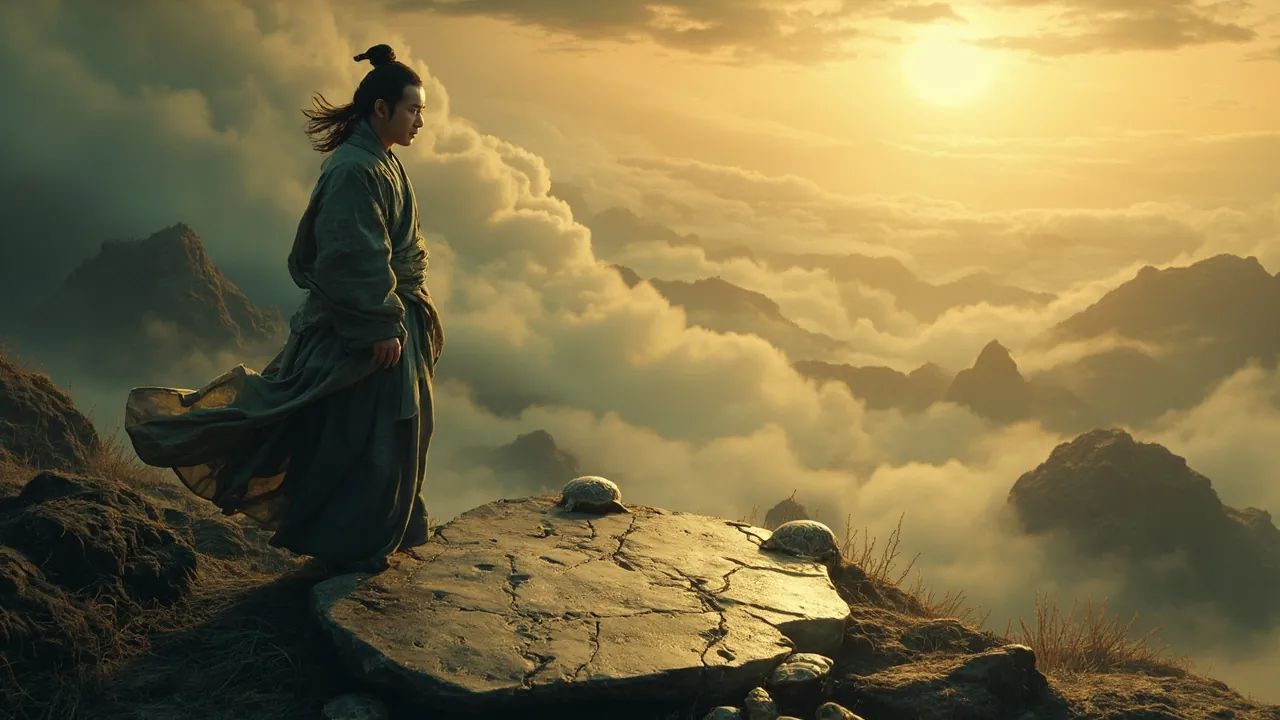
Kuafu was one of a race of giants in ancient Chinese mythology — tall enough to stride across mountains, fast enough to outrun any mortal man, strong enough to wrestle bears. He lived during a time when the world was still being shaped, when gods and humans existed in closer proximity, when the boundaries between what was possible and what was not had not yet been firmly established.
And Kuafu, being a giant, looked at the world and found it wanting. Specifically, he looked at the sun — this blazing, impossible thing that crossed the sky every single day, bringing light and warmth and the rhythm of life — and he decided it was too much trouble. The sun rose in the east and set in the west, and every day Kuafu watched it go, and every day he thought: why? Why does it leave? Why doesn’t it stay?
At first, he tried to solve the problem practically. He demanded that the sun stay in the sky longer. He asked it to slow down, to linger, to give people more light, more warmth, more time. The sun, being the sun, ignored him. It rose and set on its own schedule, indifferent to the preferences of giants.
This made Kuafu angry. And Kuafu, being a giant, expressed his anger at a scale that reshaped the earth.
He would catch the sun. He would grab it — this burning, brilliant ball of fire that blazed across the sky — and he would hold it in place. He would make it stay. He would force the sun to give people the light they deserved.
It was, by any rational measure, the most absurd ambition in the history of mythological beings. The sun is a star. It is incomprehensibly vast. It is a ball of nuclear fire 93 million miles away. Kuafu was a giant, but he was still, in cosmic terms, roughly the size of a dust mite trying to catch a bonfire by running at it. The physics did not favor him.
Kuafu started running anyway.
The Chase Across the World
The myth describes Kuafu’s chase in terms that are almost geographic. He ran east, following the sun’s path, chasing it from horizon to horizon. He was so fast that rivers bent backward as he passed them. Mountains crumbled in his wake. He ran through the desert, through the plains, through the great rivers of northern China, and the sun stayed just ahead of him — always visible, always burning, always retreating at the exact speed it always moved.
There are different versions of how the story ends, but they all agree on the broad strokes. After chasing the sun all day, running faster than any being in existence, Kuafu grew thirsty. The chase had burned through him. His thirst was so immense that he drank dry an entire river — the 河 — He river, one of the great waterways of ancient China — and was still thirsty. He drank from another river, and another, and still the thirst consumed him.
The 河 he drained is almost certainly the Yellow River, the same river that gave northern Chinese civilization its name and silted its own bed for ten thousand years. To ancient readers, the image of one being emptying the Yellow River in a single afternoon wasn’t a fantasy of impossible scale — it was a fantasy of intuitive scale. The river was the largest thing they knew. Saying Kuafu drank it dry was the storyteller’s way of saying: his thirst was bigger than the biggest thing. The myth is doing the same heavy lifting that American tall tales do when Paul Bunyan scoops out Lake Superior to wash his hands, or when Pecos Bill lassoes a thundercloud. Exaggeration isn’t decoration; it’s the only way language can hold something that big. And the fact that even after drinking the biggest river in his world, Kuafu was still thirsty, tells you everything you need to know about the size of the thing he was chasing.
The story itself comes down to us in fragments, stitched together from older sources. The earliest written version appears in the 山海经 — Shan Hai Jing, the Classic of Mountains and Seas, a 2,000-year-old bestiary and geography that reads like a fever dream written by a cartographer. A shorter, more philosophical account appears in the Zhuangzi, the Daoist text that uses absurd stories to dismantle the assumption that winning is the point of playing. Read in Zhuangzi, Kuafu isn’t a cautionary tale at all — he’s a Daoist saint, a man who understood that the chase was the destination all along. The two readings have fought each other for two millennia, and neither side has won. That tension is part of why the story is still alive.
You can hear the same tension in Greek myth, where Prometheus steals fire and is punished for it forever, but the punishment never quite retroactively makes the act evil. The Greeks argued about Prometheus the way Chinese scholars argued about Kuafu: was he a hero or a fool? Was the cost worth the gift? The answers never settled, which is why their stories still travel. The same argument has been playing out in American literature for two centuries, from Melville’s Ahab chasing his white whale across three doomed years, to Kerouac’s Dean Moriarty burning himself out in pursuit of a horizon that keeps moving.
In some versions, his body simply gave out. The great effort, the heat, the dehydration — even a giant has limits, and Kuafu had pushed himself past them. He fell.
In other versions, he was closer than anyone had ever been. He could almost reach it. The heat was unbearable but he kept going, kept pushing, kept running until his body simply could not continue. The sun’s heat was too much, even for a being made to挑战 the sky.
He died running toward the thing he wanted, reaching for something that could never be held.
What Happened After He Fell
But here’s where the story takes its unexpected turn, and this is the part that separates Kuafu from Icarus, from every other myth of hubris and fall.
When Kuafu died, his body did not simply rot and disappear. Being a giant of divine origin, his body transformed. His eyes became the sun and moon — or in some versions, his left eye became the sun and his right eye became the moon. The mountains that crumbled beneath his feet during the chase became the ridges of his body as he lay down in death. His breath became the wind. His voice became thunder. His limbs became the four directions — east, west, north, south.
The forest that grew on his abandoned staff became the 桃林 — Peach Grove — a vast orchard of peach trees that provided fruit and shade to travelers for generations.
In other words: Kuafu failed completely at his stated goal, and succeeded magnificently at everything else. He didn’t catch the sun. But in the trying, he shaped the world. His death created the very conditions that made life possible for everyone who came after him.
This is not the story of hubris punished. This is the story of ambition redirected, of a force so great that even its failure became a foundation.
What Are You Running Toward?
Every culture tells stories about what happens when humans reach too far. The Greeks said don’t — that reaching for god-like power will destroy you. And they’re not wrong. Icarus flew too close to the sun and fell, and that story is true and important and worth remembering.
But Kuafu’s story asks a different question. Not “what happens when you reach too far?” but “what happens when you reach as far as you possibly can, knowing you might not make it?”
There’s a kind of person — and you’ve probably met them, maybe you are one — who looks at an impossible problem and doesn’t ask whether they can win. They just start running. They don’t calculate the odds. They don’t weigh the cost-benefit analysis. They see something that needs to be done, or something that calls to them, and they move toward it even when every rational voice is screaming that they’re going to fail.
Sometimes those people fail completely. The sun keeps setting. The river stays dry. The world goes on without changing.
But sometimes — and this is the Kuafu argument, the thing the myth is trying to tell you — sometimes the running itself changes things. Sometimes the attempt reshapes the landscape. Sometimes even a failed giant creates the peach grove.
The person who starts the project everyone says is doomed might fail, but in the failing, they might create the foundation that someone else builds on. The activist who fights the unwinnable fight might lose the battle but shift the conversation. The artist who pours everything into work that critics dismiss might, after they’re gone, become the influence that changes everything.
Kuafu didn’t catch the sun. But Kuafu created the peach trees.
The Legacy of Running
There’s another dimension to this story that’s easy to miss if you only read it once. Kuafu didn’t run away from something. He ran toward something. He saw a problem — the sun setting, darkness coming, people without enough light and warmth — and instead of accepting it, instead of adapting to it, instead of being philosophical about the natural order, he decided to fight it. He decided that the way things are is not the way things have to be, and he was willing to die trying to prove it.
That quality — the refusal to accept “that’s just the way it is” as an answer — is one of the things Chinese culture has always admired. 夸父逐日 gets used in modern Chinese to describe someone who bites off more than they can chew, someone whose ambitions are laughably outsized relative to their abilities. But it doesn’t have the same mocking quality as, say, “Tilting at Windmills” does in English. When Chinese people use this phrase, there’s usually an undertone of admiration alongside the recognition of futility. The person who chases the sun might look ridiculous. But they’re running in the right direction.
And here’s the thing about running toward something: you get to choose what you’re running toward. Kuafu could have run away from the darkness. Instead, he ran toward the light. Even knowing he couldn’t catch it, even knowing he would die trying, he ran toward the thing he wanted, and he made something beautiful in the attempt.
The sun still sets. The nights still come. The world has not changed in the way Kuafu wanted it to change. But his eyes became the sun and moon. His breath became the wind. His staff became a forest that fed travelers for a thousand years.
Not bad for a failed chase.
Not bad at all.