Some stories are about winning. Others are about the running. The legend of Kuafu belongs to the second kind — a tale of a giant who decided to outrun the sun, died trying, and left something behind that his people remembered for millennia.
Kuafu appears in several ancient Chinese texts, most notably Shan Hai Jing, which describes him as a giant of enormous size. The exact details vary depending on which version you read — some say he was hundreds of feet tall, others suggest he was simply a man of unusual height and constitution. Either way, he was large enough to drink rivers dry and fast enough to run down bison. When the texts describe his appetite and his speed, the tone is awe mixed with a certain unease. This was not an ordinary man.
The story begins, as many Chinese myths do, with a problem. According to the earliest accounts, Kuafu lived in a time of unbearable heat. The sun was merciless — crops withered, rivers dried to muddy traces, people suffered. The exact cause varies by retelling. Sometimes it’s that there were multiple suns (a common mythological motif in ancient China, where the idea of solar cosmography involved multiple celestial bodies), and their combined heat made life impossible. Other versions describe a single sun that simply blazed too fiercely. In all versions, the outcome is the same: people were dying, and something had to change.
The Decision to Chase
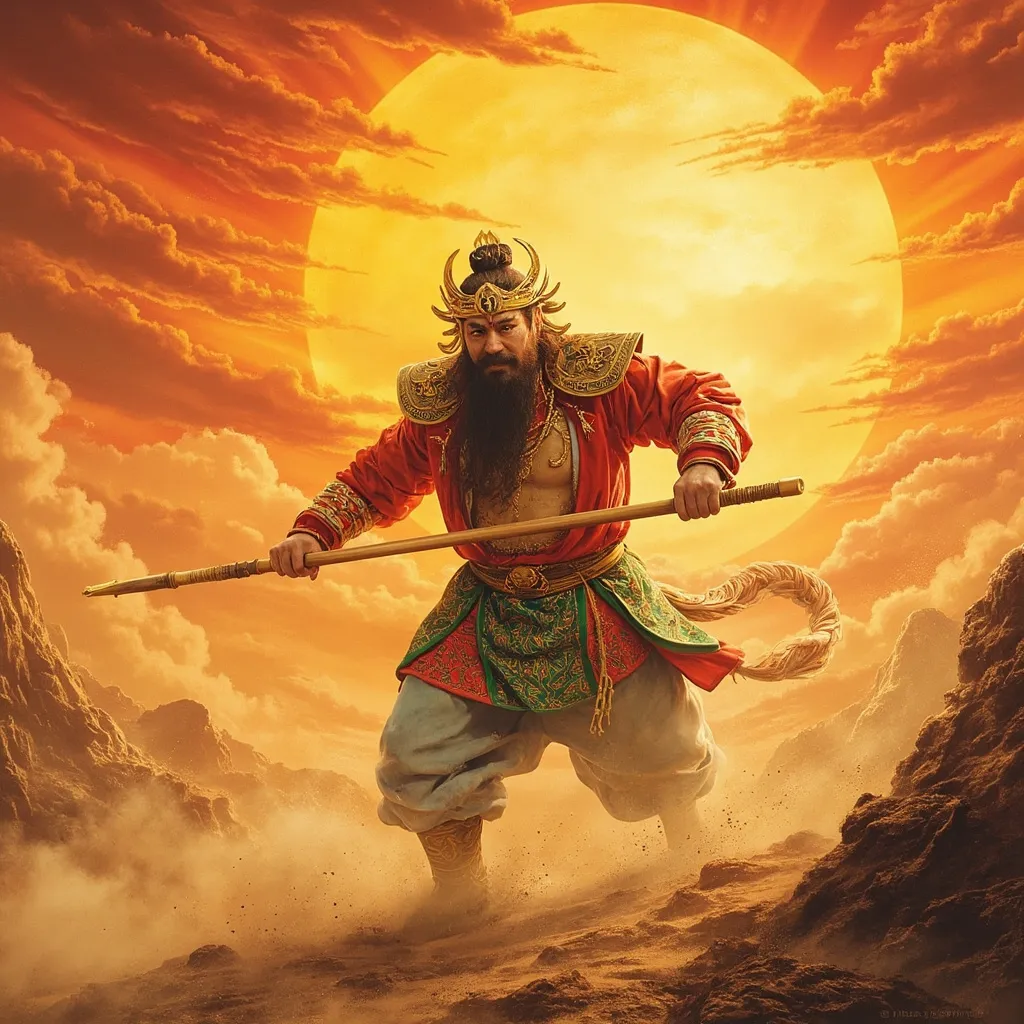
What possessed Kuafu to do what he did is the part that fascinates me most. The texts don’t spend much time on his internal deliberation. They simply say: he decided to chase the sun.
Think about that for a second. The sun. Not a deer, not an enemy tribe, not a natural disaster he could fight or flee from. The sun — a burning ball of gas ninety-three million miles away, moving across the sky with the indifference of celestial mechanics. Kuafu decided to run after it. To catch it. To, as the idiom kuafu zhu ri suggests, pursue something that by definition cannot be caught.
He didn’t have a plan, exactly. Or rather, his plan was so simple it barely qualified: run toward the sun, reach it, grab it. Done. The flaw in this logic is obvious to us, and was probably obvious to some of his contemporaries, but the texts don’t suggest he had many doubters. Perhaps everyone was desperate enough to try anything. Or perhaps Kuafu was simply the kind of person who, once he decided something, was not interested in hearing why it wouldn’t work.
He set out at dawn. The sun rose in the east, and Kuafu ran toward it.
The Long Run
What followed was, by all accounts, an extraordinary feat of endurance. Kuafu crossed rivers — not by fording them but by drinking them dry, according to some versions, which tells you something about the scale of the character we are dealing with. He crossed mountains. He outpaced clouds. The Shan Hai Jing describes him covering vast distances with the ease of someone out for a morning stroll, except the stroll covered territories that would take normal travelers weeks to cross.
The sun, naturally, kept moving. This is the thing about celestial bodies — they do not stop, do not slow, do not care how determined the pursuer is. As noon approached, Kuafu found himself directly beneath the sun, his world blazing with light and heat. He was, presumably, closer than any human had ever been. Closer than any human had any right to be.
Then the heat became a problem.
The texts describe him becoming thirsty. Not mildly dehydrated-thirsty, but desperately, dangerously thirsty. He needed water on a scale that no longer matched his giant body. He turned his attention to rivers and lakes, drinking them dry one by one, but it wasn’t enough. The sun had outpaced him — he’d reached its closest point and then it had moved on, leaving him behind, leaving him parched.
The final details are grim. Kuafu collapsed. Some versions say he made it to a river called the Huanghe (Yellow River) and drank it completely, then moved to the Wei River and drank that too, but still couldn’t quench his thirst. Others say he simply lay down beneath a tree — a famous tree, in some tellings, the Dingjun or some other designated mythological landmark — and died.
The Ambition Problem
What are we supposed to take from this? The straightforward reading is that Kuafu overreached. He attempted something that violated the fundamental order of the universe, and the universe punished him for it. This is a common theme in Chinese mythology — hubris followed by divine retribution. The people who try to climb to heaven, the ones who challenge the gods, the titans who make war on the cosmos. They always lose.
But I think the story is more complicated than a simple warning against pride. If Kuafu had been trying to steal the sun’s fire, like Prometheus, we could read it as a rebellion story. If he had been trying to destroy it, we’d have a different kind of tale. He wasn’t doing either. He was trying to catch it — and the texts suggest he genuinely believed he could bring it back to his people. The sun would somehow, in his mind, become a gift. A captured, domesticated sun that would provide warmth without destruction.
This is, in a sense, the most human kind of ambition. Not malice, not pure ego, but a genuine desire to fix things combined with a catastrophic failure to understand limits. Kuafu wasn’t evil. He was wrong. He underestimated the scale of what he was pursuing and overestimated his own capacity to handle it.
The irony is that he got closer than anyone before him. He ran further than any giant before or after. He reached a point in the sky where most humans cannot even conceptualize traveling. And then he died in the space between his triumph and his goal.
What He Left Behind
The story doesn’t end with Kuafu’s death, because death is rarely the ending in Chinese mythology. What he left behind is almost more interesting than the chase itself. According to various retellings, when Kuafu died, his body transformed. Some say his staff became a forest of peach trees. Others say the area where he collapsed became a region of unusual greenery, a testament to the power that had been in him. The most common version describes his limbs becoming the directions — his arms stretching east and west, his head pointing the way others should go.
This is not a story about a villain. It’s about someone who gave everything to an idea and paid the price. The Chinese idiom kuafu zhu ri (夸父逐日) doesn’t carry the negative connotations you might expect. It suggests determination, ambition, the willingness to pursue something most people would consider foolish. It’s not entirely a compliment, but it’s not entirely a criticism either. It means: someone who aimed for the impossible and died trying.
We have a word for this in English, too. We call it “quixotic,” after Don Quixote, another figure who tilted at windmills, mistook ordinary things for cosmic challenges, and destroyed himself in pursuit of a vision that couldn’t survive contact with reality. But there’s a difference. Don Quixote was deluded — he was chasing phantoms born of mental illness. Kuafu was chasing something real. The sun existed. He simply couldn’t catch it.
The Modern Parallel
I think about Kuafu when I encounter people working on genuinely ambitious projects — the startup founders who think they can disrupt industries that have been stable for decades, the scientists pursuing research that their peers say is impossible, the activists who believe they can change systems that have outlasted every previous attempt to reform them. Some of them will fail, and some of those failures will be the result of exactly the kind of hubris the story warns against. But some of them will get further than anyone thought possible, and a few will die of thirst having come closer than anyone else, and what they leave behind will matter.
Giants in the Chinese Imagination
The Kuafu story sits within a particular tradition of “giant narratives” in Chinese mythology that is worth understanding separately. Ancient Chinese texts are full of oversized figures — not just Kuafu, but the titan-like rugged races, the enormous beings who appear in flood mythology, the cosmic bodies whose physical scale is the point of their existence. These figures were not simply fantasy; they served a cosmological function. The world had been created from Pangu’s body (as we’ll discuss in the next article), and the lingering presence of giants was a reminder that the world was still settling into its current proportions. Giants were what happened when something from the primordial creation phase persisted into the later, regulated world.
This is why Kuafu’s size is not incidental. He is a leftover from an earlier epoch, someone whose proportions belong to the age of raw creation rather than the age of settled order. His inability to function within normal human constraints — the need to drink rivers dry, the speed that outpaces clouds — marks him as someone operating outside the rules that govern ordinary life. When the texts describe him with a mixture of awe and unease, they are registering exactly this: here is someone who is too big for the world he lives in.
There is a theory, proposed by some scholars of Chinese mythology, that Kuafu represents a solar deity in an older layer of the tradition — a god who was eventually demoted or humanized as the worship of the sun became more abstract and ritualized. In this reading, the chase is not a misguided human pursuit but the echo of a divine conflict, a memory of when the sun was something that could be confronted rather than simply observed. The giant who chases the sun was once the sun’s equal; the story remembers the confrontation even after the participants have been reduced to human scale.
On Preparation and the Cost of Grandeur
The question isn’t really whether Kuafu should have tried. He did try, and the story is better for it. The question is whether he prepared properly, whether he understood the cost, whether he was honest with himself and his people about what failure would mean. The texts don’t address these things, which is frustrating. We are left with the image of a giant running toward a star, and a sun that never stopped to consider whether he deserved to catch it.
One of the things I find most interesting about the story is what it doesn’t say. It doesn’t tell us whether Kuafu asked for help. It doesn’t tell us whether anyone advised him against the chase, or whether he had conversations with his community before setting out. It presents the decision as his and his alone — a solitary act of will that may have been heroic or may have been reckless, depending on your interpretation. The silence of the texts on this point is almost more telling than anything they explicitly state. Ancient Chinese culture was highly social, deeply concerned with proper relationships, family obligations, and the weight of collective opinion. For a story to present such an individualistic decision without comment is itself a statement about Kuafu’s exceptionalism. He was not a normal person, and normal rules did not apply to him.
This cuts both ways. It means he was free to attempt the impossible. It also means he had no one to tell him the impossible was still impossible when he was three days in and beginning to struggle. The price of exceptional freedom is exceptional isolation.
Maybe that’s the real moral. The sun doesn’t care. The universe operates on physics, not on the nobility of your intentions. But we remember Kuafu, and we don’t remember the sun. The sun is just there, has always been there, will always be there. Kuafu is a story, which means he lives in a different way, in the minds of people who heard his tale and passed it on and will keep passing it on as long as there are people who understand what it feels like to want something you cannot have.
He didn’t catch the sun. But he ran far enough that we still talk about the running.
Recommended Reading and Products
Disclosure: This article contains affiliate links. We earn a commission on qualifying purchases, at no extra cost to you.