In the opening pages of the Zhuangzi - one of the two foundational texts of Daoist philosophy, written in the fourth century BCE by a thinker named Zhuang Zhou - there is a passage so strange and so large that it has been picked over by Chinese commentators for twenty-three centuries and is still making Western translators uncomfortable.
The passage describes a fish.
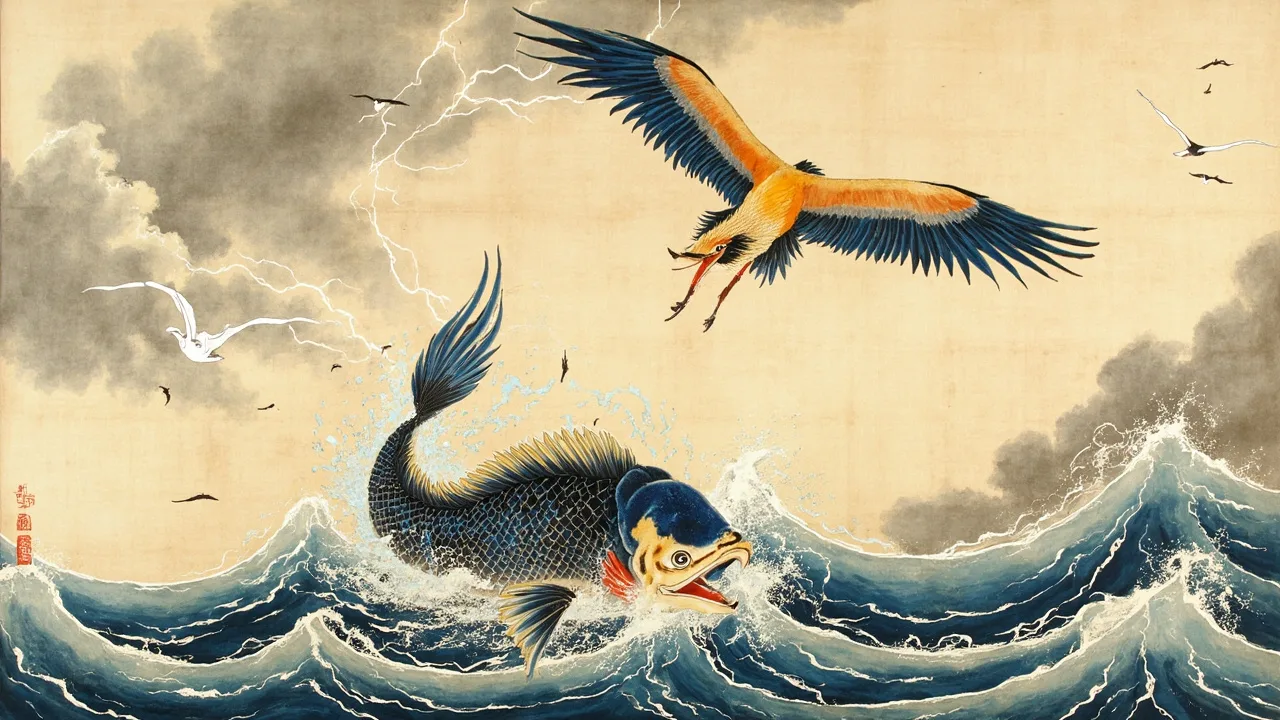
The fish is called the Kun (鲲). It is so big that no one has ever measured it. It lives in the northern sea - the Beiming (北冥), the Northern Dark Sea, a body of water so vast it functions more as a metaphor than a geography. The fish swims there for many years - some versions say several thousand years - until one day it transforms. It becomes a bird. The bird is called the Peng (鹏). And the bird is, in turn, so big that its wingspan is described as the distance between sea and sky.
This is the Kunpeng (鲲鹏). It is the most extravagant transformation story in the Chinese tradition. And the passage goes on to say something very strange about what happens when the bird flies.
The bird rises on a wind. The wind is not an ordinary wind. It is the wind of 90000 li. A li in the Warring States period was about 300 meters, so 90000 li is roughly 27000 kilometers. The bird, the passage says, waits for this wind, lifts on it, and travels south to the Nanming (南冥), the Southern Dark Sea. It rides the wind at a height of 90000 li - up where the air is the color of a pale horse, where there is no ordinary weather, where birds and humans and most of what we think of as reality do not reach.
The Zhuangzi uses this image as the opening of the Xiaoyao You (逍遥游, “Roaming Without Limits” or “Free and Easy Wandering”), the first and most famous chapter of the book. The passage is not really about a fish. It is about the relationship between capacity and circumstance, between the size of a creature’s nature and the size of the world it can move through. The Kun that lives in a small pond is still a Kun; the small pond does not let the Kun be what it actually is. The Peng that waits on the ground is still a Peng; the ground does not let the Peng fly.
The whole rest of the Xiaoyao You chapter is built on this opening image. The little birds in the hedge laugh at the Peng for being so ridiculous. The cicada and the dove laugh at each other. The Zhuangzi text uses these smaller creatures as foils - as examples of beings whose smallness is appropriate to their small worlds, and whose mistake is to think that the size of their world is the size of reality.
It is one of the great passages in classical Chinese philosophy. It is also, incidentally, the source of one of the most widely used idioms in modern Chinese.
The Fish That Became a Bird
It is worth pausing on the transformation itself, because it is not the only transformation in Chinese mythology and it is worth noticing what makes this one different.
In most mythologies, transformations go from less to more powerful, or from more to less human. A fisherman becomes a god. A star becomes a maiden. A fox becomes a woman. The transformations imply gain or loss; they are moral events.
The Kun-to-Peng transformation is different. It is not a moral event. It is a category event. A fish that has lived its entire life as a fish discovers that it can be a bird. The bird is not more virtuous than the fish. The bird is not more powerful in any ordinary sense. The bird is just larger. It can move through more of the world. It can see more of what is.
This is one of the central insights of Zhuangzi’s philosophy. The world is bigger than any one creature’s experience of it. The hedge-bird that looks at the sky and sees something it cannot imagine is not wrong about its own limits - it has genuine limits. But it is wrong to think that those limits are the limits of reality.
The Xiaoyao You passage uses the image of the Peng with a kind of affectionate awe. The bird is not praised for being virtuous. The bird is praised for being large, and large in the specific way that lets it move through more of the world than other creatures can. The Xiaoyao You’s concept of xiaoyao - “free and easy wandering” - is the state of a creature whose nature and whose circumstances fit each other well enough that the creature can do what its nature actually is.
A small bird in a hedge can be in a state of xiaoyao if the hedge is where it belongs. A Peng in a hedge cannot. The Peng needs the 90000-li wind.
The Southern Sea and the Wind of 90000 Li
The geography of the Xiaoyao You is unusual. Zhuangzi does not place the Kun and the Peng in any real place. He places them in two mings - the Northern Dark Sea and the Southern Dark Sea. These are not bodies of water you can find on a map. They are mythic bodies. They represent the edges of the world - the place where ordinary reality runs out.
The wind of 90000 li is not a meteorological phenomenon. It is also mythic. It is the wind that lets the Peng rise. The Peng cannot rise on its own power; the passage is explicit about this. The Peng waits for a wind large enough to lift it. When the wind comes, the Peng rises on the wind, and it travels south, and it settles in the Southern Dark Sea.
The 90000-li number is significant. It is not 30000, which would be a more natural “very high” number. It is not 100000, which would be the obvious “absolute maximum” number. It is 90000, which is the number that says “almost the maximum, but specifically the maximum that the Peng needs.” Chinese commentators have spent centuries arguing about whether 90000 has any cosmic significance; the most interesting readings treat it as a deliberately approximate number, the kind of number that says “as high as possible, given what the Peng is.”
There is also a beautiful physical detail in the passage. The Peng, the text says, looks down at the world from 90000 li and sees the sky below it as a single flat blue dome - “like a single tile of blue tile-blue.” From the height the Peng flies at, weather is no longer visible. The Peng sees weather from above, the way you might see weather from an airplane window, and the world looks like a still painting rather than a turbulent place.
This is the key visual image of the whole passage. The Peng sees the world as still. The little creatures below see the world as chaotic. The difference is not in the world. The difference is in the height.
The Hedge-Birds That Laugh
After the Kun-Peng passage, Zhuangzi introduces a brief and very funny interlude. A cicada and a dove are chatting in a hedge. They laugh at the Peng for being so enormous. Why would a bird need such big wings? The cicada can fly from tree to tree. The dove can fly from grove to grove. Why would any creature need to fly 90000 li?
The passage is not being cruel to the cicada and the dove. The cicada and the dove are doing what small creatures do. They are sizing up the world in terms that fit their experience of it. The mistake is not theirs. The mistake would be theirs if they tried to deny the Peng’s reality, or to insist that the size of their experience was the size of all experience.
The cicada and the dove are a warning against one specific intellectual error: the error of mistaking the scope of one’s own world for the scope of reality.
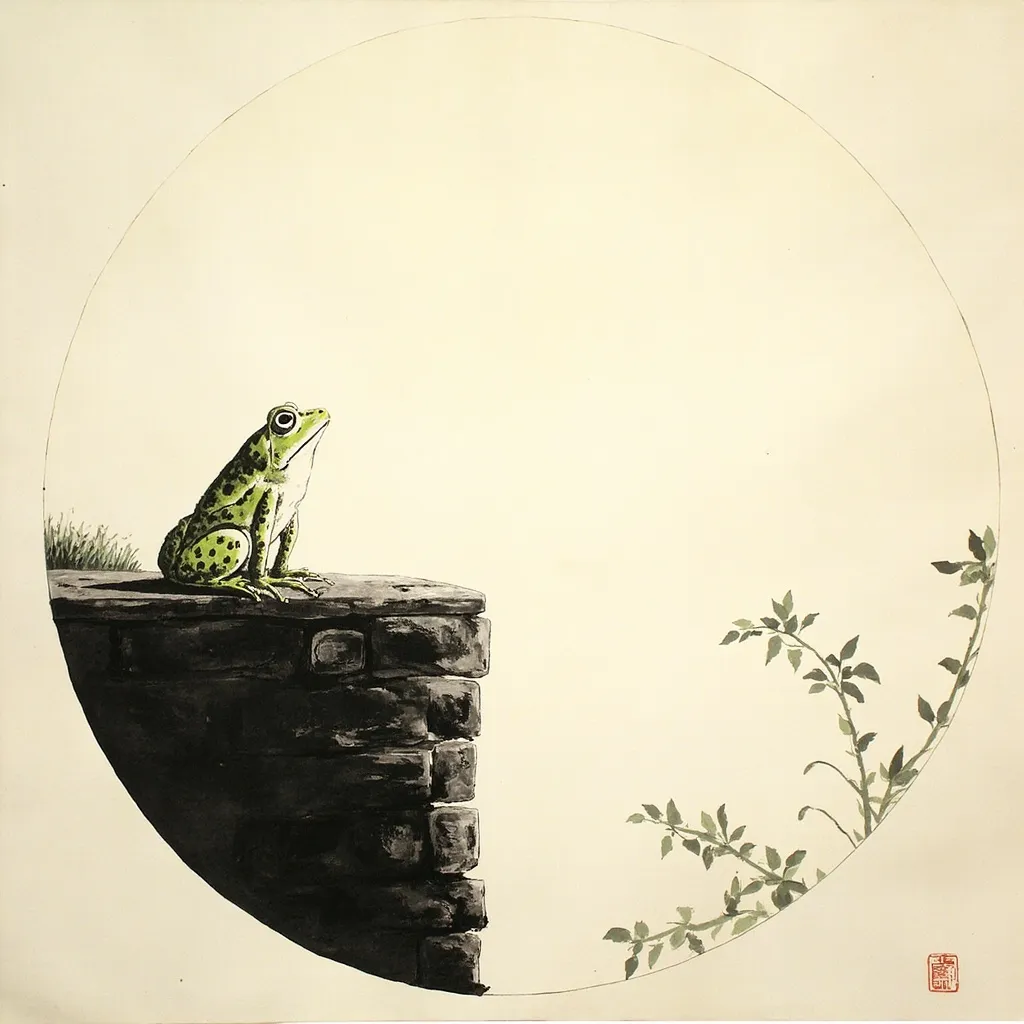
Zhuangzi returns to this theme throughout the Zhuangzi. The book has many chapters, and the Xiaoyao You is only one of them, but the image of the small creature laughing at the large creature is so useful that it appears in different forms throughout the text. There is the story of the frog at the bottom of the well who thinks the sky is the size of the well opening. There is the story of the small bird that laughs at the great Peng. There is the story of the seasonal insects that laugh at the cicada that lives longer than they do.
All of these stories are variations on a single insight: a creature’s experience of the world is bounded by the creature’s nature, and the bound is real, but the bound is also small relative to the size of what is.
This is the philosophical core of the Kun-Peng myth. Everything else in the modern reception of the image - the language, the idiom, the paintings - is downstream of this single insight.
The Kunpeng in Chinese Idiom and Modern Usage
The Kun-Peng image is one of the most quoted in Chinese literature, and one of the most commonly invoked in modern Chinese political and educational language.
The single most common idiom is 鲲鹏之志 (kunpeng zhi zhi), which translates roughly as “the ambition of the Kunpeng” or “the spirit of the Kunpeng.” It is used to describe someone with extraordinarily lofty ambitions - someone whose plans, goals, or aspirations are out of proportion to the smallness of their present circumstances.
The idiom is not, despite what you might assume, reserved for high political language. It is used in:
- Speeches by political leaders about national ambition and vision.
- School graduation speeches about young people’s futures.
- Personal essays about overcoming humble beginnings.
- New Year messages about the year ahead.
- Business and entrepreneurial writing about “thinking big.”
A startup founder in China talking about “thinking big” will often reach for the Kunpeng image. A teacher talking to students about their potential will reach for the Kunpeng image. A politician talking about national ambition will reach for the Kunpeng image. The image is so deeply embedded in the language that it functions as a default metaphor for any situation in which someone has plans that exceed their present circumstances.
There is also a related image, the 鹏程万里 (pengcheng wanli), which literally means “the Peng travels 10000 li” and which is used as a blessing for someone’s career or journey. You will find this phrase on graduation cards, on farewell banners, on departure gifts, on framed calligraphy in offices.
The phrase is, in other words, doing a lot of cultural work. It is the Chinese-language equivalent of “may your ambitions exceed your grasp.” But it is also doing more specific work than that English phrase. The Kunpeng image has a particular Chinese shape: it is a creature whose nature exceeds its circumstances, and whose circumstances have to be expanded before the creature can become what it actually is. The idiom thus implies that ambition is not just a personal virtue but a project of world-building. The Peng needs the 90000-li wind, and the 90000-li wind does not exist on its own - it has to be created, or waited for, or recognized.
This is why the Kunpeng image is so often used in political language about national ambition. A country with “the ambition of the Kunpeng” is a country that believes it must, by its own efforts, create the conditions in which its full nature can manifest.
The Kunpeng in Modern Visual Culture
You can find the Kunpeng in modern Chinese visual culture almost everywhere you look. It is a default subject for:
- Traditional Chinese ink paintings, especially large-format landscape paintings where the Peng flies above the sea.
- Public sculpture at airports, train stations, and government buildings.
- Animated films and television series, where the Peng is often the largest creature in the bestiary.
- Video games, where the Peng is a recurring boss-class enemy.
- Corporate logos, particularly for technology and finance companies.
The image has also traveled internationally. It appears in Chinese diaspora art, in Korean and Japanese interpretations (the Korean geumbul giant-bird myth has been read as a regional relative), and in Western translations of the Zhuangzi. The image is now part of the global vocabulary of Daoist philosophy in a way it was not fifty years ago.
It is also increasingly a meme. You can find animated GIFs of the Kun transforming into the Peng, used in Chinese social media to express the sentiment of “I am about to do something very large.” The meme form is recent but it shows the durability of the underlying image. The Kun-Peng story has been moving for twenty-three centuries. The twenty-first-century internet has not slowed it down.
What Is Actually True Here
A few things about the Kun-Peng story that are worth saying plainly, because they are easy to lose in translation.
The Kun-Peng is not really a story about a fish and a bird. It is a story about the relationship between nature and circumstance. A creature whose nature is large but whose circumstance is small is in a particular kind of trouble. The trouble is not a moral failure. The trouble is a structural mismatch. The Zhuangzi’s solution is to recognize that the mismatch exists, and to wait for the wind.
The Kun-Peng is not a story about ambition in the Western self-help sense. The phrase “the ambition of the Kunpeng” in modern Chinese is not just “have big goals.” It is “have a nature that exceeds your present circumstances, and wait for the wind that lets that nature move.”
The Kun-Peng is not a story about heroic individuals. The 90000-li wind is not the Peng’s own power. The Peng does not fly on its own strength. The Peng rides the wind. This is one of the deepest Daoist insights: large things move by being moved by large things, not by their own effort.
The Kun-Peng is also not, despite what some English-language popularizations will tell you, the source of the word “Kung Fu” or of any other martial arts term. The kun of kunpeng (鲲) and the kun of kung fu (功夫) are different characters with different etymologies, and they have no connection. The Kunpeng is a Daoist philosophical image, not a martial arts symbol.
What the Kun-Peng is is one of the most useful images the Chinese tradition has produced for thinking about the relationship between capacity and opportunity. A creature with the nature of a Peng needs the wind of 90000 li to actually fly. A creature with the nature of a Kun needs the Southern Dark Sea to actually swim. The mismatch between nature and circumstance is real. But the wind, when it comes, lets the nature be what it is.
Recommended Products for Zhuangzi and Kunpeng Mythology
If this article has made you want to read the Zhuangzi itself, or to hang a piece of Kun-Peng imagery on your wall, here are a few items that hold up.
- Zhuangzi: The Essential Writings (Brook Ziporyn translation) - The most reliable modern English translation of the Zhuangzi, with the philosophical commentary you want. Brook Ziporyn’s translation has become the standard academic version.
- Daoism: A Beginner’s Guide (James Miller) - A short, accurate overview of Daoist philosophy with the Zhuangzi and Laozi in context. Useful if you want to place the Kunpeng passage in the larger Daoist tradition.
- Classical Chinese Scroll Painting Reproduction (Kunpeng subject) - Museum-quality prints of traditional Kun-Peng scroll paintings are available from several museum gift shops and Chinese art-print retailers. Look for ones that show both the Kun-fish and the Peng-bird in the same composition.
- Chinese Calligraphy Brush and Ink Set - The Kun-Peng image is one of the most popular calligraphy subjects. A basic brush-and-ink kit is the entry point; the image is forgiving of imperfect lines.
- Traditional Chinese Inkstone (She-Yan or Tao-He style) - A good inkstone is the foundation of any calligraphy or ink-painting setup. She-Yan (she ink) stones from Anhui province are the traditional high-quality choice.
The Zhuangzi has been moving for twenty-three centuries. The Kun-Peng image has been moving for longer than that. There is no hurry. The wind comes when it comes.