The Kunpeng: The Giant Bird That Was Once a Fish
A Complete Guide to the Kunpeng for Americans
There is a moment in every person’s life when they first learn that the universe is much, much bigger than they imagined. For the ancient Chinese philosopher Zhuangzi, that moment came when he thought about a fish.
Zhuangzi lived in the 4th century BCE, during China’s Warring States period — a time of enormous intellectual creativity when thinkers like Confucius, Laozi, Mencius, and Zhuangzi himself were developing the philosophical frameworks that would shape Chinese civilization for the next 2,500 years. Zhuangzi was the most playful and imaginative of them all. While other philosophers wrote serious treatises about proper governance, Zhuangzi wrote parables about butterflies, trees that were useful precisely because they were useless, and a fish that could become a bird.
The fish was named Kun. The bird was named Peng. And the story of how one became the other is one of the most magnificent in all of Chinese mythology.
This is the kunpeng — the giant divine bird whose wings stretched so wide they blotted out the sun, whose flight from the southern sea to the northern sea shook the world and made the cicada and the dove laugh at their own tiny flights.
The Zhuangzi Parable: How the Kun Became the Peng
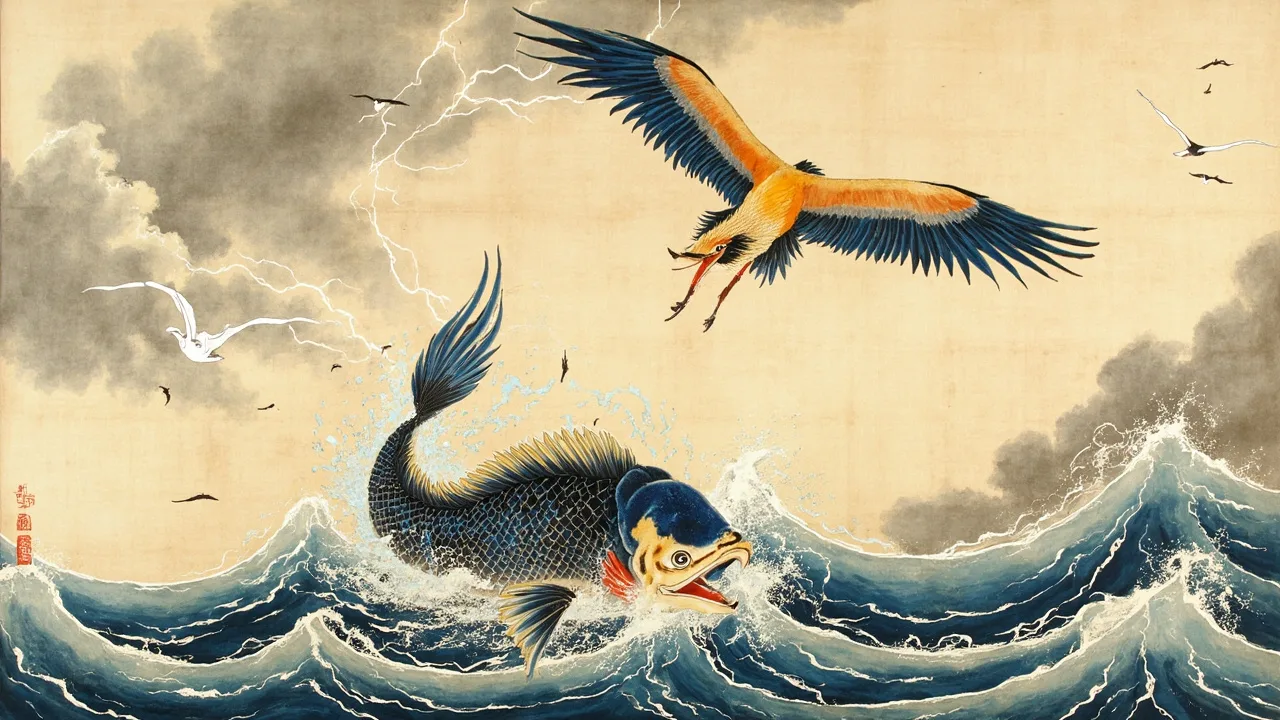
In his text “Free and Easy Wandering” (Zhuangzi’s most famous chapter), the philosopher tells of the great fish Kun, living in the northern sea. Kun was enormous — so enormous that no one could say how many thousands of miles it measured. And then, for reasons known only to cosmic whimsy, Kun decided to transform. The fish turned on its side, and its scales became feathers. Its fins became wings. And Kun the fish became Peng the bird.
When Peng spread its wings, they covered an area的天空 — the sky itself — so vast that no measurement could capture it. When it flew, the force of its wingbeats created storms that sent fish and turtles flying through the air for hundreds of miles. It rose on the wind to the heavens, riding the autumn currents high above the world, looking down at humanity as the tiniest specks.
Zhuangzi uses this story not to describe a real bird — though many later Chinese writers would treat it as real — but to make a philosophical point about perspective. The cicada and the dove make fun of Peng’s flight, not understanding why anyone would bother flying so far. But who is to say which of them — the tiny bird laughing at the giant, or the giant soaring above them all — is truly free?
This is the essence of the kunpeng mythology: it is a story about the relativity of scale, the humility of recognizing how small we are compared to the cosmos, and the joy of imagining something so vast that it makes our problems feel small.
The Scale of the Peng: Numbers That Stagger the Imagination
Later Chinese writers took Zhuangzi’s parable and ran with it, filling in staggering details about the peng’s true size. According to these later texts:
The Peng’s wings were described as covering 3,000 li — a li is roughly a third of a mile, which means the wings stretched nearly 1,000 miles. When it flew, it created a wind so powerful that it lifted water in great geysers, transforming the sea into a spiral of mist and spray that rose to the heavens. It flew from the eastern sea to the western sea in six months, feeding on fish so plentiful that the water was black with them for a thousand miles.
The philosopher Liezi, another Daoist writer, described the Peng as capable of flying so high that humans below could no longer see it, only hear the sound of its wings beating like distant thunder. When it descended, it caused winds that flattened forests and flooded valleys.
The Peng in Chinese Poetry: The Bird of Transcendence
Chinese poets became obsessed with the peng. It represented the ultimate aspiration — the ability to rise above the mundane world, to see things from the cosmic perspective, to transcend the limitations of ordinary existence.
Li Bai, the great Tang Dynasty poet (701–762 CE), wrote several poems about the peng. In one of his most famous, he describes wanting to ride the peng to the heavens, to abandon worldly concerns and achieve the perspective of the immortal. “The peng flies to the southern sea,” he wrote, “riding the wind, its shadow briefly passing over the world below.”
This is the cultural DNA of the kunpeng: it became shorthand for the highest spiritual aspiration. When a Chinese person calls someone a “peng” — an informal compliment — they are saying that person has transcended ordinary limits and achieved something extraordinary. The phrase “peng zhi da dan” means “great ambition” or literally “the peng’s great leap.”
In classical Chinese poetry, the peng also represents the way true greatness cannot be understood by small-minded people. Just as the cicada and dove laugh at the peng, ordinary people laugh at geniuses, mystics, and visionaries whose ambitions seem ridiculous. The peng teaches patience with those who cannot understand us.
The Kunpeng and the Chinese Concept of Transformation
The kunpeng story is deeply connected to one of the most important concepts in Chinese philosophy: transformation (hua). Chinese thought has always emphasized that nothing is fixed — everything changes, and wisdom lies in adapting to change rather than resisting it.
The fish becoming the bird is the ultimate metaphor for transformation. Kun did not fight the change. Kun did not cling to being a fish. When the moment came to become a bird, Kun became a bird. This is the Daoist ideal of wu wei — non-resistance, flowing with the natural current of things.
In Chinese mythology, many creatures transform. The dragon can become mist. The fox spirit can become a beautiful woman. The phoenix rises from its own ashes. But the kunpeng transformation is the grandest of all — a total metamorphosis from the largest fish to the largest bird, a leap across the entire scale of existence.
This is why the kunpeng is so important to Daoist meditation practices. Practitioners aim to achieve a state called “penghu” — “peng transformation” — in which the practitioner想象中的身体 becomes light enough to float upward, leaving the earthly body behind. It sounds fantastical, but the underlying idea is real: that human beings are not fixed, that we can transform ourselves through spiritual practice.
The Peng and Hurricane: A Modern Connection
Here is something that will surprise Americans: the kunpeng has a direct connection to a modern weather phenomenon. The Chinese characters 鲲鹏 (kun + peng) are pronounced exactly like “hurricane” in Cantonese. Linguists believe this is coincidental — but it is a striking coincidence. The kunpeng is the great storm bird, and hurricanes are the great storms. The connection reveals how deeply the myth of the peng is embedded in Chinese language and culture.
In modern Mandarin, “kunpeng” is still used as a metaphor for great ambition or a sweeping, world-changing force. When Chinese entrepreneurs talk about their startups, they sometimes describe their ambition as “kunpeng zhi zhi” — “the ambitions of a peng.” When Chinese military strategists describe a decisive shift in the balance of power, they describe it as a “kunpeng zhuanyi” — a “peng’s great shift.”
Peng in Japanese and Korean Culture
The kunpeng is not exclusively Chinese. The same mythology appears in Japan as “Kunpeng” (written with the same Chinese characters) and in Korea as “Kunbaeng.” In Japan, the peng mythology merged with local traditions to create the “tengu” — a different but related creature, a supernatural being with immense powers of flight. The tengu is more mischievous than the benevolent peng, but both share the quality of being able to transcend ordinary limitations.
In Korean folklore, the kunpeng became a symbol of the scholar who has achieved such mastery that he can see the world from above, understanding the big picture that escapes ordinary minds. Korean civil service exam slogans sometimes reference the peng to describe the ideal official — someone with both great vision and great compassion.
The Kunpeng and the Phoenix: A Contrast
The kunpeng is often compared to another great celestial bird in Chinese mythology: the fenghuang, or phoenix. But the two creatures represent very different things.
The phoenix is associated with the empress, with feminine energy (ying), with the south, with fire, and with renewal. It rises from its own ashes, representing the eternal cycle of death and rebirth.
The kunpeng is associated with the emperor (in some later traditions), with masculine energy (yang), with the north, with water, and with transcendence. It does not rise from ashes — it rises from the sea, flying upward to the heavens.
Where the phoenix is about cycles, the peng is about one great upward journey. Where the phoenix is warm and feminine, the peng is cool and masculine. Where the phoenix lives in the court, the peng lives in the wild heavens.
Together, they represent the full spectrum of Chinese cosmological thinking — transformation within cycles, and transcendence above them.
Visiting the Kunpeng Today
The kunpeng does not appear in many tourist sites the way dragons and phoenixes do, but there are some ways to experience its presence:
Mount Penglai: In Shandong Province, there is a mountain called Mount Penglai (Penglai means “peng coming to rest”). According to Chinese mythology, this is where the immortals live, on islands in the eastern sea. While the islands themselves cannot be visited — they drift, and mortals cannot find them — the mountain is a real place with a temple complex dedicated to Daoist immortals.
Chinese theme parks: Several major Chinese theme parks, including Chimelong Paradise in Guangdong and Happy Valley in Shenzhen, feature massive kunpeng statues and roller coasters designed around the peng theme.
Chinese calligraphy: The characters 鲲鹏 are a popular calligraphy subject. Look for scroll paintings featuring the characters in large, dramatic script — they are usually meant to inspire ambition and transcendence.