In a small town called Kunshan, somewhere between Suzhou and Shanghai, a working musician named Wei Xuance (魏良辅) spent roughly a decade in the early 1500s doing something that sounds mundane and was not. He was rewriting the rules of how a Chinese stage could sound. He took the existing singing styles circulating around the lower Yangtze — rough, local, each with its own dialect and its own tuning — and fused them into a single, deliberately polished system. He tightened the melodies, added the wubi (五佈) bamboo clapper and a more precise percussion backbone, and wrote a treatise called 《曲律》 (Qulü, “The Rules of Song”) laying out exactly how his new style was supposed to go. The result, refined over the following decades by his student Liang Chenyu (梁辰鱼) and a small circle of scholar-musicians in Suzhou, was a form of theater that combined a soft Wu-dialect vocal line, an unusually literary script tradition, and a long, slow, painterly kind of movement. It did not yet have a stable name. Within a generation it was being called Kunshan qiang (昆山腔), then more simply Kunqu (昆曲), and it was on its way to becoming the dominant operatic form of late imperial China for roughly the next 250 years.
That is the bare-bones origin story. The fuller story is what this article is about: who Wei Xuance and Liang Chenyu actually were, why a regional dialect form from the Yangtze delta ended up on imperial stages in Beijing, what The Peony Pavilion does that no one had quite done on a Chinese stage before, how Kunqu shaped the body vocabulary of every later Chinese opera, what nearly killed it in the twentieth century, and what a young actress named Zhang Jiqing did in 2001 that earned the form a UNESCO designation and a second life.
The Origins: A Decade in Kunshan and the Long Rise of a Wu-Dialect Sound
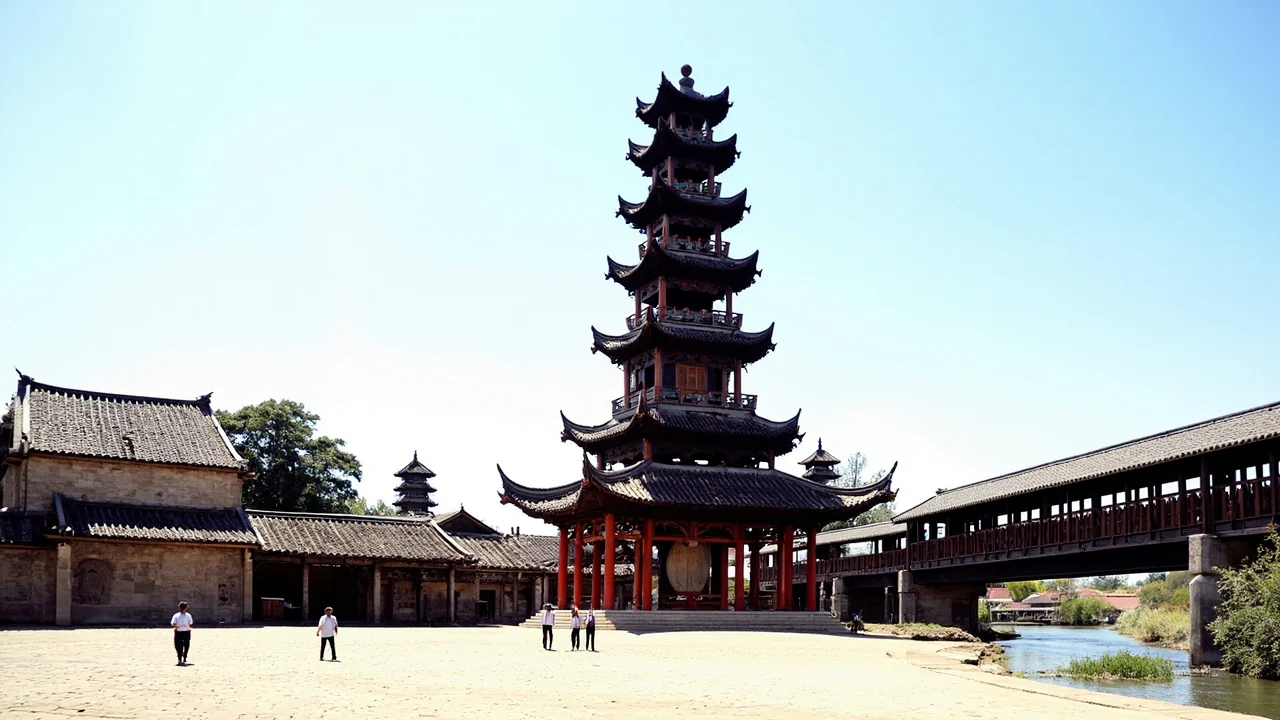
To understand Kunqu, you have to understand the water-town Jiangnan — the network of canals, lakes, and trading cities south of the Yangtze, anchored by Suzhou, Hangzhou, and the smaller towns of Kunshan, Taicang, and Changshu that strung along between them. From the late Song dynasty onward, this was the wealthiest, most urbanized, most culturally ambitious region in China. Suzhou alone, in the 14th and 15th centuries, may have had close to a million residents. The cities were full of professional entertainment — singing houses, banquet troupes, brothel-theaters where a customer could sit with wine and watch an all-female cast perform short plays, literati poetry clubs, music clubs, the whole ecosystem of an urban leisure culture that fed on the region’s enormous textile-and-grain wealth. Jiangnan is where the Chinese professional theater, in something close to its modern sense, was first assembled.
Before Wei Xuance got to it, the singing traditions of this region were a mess, and a mess is a kind way of putting it. There were at least four rival vocal styles competing for stage space. The one with the deepest roots was the local Suzhou-Taicang area Wu dialect singing, with its soft consonants, its sliding pitches, and a long tail of pre-existing song-tunes (qupai, 曲牌) inherited from the Song dynasty. The most prestigious of the competing styles in the 14th and early 15th centuries was actually Yiyang qiang (弋阳腔) from Jiangxi, a high-energy, percussion-driven, chorus-supported form that was already sweeping the empire in the early Ming. There was also Yuyao (余姚腔) from Zhejiang and the Haiyan (海盐腔) style, both of which had been promoted inside the court of the early Ming emperor Zhu Yuanzhang.
Kunqu’s innovation, when it came, was not a single new tune or a new plot. It was a synthesizing project that produced a form with several distinctive technical features.
The first was linguistic refinement. The Wu-dialect vocal line is famously soft at the consonant level — the final stops in particular are reduced or dropped — and the pitches move through narrow, curving intervals rather than the wider jumps of northern singing. Wei Xuance and his circle treated these features not as accidents of dialect but as the very substance of the new form. A Kunqu line has to be singable on the breath, the vowels elongated, the consonants almost swallowed. It is the opposite of a belting style. Listeners often describe it as sounding closer to chamber music than to opera.
The second was systematic melodic work. The earlier singing had leaned on inherited tune-patterns (the qupai tradition, ultimately drawn from Song dynasty ci poetry) but had let the actual notes drift wherever local habit took them. Wei Xuance’s school standardized the qupai into a more rigorous melodic grammar, each tune-pattern having a clearly defined pitch skeleton that the composer-vocalist then filled with new lyrics. This is closer to how Western art-song or jazz standards work than to the looser folk-song template that informed most regional Chinese singing.
The third was rhythmic precision. The bamboo clapper and the small drum that previously had been used only as background pulse were reorganized into a precise time-keeping backbone. The genre’s distinctive slow-fast-slow pacing — the famous “one slow, three quick, one slow” structure of its principal set piece, the nanci (南词) — comes from this re-engineering of percussion. It is what gives Kunqu its characteristic shape: a long, slow, almost motionless opening passage that builds into rapid, virtuosic runs, then settles back into stillness. Modern audiences find it hypnotic. Sixteenth-century audiences found it new.
The fourth was literary ambition. The musician who most fully realized what Wei’s system could do was his student Liang Chenyu (1519–1591), a Suzhou literatus who had failed the imperial examinations and poured that failure into writing. In 1540 he circulated a play called 《浣纱记》 (Huansha ji, “The Story of the Washing Silk”) that used the new Kunshan singing throughout. It was a hit. It marked the moment Kunqu stopped being one regional style among many and started being the form literate Suzhou wanted to watch. Within fifty years the form was on stage in Nanjing, Hangzhou, Beijing; within a hundred it had displaced both Yiyang and Haiyan as the prestige style of the empire, and would hold that position until the early Qing.
The Peony Pavilion: How Tang Xianzu Made the Form and the Form Made the Play
The work that fixed Kunqu forever in the Chinese imagination is not Huansha ji. It is a 1598 play that was a commercial failure in its author’s lifetime and a permanent masterpiece in every century since: 《牡丹亭》 (Mudanting, “The Peony Pavilion”) by Tang Xianzu (1550–1616).
Tang Xianzu is one of the four great dramatists of late imperial China, and the only one of the four whose reputation has actually grown in the modern era. He was born into a literary family in Linchuan, Jiangxi province, passed the provincial examination in 1577, and spent the next two decades in and out of minor bureaucratic posts in southern China. He wrote four great dream-plays in his late forties and fifties: Mudanting, 《紫钗记》 (The Purple Hairpin), 《南柯记》 (A Dream Under the Southern Branch), and 《邯郸记》 (A Dream of Handan) — collectively known as the “Four Dreams of Linchuan” (临川四梦). All four are written in a form that is essentially a Kunqu stage script, with the new Wu-dialect singing as the principal musical vehicle.
What Mudanting does on stage had not been done before in quite that way. The plot is simple. Du Liniang, a sixteen-year-old from a respectable family in southern Fujian, falls asleep in the family garden one spring and dreams of meeting a young scholar she has never seen. They fall in love in the dream, consummate the love in the dream, and she wakes. The dream has been so vivid that she pines for it, gets sick, paints a self-portrait and dies. The scholar, Liu Mengmei, then happens to find the portrait in a deserted garden three years later. He falls in love with the portrait. The painted Du Liniang turns out to be, in the logic of the play, not a picture at all but a soul, and the soul is recoverable. A Daoist abbot intervenes. Du Liniang is resurrected. The lovers marry. The father, who is furious, eventually relents.
What makes this more than a love story with a happy ending is that Tang Xianzu is making a serious philosophical claim. The famous line, often quoted, is “情不知所起,一往而深” — roughly, “Love does not know where it begins; once it begins, it goes deep.” The “deep” part is the point. The play is arguing, against the entire Neo-Confucian mainstream of late Ming thought, that feeling (qing, 情) is not a secondary reality to be subordinated to principle (li, 理) but a substantive reality in its own right, with its own legitimate force. A young woman who has never been touched by a man, who has never even been outside the family compound, is fully entitled to the deepest love of her life — and the cosmos will rearrange itself to honor that entitlement.
Kunqu is what makes this philosophical claim land on stage. The medium is the message. The slow, drawn-out opening scene in which Du Liniang walks through her garden for the first time and notices, in the soft Wu dialect and the elongated qupai of the new singing, that the willow is green and the peonies are opening and the bean-curd flowers are dying — that scene runs for the better part of an hour in a full-length production. The famous “惊梦” (Jing meng, “Startling Dream”) scene in which she meets the lover in the dream is a single continuous musical set piece built around a single extended qupai form. There is no equivalent in European theater of the period. You would have to wait for Wagner to find a stage composer who took seriously the idea that time itself — a sustained passage of stretched stage time — could be a vehicle of meaning. (And in fact Wagner and Tang Xianzu were born within fifteen years of each other.)
The Peony Pavilion, in its full 55-scene version, runs about twenty hours. The full text was a flop. The shorter 39-scene version that was actually performed had a more mixed reception. Tang Xianzu died in 1616, having written four masterworks and spent most of his later life as a low-ranking official and finally a private scholar, increasingly alcoholic. His plays were not lost — they were, in fact, widely read and performed — but they sat in a strange half-light: too literary for the popular stages, too popular for the strict Confucianists, too long for the casual playgoer.
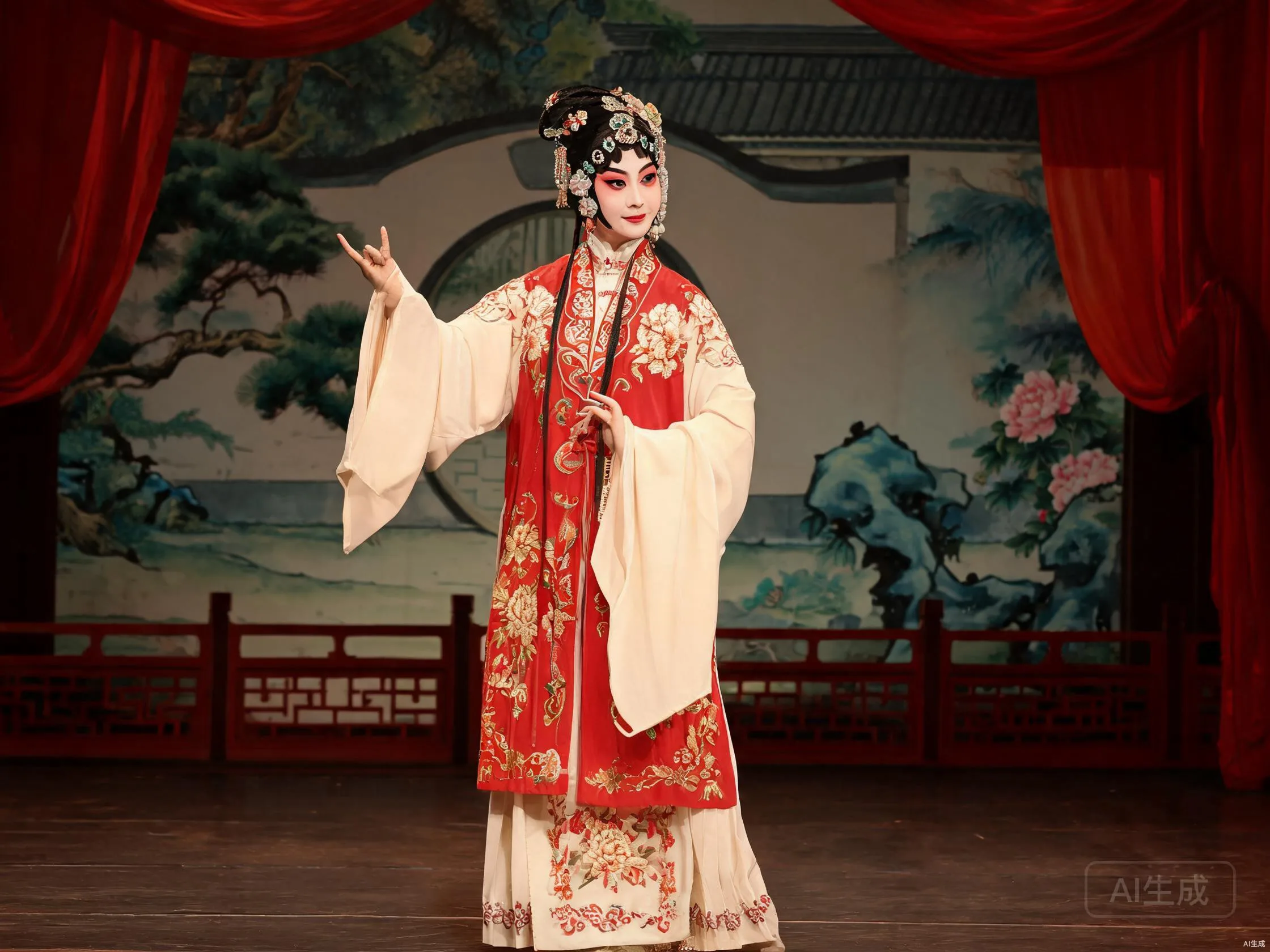
What rescued Tang Xianzu’s reputation, and what made Kunqu irreplaceable in the Chinese canon, is the acting tradition that grew up around his plays. By the early Qing, every professional Kunqu troupe carried a stock repertoire built largely from Tang’s four dream-plays plus a smaller group of other masterworks (the most famous of which is 《长生殿》 (Changsheng dian, “Palace of Everlasting Life”) by Hong Sheng, 1645–1704). The Peony Pavilion specifically had a separate life of its own as a kind of examination piece for the “young female lead” (qingyi, 青衣) role-type, and the role of Du Liniang became the single most prestigious female lead in the entire Chinese operatic tradition — the role a serious young actress had to be able to perform if she wanted to be considered a real artist. The major 20th-century Kunqu performer Mei Lanfang (1894–1961), who is far better known in the West for his Peking opera work, was trained as a Kunqu actor and continued to perform and teach Kunqu throughout his career. Kunqu is in his bones.
Kunqu as the Mother Tongue of Chinese Opera
The form that most foreign visitors know as “Chinese opera” is Peking opera (Jingju, 京剧) — the loud, acrobatics-heavy, face-painted style centered on Beijing in the 19th and 20th centuries. Peking opera is what most people mean when they say “Chinese opera,” and Peking opera is, in its formal bones, a descendant of Kunqu.
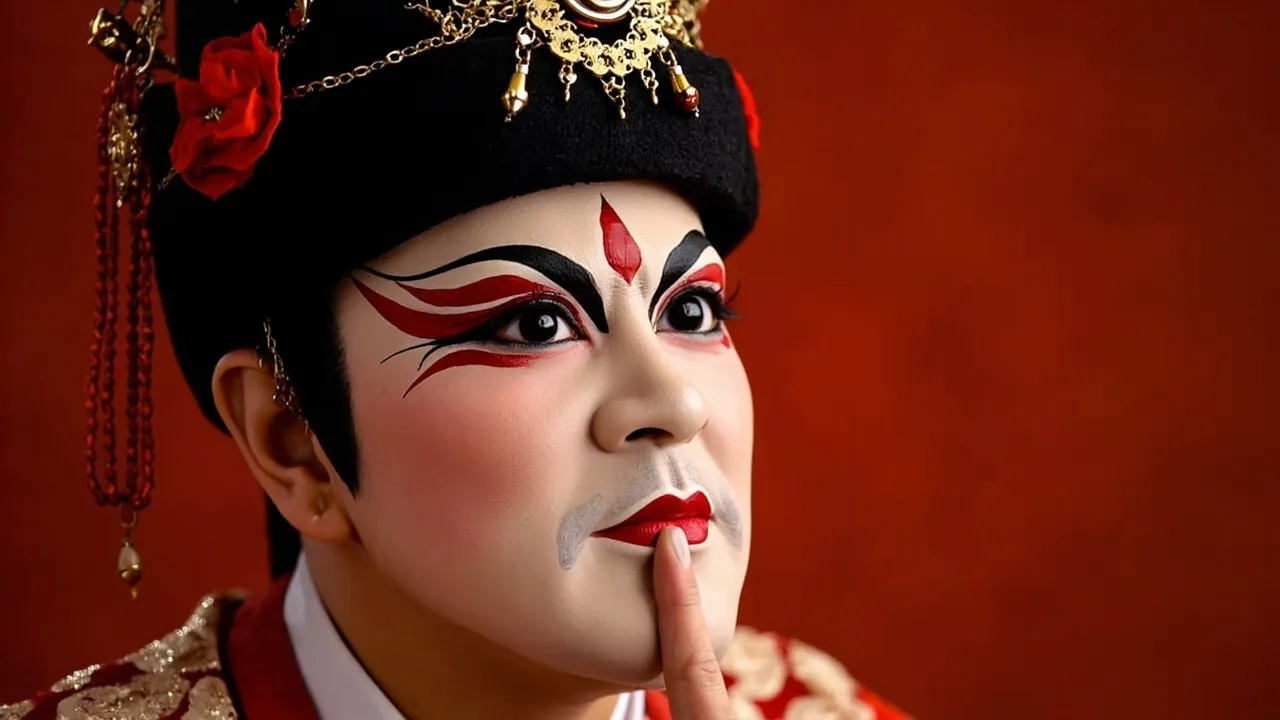
The technical vocabulary of Chinese opera — the shou, eye, fa, bu (手眼法步, “hands, eyes, technique, steps”) of the role-types, the sheng, dan, jing, chou, mo (生旦净丑末) role category system, the whole convention of xieyi (写意, “writing the idea”) rather than mimetic realism, the use of the long silk sleeve and the riding crop and the fan as semiotic props — all of this crystallized inside the Kunqu tradition and was inherited, with modifications, by Peking opera when the latter came together as a distinct form in the 1790s–1820s. The principal Peking opera acting lineages explicitly claim descent from late Ming Kunqu masters, particularly the so-called Weitan School (崑曲派) performers who moved north in the 18th century and taught a generation of actors in Beijing who would become the founders of the new form. When you watch a Peking opera actor do a slow, hand-painted sleeve movement that seems to say something unsayable, you are watching something that was originally a Kunqu gesture.
Kunqu’s position in this story is the strange one of a parent form that almost did not survive the success of its own children. By the mid-19th century, the slower, more literary Kunqu was being out-competed in the commercial theaters of Shanghai, Beijing, and the treaty ports by a whole family of newer, more accessible local opera forms — Peking opera, Yue opera (the all-female Shaoxing form that is the second most popular Chinese opera today), Sichuan opera with its face-changing tricks, Cantonese opera, and others. Kunqu troupes shrank. By the 1930s there were probably fewer than a hundred working professional Kunqu actors in all of China. By the 1960s the tradition was being kept alive mostly by a small number of amateur clubs in Suzhou, Shanghai, and a few other cities, and by the few remaining elderly masters who still taught the role-types. The Cultural Revolution (1966–1976) finished the contraction. Performance was banned as bourgeois. Troupes were dispersed. Some senior masters died. Some emigrated.
The 2001 Revival and UNESCO Recognition
The reversal is the most surprising part of the story, and it is genuinely worth telling.
In 2001, the Suzhou Kunqu Theatre, working with the literary scholar Bai Xianyong (白先勇) — a Taiwanese novelist and play-director who had been advocating a Kunqu revival for two decades — staged a 36-hour concert version of The Peony Pavilion in six nights at the Garden of the Master of the Nets in Suzhou. The production starred Zhang Jiqing (张继青), a then-62-year-old Kunqu actress who had been trained in the old way by the legendary performer Yu Zhenfei (俞振飞), and Wang Fang (汪芳), then 30, as the young Du Liniang. Wang Fang was a graduate of the Suzhou Kunqu school, one of the small cohort of young performers the Chinese government had been quietly funding to keep the form from dying out completely.
The production was a sensation. It toured internationally — to the Kennedy Center in Washington, to London’s Barbican, to Paris, to Taipei. It sold out. It drew audiences who had never seen any form of Chinese opera, who were by all reports genuinely moved. In 2001 the same year, UNESCO proclaimed Kunqu a Masterpiece of the Oral and Intangible Heritage of Humanity — the first Chinese performing art to receive the designation. The Suzhou production is generally credited, in public memory, as the event that shifted Kunqu’s status from a dying relic to a living tradition.
The revived form is not the old form. The 36-hour Peony Pavilion is a heavily edited adaptation, not the full 55-scene original. Modern productions use amplified sound and modern lighting. The young actors in the Suzhou school train for seven to ten years before they are allowed on a main stage, in a curriculum that looks more like conservatory training than traditional master-and-apprentice transmission. Whether this counts as continuity or as something new is a real question, and one that the performers themselves argue about in print.
What is not in question is that, as of 2026, Kunqu is being performed regularly in Suzhou, Shanghai, Nanjing, Beijing, Taipei, Hong Kong, and a handful of overseas Chinese theater communities, that there are now several full-time professional troupes, that the role-types are being actively taught, and that UNESCO’s 2001 designation has not been revoked. The form Wei Xuance synthesized in a small Jiangnan town in the early 1500s is six centuries old. The form the Suzhou performers are now putting on stage is also six centuries old. The thread between them is real, even if you have to look carefully to see it.
For an English-speaking reader who wants to follow the form into the present, the most useful entry point is still the Cyril Birch translation of The Peony Pavilion (Indiana University Press, 1980), which renders the full 55-scene version into readable English verse and comes with a substantial scholarly introduction. The most useful scholarly synthesis in English is A. C. Scott’s Traditional Chinese Plays Volume 1 and Tan’s The Rise of the Modern Chinese Theater (Xiaomei Chen). If you are in Suzhou, the Suzhou Kunqu Museum (苏州昆曲博物馆) on Pingjiang Road has regular performances and a permanent collection of costumes, scripts, and historical instruments. The annual Kunqu Festival in Suzhou every spring brings together troupes from across the Chinese-speaking world.