In the sixth century BC, a record-keeper at the Zhou dynasty court allegedly met a younger man who walked with a peculiar gravity — as if the ground beneath him rose slightly to meet each step. The record-keeper was old, tired, and about to leave civilization forever. The younger man was Confucius, and he had come a long way to ask the old archivist about ritual and propriety.
The old man gave him an answer that baffled Confucius: “The men you speak of have long since rotted away. What you are looking for is not in words. The truly virtuous man — he lets the fish sink to the bottom of the stream.”
No one knows for certain whether this meeting ever happened. The man Confucius reportedly met is known as Laozi, and he may be the most influential philosopher who may never have existed. But the book attributed to him — the Tao Te Ching — definitely exists. Eighty-one chapters. About 5,000 Chinese characters. And a set of ideas so patient and so elastic that they have outlasted every empire that tried to suppress or adopt them.
This is the story of how that book was born, what it says, and why a Silicon Valley visionary quoted it the night he launched the most important computer of the twentieth century.
Who Was Laozi? The Keeper of the Archives Who Maybe Never Existed
The name “Laozi” (老子) is actually a title. It means “Old Master.” His personal name, if he had one, was probably Li Er (李耳) — or possibly Lao Dan (老聃), the two characters that sound vaguely like each other when spoken quickly. Ancient Chinese sources disagree on nearly everything about him, including whether the two names refer to the same person.
What most accounts agree on is this: Laozi held a position as an archivist or keeper of records at the Zhou dynasty court. In the sixth century BC, the Zhou king was largely a figurehead — the real power had drained away into the hands of feudal lords — but the royal archives still existed, and someone had to tend them. Laozi, by this reading, was a bureaucrat of modest rank who had access to the accumulated wisdom of two centuries of Zhou civilization.
Then came the meeting with Confucius.
The Shiji, the great history written by Sima Qian around 94 BC, describes Confucius visiting Laozi to ask about rites (li, 礼). Laozi’s response was not a lecture. It was, essentially, a dismissal: “The men you long for — Chóng Huá, Shū Nián, Wén Wang, Zhòu Gōng — they are all bones now. Only their words remain. A wise ruler hears the current moment and does what works, not what the ancients prescribed.”
He then told Confucius something sharper: “Your theories are too ostentatious. You want the world to respect your wisdom. But look at you — pale and agitated, like a dog yapping at a frog in a storm. You are exhausting yourself chasing what cannot be caught.”
This is a startling exchange. In Chinese cultural memory, Confucius is the great teacher of propriety, the civilizing force of Chinese society. For an old archivist to dismiss him so directly — that is like a quiet librarian at the British Museum telling Voltaire he has missed the point.
The Shiji says Laozi and Confucius met more than once. Later Daoist texts expand this into a full philosophical duel. Whether any of it happened is genuinely unknown. What is certain is that by the time Sima Qian wrote his history, the pairing of Laozi and Confucius was already a fixed point in the cultural imagination — the old sage versus the young activist, stillness versus reform, nature versus civilization.
And then Laozi disappeared.
The Hangu Pass: How Yin Xi Got a 5,000-Word Book Out of a Disappearing Sage
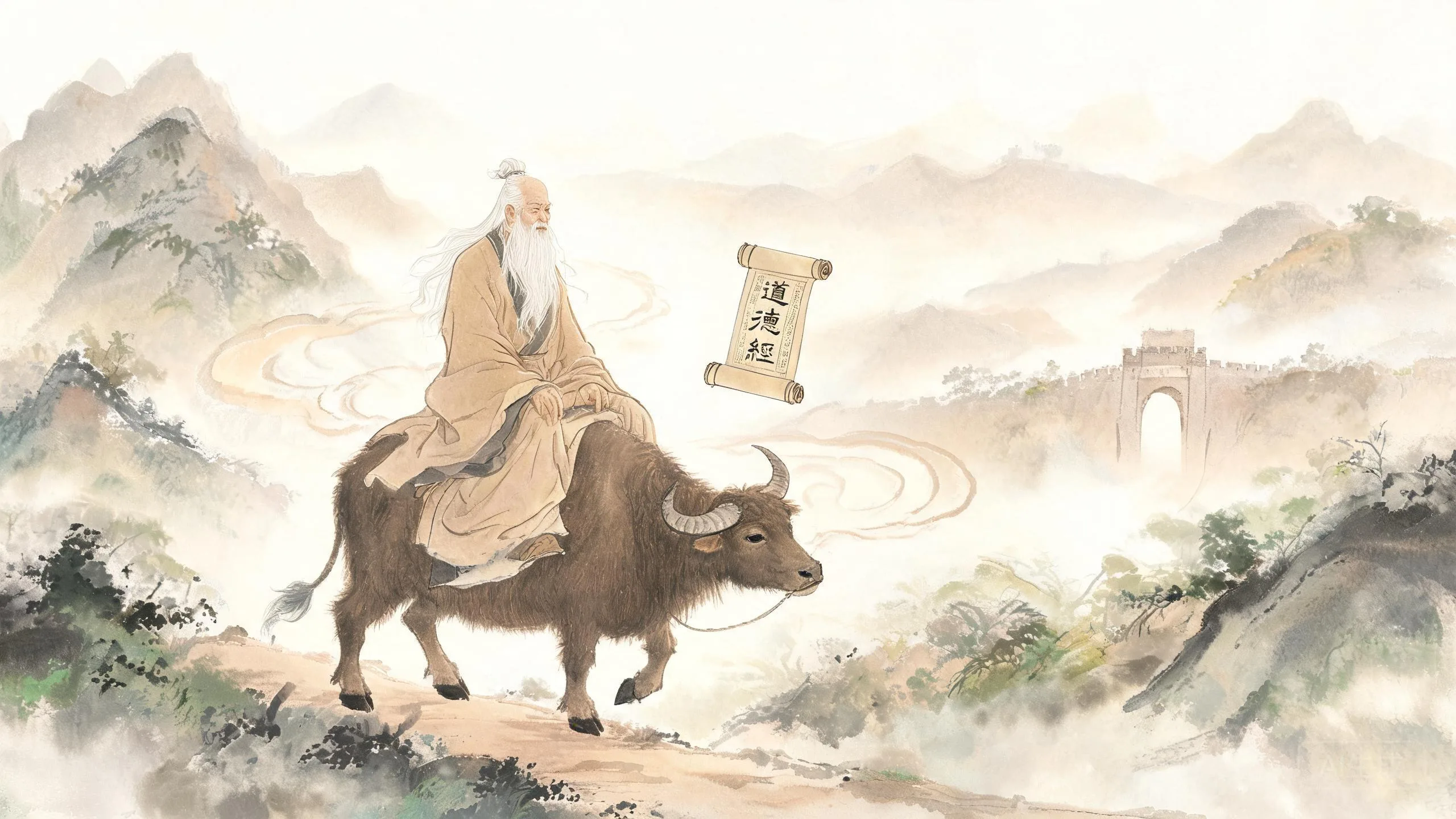
According to the popular legend, Laozi grew so weary of the declining Zhou dynasty that he decided to leave. He saddled a blue ox — or sometimes a water buffalo — and rode west out of the capital, past the Yellow River, toward the mountains that marked the border of Chinese civilization.
At the Hangu Pass (函谷关), the frontier gate that separated the Zhou heartland from the wild west, a man named Yin Xi (尹喜) stood watch. Yin Xi was not just a sentry. Some accounts call him a scholar, others a mystic. What all versions agree on is that he looked up one day and saw a strange vapor approaching from the east — a purple cloud, or a beam of light, or simply an old man on an ox with an expression of total calm.
Yin Xi recognized something in this traveler. He reportedly said: “If you are leaving, you must write down what you know. I will not open the gate until you do.”
This is the spine of the entire story. The gatekeeper demanded the book. Laozi resisted — or the legend says he did. The exchange went something like this:
Yin Xi: “Write it down.”
Laozi: “Why should I?”
Yin Xi: “Because if you don’t, I cannot let you pass.”
And so Laozi sat down at Hangu Pass and wrote the Tao Te Ching (道德经) — the Classic of the Way and Its Power. Roughly 5,000 characters in all. Eighty-one short chapters. When he finished, he handed over the scroll, passed through the gate, and rode westward into the mountains.
The legend says he was never seen again. “Mo zhi qi suo zhong” — “No one knows where he finally came to rest.”
What is a reader today supposed to make of this story? Part myth, part founding narrative, part allegory for how wisdom gets preserved: someone has to hold the gate open and demand the words before they disappear. The story of Yin Xi is really the story of every translator, every scholar, every curious person who ever copied out the text by hand and passed it to the next generation.
The Tao Te Ching did not survive because it was officially endorsed by the Zhou court. It survived because people like Yin Xi decided the words were worth keeping.
The 81 Chapters in Plain English: Five Core Ideas That Rewired Chinese Thought
The Tao Te Ching is not a systematic treatise. It does not build arguments step by step. It speaks in images, paradoxes, and short sharp statements that hit differently on the fifth reading than on the first. The book is traditionally divided into two parts: the first 37 chapters are called the Tao Ching (Way Classic) and the last 44 are the Te Ching (Power Classic). But the division is loose, and the two ideas — the Way and its Power — bleed into each other throughout.
Here are five ideas from the text that shaped Chinese civilization.
1. Wu Wei — Action Through Non-Action
Chapter 2 of the Tao Te Ching opens with a line that still stops readers cold:
道可道,非常道;名可名,非常名。 “The Tao that can be told is not the eternal Tao. The name that can be named is not the eternal name.”
This is the great disclaimer. Whatever follows is not the whole truth — it is an attempt, a finger pointing at the moon. And then, in the same chapter, comes the practical core:
是以圣人处无为之事,行不言之教。 “Therefore the sage acts through non-action (wu wei) and teaches through silence.”
Wu wei does not mean doing nothing. It means acting in harmony with the natural flow of things rather than forcing outcomes. A river does not push — it follows the terrain. A skilled farmer does not fight the season — she works with it. In Daoist thought, the most powerful action is the one that requires the least resistance, because it is aligned with how things already want to go.
2. Soft Overcomes Hard
Chapter 78 is one of the most quoted passages in all of Chinese philosophy:
天下莫柔弱于水,而攻坚强者莫之能胜。 “Nothing in the world is as soft as water, yet nothing is better at overcoming the hard.”
Water seems weak. You can cup it in your hands and it slips through your fingers. But water carved the Grand Canyon. A flood can topple walls. In Daoist thinking, softness and yielding are not weaknesses — they are the mature form of strength. The oak tree snaps in the storm; the willow bends and survives.
This idea became foundational in Chinese martial arts, in diplomatic strategy, and in the self-image of Chinese political philosophy, which often preferred indirection and patience over confrontation.
3. The Tao Follows Nature
Chapter 25 describes the Tao as something that exists prior to the gods, prior to heaven and earth:
人法地,地法天,天法道,道法自然。 “Man follows earth, earth follows heaven, heaven follows the Tao, the Tao follows what is natural.”
Everything has its own nature. Water flows down. Fire rises. Birds migrate. When human beings act in accordance with their own nature — simple, unforced, undecorated — they align with the Tao. When they pile on artificial rules and elaborate rituals, they move away from it. This is why Laozi is suspicious of civilization: every advance in social complexity creates new forms of artificiality and new opportunities for people to become disconnected from what is real.
4. Being and Non-Being Give Birth to Each Other
Chapter 2 also contains this:
有无相生,难易相成,长短相较,高下相倾,音声相和,前后相随。 “Being and non-being create each other; difficult and easy complete each other; long and short contrast each other; high and low rest upon each other; sound and voice harmonize; front and back follow each other.”
This is not a mystical statement. It is an observation about how things exist in relation to their opposites. A room is useful because it is empty inside. A handle is graspable because the blade is solid. In Daoist philosophy, the tendency to think only in terms of what is present — what exists, what is strong, what is visible — is a fundamental mistake. What is absent shapes what is present just as much.
5. Emptiness Is the True Use
Chapter 11 is the shortest argument in the book for why less is more:
三十辐共一毂,当其无,有车之用。埏埴以为器,当其无,有器之用。凿户牖以为室,当其无,有室之用。故有之以为利,无之以为用。 “Thirty spokes converge at a hub; when the hub is hollow, there is use for the wheel. Clay is molded into a vessel; when the clay is hollow, there is use for the vessel. Doors and windows are cut to make a room; when the room is empty, there is use for the room. What is present gives it its practicality; what is absent makes it useful.”
The Daoist ideal of emptiness — xu (虚) — is not nihilism. It is a positive quality: openness, receptivity, the space into which something new can enter. A mind full of fixed opinions cannot learn. A schedule packed solid cannot accommodate the unexpected. The sage keeps the inner bowl empty so it can be filled.
These five ideas — non-action, softness as strength, naturalness, the interdependence of opposites, and the power of emptiness — spread through Chinese civilization like water through stone. They seeped into medicine, painting, poetry, calligraphy, martial arts, garden design, and governance. And they did not do this because an emperor mandated them. They did it because they were genuinely useful frameworks for thinking about power, nature, and human limitation.
How the West Discovered the Tao Te Ching: Jobs, Le Guin, and 2,500 Years of Translation
The Tao Te Ching is, by most counts, the most translated text in human history after the Bible. It has been rendered into English perhaps 250 times. The first significant Western translation was by the British scholar Arthur Waley, whose 1934 The Way and Its Power brought the text to the attention of the English-speaking world. Waley translated from the Chinese directly and tried to strip away the mystical accretions that had accumulated around the text over centuries.
A generation later, John C. H. Wu — a Chinese diplomat and jurist — produced a translation in 1961 that emphasized the literary beauty of the original. Wu’s version was spare and rhythmic, closer to the Chinese than Waley had been.
Then, in 1997, the science fiction writer Ursula K. Le Guin published her own translation. Le Guin was not a sinologist by training, but she understood something about the text that many scholars missed: it is a work of literature, not just philosophy. Her version foregrounded the rhythms, the paradoxes, the dry humor that runs through the Tao Te Ching. Her introduction argued that Laozi was not a religious figure but a philosopher of the first order, and that the text had been distorted by centuries of Daoist religious interpretation that tried to turn it into scripture.
It was Le Guin’s translation, more than any other, that introduced the Tao Te Ching to the American counterculture of the 1960s and 70s. The same generation that was reading the Tao Te Ching was also, coincidentally, inventing personal computing.
Which brings us to Steve Jobs.
On January 24, 1984, Jobs stood on the stage of the Flint Center at De Anza College in Cupertino, California, and introduced the Macintosh computer. The presentation is legendary — Jobs had just demonstrated the machine’s capabilities, and the audience was applauding. Then he paused and said something that seemed, at the time, like a throwaway line:
“Here’s to the crazy ones.”
But the famous “Think Different” campaign that Apple ran in the late 1990s — and the spiritual biography of Jobs by Walter Isaacson — reveal a deeper connection. Jobs was drawn to Zen Buddhism, to simplicity in design, to the idea that the most powerful technology is technology that gets out of your way. He visited India. He studied calligraphy. He spent time at the Zen center in Los Altos. The Macintosh — with its graphical interface, its deliberate rejection of complexity, its “computer for the rest of us” ethos — was, in its own way, a product of Wu Wei: powerful not by adding more, but by removing everything unnecessary.
Whether Jobs directly quoted the Tao Te Ching is beside the point. The point is that a 2,500-year-old text about softness, naturalness, emptiness, and non-action found its way into the design philosophy of the most influential technology company of the twenty-first century. The Tao does not announce itself. It just flows.
For the modern reader, whether you come to the Tao Te Ching as a student of philosophy, of Chinese history, of design, or of leadership, the text rewards patience. It does not argue with you. It does not demand you agree. It simply states how things are, in short lines that sit in your mind like stones in a stream and slowly, over months and years, change the shape of the water around them.