Let me tell you about one of the most embarrassing stories in Chinese literature. It involves a grown man, a famous city, and a complete inability to walk properly. The Chinese have been laughing at this guy for over two thousand years, and honestly, we probably should too — though perhaps with a little more self-reflection than we usually manage, because most of us have a little bit of this story living somewhere in our own histories.
The story is called 邯郸学步 — handan xué bù — which translates to “learning to walk in Handan.” It’s a four-character idiom that has become shorthand in Chinese for a very particular kind of spectacular failure: trying so hard to imitate someone else that you lose what made you distinctive in the first place. The phrase is used when someone tries to adopt a new skill or style and ends up losing their original ability entirely. It’s a warning, wrapped in an absurd anecdote, about the dangers of mindless imitation.
The Setup: A Beautiful City and Its Beautiful People
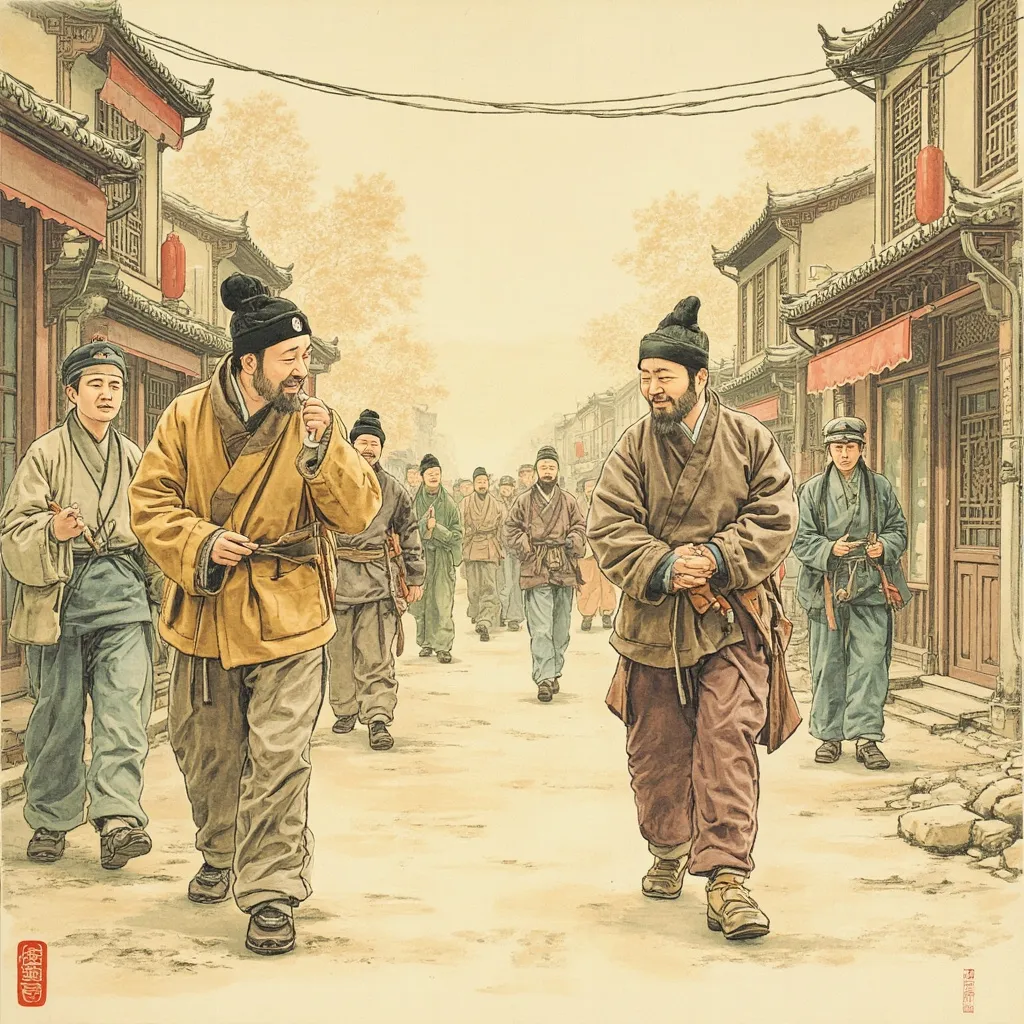
The story originates in the Zhuangzi, one of the foundational texts of Taoist philosophy, so we’re talking about something at least 2,300 years old — a time when China was fragmented into competing states, each with its own customs, dialects, and cultural specialties. The setting is the ancient city of Handan, which was indeed a magnificent place during the Warring States period. As the capital of the Zhao state, it was a center of culture, politics, and refinement, famous throughout the Chinese world for its sophistication and its distinctive approach to the most mundane of human activities: walking.
See, Handanese walking was apparently something special. There’s some debate among historians about exactly what made it so notable — the textual accounts are not perfectly clear on the mechanics — but historical records describe it as graceful, elegant, with a particular sway or rhythm that marked you as a person of cultivation and refinement. It wasn’t just about getting from point A to point B. It was about how you got there, the posture you maintained, the way your body expressed your relationship to the space around you. Whether it was the actual gait, the overall bearing, or some combination of factors that made up “the Handanese style,” the point is the same: people from Handan walked beautifully, and everyone knew it. It was their signature, their cultural trademark, the thing that marked you as a person of the capital.
Now, somewhere in this world lived a man from the state of Yan. We don’t know his name, which is probably for the best given what happened to him — he’d probably prefer to be anonymous too, and history has mercifully obliged. This man had heard about the legendary Handanese walk, and like many people who hear about something impressive, impressive in a way that seems accessible, something that might rub off on you if you just get close enough to it, he decided he wanted it for himself. He wanted to walk like the people of Handan. He wanted that grace, that refinement, that je ne sais quoi that made Handanese walking the talk of the Warring States world.
The Journey: A Man on a Mission
So the man from Yan packed his bags and made the journey to Handan. This wasn’t a casual trip — traveling between Warring States era China was slow, dangerous, and not the kind of thing you did on a whim. The roads were rough, bandits were a genuine threat, and the journey would have taken weeks on end, crossing through multiple states with different rulers and different bureaucratic requirements. He was making a serious investment in self-improvement, betting that the returns would be worth the cost and the risk.
When he arrived in Handan, he must have been immediately impressed. The city was everything he’d heard and more — the grand architecture, the busy markets, the cultivated atmosphere that spoke of centuries of accumulated refinement. And true to the rumors, he noticed right away that the locals had something special in the way they carried themselves. Their gait wasn’t just functional, wasn’t just about efficiency or speed. It was beautiful. There was an art to the way they moved through the crowded streets, a kind of effortless grace that seemed to come naturally to everyone who lived there.
The man from Yan watched carefully. He studied the way people walked down the street, the way they turned corners, the way they carried their weight, the rhythm of their steps, the posture of their spines. He was a careful observer, this man — he wasn’t going into this half-cocked. And then, because he was apparently the kind of person who jumps in with both feet once he’s made a decision, he started practicing immediately.
He imitated their posture. He copied their stride length. He worked on matching their rhythm and timing. He watched a particularly graceful walker and tried to match her step for step. Day after day, he walked the streets of Handan, trying to absorb the local style through sheer repetition, through the brute force of imitation. He had decided that if he just practiced long enough, with enough dedication, he could reprogram his body’s entire way of moving through the world.
The Catastrophe: A Man Who Forgot His Own Feet
Here’s where things go wrong — and honestly, they go wrong in a way that’s almost hard to believe, which is why the story has survived so long. It’s too absurd to be made up, too much like a fable to be straightforward history. The man from Yan practiced so relentlessly, trying so hard to shed his old way of walking and replace it entirely with the Handanese style, that he actually managed to lose his original gait entirely.
He couldn’t walk the way he used to walk. His body had spent years — possibly decades — moving in one particular pattern, his own pattern, the one he’d developed since childhood, the one that felt natural to him. And he’d essentially overwritten that pattern with something new. He was trying to be someone else, and in the process, he forgot how to be himself.
But here’s the cruel irony, the detail that makes this story stick in the mind: he hadn’t actually mastered the Handanese walk either. He was caught in the middle, a linguistic phenomenon known in some contexts as “interlanguage” — not quite one thing, not quite another, a hybrid that didn’t function properly as either. He couldn’t walk the Yan walk anymore because he’d abandoned it. He couldn’t walk the Handan walk because he hadn’t actually learned it properly — he’d learned the surface movements without the underlying foundation that made those movements meaningful. He was like someone who has memorized the vocabulary of a foreign language without learning the grammar, producing strings of words that make no sense to native speakers.
According to the story, he ended up crawling back home, having forgotten how to walk properly in either style. The image of a grown man crawling home after a self-improvement trip is obviously played for comedy, and the Chinese have been enjoying this comedy for over two millennia. But the underlying lesson is dead serious. He’s lost the thing he came with — his original gait — and he hasn’t gained the thing he came for — the Handanese style. He is worse off than when he started, and his attempts at improvement have left him diminished.
Why This Story Keeps Happening
Now, you might think this is just a funny anecdote about one particularly foolish individual, a cautionary tale so extreme that it’s essentially a fable about the dangers of trying too hard. But the Chinese have kept telling this story for over two millennia precisely because it illustrates a failure mode that human beings keep falling into, generation after generation, century after century, in contexts the original storytellers could never have imagined.
Think about social media influencers who adopt the latest aesthetic, the speech patterns of their favorite podcast host, the lifestyle display of someone they admire — and end up looking like a knockoff version of something that was already a knockoff of something else. They’re trying to walk like the people of Handan, but they’ve never actually been to Handan, never actually understood what makes the Handanese walk work. They see the surface — the Instagram post, the polished video, the carefully curated persona — and they think they can replicate it by copying what they can see.
Think about companies that try to emulate the culture of a successful competitor by importing their perks, their meeting structures, their casual dress codes, without understanding the underlying foundations that made those practices work in the original context. They see a tech company with free snacks and think “if we have free snacks, we’ll have that culture.” They see another company with open floor plans and think “if we knock down our walls, we’ll be innovative.” They never ask what the snacks are actually for, what behaviors they reward, what assumptions underlie the layout. They grab the tail and call it a rope.
Think about people who move to a new city and start talking with a fake accent, adopting local mannerisms they don’t really understand, becoming a parody rather than an adaptation. Or people who read a book about productivity and try to implement every system simultaneously without understanding which ones actually fit their life, and then wondering why they’re less productive than before.
The man from Yan wasn’t wrong to admire the Handanese walk. That walk really was beautiful, and there was real value in experiencing a culture that had developed such refinement. His error was in thinking that he could simply download that style wholesale, that walking was just a matter of copying visible motions without understanding the invisible foundations that made those motions meaningful. He treated the output as something you could copy without engaging with the input that produced it.
Walking isn’t just about moving your legs in a certain pattern. It’s about the entire history of your body — your posture, your balance, your sense of yourself in space, the thousands of hours you’ve spent moving through the world in your particular way. The Handanese didn’t walk beautifully because they were born with different legs or because they had discovered some magical walking technique. They walked beautifully because of everything that had shaped those legs over a lifetime in a particular environment, surrounded by particular expectations, reinforced by particular social cues. You can’t replicate the output without the input. You can’t skip the process and arrive at the product.
The Deeper Lesson: Authenticity Isn’t Just Nostalgia
There’s a superficial reading of 邯郸学步 that turns it into a conservative argument: “stay true to your roots,” “don’t try to change,” “original ways are always better,” “the grass is always greener.” That reading misses the point, and actually leads people to make the opposite mistake from the man from Yan — to dismiss valuable learning opportunities because they feel threatened by anything that contradicts their existing approach.
The man from Yan didn’t fail because he tried to improve. He failed because he tried to improve through wholesale replacement rather than integration. He approached self-development as if he could simply delete his old self and install a new one, rather than learning from Handanese walking and thoughtfully incorporating useful elements into his existing style. He treated his own gait as an obstacle rather than a foundation, something to be eliminated rather than built upon.
The real lesson isn’t “don’t learn from others.” The real lesson is “don’t learn from others in a way that destroys what already works.” There’s a middle path between uncritical imitation and defensive rejection of all external influence. That middle path involves maintaining a foundation of “this is who I am” while selectively borrowing from others, testing new approaches against your existing reality, and integrating rather than replacing.
The man from Yan could have studied the Handanese walk, taken what resonated with his own body and history, and perhaps become a slightly more graceful version of himself. Instead, he tried to become someone else entirely and lost himself in the process. He didn’t become a better version of himself. He became a worse version of someone else.
How to Learn Without Losing Yourself
So what does this look like in practice? How do you learn from others without ending up crawling home in embarrassment?
First, recognize that expertise has context. When you admire someone’s skill or style, you’re usually seeing the output of a long development process that you don’t have access to. The glamorous lifestyle blogger developed that persona through years of iteration, not through a quick copy. You can’t skip to the output without the process.
Second, stay connected to what actually works for you. The man from Yan’s fatal error was complete abandonment of his old walk. He discarded his foundation entirely rather than building upon it. A better approach is to maintain a foundation of “this is who I am” while selectively borrowing from others.
Third, remember that authentic style comes from integration rather than imitation. The most compelling people synthesize influences from many sources into something coherent with who they are. The goal isn’t to be the best version of someone else. It’s to be the best version of yourself.
The man from Yan had the right impulse — he wanted to grow, to improve — but went about it with all-or-nothing intensity that guaranteed failure. He shows us that even good goals can be pursued in self-destructive ways, and that sometimes the fastest way to lose what you have is to reach for something you can’t grasp.
Most of us have a little bit of the man from Yan in us. We see something impressive and want it immediately, without the patient work of integration. We want the destination without the journey. We want to be someone else rather than to grow into ourselves.
The story of 邯郸学步 is a reminder that the most valuable thing you have is your own foundation — your own history, your own way of moving through the world. Protect it while you’re learning. Don’t sacrifice it on the altar of someone else’s style. Because once you lose it, you might find there’s nothing left to stand on.