A bed, a patch of moonlight, and a homesick traveler: that is all Li Bai needs in his best-known poem. The lines are taught to children across the Chinese-speaking world. Adults can recite them decades after leaving school. In one familiar translation, the poet sees bright moonlight before his bed, mistakes it for frost, raises his head toward the moon, then lowers it and thinks of home.
The original has only twenty Chinese characters. No elaborate metaphor, no biography, no explanation of why he is away. Its simplicity feels almost suspicious until you have spent a night in an unfamiliar place and watched moonlight turn the floor pale.
Li Bai—also written Li Po in older English romanization—lived from 701 to 762, during the Tang dynasty. He wrote of mountains, wine, friendship, separation, war, immortals, court frustration, and rivers rolling beyond sight. Tradition calls him the Shixian, the “Poetry Immortal.” The title captures both his apparently effortless art and the unruly legend built around him.
He has been imagined as a drunken genius tossing off perfect lines, a Daoist wanderer unconstrained by office, a romantic rebel, and a celestial being accidentally sent to earth. There is truth inside those portraits, but none is the whole man. Li Bai sought government recognition as well as freedom. He wrote polished poems as well as spontaneous-sounding ones. He loved wine, but “drunk” became a literary persona too. His life was more ambitious—and more politically dangerous—than the moonlit icon suggests.
A Wanderer from the Tang World
Li Bai’s birthplace is uncertain. Many scholars accept that he was born in Suyab, near today’s Tokmok in Kyrgyzstan, where his merchant family may have lived before moving to Sichuan when he was a small child. Other traditions place his birth within China. The debate reminds us that the Tang realm was deeply connected to Central Asia. Trade routes carried horses, textiles, music, religions, artistic styles, diplomats, and families across borders that do not match modern maps.
He grew up near Jiangyou in Sichuan, a region of dramatic mountains and strong local identity. Later accounts describe a precocious boy reading widely, practicing swordsmanship, and absorbing Daoist ideas. Unlike many ambitious men, he did not rise through the standard imperial examination route. His family background may have complicated eligibility, or he may simply have preferred another path. He pursued patrons, personal introductions, reputation, and strategic friendships.
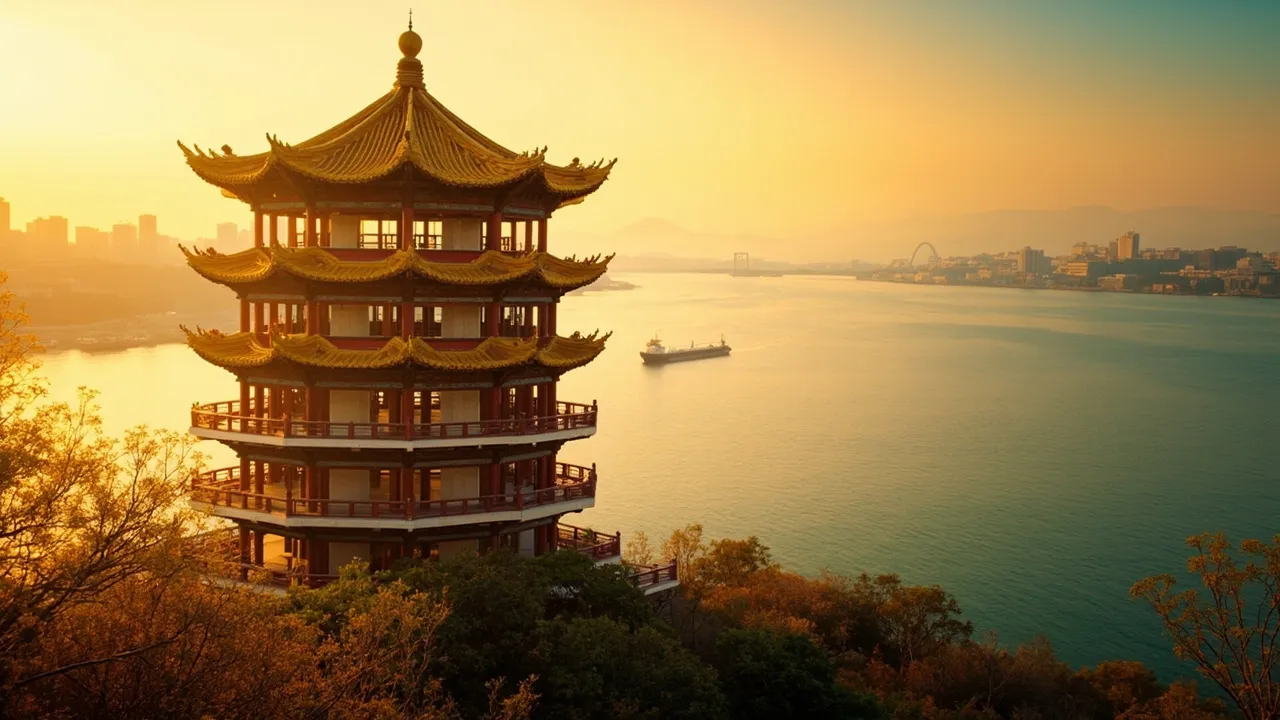
In his twenties, Li Bai left Sichuan and traveled along the Yangtze River. Travel was not a weekend hobby. Boats, horses, inns, monasteries, official stations, and private hospitality carried him through a landscape that could be beautiful and physically punishing. His poems name real places—Mount Emei, Jingmen, the Yellow Crane Tower, Lake Dongting—while transforming them through imagination.
One poem sends water falling three thousand feet at Mount Lu, as though the Milky Way dropped from heaven. The measurement is not a surveyor’s claim. Classical Chinese poetry often uses enormous numbers to produce emotional scale. Li Bai looks at a waterfall and refuses to make it small enough for ordinary language.
He married more than once and had children, though popular portraits tend to leave his domestic life offstage. He also cultivated connections with officials and religious figures. In 742, Emperor Xuanzong summoned him to the Tang capital, Chang’an, perhaps after influential admirers praised his talent. Li Bai received a position at the Hanlin Academy, an elite institution whose members drafted documents and served the emperor’s literary needs.
This sounds like success. It was not the high policy role he wanted. Court anecdotes picture him composing verses for imperial entertainment, sometimes while drunk. The famous consort Yang Guifei appears in poems comparing her beauty with peonies and heavenly figures. Later stories say Li Bai made the powerful eunuch Gao Lishi remove his boots, a delicious scene of artistic pride humiliating court authority. Historians treat such anecdotes cautiously.
After roughly two years, Li Bai left Chang’an. Whether dismissed, encouraged to depart, or simply unable to fit court life, he never secured the lasting political position he desired. The episode created one of his enduring tensions: a poet who celebrated freedom but wanted recognition from the center of power.
Around 744, he met Du Fu, who would become another giant of Chinese poetry. Du Fu was younger and not yet famous. They traveled together for a time and exchanged poems. Du Fu wrote repeatedly about Li Bai with affection and concern. Li Bai addressed fewer surviving poems to Du Fu, which has led generations of readers to joke that the friendship was unequal. Surviving texts are not a full record of feeling, but the contrast is hard not to notice.
Why the Poems Feel Effortless
Li Bai wrote in several classical forms. Some poems follow regulated verse, whose strict patterns govern line length, rhyme, tonal contrast, and parallelism. Others use gushi, “old-style poetry,” with greater formal flexibility. He also excelled in short jueju, often translated as quatrains, which compress a scene or turn of thought into four lines.
To English readers, translations can look spare and free. The Chinese originals are anything but casual. Each character carries sound, meaning, literary association, and grammatical possibility. Classical Chinese often omits subjects, articles, tense markers, and connectors that English expects. A translator must decide whether a line says “I see,” “he sees,” or simply “seeing.” That openness is one source of the poems’ spacious feeling.
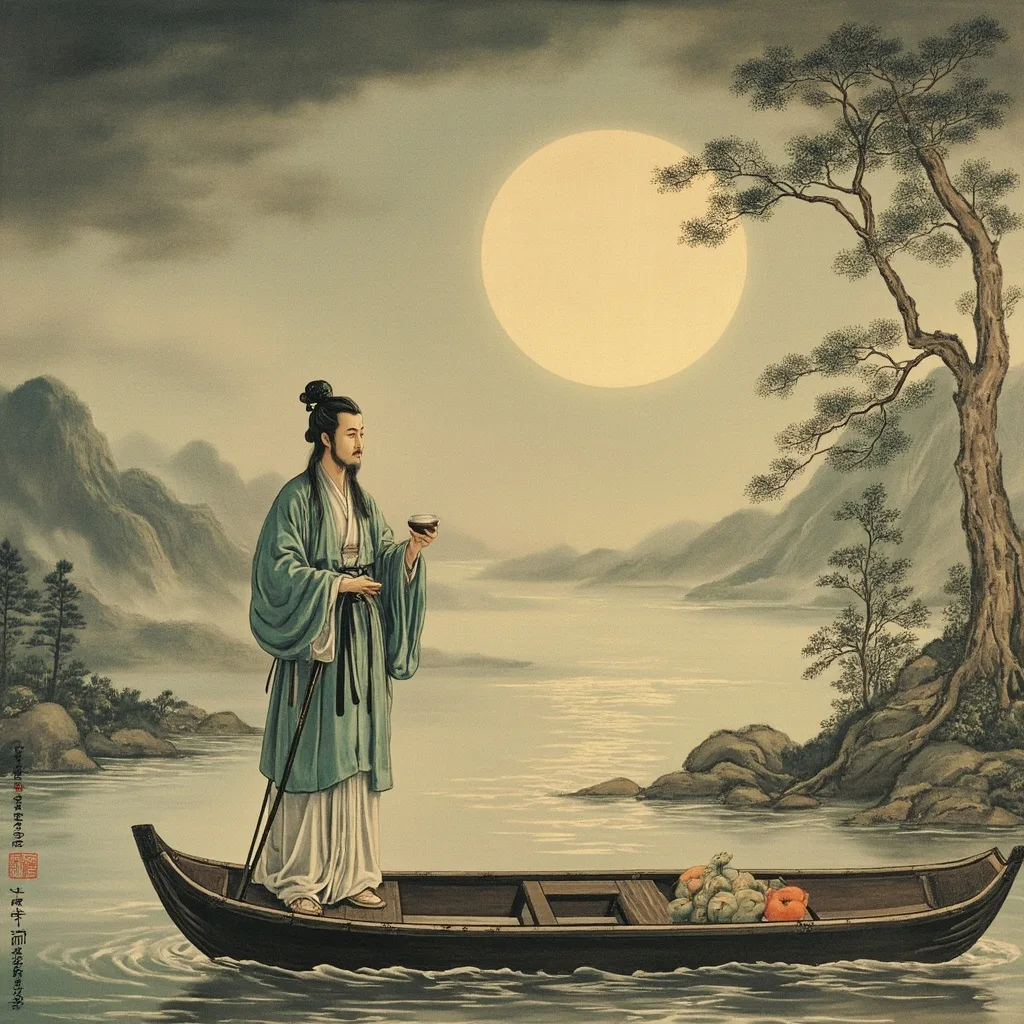
Consider “Drinking Alone under the Moon.” Li Bai raises a cup among flowers, with no companion nearby. He invites the moon, and his shadow joins them, making three. The moon cannot drink; the shadow only follows. Still, they become temporary friends until spring ends. The scene is playful, lonely, theatrical, and metaphysical at once.
Wine in Li Bai is never just a beverage. It loosens ordinary boundaries, creates fellowship, permits candor, and gestures toward Daoist transcendence. It can also mark disappointment. A man shut out of useful office may declare that worldly success is not worth sobering up for. Yet he keeps writing to patrons and accepting appointments. The contradiction is human, not hypocritical.
His landscapes move. Rivers descend from heaven, cliffs rise into clouds, boats race past mountains, white hair becomes three thousand feet of sorrow. Where the poet Wang Wei often builds still, meditative scenes, Li Bai favors propulsion and sudden scale. Even quiet moonlight travels across distance to connect separated people.
Friendship poems show another side. In “To Wang Lun,” Li Bai is about to depart by boat when he hears singing and foot-stamping on shore. He says Peach Blossom Pool may be a thousand feet deep, but it is not as deep as Wang Lun’s feeling in seeing him off. The hyperbole is affectionate, almost conversational. Legend later embroidered the occasion, but the poem needs no elaborate backstory.
Then there is voice. Li Bai can sound astonishingly direct: “Bring in the wine!” or “Heaven gave me talents; they must be put to use.” Those translations from “Bring in the Wine” have become motivational quotations, though the poem’s mood swings between confidence, extravagance, mortality, and despair. He orders fine horses and costly furs exchanged for wine so the companions can dissolve “the sorrows of all time.” It is not a sensible financial plan. It is unforgettable poetry.
A common myth says Li Bai improvised everything in a haze. Tang literary culture prized apparent spontaneity, but trained spontaneity is still training. He knew earlier poetry, historical allusions, court rhetoric, folk-song traditions, and formal craft. A jazz solo can feel airborne because the musician has practiced scales for years. Li Bai’s ease is an artistic achievement, not absence of labor.
Moon, Wine, Friendship, and the Search for Freedom
The moon is one of Li Bai’s great companions because it is both local and shared. It hangs above an inn, a mountain pass, a battlefield, or a hometown. A traveler can see the same moon as distant family. In a society where official service and travel separated people for months or years, celestial objects carried emotional messages across geography.
American readers sometimes encounter these poems in nature-spiritual terms, detached from social context. Daoist influence is genuinely important. Li Bai admired mountains associated with immortals, befriended Daoist adepts, and wrote about transcending the dusty human world. But mountain travel could also involve temples, local officials, servants, boatmen, and invitations. Solitude in poetry is often composed within a busy network.
His freedom likewise has edges. Li Bai’s persona refuses to bow before petty convention. He imagines riding the wind, crossing oceans, ascending sacred peaks, and drinking with ancient worthies. At the same time, Tang men of his class were bound by family obligations, patronage, rank, law, and imperial politics. The poems become powerful partly because release is desired, not fully possessed.
His treatment of women deserves a careful reading. Some poems speak in female voices, a longstanding literary practice through which male poets explored longing, abandonment, or political frustration. “The River-Merchant’s Wife” traces a woman’s memory from childhood to marriage and separation. Ezra Pound’s famous English adaptation introduced many American readers to it, though Pound worked from notes and reshaped details. We should admire the emotional construction without pretending it is an unmediated record of a Tang woman’s life.
Li Bai also wrote frontier poems about soldiers, campaigns, and women waiting at home. The Tang dynasty’s military expansion brought glory and suffering. His views vary by poem: heroic energy can sit beside grief over endless war. That range resists turning him into a single modern political type.
Translation intensifies every ambiguity. His name appears as Li Bai in pinyin romanization and Li Po under Wade-Giles conventions. “Quiet Night Thought,” “Thoughts on a Tranquil Night,” and “Night Thoughts” may all refer to the same famous moon poem. No version can preserve character count, tones, rhyme, syntax, allusions, and emotional naturalness at once.
The best approach is to read several translations. One may keep the image sequence; another may capture rhythm; a third may explain an allusion in notes. If possible, listen to the Chinese. Even without understanding every word, you can hear the compact line and recurring rhyme. Translation is not a dirty window blocking the real poem. It is a set of doors, each opening at a different angle.
I first understood this after comparing five versions of the line often rendered “the bright moon lifts from the Mountain of Heaven.” Some translations made it stately, others stark. None felt definitive. Together they revealed how much room the original gives the reader. Li Bai had not failed to specify. He had built resonance through compression.
Rebellion, Exile, and the End of the Journey
In 755, the An Lushan Rebellion shattered Tang stability. The general An Lushan rebelled, captured major capitals, and triggered years of warfare, displacement, famine, and political fragmentation. Emperor Xuanzong fled Chang’an. His son took the throne as Emperor Suzong while another son, Prince Yong, organized forces in the south.
Li Bai joined Prince Yong’s staff, apparently believing he was serving a loyal campaign. Court politics turned against the prince, who was defeated and killed. Li Bai was arrested for his involvement and sentenced to exile in Yelang, a remote southwestern region whose exact reference in this context is debated.
Friends and patrons intervened. He traveled toward exile slowly, writing along the way, and received an amnesty before reaching the destination. His poem “Setting Out Early from Baidi City” celebrates a swift downstream journey through the Three Gorges: leaving the colorful clouds at dawn, traveling a thousand li in a day, hearing monkeys cry from both banks, and passing ten thousand mountains in a light boat. Readers often connect its buoyancy with release, though dating and context remain discussed.
Li Bai’s final years were unsettled. He stayed with relatives and friends, suffered illness, and died in 762 in Dangtu, in today’s Anhui. A beloved legend says he drowned after leaning from a boat to embrace the moon’s reflection. It is perfect Li Bai mythology: wine, water, moonlight, and fatal transcendence. It is almost certainly not how he died.
The legend persists because it edits a messy life into one luminous image. The historical Li Bai died ill and dependent, after political catastrophe had destroyed many ambitions. The legendary Li Bai reaches for beauty and passes out of the world. Both endings produce emotion, but only one makes a good painting.
His work survived through collections copied, edited, printed, taught, and anthologized. The number of poems attributed to him is around a thousand, though textual histories are complex. Later critics made him a central figure in the Tang “golden age,” often pairing him with Du Fu. Li Bai became the spontaneous, otherworldly genius; Du Fu the disciplined, morally engaged historian-poet. Both labels simplify extraordinarily varied writers.
How Li Bai Became a Global Poet
Li Bai’s influence within East Asia is immense. His poems circulated in Korea, Japan, and Vietnam through traditions of literary Chinese. Painters and calligraphers responded to his images. Operas, stories, schoolbooks, television dramas, and popular songs retold his life. His lines entered everyday speech and collective memory.
In the English-speaking world, translations and adaptations multiplied in the nineteenth and twentieth centuries. Ezra Pound’s Cathay helped reshape modernist poetry, despite being based on the notes of scholar Ernest Fenollosa rather than Pound’s command of Chinese. Composer Gustav Mahler used German adaptations of Chinese poems, including works linked to Li Bai, in The Song of the Earth. The path from Tang Chinese to French paraphrase, German verse, orchestral song, and global concert hall is a remarkable chain of reinvention.
Modern readers still recognize his basic pressures: wanting meaningful work, performing confidence while disappointed, leaving home, missing friends, and using beauty to survive uncertainty. His cultural world is distant, but his emotional turns are quick and legible. A moonlit floor can cross twelve centuries without much explanation.
Start small. Read “Quiet Night Thought,” “To Wang Lun,” “Drinking Alone under the Moon,” “Bring in the Wine,” and “Setting Out Early from Baidi City.” Try two translators. Read aloud. Then notice how the popular image of a carefree drunk changes once court ambition, civil war, and exile enter the story.
Li Bai is called immortal not because he escaped death. His body failed, his political plans failed, and the Tang world he knew fractured. The immortality belongs to voice. Every time a child looks down at “frost” on the floor and then lifts their head to the moon, the traveler begins again.
Continue Exploring Chinese Culture
For the legendary origins of the civilization Li Bai inherited, read Huangdi, the Yellow Emperor. Dragon and Phoenix Symbolism introduces the auspicious visual language that appears throughout Chinese art. The bird in Li Bai’s imaginative world has a history distinct from the Western phoenix; explore it in Fenghuang and Phoenix Mythology. To see how Chinese artistry later traveled through global trade, visit Ming Blue-and-White Porcelain.