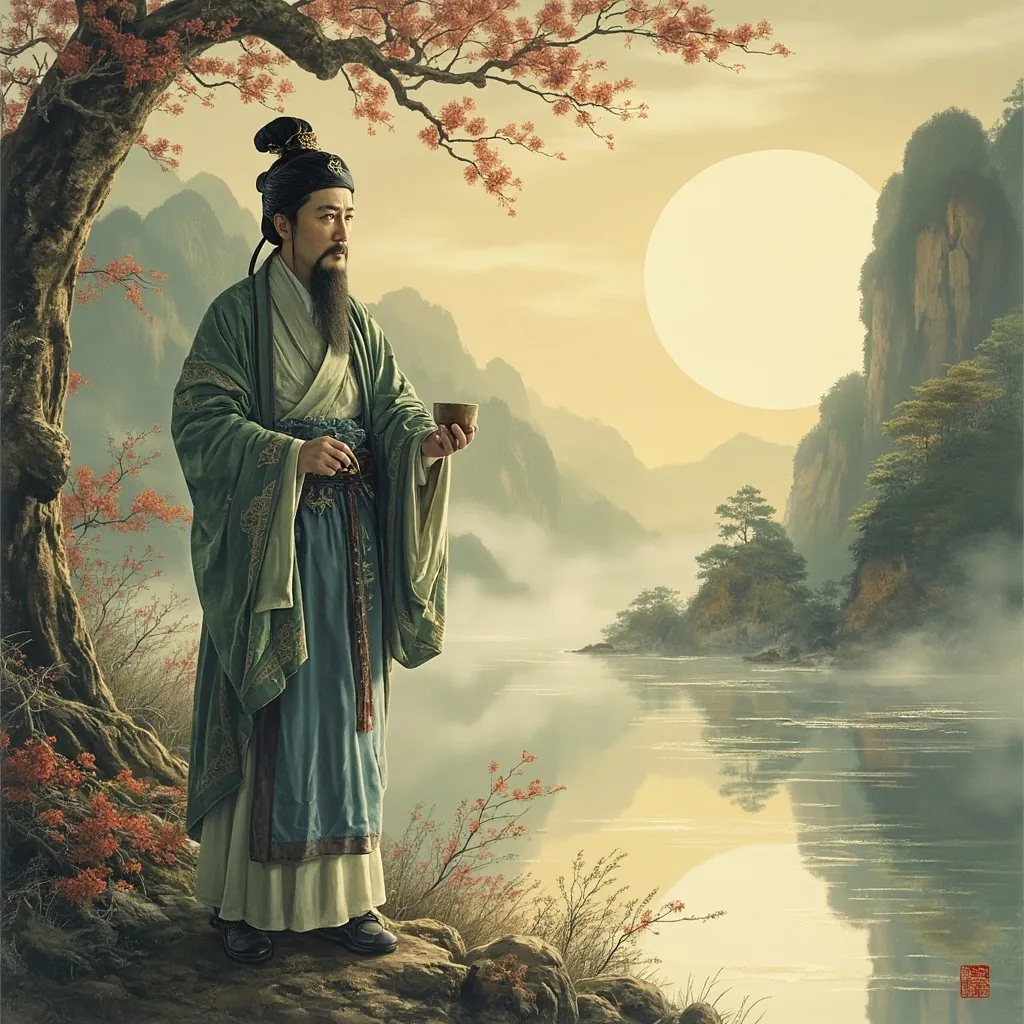
category: Chinese Culture tags: [“Li Bai”, “Tang Dynasty”, “Chinese Poetry”, “Poet Immortal”, “Du Fu”, “Classical Chinese Literature”] image: /images/li-bai.jpg categories: [Chinese History, Literature & Poetry] alt_text: “Illustration depicting li bai, in a traditional Chinese cultural setting” affiliate_products: [chinese-history-book, chinese-poetry-collection, chinese-culture-book]
There are poets, and then there’s Li Bai. While Shakespeare may dominate the Western literary imagination, and Homer holds sway over the ancient world, Li Bai occupies a space in Chinese culture that is almost mythological in its dimensions. He is called the “Poet Immortal” (诗仙, Shīxiān), a title bestowed not by accident but by the force of his own extraordinary gift for language. His verses don’t merely describe the world — they lift you out of the world entirely, into a realm of moonlight and mountains and wine and freedom that feels more real than the room you’re sitting in as you read them.
Li Bai lived during the Tang Dynasty (618–907 CE), widely considered the golden age of Chinese civilization — a period of unprecedented political stability, economic prosperity, and cultural flowering. It was an era when poetry was not merely appreciated but required; if you wanted to hold public office in the Tang, you had to pass a imperial poetry examination. The Tang court attracted the finest minds from across Asia, and the city of Chang’an (modern Xi’an) was the largest, most cosmopolitan metropolis on Earth. Into this extraordinary world, Li Bai arrived like a comet, trailing fire and wonder.
His life reads like one of his own poems — full of movement, passion, solitude, friendship, wine, and a relentless restlessness that drove him from the mountains to the capital to the Yangtze River and back again. He died, by most accounts, in a boating accident on the Yangtze in 762 CE, though legend prefers the story that he drowned while reaching for the moon’s reflection in the water. Given the man, that seems fitting.
The Making of a Poet Immortal: Early Life and Influences
Li Bai was born in 701 CE in Suiye, a region on the far western frontier of the Tang Empire (modern Kyrgyzstan, if you’re checking the map). His family had been exiled there generations earlier during political upheavals, and while they maintained their aristocratic pretensions, the reality of frontier life was grittier and more freewheeling than life in the imperial heartland. Some accounts say his father was a merchant; others claim he was a failed official. What seems certain is that Li Bai grew up outside the rigid social structures that would have shaped a more conventional scholar.
According to legend — because with Li Bai, everything eventually becomes legend — he was a rebellious child who showed little interest in the Confucian classics that were the bread and butter of the Tang examination system. Instead, he was said to have been more interested in swordsmanship and Daoist meditation. One famous story describes how the young Li Bai, while traveling on a boat, saved a drowning woman by simply jumping in after her, then wrote it off as a minor adventure. Another tells how he spent years as a wandering swordsman before he ever seriously pursued poetry.
This background matters, because it shaped the voice that would later make Li Bai the most distinctive poet of his age. Where his contemporary Du Fu was scholarly, precise, and politically engaged — a poet of the street and the suffering — Li Bai was a poet of escape, of the mountains, of wine and friendship and the sheer intoxication of being alive. His work drew as much from the freewheeling, nature-obsessed traditions of Daoism as from the formal structures of Confucian learning. He was, in a sense, the original countercultural figure.
At around age fifteen, Li Bai began taking poetry seriously. He studied the works of earlier masters — Qu Yuan, the 3rd-century BCE poet of melancholy and loyalty; Cao Zhi, whose emotional directness influenced Li Bai’s conversational style; and the anonymous authors of the楚辞 (Cí, “Songs of Chu”), whose lyrical, fantastical imagery left a permanent imprint on his imagination). By his twenties, his own poems were already circulating among literary circles, and his reputation began to grow.
The Great Friendship: Li Bai and Du Fu
No story in Chinese literary history is more cherished than the friendship between Li Bai and Du Fu. It was one of the great literary partnerships of any culture, anywhere — a relationship between two poets who were, in temperament and style, almost perfectly opposite, and who found in each other a complement and a catalyst.
They first met in Luoyang in 744 CE, when Li Bai was already a celebrated figure and Du Fu was a young, ambitious poet still finding his voice. Li Bai was nearly a decade older, famous throughout the empire, and by all accounts gregarious, wild, and prone to drinking binges that could last days. Du Fu was more reserved, more politically aware, and far more disciplined. Yet something clicked between them, and they spent the better part of a year traveling together, trading poems, and drinking in the company of another poet who truly understood the craft.
What survives of their correspondence is fragmentary but electrifying. Li Bai wrote a poem for Du Fu in which he described Du Fu as his soulmate in poetry — someone who could match him line for line. Du Fu, in return, wrote poems about watching Li Bai compose — marveling at how effortlessly the words seemed to flow from him, as if the natural world itself whispered verses into his ear.
Their paths diverged in 744, when Li Bai accepted an invitation to join the imperial court in Chang’an. Du Fu continued his own journey, eventually becoming the great social realist poet of the age, writing about war, famine, and the suffering of ordinary people with a precision that no other Tang poet matched. But the bond between the two never broke. They exchanged poems across the miles, and Du Fu never stopped writing about his older friend — sometimes with admiration, sometimes with worry about Li Bai’s restless wandering, and always with deep affection.
The two men represent, in many ways, the two great poles of Tang poetry. Li Bai wrote about transcendence, about escaping the cares of the world through wine, nature, and the creative act. Du Fu wrote about engagement, about facing the world’s suffering directly and bearing witness. Together, they encompass the full range of what poetry can do — lift us out of ourselves and help us see the world more clearly.
The Lyricism of Li Bai: Quiet Night Thought and Other Masterpieces
Li Bai’s output was enormous — the surviving canon contains over a thousand poems, though scholars believe many more have been lost. But a handful of poems are so widely known in China that children learn them before they can read properly, and they appear everywhere — on restaurant walls, in textbooks, carved into the stones of monuments. These poems are not merely famous; they are woven into the fabric of Chinese cultural life.
静夜思 (Jìng Yè Sī, “Quiet Night Thought”) is perhaps the most famous poem in the Chinese language. It consists of just four lines:
举头望明月, 低头思故乡。
(raise my head to gaze at the bright moon, / lower my head to think of my distant home)
That’s it. Twenty words in Chinese, and somehow it contains the entire human experience of homesickness, of looking up at the same moon that your loved ones back home are also looking at, and feeling simultaneously connected to them and separated from them by thousands of miles. Li Bai’s genius was his ability to find the cosmic in the everyday, to take an image as common as the moon and make it carry the weight of existential longing. Quiet Night Thought has been translated into virtually every language on Earth, and every translation somehow preserves its directness and emotional power.
花间一壶酒 (Huājiān Yī Hú Jiǔ, “A Pot of Wine Among the Flowers”) is another masterpiece of apparent simplicity. In this poem, Li Bai drinks alone beneath the moon, with only his shadow for company — and then addresses the moon directly, suggesting that the three of them (himself, his shadow, and the moon) should form a party. It begins:
花间一壶酒, 独酌无相亲。 举杯邀明月, 对影成三人。
(A pot of wine among the flowers; / I drink alone, with no close friend. / I raise my cup to invite the bright moon. / Facing my shadow, we are three.)
It’s funny, lonely, and transcendent all at once. The moon and shadow are clearly metaphors — the moon representing a kind of ideal companionship, the shadow perhaps the part of himself he keeps hidden. But the poem never feels heavy or didactic. It feels like the kind of thought you might actually have after your third glass of good wine on a spring evening, and that’s Li Bai’s deepest gift: making the profound feel effortless.
Among Li Bai’s longer works, the将进酒 (Qiāng Jìn Jiǔ, “Bring In the Wine”) is the most celebrated. It’s a poem about wine, mortality, and the futility of worrying about the future when the present offers such rich rewards. Its opening lines are among the most quoted in Chinese literature:
君不见黄河之水天上来, 奔流到海不复回。 君不见高堂明镜悲白发, 朝如青丝暮成雪。
(Do you not see / the Yellow River’s waters surge from heaven, / racing to the sea, never to return? / Do you not see / bright mirrors in high halls grieve over white hair, / morning like black thread, by evening become snow?)
This is Li Bai at full power — large, sweeping, philosophically bold. He argues, in his inimitable way, that life is short and the wine is excellent, so why waste time on sorrow? It’s a deeply Taoist poem in its embrace of the natural flow of things, and it captures something essential about Li Bai’s outlook: he was not a man who wanted to fight the current of life. He wanted to ride it.
The Legendary Life: Wandering, Wine, and the Search for Immortality
One of the most important things to understand about Li Bai is that he was not primarily a man of letters in the way we understand the term today. He was a wanderer — a man for whom staying in one place was an act of violence against his own nature. He traveled extensively throughout the Tang Empire, from the deserts of the west to the mountains of Sichuan, from the cosmopolitan capital of Chang’an to the great river cities of the Yangtze basin. He was as much a travel writer as a poet, and his poems function as a kind of intimate travelogue of the Tang world.
He was also, by most accounts, an enthusiastic drinker, and his relationship with wine plays a central role in his self-image and his poetry. He wrote openly about his drinking, often treating it not as a vice but as a conduit to a higher state of consciousness — a way to loosen the constraints of everyday awareness and touch something more essential. He was reportedly a cheerful drunk, generous with his wine, and always ready to share a cup with a stranger who turned out to be an interesting conversation partner.
Daoism was another consuming passion. The Tang Dynasty was a period of intense religious experimentation, and Li Bai was drawn to Daoism’s emphasis on living in harmony with nature, its openness to mystical experience, and its willingness to embrace the body’s desire for longevity and transcendence. Li Bai reportedly studied with Daoist masters, practiced meditation, and took elixirs — some of which, by the way, may have included toxic heavy metals, which could explain certain aspects of his later life. He was fascinated by the figure of the immortal — the being who had transcended ordinary human limitations — and he styled himself as a kindred spirit, a man already halfway out the door of the material world.
His wanderings eventually brought him into contact with the Tang imperial court, where his reputation had preceded him. In 742, he was summoned to Chang’an and presented to Emperor Xuanzong, who was so impressed that he granted Li Bai a minor official post — largely honorary, as it turned out, since Li Bai had no real interest in bureaucratic routine. He spent a few years in the capital, writing poems for the court and enjoying the company of other literary figures, but the constraints of palace life eventually proved too confining. He left the court and returned to his wandering life.
The last years of Li Bai’s life were marked by turmoil. The An Lushan Rebellion — one of the most devastating conflicts in Chinese history — erupted in 755, shattering the peace and prosperity of the Tang golden age. Li Bai’s life was upended along with everyone else’s. He attached himself to various military figures, wrote poetry in support of the imperial cause, and spent years in displacement and uncertainty. He died in 762, near Nanjing, on the banks of the Yangtze River. The circumstances are disputed, but the most poetic version of the story — that he drowned reaching for the moon’s reflection — says everything about how the Chinese people wanted to remember their Poet Immortal.
Li Bai’s Legacy in Modern Culture
Li Bai’s poems have never fallen out of fashion in China. They are memorized by schoolchildren, quoted in everyday conversation, and referenced in everything from films to political speeches. His image appears on stamps, his verses are inscribed on the walls of restaurants and teahouses, and his life story has been retold in novels, operas, and television dramas.
Internationally, Li Bai’s reputation has grown steadily as more readers encounter his work through translation. He is one of the few Chinese poets whose work is widely available in English, and the many translations of his poems — by Arthur Waley, Ezra Pound (who took considerable liberties but captured the spirit brilliantly), and many others — have introduced his work to millions of readers who would otherwise never have encountered Tang poetry.
Recommended Products:
The Poetry of Li Bai - Bilingual Edition — A beautifully produced bilingual edition of Li Bai’s greatest poems in Chinese and English translation, with detailed notes and biographical context. An essential addition to any lover of world poetry.
Quiet Night Thought: Li Bai Scroll Art Print — A museum-quality reproduction of the poem “Quiet Night Thought” in classical Chinese calligraphy, set in an elegant scroll format with traditional mounting. Perfect for a study, library, or meditation space.
Tang Dynasty Poetry Anthology - Li Bai, Du Fu, Wang Wei — A comprehensive anthology of Tang Dynasty poetry featuring Li Bai alongside his great contemporaries, providing full context for his work within the golden age of Chinese verse.
Jade Inkstone Calligraphy Set — A traditional Chinese calligraphy set including a quality jade inkstone, ink stick, brush, and water dropper — everything needed to practice writing Li Bai’s poems in classical Chinese script.
Li Bai Biographical Documentary - The Poet Immortal — A critically acclaimed documentary tracing Li Bai’s life and travels across China, filmed on location at the mountains, rivers, and cities that inspired his greatest verses.
Li Bai’s poems have a quality that is genuinely rare in literature: they make you feel the world more intensely. After reading Quiet Night Thought, you’ll never look at the moon the same way. After reading A Pot of Wine Among the Flowers, you’ll want to pour yourself a drink and sit outside. His work doesn’t require you to understand Chinese culture or Chinese history or Chinese literary conventions. It requires only that you be human, and alive, and capable of wonder. In that sense, Li Bai belongs not just to China but to everyone who has ever looked up at the stars and felt, for just a moment, that they were exactly where they were supposed to be.