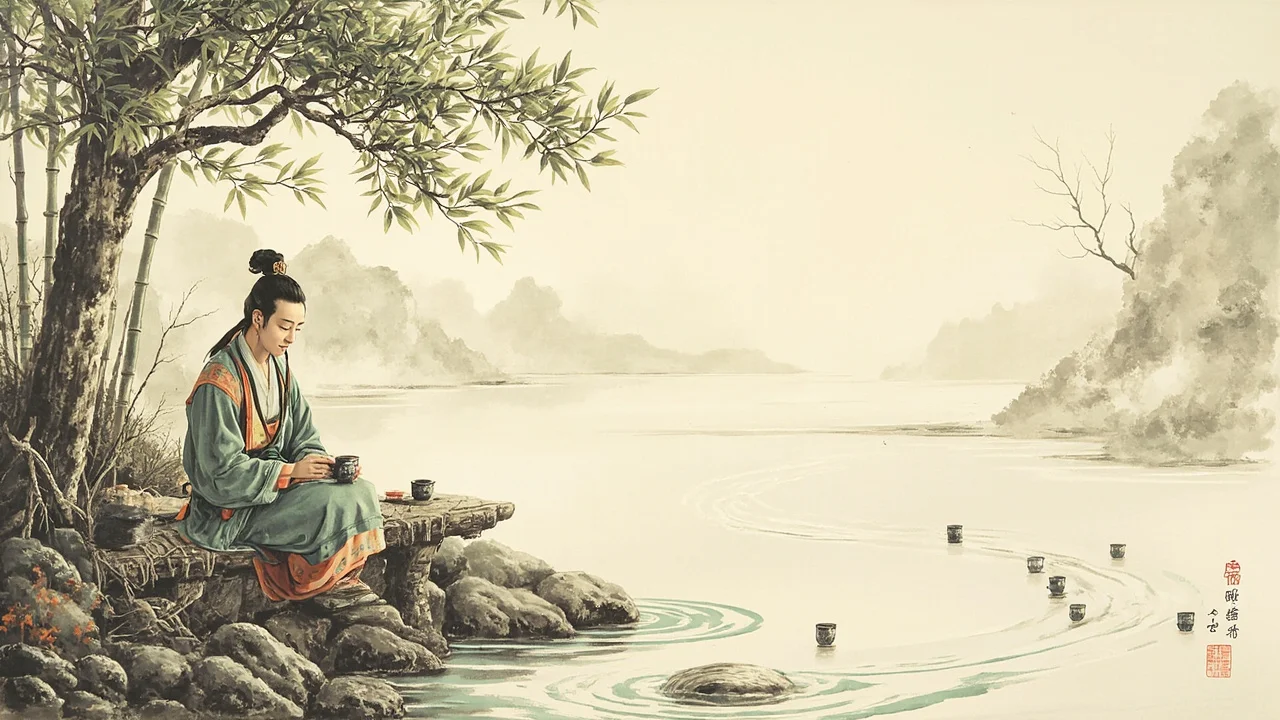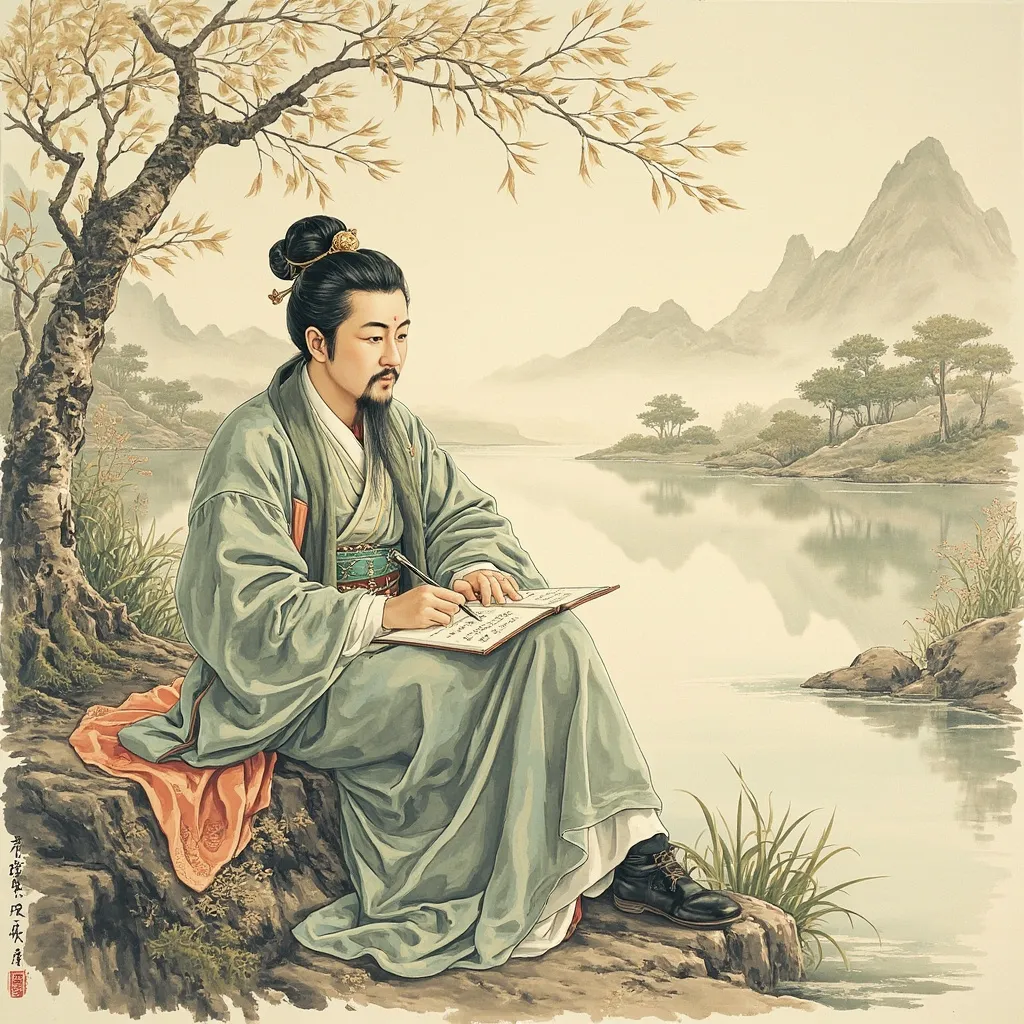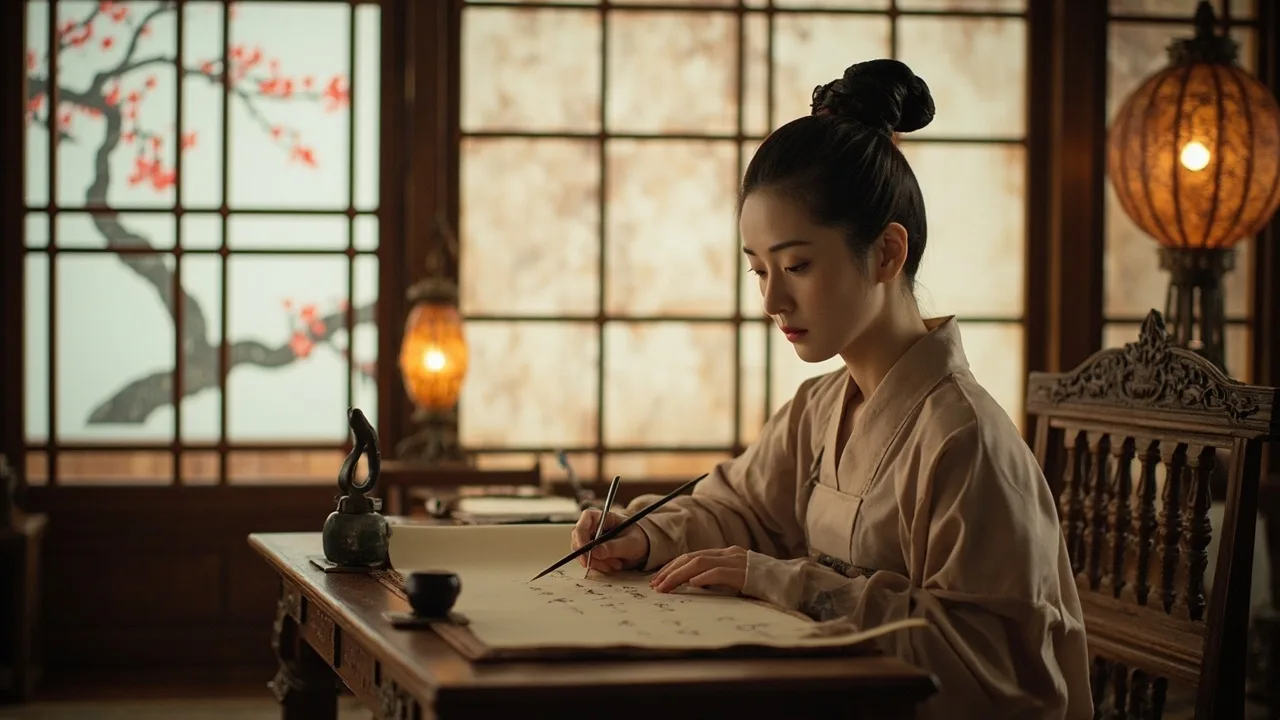
There is a small building in the southern suburbs of modern Jinan, in Shandong province, with a long curved roof, dark wooden eaves, and a placard reading 漱玉泉 (Suyu Spring, “Spitting-Jade Fountain”). Tourists line up to take photographs there. Most of them do not realize that the spring was once associated with a local woman — a girl who grew up playing near it in the late 1000s CE and went on to become the most celebrated female poet in the entire Chinese literary tradition.
Her name was Li Qingzhao (李清照, 1084 – c. 1155 CE). She lived through one of the most politically catastrophic periods in Chinese history — the fall of the Northern Song dynasty to the Jurchen Jin invasion in 1127 CE — and turned her response to that disaster into poetry that, more than 900 years later, still reads as if it was written yesterday.
She is remembered as “The Goddess of Ci” (词后, cihou), a title that ranks her as the supreme practitioner of the ci form, a kind of Chinese lyric poetry written to fixed musical patterns. Ci was already centuries old when Li Qingzhao arrived on the scene. By the time she was done with it, no one could touch her.
But who was she, exactly? What did she actually write? Why was her poetry so good? And what has happened to her reputation over the nine hundred years since she died?
Who Li Qingzhao Was
Li Qingzhao was born in 1084 in Zhangqiu, near Jinan in Shandong, into a family that took both literature and the imperial examination seriously. Her father, Li Gefei (李格非), was a noted prose stylist and a member of the Jinshi cohort that produced the reformist official-and-essayist Su Shi. Her mother, an educated woman from a good family, came from a line that included some of the best scholars of the late Northern Song. Li Qingzhao’s childhood home was full of books, calligraphy rubbings, and adult conversation about poetry. By the time she was a teenager she could already write respectable verse.
She was also unusually well-read. In her later critical essay Lun ci (“On Ci,”), the only surviving theoretical statement we have from her hand, she gives a quiet but devastating ranking of major ci poets — Su Shi, Ouyang Xiu, Liu Yong, the late Tang masters — and dismisses most of them as inconsistent or pedestrian. The hierarchy she constructs, with one or two exceptions, reads a lot like a single dictation filtered through her own taste. Scholars have spent a thousand years arguing about whether her judgments are fair. Most of them agree she is rarely wrong.
At sixteen or seventeen, in 1101 or 1102, she married a scholar-official named Zhao Mingcheng (赵明诚). The marriage was a literary partnership as much as anything else. Zhao, the son of a high-ranking official, shared her passion for books, calligraphy rubbings, ancient bronze vessels, and inkstones. The couple spent their early married years cataloguing the family collection, comparing rubbings of inscriptions, and trading poems about the small details of scholarly life. Their marital happiness shows up, often obliquely, in her early poetry — a cup of tea shared in a cold study, the distant sound of a flute from a neighbor’s house, the ache of being separated when her husband went on a long business trip.
The marriage lasted until 1129 CE, when Zhao Mingcheng died during a desperate flight south from the advancing Jurchen armies. Li Qingzhao was then in her mid-forties. After his death — and especially after the loss of most of their collection, much of it lost in a fire, in looting, or to theft by a relative they had unwisely trusted — her life became one of poverty, ill health, and exile. She wandered between Hangzhou, Jinhua, and other cities of the Southern Song. She spent much of her later life trying to complete a memorial catalogue of her husband’s collection titled Jinshi lu (金石录, Record of Metal and Stone). She died sometime after 1155 CE, probably in Hangzhou.
By the time she died, the ci poetry she had spent her life perfecting was already considered a high-water mark of the form. Over the next several centuries her reputation only grew. Most modern critics now agree that her late poems in particular are among the very finest short lyrics in any language.
What Ci Poetry Is
To understand Li Qingzhao’s contribution, you have to understand ci as a form. It was the dominant Chinese lyric genre of the Song dynasty, and it has features that go well beyond what English-language “lyric poetry” usually implies.
Each ci poem was written to a fixed musical pattern — called a cipai (词牌) or tune pattern — that specified a particular number of lines, a particular number of syllables per line, a particular rhyme scheme, and a particular rhythmic structure. A single cipai such as Slow Slow Tune (慢, man) might be set to a single musical melody, and a hundred different poets could write a hundred different lyrics to the same tune. The poet was essentially choosing among pre-existing musical canvases and supplying words that fit.
This has a couple of implications. First, ci poems were originally meant to be sung. Song dynasty ci was closer to popular song than to high-brow verse — it was what was performed at banquets, in brothels, at court entertainment. Li Qingzhao’s early poems, in particular, belong to a sub-tradition (the Wanyue (婉约) or graceful-and-restrained school) that treated the form as delicate love poetry addressed to an absent or present beloved.
Second, ci has a strong melodic shape: every poem has its own internal pulse. Some cipai are short and snappy. Some are long, slow, and cyclical, with stanzas building on each other. Li Qingzhao wrote within virtually every major cipai in the Song repertoire. Her mastery of pattern is part of why the form has never been quite the same since.
Third, ci vocabulary was, by convention, a specific subset of the Chinese language — emotional, image-heavy, packed with seasonal references, full of particular sensations: willows, lotus, candlelight, the smell of orchid, the cold of late autumn, the first cup of wine at dusk. The skill was to make this shared vocabulary feel personal. Li Qingzhao was the best at it by quite a margin.
Her Two Distinctive Bodies of Work
Li Qingzhao’s surviving poems fall into two very clearly defined phases. The shift between them is the most important fact about her work, and the most important thing to grasp if you want to read her poems in any meaningful order.
The early period (c. 1100 – 1127 CE) consists of love lyrics and occasional pieces written during her marriage. These are bright, witty, sensual, and full of small domestic details — sometimes amusing, sometimes flirtatious. “I am too lazy to brush my hair,” goes one of her most famous early poems, “and let the day go past. I am too shy, lately, to ask guests in.” Another, written during one of Zhao Mingcheng’s business trips, sends him off with a gentle tease: “Don’t forget me when the peach blossoms bloom. I will send you spring news from this river town of ours.” It’s charming, sharp, and almost modern in its self-aware humor.
The late period (1127 CE onward) is something else. After the Jurchen invasion, after the loss of her husband, the destruction of her home, and the looting of her collection, her poems become spare, grief-stricken, and haunted. They also become longer, more meditative, and structurally unusual. One of her most famous late poems, often titled Sheng sheng man (声声慢, “Slow, Slow Tune”) — written to one of the most demanding long cipai in the Song repertoire — opens with a cascade of fourteen different “cold” modifiers and then settles into a slow, almost free-floating meditation on the impossibility of remaining cheerful when the world has changed.
Looking for him, I seek the cold. Searching, I seek the cold — a chill in the bones, more than any year before. A cup of tea, warmed a moment ago, now is cold again, as if to mock the mood of one who holds it. Snow falls outside, plum blossoms in the courtyard flourish and fade, and yet I feel nothing of spring’s arrival. I clutch my sides, my thoughts wander, I have nothing to give to this afternoon but grief. …
(Translations vary; this is a loose rendering from the much-quoted opening.)
That single cipai — sheng sheng man, “Slow Slow Tune” — is in some ways the most extended single piece of ci lyrics in the entire Chinese canon. It is also one of the most quoted. The oppressing mood is so carefully constructed that each of its fourteen “cold” modifiers at the opening feels exact and inevitable.
Her Theory of Ci and Why It Mattered
The Lun ci (“On Ci”) essay we have is fragmentary — it survives mostly because later critics quoted it when arguing about her or about poetry. But even in the broken form we have it, it reveals a startlingly modern aesthetic.
She opens with a sharp historical thesis: the ci tradition since the late Tang has been one of decline because each generation has tended to copy the previous generation, gradually losing touch with the original musical and emotional register of the form. She praises (and ranks) the best late-Tang ci poets, then criticizes — sometimes witheringly — the way early Northern Song poets handled it. She has grudging respect for Su Shi’s expansion of the form but clearly prefers the Wanyue mode she herself has perfected: ci as a finely controlled art of mood, restraint, and subtextual emotion.
She also introduces the famous distinction that later critics would echo and contest for centuries: the difference between ci as saying something (the Wanyue mode, where each word is weighed and calibrated) and ci as saying-it-by-saying-not-anything (a more expansive, even philosophical mode associated with Su Shi’s Haofang or “open and unrestrained” school). She concludes — at least in the surviving fragments — that a great ci poem should do both at once: control the words, exactly and without ostentation, in a way that lets emotional and political truth emerge almost incidentally.
The modern critic Ronald Egan, in The Burden of Female Talent, has argued that Li Qingzhao’s Lun ci does something we don’t fully appreciate in English-language commentary: it constructs the rules of a genre that had not been theorized that way before. The “rules of ci” — its tonal pattern-rules, its distinction between ornamental and structural words, its attack on self-pity as a sentiment inappropriate to serious lyrics — were her codification as much as anyone else’s.
Her Reputation Over a Thousand Years
Li Qingzhao’s reputation has, frankly, never been the same twice. In the Song dynasty itself she was recognized as a major poet by readers, but in the Yuan and Ming dynasties her status quietly slipped in some quarters — partly because of moralistic criticism of her later life (the gossip about an alleged second marriage to a man she later sued was exaggerated into a “scandal”), partly because the kind of dense, personal, technically demanding lyric she wrote fell out of fashion for a while.
By the eighteenth century, during the Qing dynasty, her reputation had rebounded so fully that she was routinely placed on lists of the most important ci poets in history, alongside masters who had been writing for centuries longer. In the twentieth century, the May Fourth Generation — with their taste for personal, confessional, technically innovative poetry — treated her as essentially a foremother of modern Chinese writing. Modern Chinese scholars, both inside and outside the mainland, generally treat her as the single greatest ci poet who ever lived and as one of the four or five most important women poets in any world literature. Modern Western translations — notably by Kenneth Rexroth in One Hundred Poems from the Chinese (1956) and by C. H. Kwock and Vincent McHugh in The Penguin Book of Chinese Verse (1967) — made her work widely available in the English-speaking world for the first time. Modern feminist readings, beginning in the 1970s, gave her a prominent place in the global rediscovery of women writers.
If you ask Chinese poetry students today who the most important ci poet of all time is, the answer is short. Li Qingzhao. No commas, no qualifiers, no “probably.”
Reading Her Today, and How to Start
If this article has made you curious to actually read Li Qingzhao’s poems (and you should — they are easy to fall in love with), a few suggestions.
The standard scholarly English-language work is Ronald Egan’s The Burden of Female Talent (Princeton, 1992) and his later works on Song ci poetry. The classic 1979 translation by James Liu, Major Lyricists of the Northern Sung, includes a substantial selection of her poems with detailed notes. For a more impressionistic but accessible introduction, Kenneth Rexroth’s One Hundred Poems from the Chinese includes a generous selection.
If you want to read her poems in Chinese as well as English, the standard scholarly Chinese edition is based on the Ming dynasty collection titled 漱玉词 (Suyu ci, “Spitting-Jade Lyrics”). Modern Chinese editions print both text and detailed line-by-line commentary.
I would also gently recommend pairing your reading with gongfu cha, the Chinese tea ceremony. Call me superstitious, but I think the kind of attention Li Qingzhao paid to small sensory details — the warmth of a teacup cooling in autumn air, the color of plum blossoms outside a snowy window — translates unusually well into a quiet hour with a teapot and a small clay cup. Here are a few pieces that will hold up through years of use:
- Gongfu Tea Set with Yixing Clay Teapot — The Yixing teapot is the traditional vessel for this kind of tea ceremony. A small (60–150 ml) pot made of unglazed zhisha purple clay is what most experienced gongfu drinkers use for oolong and aged sheng pu’er.
- Chinese Loose-Leaf Tea Sampler (Oolong, Green, White, Black) — A small sampler covering a few classic Chinese styles (Tieguanyin oolong, Longjing green, silver needle white, Yunnan red) lets you taste the range of the tradition without buying in bulk.
- Travel Gaiwan Set for Tea on the Road — A 100-ml lidded porcelain cup meant to steep leaves and serve as a drinking vessel, useful when you do not have space to set up a full gongfu tray.
- Collected Ci Poetry of the Song Dynasty (qscbc edition) — A bilingual (Chinese-English) anthology of Song ci including Li Qingzhao’s poems alongside her contemporaries. Look for the Sun, de Bary, Schirokauer editions for the academic standard.
- Song Dynasty Arts and Culture (illustrated coffee-table book) — Coffee-table surveys of the Song dynasty are the easiest way to get a feel for the visual, material world she inhabited — its buildings, its furniture, its ceramics, its printing, its dyed silk.
A final note. Li Qingzhao’s poetry is often taught in Chinese schools as if it were a school exercise. Don’t be put off by that. Read her poems in the order she wrote them. Read them slowly. The early ones will make you smile. The late ones will keep you up at night. Both are doing the same thing — recording exactly what someone actually felt, at full attention, with no exaggeration — and that is the rarest thing anyone has ever managed in poetry.