- “Chinese Folklore Collection Books”
- “Traditional Chinese Fans”
- “Romantic Chinese Movies DVD”
- “Chinese Classics Audiobook”
- “Handcrafted Butterfly Art Items”
Liang Shanbo and Zhu Yingtai: The Butterfly Lovers of Chinese Legend
There is perhaps no love story in Chinese literature more heartbreaking, more beautiful, or more enduring than that of Liang Shanbo and Zhu Yingtai—the Butterfly Lovers. For over a thousand years, this tale of two young people who fell deeply in love but could never be together has moved Chinese audiences to tears, whether encountered through opera, film, television, or the simple words of an old storyteller by lantern light. The story has everything: a clever girl who disguises herself as a boy to attend school, a studious young man who becomes her sworn brother without knowing her true identity, three years of friendship that blooms into love, a scheming father who arranges a different marriage, a doomed romantic rivals’ contest, a desperate chase to a grave, and finally, at the very end, two butterflies rising from the earth to dance together among the flowers—forever free, forever together, forever in love.
This is the story that Chinese people tell when they speak of love that transcends death itself. It is sometimes called the Romeo and Juliet of the East, though that comparison, while convenient, hardly captures what makes the Butterfly Lovers uniquely Chinese—a tale shaped by the rigid social hierarchies, the strict gender expectations, and the pressing weight of family duty that governed life in ancient China. The tragedy of Liang Shanbo and Zhu Yingtai is not merely that they loved each other and could not marry. The tragedy is that the very society they were born into made their love almost impossible from the very first word of introduction.
The Girl Who Became a Student
The story is set in the late Qin Dynasty period, a time of great social tradition and Confucian values. In the town of Shangyu in what is now Zhejiang Province, there lived a family named Zhu—the Zhu family had a daughter named Zhu Yingtai, a young woman of extraordinary intelligence, beauty, and spirit. From childhood, Yingtai was different from most girls of her era. While other daughters of good families were learning embroidery, needlework, and the domestic arts that would prepare them for marriage, Yingtai craved something else entirely: she wanted to study, to read the great classics, to sit in a schoolroom and debate philosophy with other students, to become learned in the ways of poetry and history.
But in ancient China, girls simply did not attend schools. Education was for boys, for sons who would carry on the family name and serve society through government positions earned by imperial examination. A girl pursuing education was not merely unusual—it was nearly unthinkable. Yingtai’s father, a man of some wealth and strong traditional values, had arranged for her to marry the son of a prominent local family. Her future was set: become a good wife, a wise mother, manage the household, and raise children. No amount of learning would change this destiny, her father believed.
But Yingtai was not a girl who accepted her destiny quietly. She devised an audacious plan. She would dress as a boy, bind her hair, take on a masculine name, and travel to a famous academy outside of town to pursue her education. She knew the risks—she knew that discovery would bring shame upon her family—but she cared more about learning than about propriety, or so the story often suggests. In some versions, her mother helps her with this disguise; in others, she acts entirely alone. Either way, Zhu Yingtai became, for all practical purposes, a young man named Zhu Yaxing, and she set off for the White Crane Academy in Qixi, where students came from across the region to study under learned teachers.
This first act of courage—the willingness to break social rules and risk everything for education—sets the tone for everything that follows. Yingtai is not a passive heroine waiting to be rescued. She is someone who actively shapes her own fate, even when that fate proves tragically uncontrollable.
Brothers at the Academy
At White Crane Academy, Yingtai met Liang Shanbo, a young man of similar age and temperament from a poor but scholarly family. Shanbo was earnest, diligent, quiet, and deeply dedicated to his studies. Where other students were sometimes distracted by the pleasures of youth, Shanbo focused on his books and his duties as a student. He was precisely the kind of young man that traditional Chinese society valued and celebrated—someone who would work hard, pass the imperial examinations, and bring honor to his family through academic achievement.
What Shanbo lacked in wealth he made up for in character, and when Yingtai arrived at the academy as a new student, Shanbo was one of the few who treated the newcomer with genuine warmth and hospitality. The two quickly became close friends. They shared the same bed in the dormitory, studied together, ate together, and walked together along the paths around the academy, discussing the classics, debating philosophy, and forming a bond that felt deeper and more meaningful than ordinary friendship.
Yingtai, of course, knew her own secret. She was a girl disguised as a boy, sharing quarters with other boys, and she had fallen deeply in love with her kind and talented roommate. But she could not reveal the truth. Doing so would mean leaving school, returning home in disgrace, and losing the precious freedom to learn and explore the world beyond her father’s house. So she kept her secret and her heart locked away, hoping that somehow, someday, the truth might come out in a way that would allow love to triumph.
Over the course of three years at the academy, the bond between Shanbo and Yingtai grew ever stronger. They became sworn brothers in a traditional ceremony, pledging eternal friendship and loyalty to each other. Yingtai gave Shanbo a silk fan with a butterfly design as a token of their bond—but the true meaning behind that gift, the message of romantic love hidden within the platonic gesture, was lost on the sincere and oblivious Shanbo. He saw a gift from a dear friend and brother. He had no idea he was holding the first confession of love.
Shanbo’s own feelings were stirring, but he was equally blind to them. He knew only that he had found in Yingtai a friend unlike any other, someone who understood him completely and made his years at the academy the happiest of his life. When the time came for Yingtai to return home due to a message that her father was ill, Shanbo accompanied her part of the way, unaware that this farewell would be the beginning of the end for both of them.
The Long Separation and the Betrothal
Yingtai’s father had not sent for her because of illness. He had received word that the son of the Ma family from Pingyang—an advantageous match for his daughter—had expressed interest in marriage. The scheming father arranged for his daughter to be called home, and as soon as she arrived, he began making arrangements for the wedding.
Yingtai was horrified. She confessed to her parents that she was already in love—with Liang Shanbo, a poor student with no wealth, no family connections, and seemingly no prospects. Her father was furious. How could his daughter, from a respectable family, throw away a prestigious match for some unkempt scholar? The answer, for him, was obvious: she could not. The engagement to the Ma family son was confirmed, and Yingtai was told to prepare for a wedding she did not want.
Meanwhile, back at the academy, Shanbo had no idea what had transpired. He finished his studies and returned home, only to learn from his mother that the Zhu family had sent a matchmaker to their house. The matchmaker claimed that the Zhu family had a daughter named Zhu Yingtai who had disguised herself as a boy to attend school, and that she was in love with Liang Shanbo. Would the Liang family consider a marriage alliance?
Shanbo was stunned. His dear friend Yaxing was a woman? And she was in love with him? The realization hit him like a thunderbolt—suddenly, all those years of closeness, the deep bond, the silk fan, the passionate friendship, came into focus in a completely new light. This was not a brotherhood. This was love, real and profound, and Shanbo felt it awakening within him now that he understood the truth. He asked his mother to go to the Zhu family and propose marriage.
But it was too late. When the Liang family matchmaker arrived at the Zhu family home, they were greeted with cold refusal. Yingtai was already betrothed to the Ma family. The father had加速 the wedding preparations precisely because he feared that Shanbo might come asking for his daughter’s hand. The match was settled, the wedding date was set, and nothing could be done.
The news broke Shanbo’s heart. He fell ill from grief and despair, and though he lingered for some time, his health never recovered. The man who had spent three years in the closest companionship with the woman he loved without ever recognizing her as anything more than a friend now understood what he had lost forever. The poverty that had prevented him from seeking a match with Yingtai’s family directly, the social conventions that had kept men and women apart even at school, the father’s ruthless determination to secure a advantageous marriage—all of these forces had conspired to separate the two lovers before they even knew they were in love.
The Grave and the Butterflies
In some versions of the story, Shanbo died of illness and heartbreak. In others, he was so devastated that he simply withered away. Either way, the news of his death reached Yingtai on the very day of her wedding to the Ma family son. She was dressed in her bridal gown, riding in a sedan chair toward her new husband’s home, when she heard that Shanbo had died. The procession passed by the hill where Shanbo was buried, and Yingtai begged to stop, claiming she wanted to offer incense and prayers at a temple nearby.
She went instead to Shanbo’s grave. What happened next differs slightly between versions, but in the most dramatic telling, the grave suddenly opened—a sign of supernatural forces at work, or perhaps simply the earth giving way to an unbearable grief. Yingtai threw herself into the grave. The earth closed behind her, and when the shocked wedding procession pried open the grave, they found no body inside.
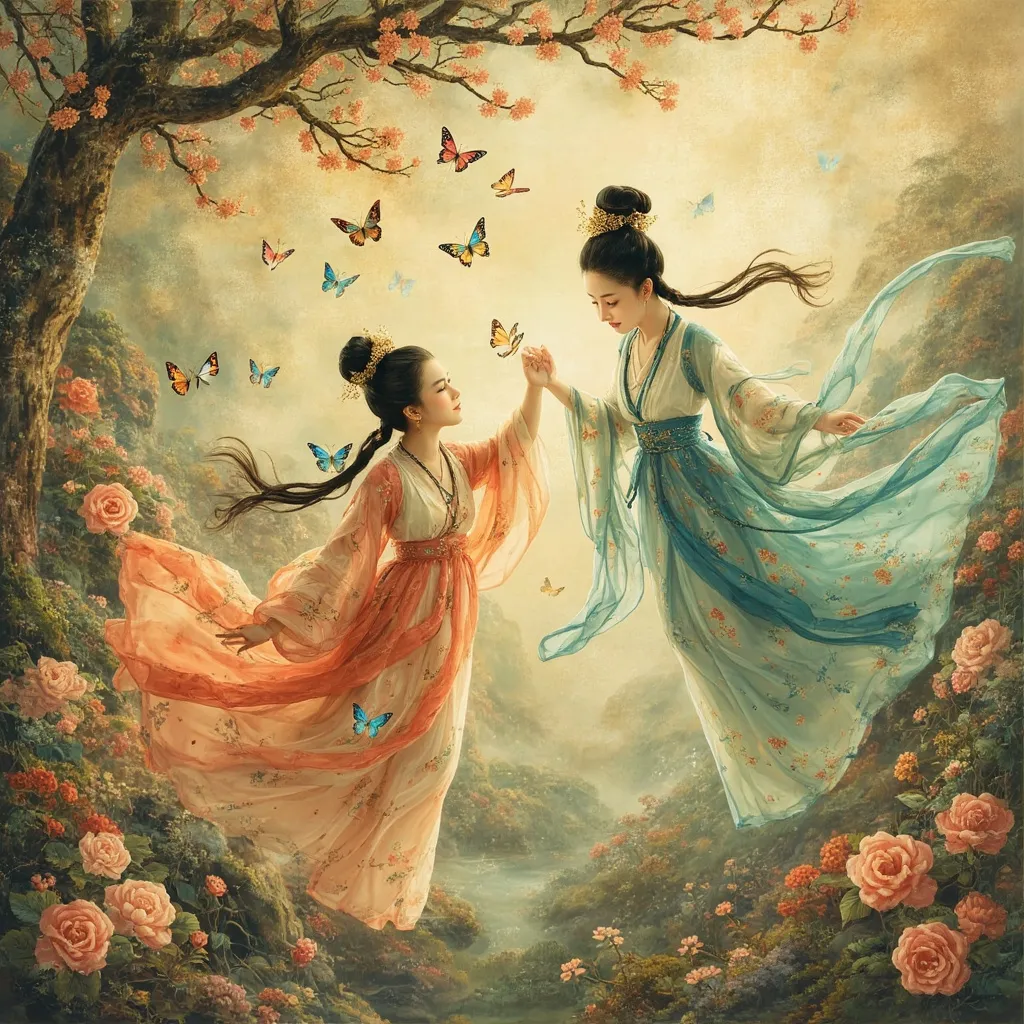
The ending, however, belongs to the living. The families, shocked and grieving, buried the two together in a single grave. And then, on the hillside, two butterflies emerged from the earth—one white, one green, dancing together in the sunlight, free at last from the constraints of society, of family duty, of rigid gender expectations, and of death itself.
This final image—two butterflies, dancing forever among the flowers—has become one of the most enduring and beloved images in all of Chinese culture. The story asks whether love can conquer all, and in the end, it suggests that yes, love is stronger than death, stronger than social convention, stronger than the grave. But it also asks at what cost. The only way these two could be together was through death, through transformation, through leaving behind the physical world entirely.
The Legacy of China’s Greatest Romance
The Butterfly Lovers story has been told and retold for over a thousand years, in every medium Chinese culture has ever known. It originated as a folk tale in the Tang Dynasty, was formalized into a play during the Yuan Dynasty, and was adapted into numerous operas, films, television series, and modern retellings over the centuries. The famous violin piece “Butterfly Lovers’ Concerto” (梁山伯与祝英台) is one of the most recognized pieces of Chinese classical music in the world, a sweeping romantic composition that tells the entire story through sound.
The tale resonates so deeply in Chinese culture because it speaks to universal human experiences—the pain of unrequited love, the frustration of social constraints, the tragedy of missed connections and misunderstandings. But it also speaks specifically to Chinese history and Chinese values. The importance of education, the weight of family duty, the need for sons to carry on the family name, the女孩子’s lack of agency in marriage decisions—these are not abstract concepts in the Butterfly Lovers story. They are the actual forces that destroy the protagonists’ happiness.
And yet, the story is not entirely bleak. Yingtai is no tragic heroine who accepts her fate quietly. She is clever, brave, and willing to break rules when they constrain her. She is the one who initiates her education, who disguises herself, who pursues Shanbo with every tool at her disposal. Even her final act—throwing herself into the grave—is an act of agency, a final declaration that she will not accept the marriage forced upon her. In a world where women had almost no power to shape their own destinies, Yingtai’s defiance, even in death, is its own form of victory.
The two butterflies, dancing together among the flowers, have become a symbol of freedom, of love that transcends all boundaries, and of the enduring human belief that some bonds are simply too strong to break. For a thousand years, Chinese audiences have watched this story and wept, and they will continue to watch it for a thousand more.
Recommended Reading & Products
Affiliate products for this article:
Chinese Folklore Collection Books - Amazon US Search - Dive deeper into China’s rich tradition of folk tales with comprehensive collections featuring the Butterfly Lovers and other beloved stories. Perfect for readers who want to explore more romantic Chinese legends.
Traditional Chinese Folding Fans with Butterfly Designs - Amazon US Search - Honor the symbolic butterflies of this love story with beautifully crafted traditional fans featuring butterfly motifs. These make elegant gifts and home decor items celebrating Chinese romance.
Butterfly Lovers Concerto - Violin Sheet Music & CD Set - Amazon US Search - Experience the emotional depth of this legendary tale through its most famous musical interpretation. The haunting violin concerto captures every moment of the love story.
Chinese Classics Audiobook Collection - Amazon US Search - Listen to the Butterfly Lovers and other Chinese literary classics in audiobook format, perfect for commutes or quiet evenings exploring ancient Chinese storytelling traditions.
Handcrafted Butterfly Art Items & Jewelry - Amazon US Search - Find handcrafted butterfly-themed items inspired by the transformed lovers—pendants, decorative pieces, and art objects celebrating eternal love and freedom.
Disclosure: This article contains affiliate links. We earn a commission on qualifying purchases.