Longmen Grottoes: China’s Greatest Buddhist Sculpture Garden
Imagine standing before a limestone cliff face the size of a city block, looking up at thousands of carved figures — Buddha statues ranging from a few inches to nearly 60 feet tall, each one shaped by hand over centuries of devotion. The rock face is divided into caves and niches, and every available surface is covered with relief carvings, inscriptions, and architectural details. The figures seem to breathe — some serene, some fierce, all radiating a quiet power that makes your skin prickle. This is the Longmen Grottoes, one of the greatest archaeological sites in the world and the defining achievement of Chinese Buddhist sculpture.
Located near the ancient Chinese capital of Luoyang in Henan Province, the Longmen Grottoes represent over 400 years of continuous carving — from the Northern Wei Dynasty in 493 CE through the Tang Dynasty and into the Ming. More than 100,000 figures are distributed across 2,345 caves and niches, making it one of the three great grotto complexes in China alongside Dunhuang and Yungang. But what makes Longmen extraordinary is the quality and quantity of its Tang Dynasty work, widely considered the apex of Chinese sculptural art.
Most Americans have never heard of Longmen, yet it attracts millions of Chinese and international visitors every year. If you’ve driven through the American Southwest and seen the ancient cliff dwellings at Mesa Verde, you have some sense of the scale and reverence that Longmen inspires in the people who visit it — except that Longmen is far larger, far older, and far more intricately carved.
Where Are the Longmen Grottoes?
The Longmen Grottoes sit on the banks of the Yi River, about 12 kilometers south of downtown Luoyang. The name “Longmen” means “Dragon Gate” — a reference to the narrow gorge where the Yi River cuts through the Guyang Mountains, creating a natural gateway that Chinese geographers compared to a dragon’s mouth.
Luoyang itself is one of China’s great ancient capitals, having served as the capital of no fewer than thirteen dynasties over its long history. When Buddhist monks began carving the Longmen caves in the late 5th century, Luoyang was the imperial capital of the Northern Wei — a dynasty of Turkic origin that had moved its court from Datong to Luoyang to consolidate power over the Chinese heartland. The Northern Wei rulers were passionate patrons of Buddhism, which they saw as a spiritual system that could unify their multi-ethnic empire and provide legitimacy for their rule.
The site choice was deliberate. The limestone cliffs along the Yi River were soft enough to carve yet durable enough to preserve the images. The river provided a scenic backdrop and a natural boundary marking the edge of the sacred space. And the location itself — between the ancient capital and the spiritual heartland of Chinese civilization — gave the project an imperial weight that ordinary religious art could never claim.
The Caves and What You’ll Find Inside
The Longmen Grottoes are usually described in terms of major caves, of which there are three principal groups: the Guyang Caves (the oldest and most famous), the Lianhua Caves (the largest), and the Fengxian Caves (the most spectacular). Each group has its own character, history, and artistic highlights.
Guyang Caves are the earliest at Longmen, begun around 493 CE during the Northern Wei period. These caves show the transition from earlier, more Central Asian influenced Buddhist art toward a more purely Chinese aesthetic. The Buddha figures here have elongated bodies, flowing robes with delicate fold patterns, and a somewhat abstract quality that reflects the influence of Indian and Central Asian prototypes. The most famous of the Guyang caves is Cave 1, which contains a massive three-level structure with hundreds of smaller figures surrounding a central Buddha.
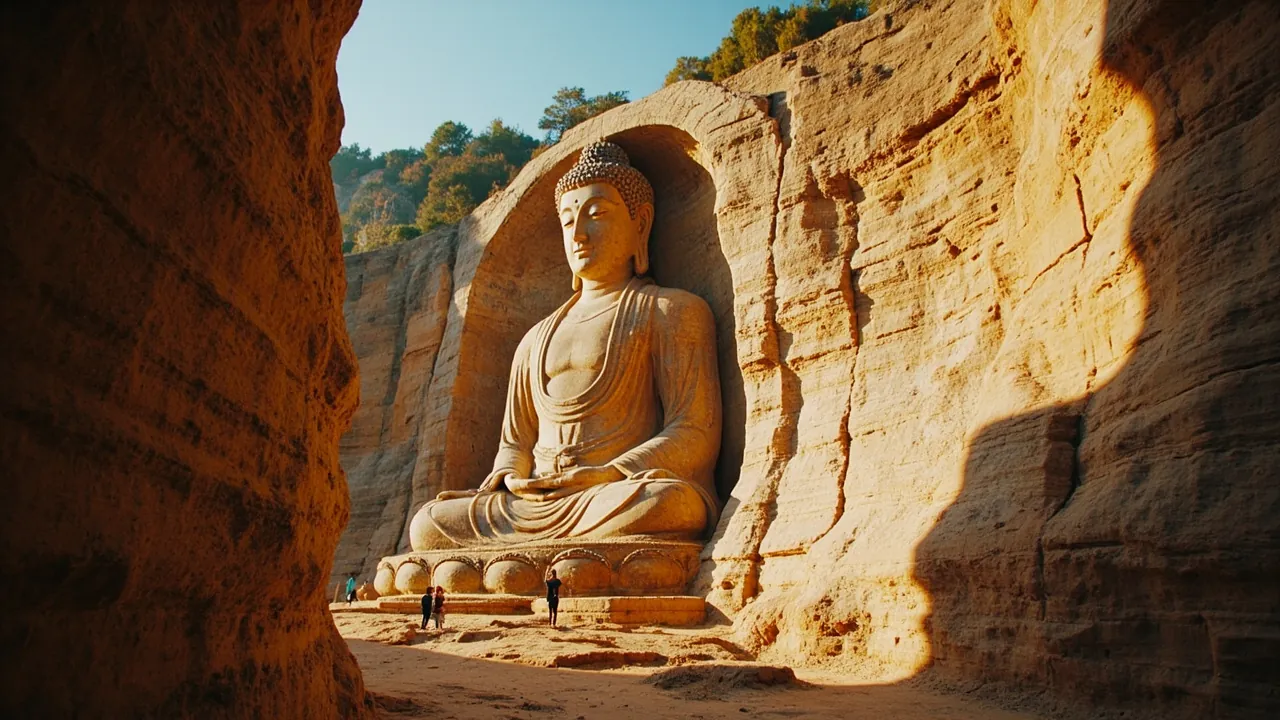
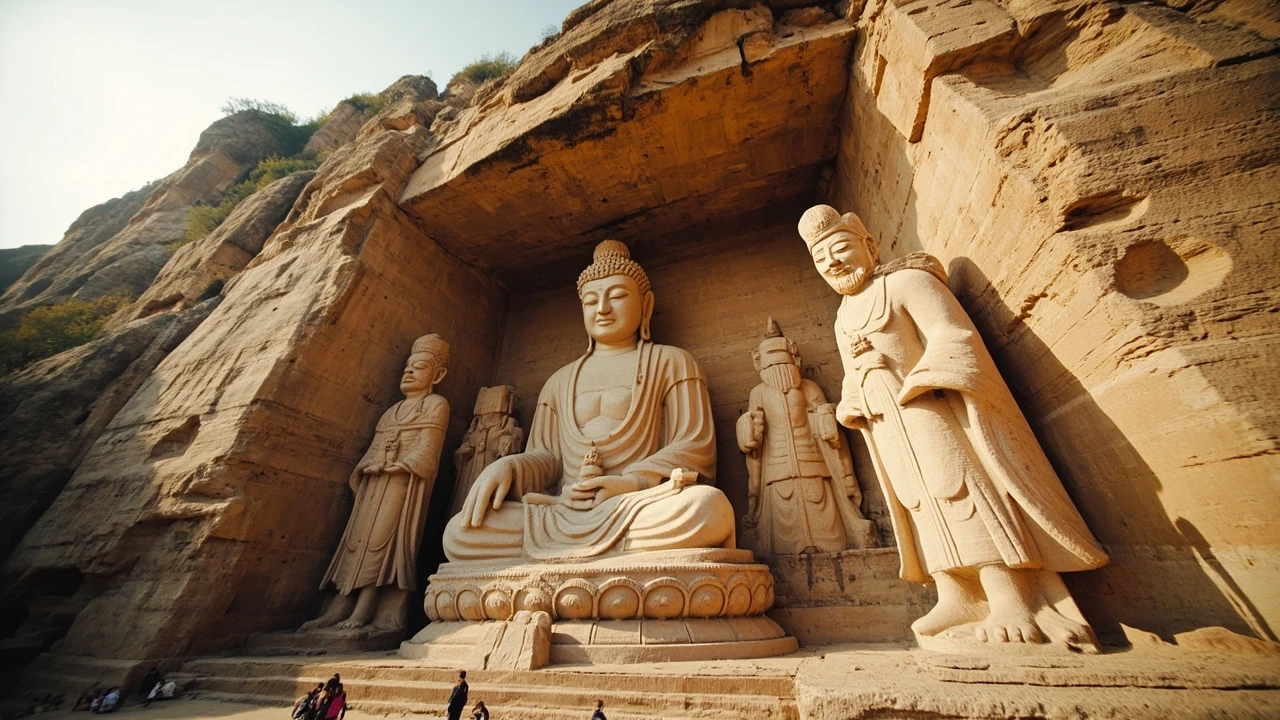
Fengxian Caves are the showstoppers — the ones that appear on postcards and in art history textbooks. The centerpiece is the Fengxian Temple (Fengxian Si), a massive 25-meter-high niche carved directly into the cliff face during the Tang Dynasty’s high point around 675 CE. Inside, you’ll find the Great Vairocana Buddha — a colossal 17-meter figure sitting in the lotus position, flanked by弟子 (disciples), Bodhisattvas, heavenly kings, and thousands of smaller figures filling every available space. The Great Vairocana is one of the largest Buddha statues in China, and its serene, confident expression captures the Tang Dynasty’s idea of enlightened power better than perhaps any other work of art in existence.
The detail work surrounding the Great Vairocana is astonishing. The attendant figures range from massive Bodhisattvas standing over 10 meters tall to tiny carved figures less than two centimeters in height. The carvings show musicians, processions, animals, and scenes from Buddhist cosmology — a complete vision of the enlightened universe rendered in limestone.
The Northern Wei to Tang Dynasty Evolution
If you have time to look carefully, the Longmen Grottoes offer a unique visual record of how Chinese Buddhist art changed over four centuries. The earliest Northern Wei caves show a distinctly Central Asian influence — figures with narrow eyes, highbridged noses, thin mustaches, and flowing robes with a pleated, almost translucent quality. These styles came to China via the Silk Road and reflect the Buddhist art traditions of India and Central Asia.
But by the time of the Tang Dynasty, something remarkable had happened. Chinese Buddhist sculptors had fully absorbed the foreign techniques and developed a distinctly Chinese sculptural language. Tang Dynasty figures are rounder, fuller, and more humanistically proportioned. They have the robust, well-fed quality that Tang culture prized — reflecting the dynasty’s cosmopolitan confidence and its appetite for physical pleasure and worldly success. The flowing robes still carry spiritual symbolism, but they now drape the human body in ways that suggest actual flesh and bone beneath the fabric.
This evolution is visible nowhere else as clearly as at Longmen. Walking from the Northern Wei Guyang Caves to the Tang Fengxian Caves, you can watch Chinese Buddhist art grow up in real time — shedding foreign influences, finding its own voice, and ultimately producing one of the greatest sculptural traditions in world history.
The UNESCO Listing and Preservation Challenges
The Longmen Grottoes were inscribed as a UNESCO World Heritage Site in 2000, recognizing their “outstanding universal value” as “the extreme manifestation of the stone carving art of the Tang Dynasty.” UNESCO’s citation specifically noted the caves as “an manifestation of the highest achievement of Chinese sculpture in the 5th-10th centuries.”
But UNESCO designation has brought as many challenges as protections. The site’s fame has attracted millions of visitors, and the carbon dioxide exhaled by crowds, combined with moisture from breath and air conditioning inside the caves, has accelerated the deterioration of some carvings. Several caves have been closed to the public permanently to protect the most vulnerable sculptures. The Chinese government has invested in climate control systems and visitor management, but the tension between access and preservation remains acute.
Pollution is another threat. Luoyang is an industrial city, and acid rain and airborne particulates have damaged the soft limestone surfaces. During the Mao era, some caves suffered deliberate destruction as part of anti-religious campaigns. The losses are heartbreaking — entire cave facades once covered with carved figures are now blank, the images hacked away by ideologically motivated attacks.
The Inscriptions: A Written History in Stone
Beyond the sculptures, the Longmen Grottoes contain one of the most important collections of ancient Chinese inscriptions in existence. More than 2,800 stele (stone tablets with carved text) have been documented at the site, recording everything from donor information and devotional dedications to historical events and literary texts.
The most famous is the Guyang Inscription (《□阳洞铭》), carved in 493 CE at the very beginning of the Longmen project. This text explains why the caves were created — as devotional acts by imperial officials and Buddhist monks seeking merit for their families and the emperor. These inscriptions are invaluable to historians, providing names, dates, and details that don’t appear anywhere else in the historical record.
For modern visitors, the inscriptions offer a powerful reminder that Longmen was not created all at once by a single patron. It was the cumulative work of hundreds — perhaps thousands — of individual donors, monks, artists, and officials, each contributing what they could over generations. The caves are a collective act of faith that outlasted the empires that built them.
Experiencing Longmen Today
If you visit Longmen Grottoes — and you should, if you have any interest in Chinese art or history — plan for at least half a day. The site is large, and rushing through it would miss the point entirely. The best approach is to hire a guide or rent an audio tour that can explain the iconography, history, and significance of what you’re seeing.
The major caves are well-labeled in English and Chinese. Fengxian Temple, with the Great Vairocana Buddha, is the obvious highlight, but don’t skip the smaller caves — some of the most beautiful and intimate carvings are in the less-visited western caves, which see far fewer tourists and reward close looking.
The best time to visit is spring or fall, when Luoyang’s climate is mild and the site is less crowded. Summer is brutally hot and humid. Winter can be beautiful, with fewer visitors and the caves’ limestone walls providing dramatic contrast against bare winter trees.
For those who can’t visit in person, the Digital Longmen project — a collaboration between Chinese universities and international partners — has created high-resolution 3D scans of many caves, available online. These digital records are both valuable for scholars and allow anyone with an internet connection to explore the caves in extraordinary detail.
Why Longmen Matters
The Longmen Grottoes represent something rare in world art history: an unbroken tradition of sculptural excellence spanning four centuries, produced under the patronage of multiple dynasties and thousands of individual believers. The site captures a moment when Chinese civilization was at its most confident, creative, and cosmopolitan — the Tang Dynasty at its height — and left that moment carved permanently into stone.
When you stand before the Great Vairocana Buddha at Fengxian Temple, you’re looking at something that took generations of artists to complete, survived wars and revolutions and modernization, and still has the power to stop you in your tracks. That’s not just ancient history. That’s a living connection to one of the greatest creative traditions the world has ever produced.
The next time you hear someone talk about the great sculptural traditions of world civilization — the Parthenon marbles, Michelangelo’s David, Angkor Wat — add Longmen to that list. China’s contribution to the story of humans making meaning in stone belongs alongside anything the West has produced.
Practical Tips for Visiting Longmen Grottoes
- Go early in the morning: The site opens at 8 AM and gets significantly crowded by midday, especially in peak season
- Hire a local guide: The English signage is improving, but a knowledgeable guide brings the caves alive in ways static labels cannot
- Wear comfortable shoes: The site involves a lot of walking and some stairs; allow at least 3-4 hours to do it properly
- Visit the associated museums: There’s a visitor center with models and reproductions that help contextualize what you’re seeing
- Combine with a Luoyang stay: The city has other important historical sites including the White Horse Temple and the Luoyang Museum
- Respect the closures: Some caves are permanently closed to protect fragile carvings; honor the restrictions
Related Products
Planning to visit Longmen or dive deeper into Chinese Buddhist art? These resources can help:
- “Chinese Buddhist Sculpture: Art at the Edge of Sanctity” — A comprehensive scholarly guide to Buddhist sculpture traditions including Longmen, with excellent photography
- “Tang: The Dynasty of Splendor” — History Book — Understanding the Tang Dynasty context is essential for appreciating Longmen’s greatest period
- Luoyang Travel Guide — A practical travel guide covering Luoyang’s historical sites including Longmen Grottoes, available at most online booksellers