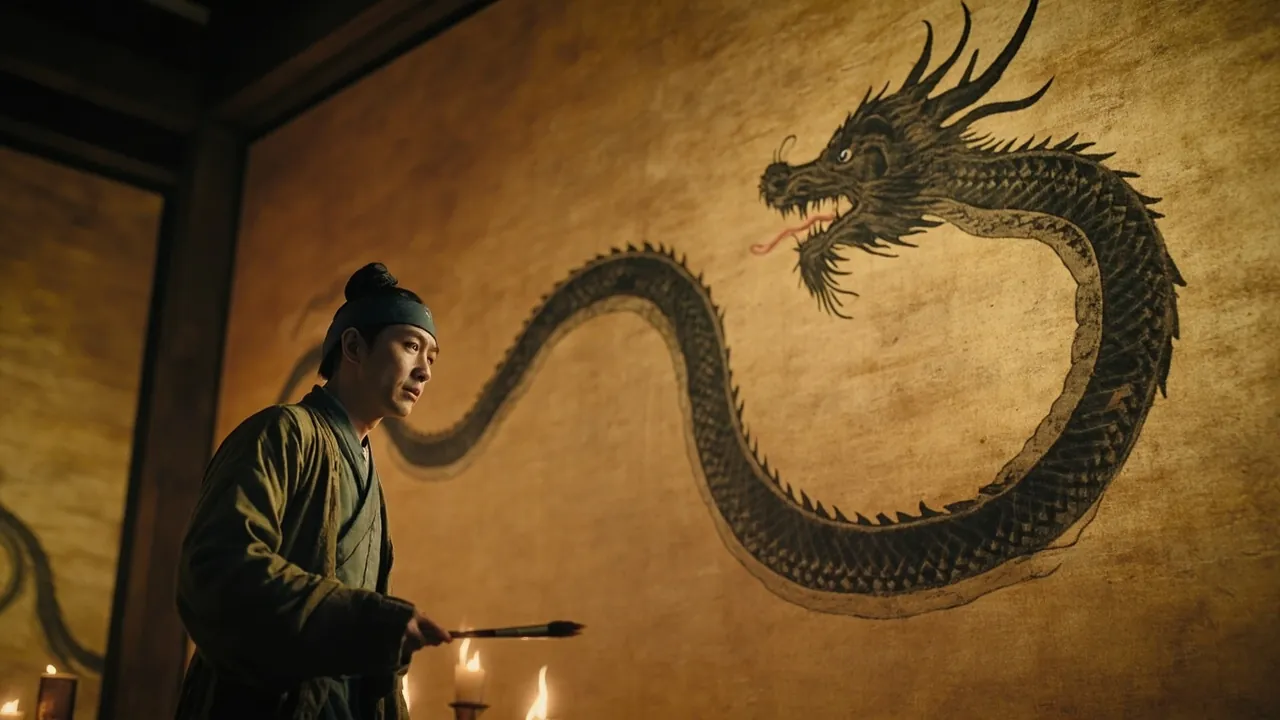
He decorated his home with dragons. Dragon carvings on his furniture, dragon paintings on his walls, dragon motifs on his clothing, dragon insignias on his household items. Everyone knew: Lord Ye absolutely loved dragons. But then one day, an actual dragon heard about his reputation and decided to pay him a visit.
The Story of Lord Ye
The idiom “Lord Ye loves dragons” (叶公好龙, yè gōng hào lóng) comes from a story found in The Annotations to the Intrigues of the Warring States, an ancient Chinese text compiled by Liu Xiang in the Han Dynasty (206 B.C. – 220 A.D.). The story is both funny and unsettling — a cautionary tale about the distance between what we claim to love and what we actually fear.
Lord Ye (叶公) was a man of considerable status and wealth. He lived during the Spring and Autumn period (771–476 B.C.) in the state of Chu, one of the most powerful kingdoms in ancient China. By all accounts, he was a person of refined tastes and deep passions — particularly when it came to dragons.
Not merely fond of dragons, Lord Ye was absolutely obsessed with them. His entire estate was a shrine to the mythical creature. The beams of his house were carved with dragons. The pillars were painted with dragons. His robes featured dragons. His cap featured dragons. His walking stick had a dragon head on it. Every room in his house showcased dragons in one form or another — stone dragons, wooden dragons, silk dragons embroidered in vivid colors, jade dragons that glittered in the lamplight.
Visitors from far and wide heard about Lord Ye’s extraordinary collection. Scholars came to admire his dragon art. Dignitaries remarked on the taste and beauty of his dragon-themed estate. Word spread across the kingdom: there was no man in all the land who loved dragons as deeply as Lord Ye of Ye.
And Lord Ye basked in this reputation. He spoke often of his admiration for dragons, describing their power, their majesty, their mystical qualities. He considered himself a connoisseur, an enthusiast, a true appreciator of the dragon’s magnificence. He would have told you, without hesitation, that dragons were his greatest passion.
But then, the story takes a turn.
Somewhere in the heavens, a real dragon — an actual, living, breathing dragon — heard about Lord Ye’s passionate declarations. Being a dragon, it was naturally curious. Here was a mortal who claimed to love dragons more than anyone else in the world. The dragon decided it simply had to meet this devoted fan.
So the dragon descended from the clouds one evening and made its way to Lord Ye’s estate. It peered through the window of Lord Ye’s study, its enormous serpentine body coiling through the clouds above the roof, its scales glinting in the moonlight. It pushed its great head through the window frame, just far enough to be clearly visible.
Lord Ye looked up from his reading.
What happened next is the crux of the entire story.
Lord Ye didn’t leap for joy. He didn’t rush forward to greet the creature he’d claimed to love more than anything in the world. He didn’t even manage a dignified hello. Instead, Lord Ye took one look at the real dragon — its massive size, its ancient eyes, its untameable wildness — and his face drained of color. His heart pounded. His hands trembled. He grabbed the nearest object and threw it at the dragon, shrieking in terror. He ran. He scrambled. He fled his own home.
The dragon, witnessing this display, was bewildered. It had come expecting a friend. Instead, it found a man who was quite literally terrified of the very thing he claimed to love. After watching Lord Ye cower in the corner, whimpering, the dragon withdrew — confused, perhaps slightly offended, and definitely amused.
This is the origin of 叶公好龙: Lord Ye loves dragons. The idiom describes someone who claims to love something but is actually afraid of it — someone whose stated passion is revealed as hollow when the real thing actually appears. It points to the gap between our performative declarations and our authentic responses, between the things we say we love and the things we actually cannot bear.
What This Idiom Really Means
On the surface, the story is almost comical. Lord Ye’s terror is so extreme, so disproportionate to any threat the dragon actually posed, that it’s hard not to laugh at him. But the humor masks a genuinely uncomfortable truth: most of us have a bit of Lord Ye in us.
We claim to value honesty, but we often fear direct confrontation. We say we want authentic relationships, but we shy away from the vulnerability that authenticity requires. We declare ourselves champions of justice, but we fall silent when standing up would cost us something. We profess to love adventure, but we rarely step outside our carefully constructed comfort zones.
In each case, there’s a gap between our stated values and our actual behavior. We love the idea of something — or more precisely, we love the way our love of that thing makes us look — but we’re less enthusiastic about the reality. The dragon in the window is the real thing, and the real thing is always more challenging, more demanding, more unsettling than the idea of it.
The idiom is particularly sharp because it targets a specific kind of hypocrisy: not deliberate deception, but self-deception. Lord Ye wasn’t lying when he said he loved dragons. He genuinely believed it. He had surrounded himself with dragon imagery, had studied dragon mythology, had built his identity around being a dragon enthusiast. But when the real thing showed up, his authentic response — panic, terror, flight — exposed the shallowness of his claimed passion.
This is what makes the story so uncomfortable. It’s not about a villain who pretended to love something for personal gain. It’s about a man who genuinely didn’t know himself — who had confused his aesthetic appreciation of something with a real willingness to engage with it. Lord Ye loved the symbol of dragons, the cultural prestige of being known as a dragon lover. He did not love dragons themselves.
The Modern Relevance: Performative Passion
In our own era, 叶公好龙 has found fresh relevance in discussions of performative activism, performative environmentalism, and performative wokeness — all terms that describe the gap between stated commitments and actual behavior.
Consider someone who posts frequently on social media about the importance of environmental conservation, who shares articles about climate change, who has a “Save the Earth” sign in their yard — but who never changes their driving habits, never reduces their air travel, and never joins a local environmental organization. When confronted with a real lifestyle change — giving up meat, for example, or accepting a job with lower pay but better environmental practices — they find reasons to hold back. They love the idea of environmentalism. They don’t love actual environmentalism.
Or consider the executive who declares that their company is “people-first,” that employee wellbeing is their top priority, that they genuinely care about work-life balance. But when employees request flexible schedules or raises that reflect inflation, the executive finds reasons to say no. The company’s culture remains demanding, fast-paced, and hostile to anyone who prioritizes family over work. The executive loved the prestige of being known as a people-first leader, but when the reality showed up — actual people with actual needs making actual demands — they discovered their passion had limits.
Or consider the person who describes themselves as “passionate about learning” and “always reading” — but who only reads books that confirm what they already believe, who never engages with challenging ideas, and who becomes uncomfortable when someone points out a gap in their knowledge. They loved the identity of being a learner, but they didn’t love the actual humility that genuine learning requires.
These are all variations on the Lord Ye theme: claimed passion that dissolves when confronted with reality.
Why We Fall Into This Trap
So why do so many of us fall into this pattern? Why do we claim to love things that, when actually confronted, we clearly don’t love at all?
Part of the answer is social signaling. In every era and every culture, certain values and passions carry social prestige. Being known as a dragon lover in ancient China was a mark of refinement and cultural sophistication. It announced to the world that you were a person of taste, someone who appreciated the mythical and the magnificent. Lord Ye may have genuinely enjoyed dragon art, dragon stories, and dragon symbolism — but his enthusiasm was also, consciously or not, a performance of cultural capital.
Today, we see the same dynamics at play. Being known as an environmentalist, a progressive, a fitness enthusiast, a foodie, a reader, a traveler — these identities carry social prestige in various circles. And there’s nothing wrong with actually being those things. The problem arises when the identity becomes more important than the substance. When we pursue the reputation more than the reality. When we love the way our claimed passions make us look, rather than the things themselves.
Another part of the answer is that we often don’t know ourselves as well as we think we do. Lord Ye had convinced himself that he loved dragons. He had so thoroughly surrounded himself with dragon imagery, had spoken so often about his dragon passion, that the belief felt true. It was only when reality intruded — when an actual dragon appeared — that he discovered what he really felt. And what he really felt was terror.
This is the value of challenge and confrontation in personal growth. Sometimes the only way to know whether your stated values match your actual values is to put yourself in situations that test them. Do you actually value honesty, or do you value keeping the peace? Do you actually value adventure, or do you value security? Do you actually value the trait you claim to love, or do you just value the status that comes with claiming to love it?
The test is always the real thing. Not the idea. Not the symbol. The reality.
The Idiom and Self-Awareness
Perhaps the most useful application of 叶公好龙 is as a tool for self-examination. The next time you catch yourself claiming to love something — or to be something — it’s worth asking a simple question: if the real thing showed up, how would I actually respond?
If you say you love your job, but you dread going to work every morning, you might be a Lord Ye. If you say you love your family, but you consistently prioritize other things over them, you might be a Lord Ye. If you say you love a particular cause, but you’ve never actually done anything difficult for it, you might be a Lord Ye.
This isn’t meant to be a source of shame. It’s meant to be a source of clarity. Self-deception is one of the most common features of the human condition, and the ability to see through our own illusions is one of the most valuable skills we can develop.
Lord Ye could have learned something important about himself that day the dragon appeared. He could have asked himself: why was I terrified? What specifically about the real thing frightened me? Was it the size? The unpredictability? The fact that a real dragon wouldn’t respect me, wouldn’t care about my status or my collection, wouldn’t perform the role I expected it to?
These are uncomfortable questions. But they’re also clarifying ones. And the discomfort is, paradoxically, a sign of growth — a sign that reality is starting to correct the fantasy, which is always the first step toward something more authentic.
Living With More Integrity
So what does it mean to live without this particular form of hypocrisy? How do we close the gap between what we claim to love and what we actually welcome?
The first step is honesty about our actual responses. If you feel terror when confronted with the real thing, that’s data — not a verdict. It tells you something true about yourself, something that might be worth investigating further. Lord Ye could have used his terror as a starting point for self-reflection. Instead, he just ran away and, presumably, kept claiming to love dragons for the rest of his life.
The second step is examining the gap between our stated values and our actual behavior patterns. Where do we see misalignment? Where have we constructed identities around things we don’t actually engage with in any meaningful way? Where have we confused looking like a certain kind of person with actually being that kind of person?
The third step is deciding what we actually want to love — and then doing the work to love it in reality rather than just in appearance. If you decide you genuinely want to care about environmental issues, that means making actual changes in your life — not just sharing articles. If you decide you genuinely want to be a good parent, that means showing up, consistently, even when it’s inconvenient. If you decide you genuinely want to value authenticity in your relationships, that means being willing to be vulnerable, even when it’s scary.
Real love — for people, for causes, for ideas, for ways of living — is demanding. It asks more of us than our performative versions ever would. And that’s exactly why the real thing is so much more fulfilling, when we can access it. Loving something real, rather than just the idea of it, is one of the deepest sources of meaning available to us. It just requires the courage to let the fantasy go.
Conclusion
The story of Lord Ye and the dragon is one of the most widely quoted cautionary tales in Chinese culture — and for good reason. It captures something true about the human tendency to construct identities around the things we claim to love, while remaining secretly terrified of the real thing.
Lord Ye’s dragons were beautiful. They were safe. They were under his control. But real dragons — real dragons that descend from the clouds, that peer through your window with ancient, knowing eyes — real dragons are something else entirely. They ask something of you. They demand that you show up, not just in appearance but in actuality.
The next time you find yourself claiming to love something, pause and ask: would I say that if the real thing showed up? Would I still love it if it cost me something? If it disrupted my plans? If it didn’t care about my reputation?
If the answer is no, you might be a Lord Ye. And that’s okay — as long as you’re willing to admit it, and willing to look a little deeper at what you actually love and what you’re actually afraid of. The dragon in your life is waiting. The question is whether you’ll run away, or whether you’ll stay and find out what’s really there.
📚 Recommended Reading & Products
Disclosure: This article contains affiliate links. We earn a commission on qualifying purchases.