Losing a Halberd and Gaining a Spear: The Chinese Idiom About Fortune and Misfortune
There’s a particular kind of moment that every person recognizes, even if they’ve never been able to name it. You’re walking home after a terrible day — you lost something important, made a mistake that cost you, or watched an opportunity slip away. Then, almost without warning, something else lands in your lap. It might not be what you lost. It’s not an exact replacement. But somehow, in the math of your life, the balance shifts just enough that you end up wondering whether your original loss was actually a loss at all.
The ancient Chinese had a compact, elegant way of naming this experience. The idiom is 亡戟得矛, pronounced wáng jǐ dé máo, which translates directly to “lost a halberd, gained a spear.” Four characters, a whole philosophy of unexpected consequences, tangled up in a question that has no clean answer: was that good or bad?
Let’s dig into where this expression comes from, what it means, and why it still feels so relevant in an age when life rarely unfolds the way we plan.
The Original Story: A Battlefield Arithmetic Problem
The tale behind 亡戟得矛 comes from the Zhanguo Ce (战国策), a collection of historical accounts and philosophical discussions from the Warring States period of Chinese history, roughly 475 to 221 BC. The specific passage appears in the records of the State of Qi (齐国) and involves a character named Zhou IT (州吁), though the details of the story are sometimes told with variations depending on the source.
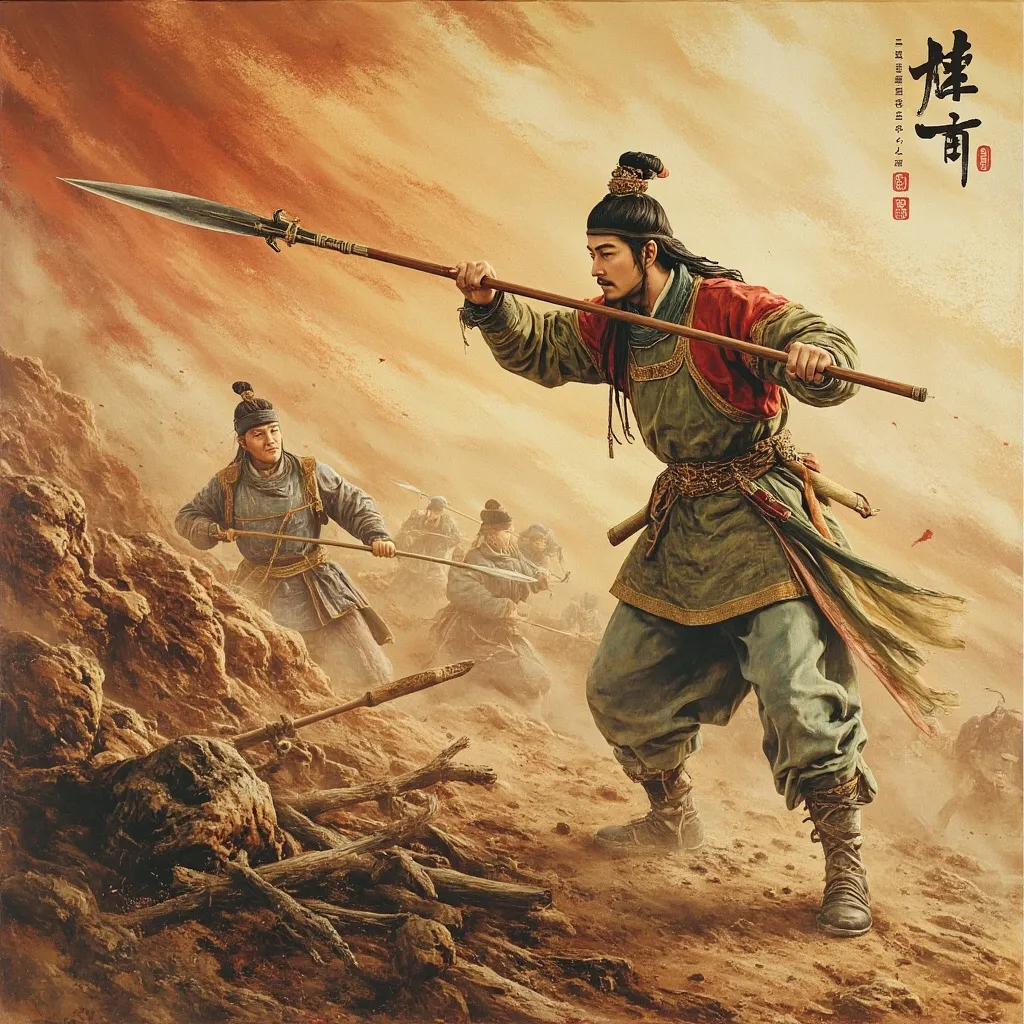
Here’s the scenario. A soldier is on a battlefield or engaged in military training, carrying his 戟 (jǐ) — a halberd, which was a long shaft weapon with a blade attachment that combined the stabbing function of a spear with the cutting capability of an axe or dagger. The halberd was a serious weapon, expensive to forge, and represented both a soldier’s primary tool and a symbol of his status and preparedness in battle. To lose your halberd was not a small thing.
During the chaos of combat or perhaps just the jostle of a crowded training ground, this soldier somehow managed to lose his halberd. He came away from the engagement without his primary weapon — a clear and measurable loss. His commanding officer, predictably, was not pleased.
But then, almost as if the universe had a sense of humor, the soldier later found something else on the ground: a 矛 (máo) — a spear. The spear was not identical to the halberd. It was lighter, simpler in construction, and had a different purpose in battle. But it was still a functional weapon. He could still defend himself. He could still fight.
So there he stood, holding a spear, having lost his halberd. His situation was changed — but was it improved? Depended on who you asked.
The story doesn’t give us a clean moral. It doesn’t tell us the soldier was rewarded for his luck or punished for his carelessness. Instead, it simply presents the situation and lets the reader sit with the ambiguity. You lost something. You found something. The exchange might have been an even trade, a net gain, or a net loss. The story refuses to resolve the question, which is precisely what makes it so memorable.
The Deeper Meaning: When Does a Loss Become a Gain?
In modern Chinese usage, 亡戟得矛 is typically applied to situations involving unexpected consequences, where a loss is partially or fully offset by an unrelated gain, and where it’s genuinely unclear whether the overall outcome is positive or negative. It’s the kind of phrase you reach for when someone complains about losing their job, only to discover six months later that the career pivot they were forced into turned out to be significantly better than what they left behind.
The idiom captures a specific philosophical tension that runs through much of classical Chinese thought — the idea that fortune and misfortune are not absolute states but relative conditions, deeply dependent on context, timing, and perspective. A loss in one dimension of your life might be simultaneously a gain in another. The spear doesn’t erase the halberd’s absence, but it does change the shape of your circumstances.
What makes this idiom particularly interesting is its deliberate refusal to judge. Most proverbs and idioms take a clear position: this is good, that is bad, do this, avoid that. 亡戟得矛 is different. It poses a question and leaves you to answer it for yourself, based on your own values, your own situation, and your own sense of what matters most.
This reflects a broader theme in Warring States-era Chinese philosophy — the recognition that life rarely offers clean binaries. Every victory has a cost. Every loss contains a seed of something else. The halberd man didn’t get his weapon back, but he didn’t walk away empty-handed either. Whether that was fortunate depended on factors the story deliberately leaves unresolved.
Why “Unexpected Consequences” Feels Like the Defining Feature of Modern Life
If you think about it, the world we live in is essentially a series of 亡戟得矛 moments playing out at scale. We make a decision that seems obviously correct, and it leads somewhere we never expected. We avoid a risk that seemed dangerous, only to find that the avoidance cost us an opportunity we didn’t know existed. The chain of cause and effect in modern life is so tangled that almost any outcome can be reframed as both a loss and a gain depending on how far ahead you look.
Consider the obvious example of a global event that disrupted millions of lives simultaneously. A pandemic forced businesses to close, travel to halt, and social routines to collapse. By any measure, it was a catastrophe. But within that catastrophe, certain industries were born, certain habits were broken that had been holding people back, and certain people discovered capabilities and opportunities they never would have found in a stable status quo. Was the overall outcome good or bad? The question is almost meaningless at scale. It was both, simultaneously, for different people in different circumstances.
Or consider something smaller and more personal, like a failed relationship. The end of a long partnership is almost universally painful. But that pain often creates space for self-reflection, growth, and eventually a better match than the one that ended. The loss was real. The gain that eventually emerged from it was also real. You can’t cancel one out with the other.
This is the territory that 亡戟得矛 maps so well. It acknowledges that life is not a ledger where every loss is purely negative and every gain is purely positive. Context shifts the value of everything. Timing changes outcomes. The same event can be experienced as tragedy and opportunity by two different people standing on opposite sides of it.
The Philosophical Angle: How Chinese Thinkers Viewed Fate and Agency
The story’s ambiguity wasn’t just a literary device — it reflected a genuine philosophical debate that was playing out in China during the Warring States period. Different schools of thought had very different answers to the question that 亡戟得矛 poses: how much control do we have over our fate, and how much is simply luck?
The Confucians tended to emphasize moral cultivation and personal virtue as the primary drivers of outcomes. If you lost your halberd, it might be because you weren’t focused enough, weren’t disciplined enough, or hadn’t cultivated the proper character. The Daoists, on the other hand, tended to emphasize the natural flow of events and the futility of attachment to specific outcomes. You lose the halberd, you find the spear, and the wise person accepts both with equanimity.
The Legalists, who were interested in governance and law, might have used this story to make a point about systems and incentives — that individual outcomes in battle depend on the system of training and discipline, not just individual skill or luck. If a soldier loses his weapon, the problem is the system that allowed it, not the soldier himself.
What makes 亡戟得矛 special is that it doesn’t champion any single philosophical position. It simply holds up a mirror to the messy reality that every loss contains the possibility of unexpected gain, and every gain carries the shadow of potential loss. The halberd and the spear aren’t opposites — they’re just two different tools for navigating the same battlefield.
Real-Life Examples: When Losing Was Actually Winning
Once you start looking for 亡戟得矛 moments, you’ll find them everywhere. Here are a few examples that illustrate how the idiom plays out in practice:
The cancelled flight that saved a life. A passenger misses a connection because of a delay and ends up on a later flight. That later flight crashes. The person who “lost” their schedule — arriving home six hours late — avoided being on the doomed aircraft. They lost time; they gained everything else.
The job loss that opened a new chapter. Someone is laid off from a long-held position after years of comfortable routine. The layoff forces them to finally start the business they’d been planning “someday.” Two years later, they’re earning more than they ever did at the job they thought they couldn’t live without. They lost a salary; they found a vocation.
The failed exam that changed direction. A student fails a critical exam that was supposed to send them down one career path. They pivot to a different field, one they never would have considered, and end up discovering a passion and talent they never knew they had. The failure was real. So was the opportunity it created.
The relationship that ended so another could begin. Someone goes through a painful breakup that leaves them heartbroken for months. During that vulnerable period, they reconnect with an old friend. That friendship becomes something more. Years later, they can barely remember the person they were so devastated to lose, because the person they found next became the love of their life.
In each of these cases, the loss and the gain are both genuine. You can’t argue away the pain of the loss by pointing to what eventually came after. But you also can’t argue that the eventual outcome was somehow meaningless just because it emerged from something painful. The halberd was genuinely lost. The spear was genuinely found. Both facts coexist, and neither one cancels the other out.
What 亡戟得矛 Teaches Us About Resilience and Perspective
There’s a practical lesson embedded in this idiom, even though the story refuses to give us a clean moral. It’s about how to hold two opposing truths at the same time — the truth of what you lost and the truth of what you found — without collapsing into either despair or naive optimism.
Genuine resilience isn’t about pretending that losses don’t hurt or that everything happens for a reason. It’s about developing the capacity to acknowledge the loss while remaining open to what the loss might make possible. The soldier who lost his halberd could have spent the rest of the battle mourning his weapon and fighting ineffectively with the unfamiliar spear. Or he could have accepted the circumstances, adapted to the tool he now had, and performed his duty with what was available to him.
This is the deeper wisdom of 亡戟得矛. It’s not about whether the exchange was “worth it” in some cosmic ledger. It’s about what you do with what you end up with after the loss and the gain have both landed in your lap.
When you find yourself in a 亡戟得矛 situation — and everyone does, sooner or later — here are some questions worth sitting with:
First, what exactly did I lose, and what exactly did I gain? Sometimes these aren’t as different as they seem. Sometimes they’re exactly the same thing in a different form. Naming both sides of the equation clearly is the first step toward understanding whether you’re ahead, behind, or exactly where you were.
Second, how am I framing this? The same outcome can feel like a catastrophe or a windfall depending on the story you tell yourself about it. This doesn’t mean you should engage in toxic positivity and pretend losses don’t matter. It means you should be honest about the narrative you’re constructing and ask whether it’s accurate.
Third, what can I do with what I have now? The soldier didn’t get his halberd back. But he had a spear, and a spear can still win a fight. Focusing on the gap between what you had and what you have now keeps you stuck. Focusing on what you can build with what you have now moves you forward.