In the 5th century BCE, in the state of Lu — present-day Shandong province in eastern China — there lived a man named Lu Ban (鲁班). He was, by all accounts, an extraordinary craftsman: a carpenter who could build things that seemed to defy the limits of his materials, an inventor whose mechanical devices seemed to possess a kind of magic, and a teacher whose techniques spread across China and beyond, shaping the way buildings, tools, and machines were made for the next two thousand years.
But Lu Ban’s story does not end with his death. Over the centuries, he was transformed from a celebrated human craftsman into a deity — the patron god of engineers, woodworkers, stonemasons, and all trades involving the use of hands and tools. Today, you can find temples dedicated to Lu Ban across China, Taiwan, and in Chinese communities worldwide. Construction workers pray to him before laying a foundation. Woodworking guilds hold ceremonies in his name. And the tools and techniques he supposedly invented are still studied and used, adapted into the 21st century.
The question worth asking is: how much of Lu Ban is history, and how much is legend? The honest answer is that we do not know exactly. But what we do know is that the figure of Lu Ban — whether he was one person or several, whether the stories are literally true or symbolically meaningful — represents something important in Chinese culture: the deification of practical skill, the belief that the person who masters their craft is worthy of reverence, and the idea that making things well is a form of spirituality.
The Historical Lu Ban
The earliest references to Lu Ban appear in texts from the Warring States period (475-221 BCE) and the Han dynasty (206 BCE – 220 CE). These texts describe him as a master carpenter from the state of Lu, famous for his precision and ingenuity. One famous anecdote describes him carving a wooden macaw (a type of parrot) that could fly — truly fly, flapping its wings and moving through the air — for the king of the state of Lu. The king was so astonished that he demanded to know how it worked, at which point Lu Ban took the bird apart to show him the mechanism. (This story sounds fanciful, but it is worth remembering that ancient Chinese texts sometimes describe mechanical automata that were real — the Han dynasty court was known to have had automatic drink-serving devices and musical automata powered by water.)
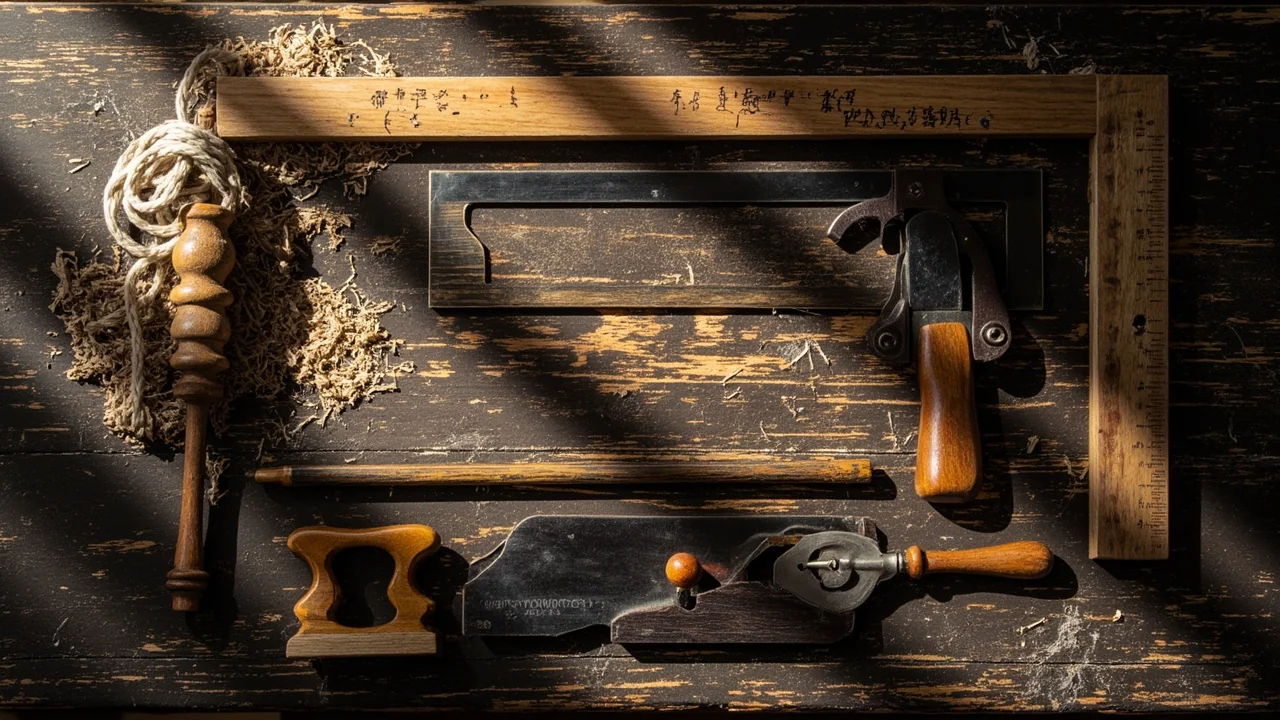
Lu Ban is also credited with inventing or popularizing several fundamental carpentry tools: the saw (ju, 锯), the measuring line (chuí mò, 墨斗), and the ink marker — the tools that allowed carpenters to make precise cuts and measurements that transformed woodworking from rough assembly into precision craft. Whether Lu Ban personally invented these tools or was the first to systematize and spread their use, the association has stuck for over two thousand years.
He is also said to have been a military engineer. Historical texts describe him designing siege weapons, fortified city walls, and mechanical defenses. One story describes him building a set of wooden “wooden horses” (automated chariots) that could carry supplies across difficult terrain. Another describes a “cloud scaling ladder” — a siege ladder that could attach to walls, apparently with some kind of hook mechanism that made it difficult to remove.
The Legend of Lu Ban’s Wife
One of the most dramatic stories about Lu Ban involves his wife, who is also said to have been a master craftsman in her own right. According to legend, Lu Ban’s wife loved him deeply and wanted to accompany him on his travels. To make this possible, she built a set of wooden wings and attached them to herself, intending to fly alongside her husband.
The story goes tragically wrong: she flew too high, was struck by a strong wind, lost control, and fell to her death. Lu Ban was devastated. In some versions of the story, he never recovered from the loss. In others, he channeled his grief into his work, becoming even more dedicated to his craft as a form of spiritual practice.
This story is sometimes used to explain why, in Chinese folk tradition, Lu Ban’s wife is not worshipped alongside him — the tradition wanted to separate the craft tradition from the tragedy. But the story itself reveals something important: in the world of Lu Ban, invention and loss are closely connected, and the drive to create can exact a terrible personal cost.
The Lu Ban Manuscripts
One of the most important sources for Lu Ban’s legend is a text called the Lu Ban Jing (鲁班经), or Lu Ban Manuscript, which was compiled in Ming dynasty China (14th-17th century) but contains material going back much earlier. The manuscript is a kind of encyclopedia of craft knowledge: carpentry techniques, architectural principles, feng shui rules for building, and — crucially for the legendary dimension of Lu Ban — instructions for making various protective and magical devices.
The manuscript includes instructions for making talismans and protective devices that craftspeople would use to guard their work against accidents, fires, and structural failures. These are not mere superstition — they reflect the real dangers of construction work and the real need for protection and assurance. A craftsman who could promise his client that a building was protected by Lu Ban’s talismans was offering psychological as well as physical security.
The manuscript also includes instructions for making a “wooden hawk” — a small wooden bird that could supposedly fly and serve as a message carrier — and a “wooden ox” that could walk and carry loads. These devices are described in enough technical detail that some historians believe they describe actual mechanical prototypes, possibly powered by springs or weights. Whether they truly worked or not, they established Lu Ban as the master of mechanical invention — China’s answer to Da Vinci, four centuries before Da Vinci was born.
The Transformation into a Deity
The apotheosis of Lu Ban — his transformation from human craftsman to deity — happened gradually over several centuries. The process appears to have accelerated during the Tang dynasty (618-907 CE), when Taoist religion was actively organizing the Chinese pantheon and absorbing popular figures into its structure. Lu Ban’s reputation as a master of hidden knowledge, magical tools, and protective arts made him a natural candidate for deification.
By the Song dynasty (960-1279), Lu Ban temples existed throughout China. The temples were gathering places for craft guilds and workers’ associations — essentially labor unions, though the Chinese guild system worked differently than its European counterpart. Craftsmen would meet in Lu Ban temples to set standards, arbitrate disputes, and honor their patron deity. The tradition of guild-based worship of Lu Ban continued into the 20th century, though it was disrupted by the social upheavals of the 20th century and revived in limited form after the 1980s.
In Taiwan and Hong Kong, Lu Ban worship remains active today. There are dedicated Lu Ban temples — the most famous is Lu Ban Hall (鲁班庙) in Taipei, which serves as a center for the construction and woodworking trades. Before any major construction project in Taiwan, it is common practice for the developer or contractor to hold a ceremony honoring Lu Ban, burning incense and offering food. Woodworking associations hold annual celebrations on Lu Ban’s birthday, which is celebrated on the 13th day of the sixth lunar month.
Lu Ban’s Influence on Chinese Technology
Beyond the religious dimension, Lu Ban’s legacy in Chinese technology is substantial — though as with many ancient figures, it is difficult to separate what he personally invented from what his tradition attributed to him.
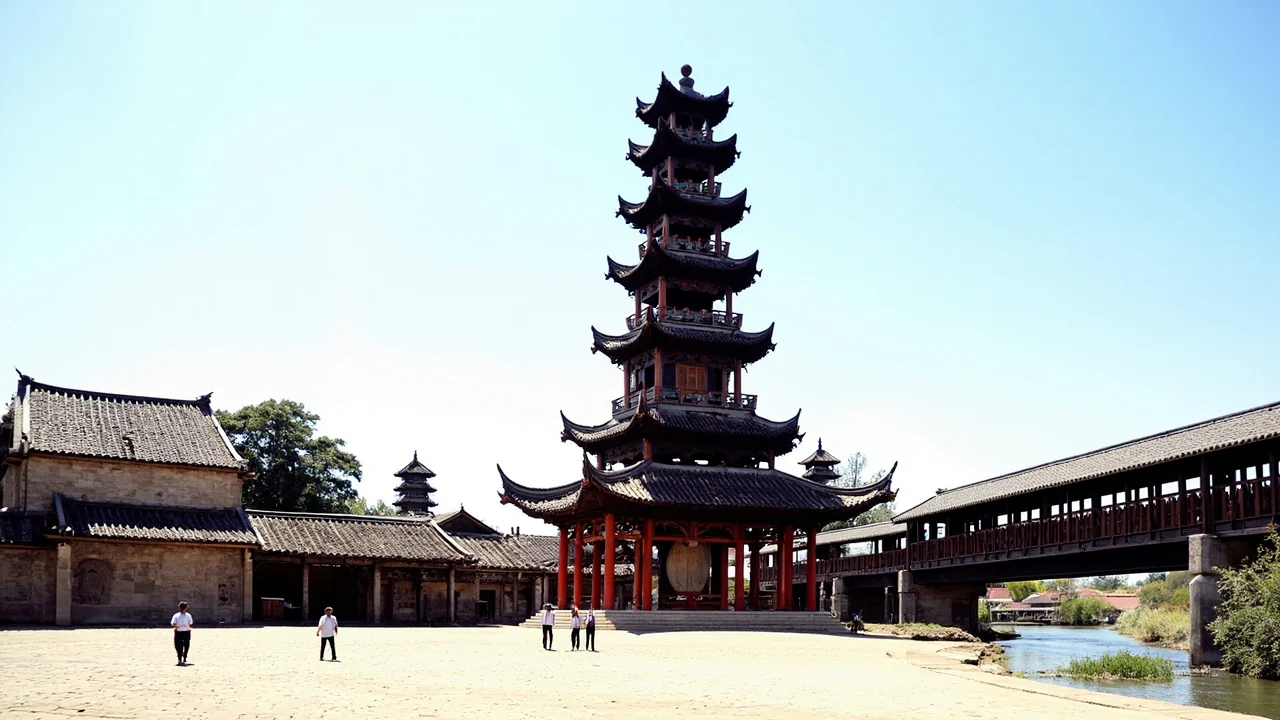
The carpentry tools associated with Lu Ban — the saw, the ink line, the measuring tools — transformed Chinese woodworking from a rough craft into a precision discipline. The precision of Chinese wooden architecture, including the great timber-frame buildings of the Tang and Song dynasties and the elaborate wooden pagodas that still stand today, owes a debt to the tool culture that Lu Ban represents.
He is also credited with establishing principles of architectural proportion and structural engineering that influenced Chinese building for centuries. These include the relationship between column height and beam span, the principles of load distribution in timber frames, and the rules for calculating materials needed for a building project. Whether these principles were codified by Lu Ban himself or by later craftsmen working in his name, the tradition of technical standardization that they represent is a hallmark of Chinese engineering.
In mechanical engineering, Lu Ban’s association with automata — self-moving devices — positioned him as the patron of a tradition that flourished in Chinese court culture. The Han dynasty “automata” are well documented in historical texts. The tradition continued through the Tang and Song dynasties, reaching a peak in the mechanical theaters of the Song dynasty, where elaborate clockwork-driven stage shows combined engineering with performance art. Lu Ban, as the legendary inventor of these devices, was the god of this tradition.
Cultural Comparisons for American Readers
Americans might recognize Lu Ban’s profile as something like a combination of Benjamin Franklin and the patron saints of European guilds — the practical inventor, the folk hero who made things work, and the patron of tradespeople. Just as Franklin is associated with inventions (the lightning rod, the Franklin stove) and also with the ideals of practical wisdom and self-improvement, Lu Ban represents both the specific craft of woodworking and the broader Chinese value of mastery through skill.
Another useful comparison is with the Freemasons, whose traditions include the veneration of a legendary master builder (sometimes identified as the biblical Hiram Abiff). Like the Masonic tradition, the Chinese craft guilds organized around Lu Ban had their own secret knowledge, their own initiation rituals, and their own claim to special wisdom. This parallel is not coincidental — guild traditions across cultures have often developed similar structures around the figure of the master craftsman as a sacred or semi-divine figure.
Lu Ban in the Modern World
Today, Lu Ban’s influence persists in unexpected places. The Chinese construction industry, one of the largest in the world, still acknowledges him. The Chinese Association of Construction Companies sometimes invokes Lu Ban in its branding. In Taiwan, there is a Lu Ban University of Technology, named in honor of the patron saint of craftsmen.
At the same time, the actual technical knowledge associated with Lu Ban — the precision woodworking, the mechanical inventions, the architectural principles — has been absorbed into modern engineering and architecture. Chinese traditional timber construction techniques have influenced modern timber frame building worldwide. And the spirit of invention that Lu Ban represents — the belief that a skilled person who understands their materials can create things that seem magical — continues to inspire engineers and makers.
Conclusion
Lu Ban’s story is really a story about what a civilization values. When a culture deifies a craftsman — when it builds temples to the person who can saw a straight line, who can calculate a load, who can build something that stands — it is saying something important about where true wisdom lies. For Lu Ban’s China, and for the China that still honors him, the answer was clear: wisdom is not only found in books and philosophical debates. It is found in the hands. It is found in the person who can take a piece of wood and a few tools and make something that did not exist before.
That is not a small thing to deify. And it is not a small thing to remember.