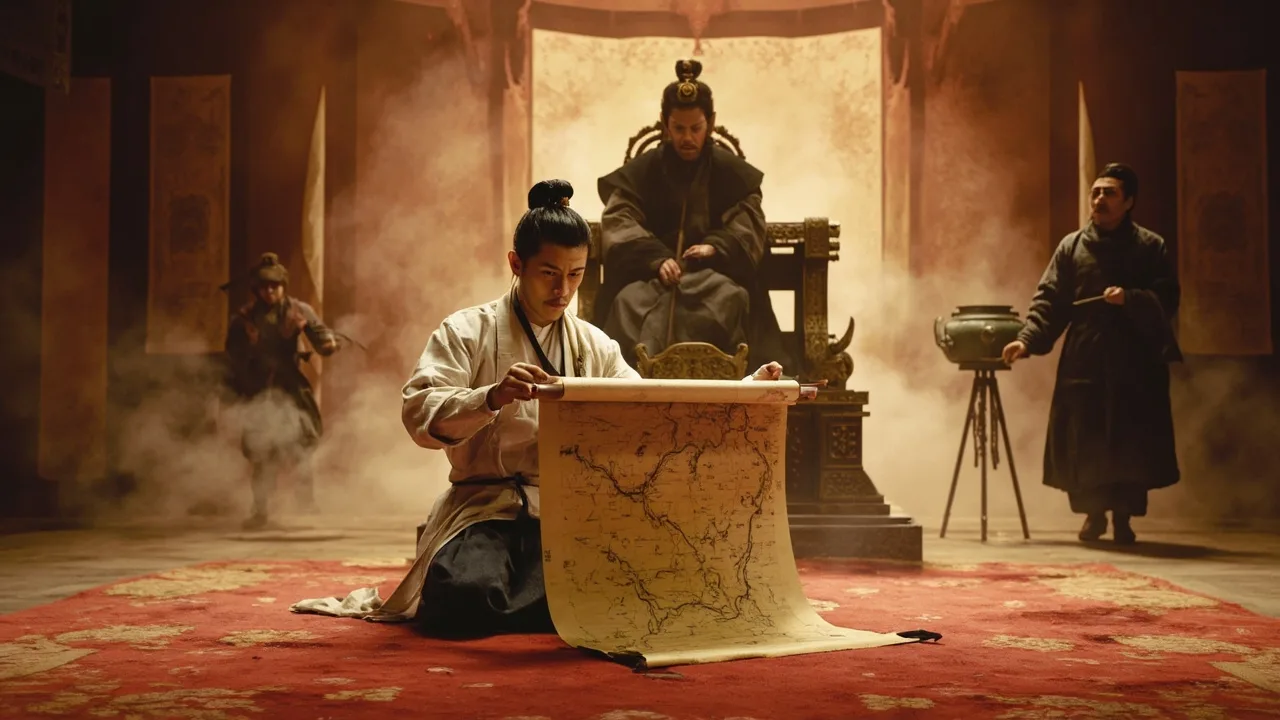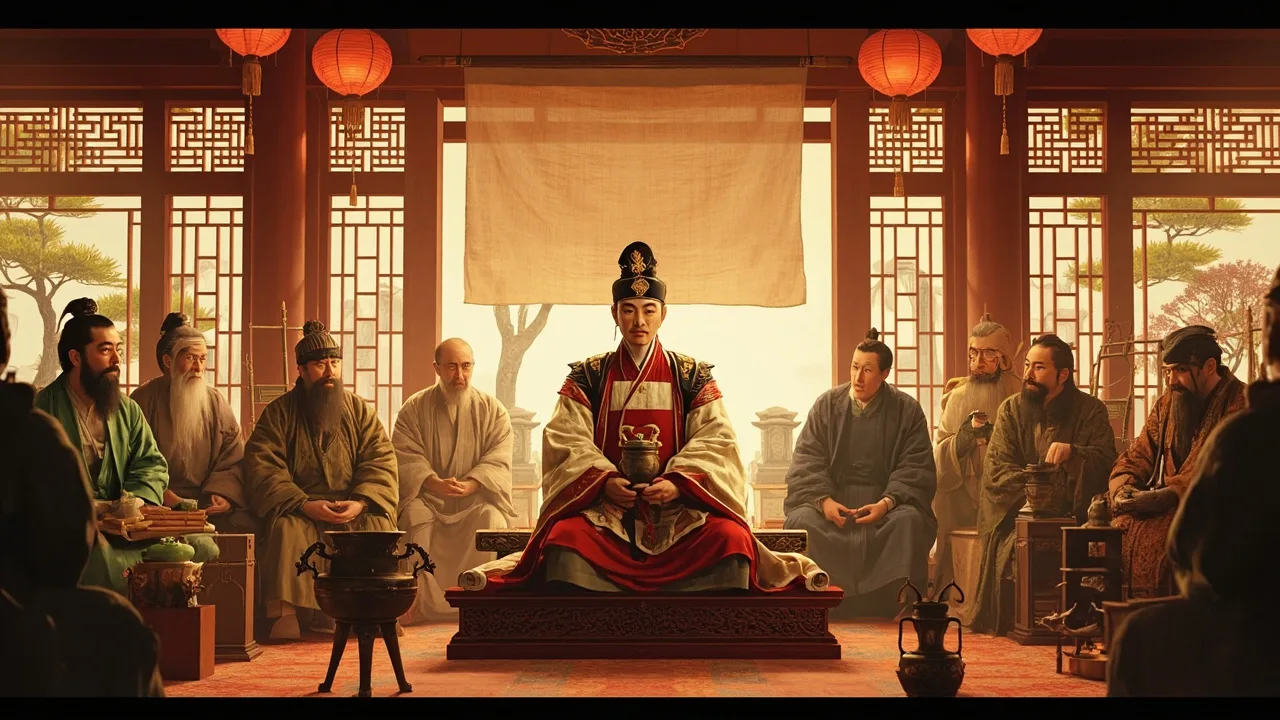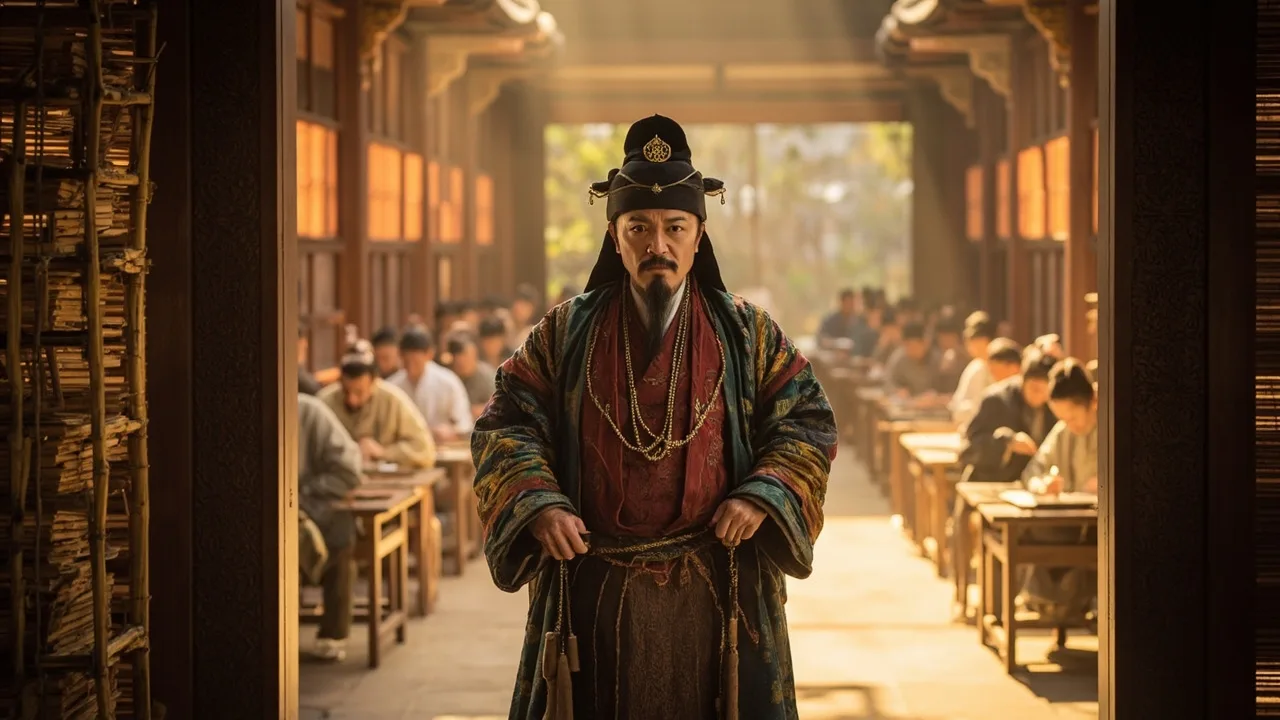
In 259 BCE, somewhere in the state of Zhao, a merchant from the small town of Yangxin made a wager that would reshape ancient China. He was not a general, not a nobleman—just a trader who had grown rich moving goods along the rivers and roads of the Warring States period. But Lü Buwei had something more valuable than gold: an eye for talent buried under layers of misfortune.
He found the future Emperor of China as a young boy, abandoned and neglected in the palace of Zhao. The prince who would one day unite all of China under the Qin flag was living like a refugee’s child, scorned by his own household. Lü Buwei looked at this stranded prince and saw something nobody else did—a once-in-a-generation opportunity. He called it qí huo kě jū: “a strange commodity worth keeping.”
That single act of recognition set in motion a chain of events that would install Lü Buwei as Chancellor of Qin, make him the most powerful non-royal in Chinese history, and give the world one of the most remarkable encyclopedias of ancient thought. And it all started with a merchant’s bet on a forgotten prince. The personal story of Lü Buwei is inseparable from the intellectual project he launched: both were calculated, both were audacious, and both reshaped China in ways their creator could only partially control.
Yangxin to Handan: The Merchant Who Saw a King in a Stranded Prince
The Warring States period (475–221 BCE) was exactly what it sounded like: China fractured into seven competing kingdoms, each desperate to conquer the others. Diplomacy, assassination, and military campaigns blended into a single unbroken struggle for survival. In this world, a prince’s life was only as valuable as his political usefulness—and young Zichar, the son of the Qin crown prince, had been written off as worthless.
Zichar was born to Lady Zhao, a concubine who fell out of favor. When tensions between Qin and Zhao escalated, the Zhao court nearly executed the boy as a diplomatic liability. Lü Buwei, operating from the border city of Handan, watched this situation with a merchant’s calculated interest. A Qin prince in the right hands was a bargaining chip; a dead prince was wasted potential.
Lü Buwei approached the problem like a business deal. He pooled together five hundred gold pieces—then raised another five hundred to purchase rare jewels and silks. He sent these gifts to the powerful Hua Yang夫人, the wife of the Qin crown prince’s brother, whom people called “Lady Huayang.” She had no son of her own and stood to gain influence by sponsoring the right heir. With her backing, the young prince Zichar was recognized as the legitimate heir to the Qin throne.
The investment was staggering for a merchant, but Lü Buwei was thinking in terms of returns that gold could not measure. A prince who owed his position to you does not easily forget who placed him there.
By 250 BCE, when the King of Qin died and Zichar’s father finally took the throne, the new king immediately installed his son as crown prince. Lü Buwei had purchased the future with his five hundred gold pieces and his willingness to act when everyone else saw only risk.
The Five-Pence Gamble: How Lü Buwei Became Qin Chancellor
The new crown prince was Ying Zheng—later known as Qin Shi Huang, the First Emperor of China. He was thirteen years old when his father became king, and the kingdom was anything but stable.
Within three years, Ying Zheng’s father died under suspicious circumstances. The young king was now on the throne, but power was far from settled. This was the moment Lü Buwei had been building toward.
He had already positioned himself as the young king’s most trusted advisor. Recognizing that a teenage ruler needed guidance, Lü Buwei arranged for a brilliant political strategist named Li Si to enter the court as a tutor to Ying Zheng. More importantly, Lü Buwei installed his own protégé, a capable administrator, to manage the day-to-day affairs of state while the king matured.
In 247 BCE, when Ying Zheng formally took the throne, Lü Buwei was appointed Chancellor of Qin—the highest office in the kingdom, answerable only to the king himself. He had risen from a traveling merchant to the second-most powerful man in the most aggressive kingdom in China.
But Lü Buwei was not finished. A merchant thinks in terms of assets and expansion, and he understood that military conquest alone would not hold a unified China together. The Warring States had fought for centuries over ideology as much as territory. Confucius had been dead for two hundred years, and his ideas about moral governance and social harmony competed against Legalist efficiency, Daoist mysticism, and a dozen other schools of thought. Whoever could shape the intellectual landscape of a united China would shape its future.
Lü Buwei decided to build something that no single kingdom could create alone: a comprehensive encyclopedia of all human knowledge, written by the greatest minds of the age.
Hiring the Universe: The Three-Year Encyclopedia Project
By 239 BCE, Lü Buwei had been Chancellor for eight years and had guided Qin through its most aggressive expansion yet. But he knew that raw military power would eventually exhaust itself. A lasting empire needed a shared intellectual foundation—a body of thought that could justify and guide unified rule.
He conceived of a project unlike anything attempted before: commission three thousand scholars to write a complete record of all knowledge in the world. The work would compile philosophy, history, agriculture, astronomy, medicine, music, and practical governance into a single authoritative text. Lü Buwei called it the Lüshi Chunqiu, or “Spring and Autumn Annals of Mr. Lü”—a title that deliberately echoed the most respected historical chronicle of the earlier Zhou dynasty.
The scope was breathtaking. The final work comprised twenty-six chapters organized into one hundred sixty sections, containing over two hundred thousand characters. It covered everything from agricultural techniques to the finer points of diplomatic protocol, from the nature of the cosmos to the psychology of persuasion. No single scholar could have produced this alone—Lü Buwei’s genius was in recognizing that intellectual synthesis at this scale required dozens of minds working in coordination.
When the encyclopedia was completed, Lü Buwei staged a public exhibition that would have impressed any modern marketing executive. He had the entire text displayed on wooden boards along the city walls of Xianyang, the Qin capital, for all to read. Then he made an extraordinary announcement: anyone who could add a single character to the work would be rewarded with a thousand gold pieces.
The stunt was not merely vanity. Lü Buwei was demonstrating that the Lüshi Chunqiu represented the full scope of human knowledge—a complete and final word on civilization itself. The “one-thousand-gold-per-character” claim was both a challenge and a guarantee: the text was so comprehensive that further addition was practically impossible. This was ancient China’s most successful knowledge-management marketing campaign.
The Lüshi Chunqiu positioned itself philosophically as an Eclectic synthesis—drawing from Confucian moral teachings, Daoist natural philosophy, Legalist statecraft, and Mohist concern for universal welfare. It did not advocate for any single school exclusively but rather selected the most practical wisdom from each tradition. This intellectual breadth would prove to be its greatest legacy.
The Affair, the Scroll, and the Fall: How Ying Zheng Turned on His Mentor
Power built on personal relationships is always fragile, and Lü Buwei’s position depended entirely on his closeness to the king he had installed. By the 230s BCE, that closeness was beginning to fray.
The trigger was a scandal that any ancient court would have gossiped about. Lü Buwei had taken as a concubine a remarkable woman named Zhao Deng, originally from the state of Chu, who bore him two sons. As Zhao Deng grew in influence within the Lü household, rumors began to circulate that she had also caught the eye of the young King Ying Zheng. Lü Buwei, ever calculating, arranged for Zhao Deng to be presented to the king as a palace woman—effectively using her beauty as a diplomatic asset.
But Zhao Deng’s sons by Lü Buwei were not so easily disposed of. One of them, known in history as the “two illegitimate sons,” reportedly resembled Ying Zheng enough that court gossips began speculating about the boy’s true parentage. Whether there was any truth to these rumors—and Sima Qian’s Records of the Grand Historian treats them with cautious skepticism—Ying Zheng eventually heard them.
Meanwhile, Lü Buwei’s political position was deteriorating independently of any personal scandal. As Ying Zheng matured into a decisive and ruthless ruler, he grew less willing to share power with any advisor. The young king had his own vision for a unified China, and that vision did not include a merchant-turned-chancellor making decisions behind the throne.
In 238 BCE, the king moved against Lü Buwei with stunning speed. The official charge involved political conspiracy, but the timing suggests a settling of old scores. Lü Buwei was stripped of his titles and expelled from the capital. Rather than face further punishment, he fled to the region of Shu, in what is now Sichuan. He spent his final years in exile, far from the court he had built.
Lü Buwei died in 235 BCE, reportedly by drinking poison—a suicide or an execution depending on which ancient source you prefer. His sons and extended family were reportedly rounded up and executed as part of the same purge.
The merchant who had seen a king in a stranded prince had outlived his usefulness.
Legacy: Why a Failed Politician Built a Book That Outlived His Dynasty
Lü Buwei’s political career ended in disgrace and death, and the Qin dynasty he helped build would itself collapse within years of Ying Zheng’s own death in 210 BCE. Yet the Lüshi Chunqiu endured.
The encyclopedia became one of the foundational texts of Chinese intellectual life, studied by scholars for the next two thousand years. Its Eclectic approach to philosophy—synthesizing the most practical elements of Confucianism, Daoism, Legalism, and Mohism—influenced an entire tradition of Chinese thought. The historian Sima Qian drew from it when compiling the records that would become China’s first great national history. The philosopher Liu An, the King of Huainan in the Han dynasty, claimed descent from Lü Buwei’s intellectual project and produced a comparable work of his own.
More significantly, the Lüshi Chunqiu shaped the educational philosophy that would define imperial China’s approach to governance. Its insistence that rulers should study broadly, draw from multiple traditions, and prioritize practical wisdom over ideological purity became orthodox. When the Han dynasty established China’s first civil service examination system two centuries later, the Lüshi Chunqiu was among the canonical texts that candidates were expected to master.
The merchant who invested five hundred gold pieces in a forgotten prince could not have predicted that his greatest legacy would not be political but intellectual. He fell from power, his family was destroyed, and his king never formally acknowledged what Lü Buwei had done for him. But the book remained.
What makes the Lüshi Chunqiu historically significant goes beyond its contents. Lü Buwei was the first person in Chinese history to attempt a systematic compilation of all human knowledge into a single authoritative text, funded not by a king or a state but by a private individual who had made a fortune in trade. This was an entirely new model for cultural patronage—one that later Han dynasty scholars would study carefully and replicate. The distinction matters: when emperors later commissioned encyclopedias, they were following a template that a merchant had pioneered.
The Lüshi Chunqiu also shaped the intellectual tradition of Eclectic synthesis that became characteristic of Chinese statecraft. Rather than committing to a single philosophical school, Chinese imperial ideology typically drew eclectically from Confucianism for moral authority, Daoism for natural philosophy, and Legalism for administrative efficiency. Lü Buwei’s encyclopedia was the earliest systematic expression of this practical approach to governance. Emperors who followed—Han Wu Di, Tang Taizong, the Yongle Emperor—all practiced this kind of selective borrowing, and the Lüshi Chunqiu was one of their reference points for how to do it.