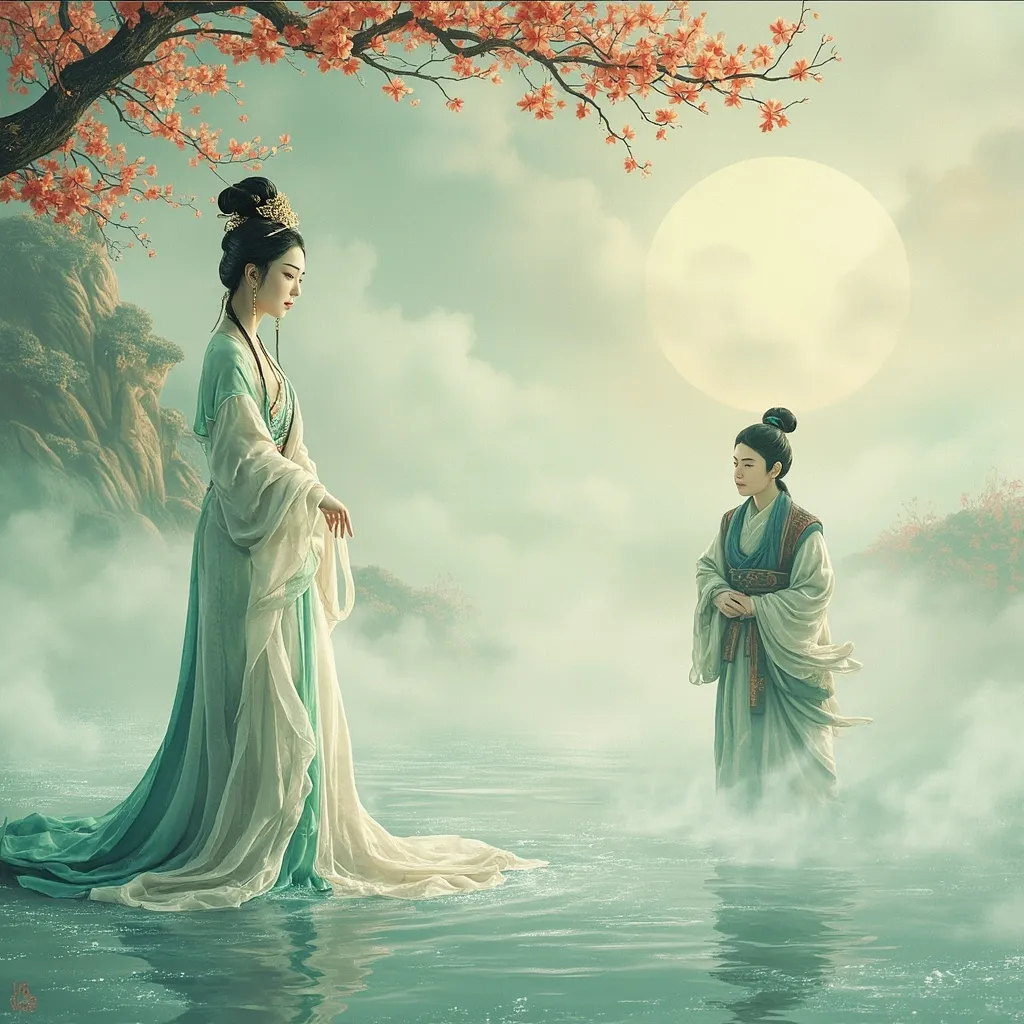
slug: “luoshen-river-goddess-ode” description: “Explore the lyrical masterpiece Ode to the River Goddess by Cao Zhi, and discover the legendary story of Luo Shen, the beautiful water spirit whose grace and sorrow have inspired Chinese artists for centuries.” keywords: “Luo Shen, River Goddess, Ode to the River Goddess, Cao Zhi, Chinese mythology, river goddess beauty, Chinese poetry,洛神赋, beautiful goddess, Chinese literature” affiliate_products:
- “Chinese poetry anthologies featuring classical works”
- “Chinese painting scrolls with goddess and nature themes”
- “Traditional Chinese silk ribbons and fabric for calligraphy”
- “Books on the history of Chinese visual arts and poetry”
- “Handcrafted jade and jadeite jewelry inspired by mythological figures” image: “/images/luoshen-goddess.jpg” categories: [Chinese Mythology] alt_text: “Illustration depicting ode to the river goddess, in a traditional Chinese cultural setting”—
Ode to the River Goddess: The Eternal Beauty of Luo Shen
There are love stories throughout human literature that capture the heart’s longing for something beautiful but unreachable, the bittersweet knowledge that some experiences exist beyond our grasp. In the Western tradition, we might think of the myth of Orpheus and Eurydice, or the troubadour tradition of courtly love where the beloved is always distant, always beyond reach. In Chinese literature, one of the most haunting expressions of this theme is a poem called “Ode to the River Goddess,” written nearly two thousand years ago by a poet named Cao Zhi. The goddess at the center of this poem—Luo Shen, the spirit of the Luo River—has become one of the most enduring figures in Chinese cultural imagination, a symbol of transcendent beauty, melancholy longing, and the pain of separation.
The poem is not just a story about a beautiful supernatural being. It is a profound meditation on the nature of beauty itself, on the relationship between the seen and the unseen, between human desire and divine perfection. To understand why “Ode to the River Goddess” has remained beloved for nearly two millennia, we need to understand both the legend of Luo Shen and the particular circumstances that led Cao Zhi to create this masterpiece.
The Legend of Luo Shen
The mythological origins of Luo Shen are not entirely clear, which is fitting for a figure who embodies the mysterious, otherworldly quality of water itself. In early Chinese sources, Luo Shen appears as a goddess associated with the Luo River, a tributary of the Yellow River in what is now Henan Province. She was understood to be a spirit of the waters, a being who existed at the boundary between the human world and the realm of the divine, possessing a beauty that transcended ordinary human standards.
According to some versions of the legend, Luo Shen was the daughter of Emperor Yao, one of the legendary rulers of ancient China. After her father tested her suitor Shun by assigning her difficult household tasks, Shun completed them all successfully, and Luo Shen became his wife. When Shun later became emperor himself, Luo Shen ruled beside him as a wise and virtuous empress. Upon her death, she was deified and became the goddess of the Luo River, a spirit who could bring blessings to those who honored her and who had power over the waters themselves.
This mythological background gives the figure of Luo Shen a particular significance. She was not merely a beautiful woman but a being who had walked the line between mortality and divinity, who had experienced both human love and divine power. This dual nature—the human queen who became a river goddess—makes her the perfect subject for a poem about the longing to transcend the boundaries that separate ordinary existence from something more beautiful and more perfect.
Cao Zhi and the Poet’s Heart
The poem “Ode to the River Goddess” was written by Cao Zhi, a prince of the Three Kingdoms period who lived from 192 to 232 CE. Cao Zhi was one of the most talented poets of his generation, known for his lyrical gift and his ability to express deep emotion in beautiful, flowing language. He was also a figure marked by personal tragedy—the son of the warlord Cao Cao, he lived through a period of intense political upheaval and family conflict that would have profound effects on his life and work.
The circumstances that led to the composition of “Ode to the River Goddess” are not entirely certain, but traditional accounts connect the poem to Cao Zhi’s own experiences of loss and longing. According to one story, Cao Zhi was traveling and stopped at the Luo River, where he was overwhelmed by the beauty of the landscape and by memories of someone he had loved and lost. As he stood by the water, he caught sight of what appeared to be a beautiful woman on the far bank—a vision so lovely that he was convinced she must be a goddess. The poem describes his encounter with this divine figure, the overwhelming beauty he witnessed, and the inevitable moment of separation when she returns to her realm beyond the mortal world.
Another interpretation connects the poem to Cao Zhi’s complicated relationship with his father and his brother Cao Pi. After Cao Cao’s death, Cao Pi became Emperor of Wei and subjected his younger brother to various forms of persecution, restricting his freedom and even threatening his life. In this reading, the poem’s theme of encountering a beautiful but untouchable being and being forced to part represents Cao Zhi’s own sense of loss and exile—the beautiful hopes of his youth destroyed by political reality.
The Poem’s Lyrical Beauty
Whatever its biographical origins, “Ode to the River Goddess” stands as one of the great masterpieces of Chinese literature. The poem is written in a flowing, lyrical style that was characteristic of the “new style” poetry that emerged during the Three Kingdoms period, combining vivid description with emotional depth in a way that was new to Chinese literature.
The poem begins with Cao Zhi describing the scene by the Luo River—his weariness from travel, his lodgings at an inn, his contemplative mood as he looks out at the water. Then comes the pivotal moment: he sees a figure in the distance, standing by the water’s edge. As she comes closer, he realizes that this is no ordinary person but a divine being, a goddess of extraordinary beauty.
The description of Luo Shen that follows is one of the most celebrated passages in all of Chinese literature. Cao Zhi describes her as having “skin like snow, complexion like jade,” with features so perfect they seem to have been carved by the gods themselves. Her hair is black as a crow’s feathers, her eyebrows like the curved wings of a cicada. When she moves, it is with the grace of a swan, the delicacy of a lotus rising from water. She wears garments of precious silk and jade ornaments that chime softly as she walks.
What makes this description so remarkable is not just its catalogue of beautiful features but the way it captures something beyond physical beauty—the sense of a being who exists on a different plane of existence, whose beauty is a manifestation of her divine nature rather than merely the luck of genetics or cosmetics. Cao Zhi’s goddess is beautiful because she is a goddess, because she inhabits a realm where such perfection is possible in a way it never is in the human world.
The Pain of Parting
The central tragedy of “Ode to the River Goddess” is the inevitable separation that must come between the mortal poet and the divine goddess. After describing his enchanted encounter with Luo Shen, the poem turns to the moment of parting. The goddess explains that she cannot stay in the mortal world, that she must return to her own realm, the palace of the River God where she dwells among the immortals.
The description of this parting is heartbreaking in its tenderness. The goddess gives Cao Zhi a precious jade pendant as a token of their meeting, promising that though they can never be together, she will think of him and he can remember her beauty. She tells him not to grieve, not to let his heart be troubled, but the poem makes clear that such instructions are impossible to follow. How can one forget a love like this, even if it was never really possible to begin with?
The final sections of the poem describe the goddess disappearing into the distance, becoming smaller and smaller until she vanishes entirely. Cao Zhi is left standing by the water, his heart full of longing, able to do nothing but watch as the vision fades. The poem ends with an image of the poet returning to his lodgings, but unable to eat or rest, his thoughts entirely occupied by the memory of what he has seen.
This ending has resonated with readers for nearly two thousand years because it captures something universal about human experience—the knowledge that some beautiful things exist beyond our reach, that longing itself can be a form of love, that memory of a perfect moment can sustain us even as it makes ordinary life feel inadequate. The goddess was never really his to possess, but the experience of seeing her, of being in her presence, even briefly, has changed him forever.
The Legacy in Art and Culture
“Ode to the River Goddess” quickly became one of the most influential works in Chinese literary history. Its imagery and themes were taken up by subsequent generations of poets, painters, and calligraphers who found in Luo Shen the perfect embodiment of beauty, longing, and the transcendence of art itself.
One of the most famous artistic responses to the poem is a handscroll painting by Gu Kaizhi, a painter from the Eastern Jin dynasty who lived around 344-406 CE. Gu Kaizhi’s illustration of “Ode to the River Goddess” is now lost, but ancient accounts describe it as a revolutionary work that captured not just the physical appearance of the goddess but her spiritual essence, her otherworldly quality. The fact that the painting itself is gone, surviving only in descriptions and copies, adds another layer to the theme of lost beauty and the longing to recover what has vanished.
Later Chinese painters continued to find inspiration in Luo Shen. The subject was particularly popular during the Tang dynasty, when artists developed new techniques for depicting flowing water and ethereal figures. By the time of the Song dynasty, Luo Shen had become one of the standard subjects for literary painting, her image rendered by masters who wanted to capture in visual form the lyrical beauty that Cao Zhi had achieved in words.
The goddess also appears frequently in Chinese decorative arts—in jade carvings, in porcelain decorations, in the embellishments on furniture and personal objects. Her image was believed to bring good fortune and to bless the possessor with beauty, grace, and the kind of refined sensibility that the poem embodies. This popular diffusion of Luo Shen’s image across Chinese material culture shows how completely she had become integrated into the Chinese understanding of beauty itself.
Themes of Longing Across Time
What makes “Ode to the River Goddess” continue to speak to readers across the centuries is its exploration of themes that are not limited to any particular culture or historical moment. The experience of encountering something beautiful and knowing it cannot be possessed, the pain of separation from what we love, the way memory can sustain and torment us in equal measure—these are experiences as relevant today as they were in the Three Kingdoms period.
Modern readers can find in Cao Zhi’s poem a reflection of their own experiences of longing and loss, whether for a person who has passed from their lives, for a love that could never be, or for some vision of perfection that they glimpsed once and have been trying to recover ever since. The poem does not offer resolution or consolation in any easy sense, but it does offer something valuable: the recognition that such longing is not a weakness but a characteristic of the human heart, a sign of our capacity to recognize and desire beauty even when we know it is beyond our reach.
In this sense, Luo Shen functions as a kind of ideal, a standard against which ordinary beauty is measured but can never match. She represents the beauty we see in nature and dream about in art, the perfection we pursue in love and can never quite achieve, the transcendence that religious traditions promise and poetry approximates. By giving a name and a story to this ideal, Cao Zhi created something that has helped Chinese readers make sense of their own experiences of beauty and longing for millennia.
Recommended Exploration Paths
For those whose curiosity has been awakened by the story of Luo Shen and “Ode to the River Goddess,” there are many ways to continue the journey. Anthologies of classical Chinese poetry often include the poem or excerpts from it, usually with notes and translation that can help readers navigate the challenges of classical Chinese expression. Look for editions that provide both the original Chinese text and a facing translation, as this allows readers to appreciate the musical qualities of Cao Zhi’s language even without full fluency in classical Chinese.
Books on the history of Chinese art frequently discuss the depiction of Luo Shen and the broader tradition of literary painting that she inspired. These visual resources can help readers see how the poem’s imagery was interpreted by artists across different periods, showing the range of creative responses that Cao Zhi’s masterpiece has generated.
Traditional Chinese silk products offer another way to connect with the cultural world that produced “Ode to the River Goddess.” The poem’s descriptions of flowing robes and shimmering fabrics take on new meaning when one understands the craftsmanship that went into producing such textiles, and the beauty that traditional silk work could achieve.
For those drawn to the philosophical and spiritual dimensions of the poem, there are studies that situate “Ode to the River Goddess” within the broader context of Chinese religious thought, exploring how the poem engages with concepts of mortality, transcendence, and the possibility of communication between the human and divine realms.
Finally, jade and jadeite jewelry inspired by mythological figures can serve as a tangible connection to the aesthetic world that Luo Shen represents. The Chinese reverence for jade as a symbol of purity and elevated spiritual quality makes jadeite pieces particularly appropriate for those who wish to honor the goddess’s memory in physical form.
The story of Luo Shen and Cao Zhi’s “Ode to the River Goddess” reminds us that some forms of beauty are too profound to be possessed but too important to be forgotten. The poet stood by the Luo River and glimpsed something divine, something perfect, something that could never be his. All he could do was bear witness, to describe what he saw with all the skill and feeling he possessed, and to trust that the description itself would preserve something of the experience for those who came after.
Two thousand years later, we are still in his debt. Through his poem, we too can stand by that river, we too can watch as a goddess appears on the far bank, we too can feel the bittersweet weight of loving something we cannot hold. The goddess herself has faded into legend, but the poem remains—a bridge across time that carries us into the presence of beauty so pure it seemed to belong to another world entirely.