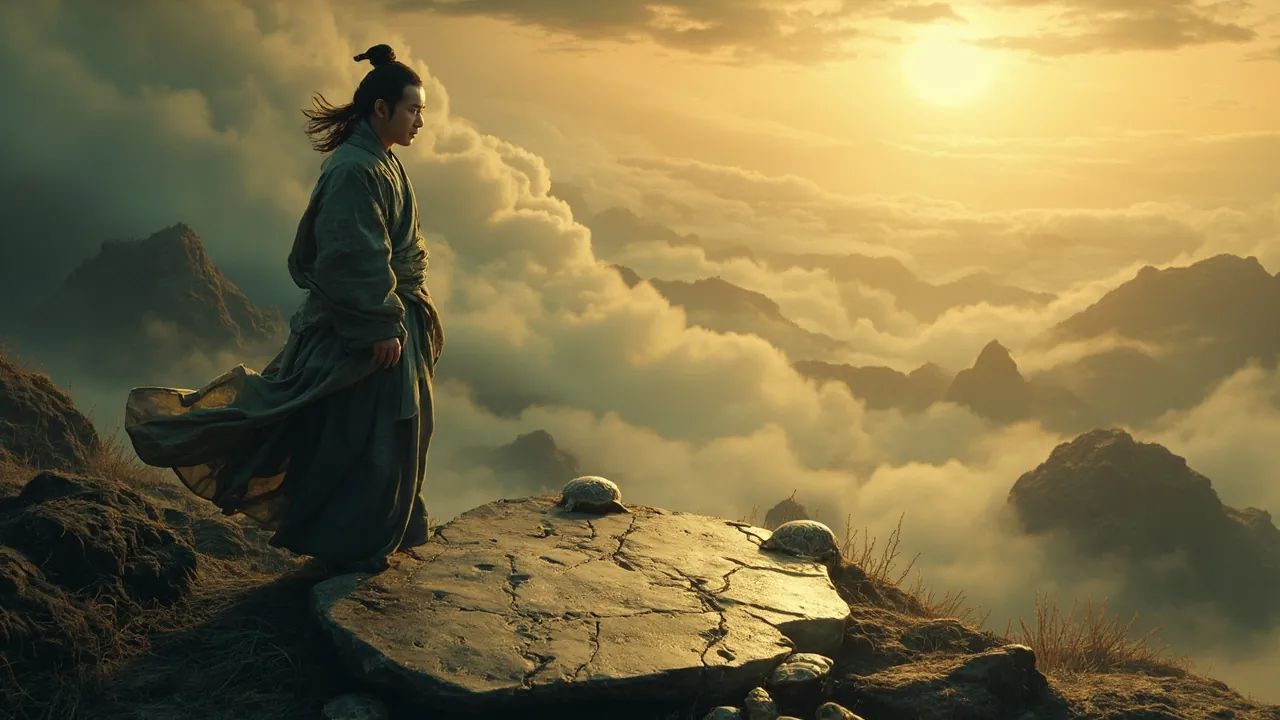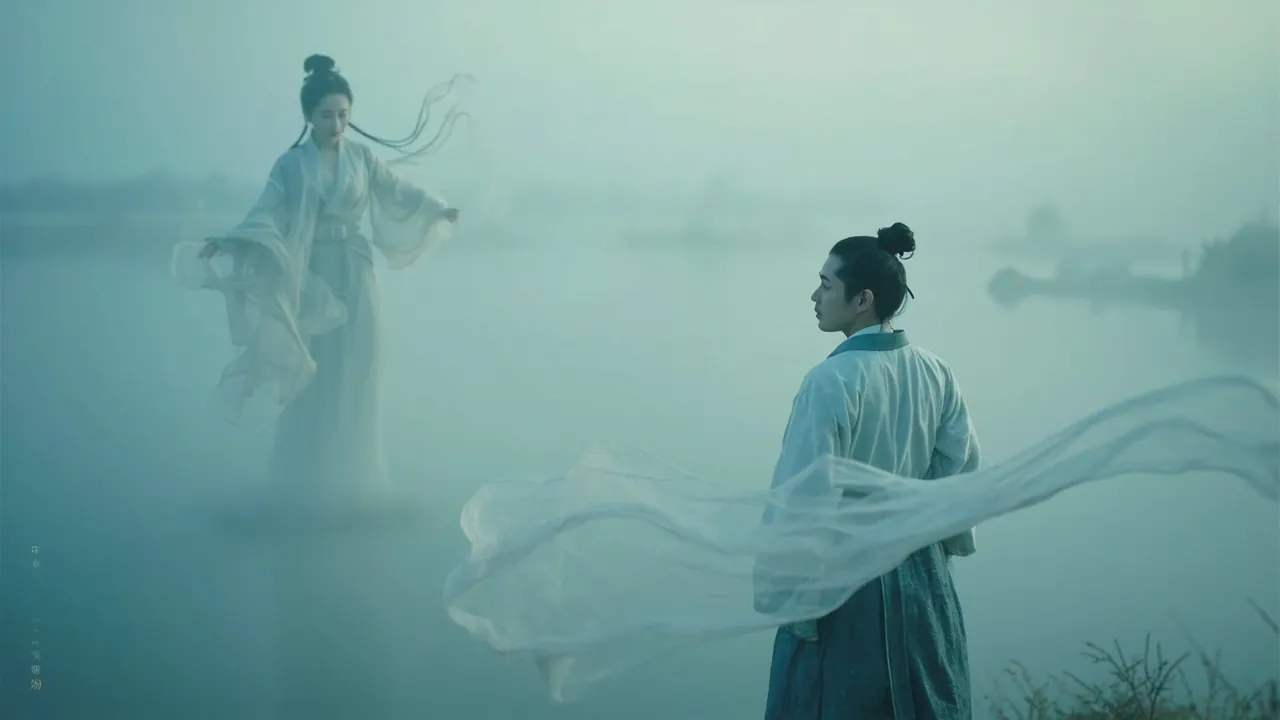
In the year 222 CE, a prince of the Cao Wei state was traveling by boat on the River Luo when he saw a woman on the opposite bank. She was so beautiful that he forgot where he was, forgot why he was traveling, forgot everything except the vision standing by the water’s edge. He stared at her across the river, and she looked back at him, and for a moment the whole world held its breath.
Then she was gone. She walked into the water and vanished beneath the surface, leaving only ripples.
The prince spent the rest of his life trying to describe what he’d seen. He wrote poems, revised them, wrote more, revised those. He couldn’t get her face out of his mind. He couldn’t find words good enough to capture her — and this was a man who had been trained since childhood in the highest art of Chinese poetry, who had competed in literary contests against the finest minds of his generation, who was considered one of the greatest poets of his era. Even he, with all his skill, found that the goddess had exceeded his ability to represent her.
The poem he eventually produced was called 洛神赋 — Luoshen Fu, the Rhapsody of the River Luo Goddess. It became one of the most famous poems in Chinese history. It has been illustrated, copied, analyzed, anthologized, and memorized by every educated person in China for nearly two thousand years. And the strange thing is that it was never really about a goddess at all.
Cao Zhi: The Prince Who Couldn’t Stop Writing
To understand the poem, you need to know something about its author.
曹植 — Cao Zhi — was the third son of Cao Cao, the warlord who founded the Cao Wei state and came closer than anyone to unifying China during the chaotic period at the end of the Han Dynasty. Cao Cao was a brilliant military commander and a surprisingly good poet, and he raised his sons to be cultured as well as capable. Cao Zhi was the youngest of the three brothers, and by most accounts the most talented — not in warfare or politics, but in the arts. He was quick, imaginative, and deeply sensitive. He wrote poetry with an ease that seemed almost supernatural, as if the words were simply appearing on the page rather than being composed.
His older brother 曹丕 — Cao Pi — was a different kind of person. More serious, more political, more aware of the brutal realities of power. When Cao Cao died in 220 CE and Cao Pi took the throne as the first Emperor of Wei, the dynamic between the brothers shifted in dangerous ways. Cao Zhi had never been particularly interested in ruling, but he was a threat simply because of his talent — his popularity with the literary community, his status as the favorite son of their father’s later years, his ability to capture people’s hearts with words. Cao Pi saw this as a challenge to his authority.
The new emperor found ways to pressure his younger brother. He made him move to a remote part of the kingdom. He demoted his titles. He put pressure on their mutual associates to distance themselves from Cao Zhi. And he made sure that the one person Cao Zhi might have turned to for comfort — his own wife — was humiliated and eventually put to death for a minor infraction.
Cao Zhi was trapped. He was a prince in name but a prisoner in practice, watched by spies, denied meaningful work, stripped of the people he loved. And he had no way to fight back — his weapons were words, and words against an emperor were suicide.
So he did what any poet would do. He wrote about something else entirely.
The Goddess on the River Bank
The Luoshen Fu begins as a travelogue. Cao Zhi describes traveling south through the mountains, crossing rivers, enjoying the scenery. Then he arrives at the Luo River and stops. He looks at the water. He sees — something.
The poem is careful not to say immediately what he sees. It builds slowly, describing the river in detail: the way the water flows, the lotus flowers on the surface, the morning mist rising. And then, gradually, the description shifts to something moving in the water, something not quite human.
Then he sees her clearly. And the poem explodes into a catalogue of her beauty that is unlike almost anything else in Chinese literature — not just “she was beautiful” but an exhaustive, obsessive account of every detail. Her hair, her forehead, her eyebrows, her eyes, her nose, her lips, her teeth, her neck, her shoulders, her hands, her feet. The color of her skin. The way she moved. The clothes she wore, described in specific detail — robes of white and purple and crimson, ornaments of jade and pearl, a headdress with hanging ribbons. The poem is essentially a portrait in language, and it goes on for page after page, each line adding another detail, as if Cao Zhi is trying to reconstruct her visually on the page because he can’t have her in person.
She is not human, the poem tells us. She is 宓妃 — Fei Fei, the goddess of this river, the spirit of the Luo. She has been seen before by other poets — the great 屈原 — Qu Yuan — wrote about a similar figure in his poems — but this version is more immediate, more personal, more like a direct encounter than a literary allusion.
Reading the Poem as a Secret Message
Here is where the poem gets complicated — and why it became such a famous act of literary courage.
Cao Zhi almost certainly wasn’t writing about a literal goddess. He was writing about someone he couldn’t name directly: his sister-in-law, the Empress 甄氏 — Zhen Shi — who had been married to his brother Cao Pi. Zhen Shi was famous for her beauty and her intelligence. She and Cao Zhi had, according to some historical accounts, a genuine connection — not necessarily romantic in any simple sense, but a deep mutual respect and affection between two people who recognized each other’s gifts.
When Cao Pi became emperor and began to systematically humiliate Cao Zhi, Zhen Shi was caught in the middle. She was Cao Pi’s wife; she couldn’t openly support his brother without consequences. But she also couldn’t entirely hide her sympathy for him. And when Cao Pi had her put to death — ostensibly for a minor breach of etiquette, but possibly for showing too much warmth toward Cao Zhi — the younger brother was devastated.
The Luoshen Fu, most scholars believe, is his response. The goddess on the riverbank is Zhen Shi — the woman he loved and could never have, the woman who was taken from him not by death in the ordinary sense but by the brutal politics of his own family. The poem’s description of seeing her across the water, of being transfixed by her beauty, of reaching toward her and being unable to touch her, of watching her fade away and disappear — this is not fantasy. This is grief, expressed through the only safe medium available.
Why safe? Because if you write a poem about a divine goddess, no one can accuse you of writing about your brother’s wife. The surface story protects the real story. Cao Zhi could express his love, his longing, his grief, his rage — and he could do it in a form so beautiful, so formally perfect, that even Cao Pi couldn’t punish him for it without looking like a barbarian who didn’t understand poetry.
This is why the poem has such a complicated emotional texture. On the surface, it’s an encounter with a goddess — marvelously, even sensually, described. But there’s an undercurrent of something rawer underneath. The goddess is untouchable. She belongs to another realm. She sees the poet and is drawn to him, but the moment of connection is followed immediately by separation. They cannot be together. The poem ends not with union but with loss — the goddess departing, the poet watching her go, unable to follow.
The Art of Indirect Expression
The Luoshen Fu is considered a masterpiece of Chinese literature for many reasons, but one of the most important is its technique of indirect expression — the use of mythological imagery to convey personal emotion in a way that could be read multiple ways.
This technique has a name in Chinese literary criticism: 寄寓 — jiyu, “to lodge meaning within.” The idea is that the surface narrative carries the primary meaning, but a deeper meaning is “lodged” within it, accessible to readers who understand the context but invisible to those who don’t. It’s a form of literary encryption, except the encryption is so beautiful that no one wants to decode it and reveal the plain text.
Cao Zhi uses this technique masterfully. The goddess is described with physical specificity that goes far beyond what a mythological figure requires — the poem reads more like a portrait of a real person than a supernatural being. And the emotions expressed — the overwhelming attraction, the inability to act, the watching and longing, the final separation — these are emotions that make perfect sense in the context of forbidden love and political imprisonment, but which seem slightly off-kilter for a straightforward encounter with a water spirit.
The genius of the poem is that both readings work simultaneously. You can read it as a beautiful mythological poem about encountering a goddess, and it’s satisfying at that level. But if you know the context — if you know about Cao Zhi and Zhen Shi and the trapped, watched, grieving life Cao Zhi was living in 222 CE — the poem takes on a second dimension of meaning that makes it one of the most emotionally powerful works in Chinese literature.
The Legacy: Beauty as Resistance
The Luoshen Fu didn’t save Cao Zhi from his brother’s persecution. He continued to live under a kind of house arrest, denied meaningful work, watched by spies, until he died young at age forty-one. His brother outlived him.
But the poem survived. And what it survived as was a testament to the power of indirect expression — the idea that when direct speech is dangerous, art becomes the language of truth.
This is why the poem has been so influential. It’s not just a love poem; it’s a poem about the necessity of encoding truth in beauty, about the way art can carry meaning that politics would punish if spoken plainly. Every Chinese poet who came after Cao Zhi knew this poem, and many of them used similar techniques — mythological disguise, symbolic landscapes, the expression of personal grief through stories about divine beings — because Cao Zhi had shown them it was possible.
The River Goddess herself became a figure in Chinese art — a standard of feminine beauty, a subject for painters across the centuries. The image of a beautiful woman rising from or standing beside water traces directly back to the Luoshen Fu. She’s been painted by artists from the 4th century onward, depicted in silk scrolls and album leaves and modern prints, always with that same quality of otherworldly translucence that Cao Zhi first gave her in words.
But the real achievement of the poem is simpler and harder to replicate: it took the most painful experience of Cao Zhi’s life — his love for someone he could never have, his grief at losing her, his rage at the brother who took her from him — and transformed it into something so beautiful that it has outlived the empire, the dynasty, the political system that caused the pain. Two thousand years later, readers can still feel the force of the emotion that drove him to write it, still recognize the particular quality of loss that he was trying to capture.
That’s what great poetry does. It takes the unbearable and makes it last. It gives grief a form that survives the people who felt it. Cao Zhi couldn’t hold Zhen Shi’s hand, couldn’t speak to her openly, couldn’t even write her name in a poem without risking his life. But he could watch her across the water, describe her beauty with an accuracy that felt like love, and give that description a permanence that outlasted everyone involved.
The goddess he saw that day on the Luo River was probably never real. But the feeling he had, watching her fade into the water — that was real. And it’s still real, every time someone reads the poem and understands, across two thousand years and a translation barrier and a completely different cultural context, exactly how he felt.
That’s the real magic of the Luoshen Fu. Not the goddess. The grief. And the art that made the grief immortal.