In the first week of 690 AD, the only empress in Chinese history ordered every flower in the imperial capital to bloom. Empress Wu Zetian (武则天, wǔ zé tiān), the woman who had just seized the throne and proclaimed her own Zhou dynasty, was hosting a winter banquet at her palace in Chang’an. She wanted color. She wanted drama. She wanted flowers.
According to the legend preserved in Youyang Zazu (酉阳杂俎), a 9th-century collection of supernatural tales, the Empress composed a poem demanding obedience from the botanical world: “By royal decree, I command you flowers of the morning, to bloom at once, without waiting for the spring.” Roses, jasmine, peonies, and magnolias — all reportedly burst into blossom overnight, terrified into submission by imperial will.
All except the peony.
The peony refused. Call it stubborn. Call it dignified. Call it the first act of political resistance in the garden. The story goes that Empress Wu flew into a rage and exiled the offending flower from Chang’an. Dragged from the warm, irrigated terraces of the imperial capital, the peonies were transported east over the mountains and dropped in the cold, dusty plains of Luoyang (洛阳, luò yáng) — a city that, at the time, had been stripped of most of its political importance after the dynasty moved west.
It was the best thing that ever happened to the peony.
Why Luoyang? The Geography of a Flower
Luoyang sits in western Henan province, on a plateau of fine-grained loess soil deposited by the Yellow River (黄河, huáng hé) over millions of years. That soil matters. Peonies love it. The loose, mineral-rich earth drains well but holds moisture at depth, giving the deep roots exactly the conditions they need to throw up those enormous, heavy blooms every spring.
The climate helps too. Luoyang lies right on the climatic line between northern and central China. Summers are hot enough to ripen wood, but winters are cold enough — dropping well below freezing in January and February — to give peonies the proper winter dormancy they require. Without that cold period, the plants won’t set buds. Too cold, and the buds die. Luoyang’s particular balance, with daily averages that swing from around 0°C in February to 26°C in July, is just right.
And then there’s the history. Luoyang was one of China’s great capitals for over a thousand years before the Tang. The Eastern Zhou, the Eastern Han, the Wei, the Sui — each dynasty in turn chose Luoyang as its seat of power, building palaces, temples, and gardens across the Luo River (洛河, luò hé) valley. When the Empress’s peonies arrived in the late 7th century, they were dropped into a landscape that already had the soil, the patronage, and the gardening culture to make them feel at home.
The earliest written records of peonies in Luoyang date to the Tang dynasty itself, but the cultivation clearly predates the legend. Botanical historians generally trace organized peony growing in the area to at least the Sui dynasty (581–618), with possibly older ornamental plantings going back to the Northern Wei period. The Empress Wu story is a myth, but it’s a myth built on a real history: by the late Tang, Luoyang had become the peony capital of China, and it has never given up that title.
The Tang Dynasty Origins: Yang Guifei and the Poet Li Bai
If the Empress Wu legend gave Luoyang its peonies, the Yang Guifei legend gave the peony its soul.
Yang Guifei (杨贵妃, yáng guì fēi), the famously beautiful consort of Emperor Xuanzong (唐玄宗, táng xuán zōng), was said to have a particular affection for peonies. Court chronicles describe how peonies were planted in vast quantities inside the imperial palace grounds at Chang’an so that the consort could walk among them. The variety most closely associated with her, the heavy-headed creamy-white peony named “Yao Huang” (姚黄, yáo huáng), is still cultivated today and remains one of the most prestigious varieties in any Luoyang garden.
The poets of the Tang, who loved nothing more than to turn a beautiful woman into a beautiful flower, took the connection and ran with it. The great Li Bai (李白, lǐ bái) wrote that Yang Guifei’s face, when powdered, looked like the pale gold of a peony in moonlight. Bai Juyi (白居易, bái jū yì), another Tang giant, composed an entire poem comparing the layers of silk in the consort’s robe to the layers of petals in a peony bloom. And the Tang poet Liu Yuxi (刘禹锡, liú yǔ xī) wrote one of the most quoted peony poems of the entire era, “Watching Peonies at Tang Pingli’s Banquet” (赏牡丹), declaring: “Only the peony is the true flower of the nation; its blooms move the capital to distraction.”
It’s worth pausing on that last line. “The true flower of the nation” — guoze tianxiang (国色天香, guó sè tiān xiāng) — is the phrase that has been attached to the peony ever since. Translated literally, it means “the color of the state, the fragrance of heaven.” It was the highest possible compliment a Tang poet could give a flower, and it fixed the peony’s cultural status for the next thirteen centuries.
By the mid-9th century, when the Tang dynasty collapsed into civil war, peony culture in Luoyang was already centuries old. The Song dynasty (960–1279) that followed saw an explosion of peony breeding: horticulturists in Luoyang identified and named over a hundred distinct varieties, organized them into formal classes, and traded them across the empire. The Luoyang Peony Ji (洛阳牡丹记, luò yáng mǔ dān jì), a Song-era monograph written by the scholar Ouyang Xiu (欧阳修, ōu yáng xiū), is the earliest surviving comprehensive treatment of peony cultivation in the world, and it remains a foundational text for peony historians today.
The King of Flowers: How the Peony Got Its Title
The peony’s elevation to “king of flowers” (花王, huā wáng) was a process that took centuries. China had long recognized a “gentleman of flowers” (花中君子, huā zhōng jūn zǐ) — the plum blossom (梅, méi), which blooms alone in winter snow. It had also long recognized the “hermit of flowers” (花中隐士, huā zhōng yǐn shì) — the chrysanthemum (菊, jú), which blooms alone in autumn frost. These two, along with the orchid (兰, lán) and the bamboo (竹, zhú), formed the “four gentlemen” of Chinese floral culture.
The peony was something different. It didn’t bloom alone in difficult conditions, didn’t ask for pity or admiration for its perseverance. It bloomed in spring, when everything was already blooming, and it bloomed bigger, louder, and more extravagantly than anything else in the garden. It was the flower of prosperity, not poverty. The flower of fullness, not restraint. The flower of court life, not mountain solitude.
The title “king of flowers” was formalized during the Qing dynasty (1644–1912). In 1903, as part of a broader effort to define official symbols for the new constitutional monarchy, the imperial court formally designated the peony as the “national flower” (国花, guó huā) — though this designation was never fully implemented before the dynasty fell in 1912. Still, the cultural association was so strong that when the People’s Republic held a similar vote in 1994, the peony won handily, with 71% of votes in favor. It remains the unofficial national flower of China today.
The Qing court had a particular love for peonies. The Forbidden City’s peony gardens were carefully maintained, and the emperor Kangxi (康熙, kāng xī) is recorded as having personally selected new varieties for imperial planting. The most prized of these, the “Qing Kong Que Xian” (青空缺线), a deep purple-black peony with a faint blue sheen, was reserved for palace cultivation and never given to common gardens.
This imperial patronage had a lasting effect on peony breeding in China. Whereas European peony breeding focused primarily on medicinal and cut-flower uses, Chinese breeding concentrated on display varieties for garden and temple planting. The result is that today’s Chinese peony cultivars tend to be larger, more colorful, and more architecturally elaborate than their European counterparts — a tradition going straight back to those Tang palace gardens and refined by a thousand years of court patronage.
The Modern Peony Festival: A City in Bloom
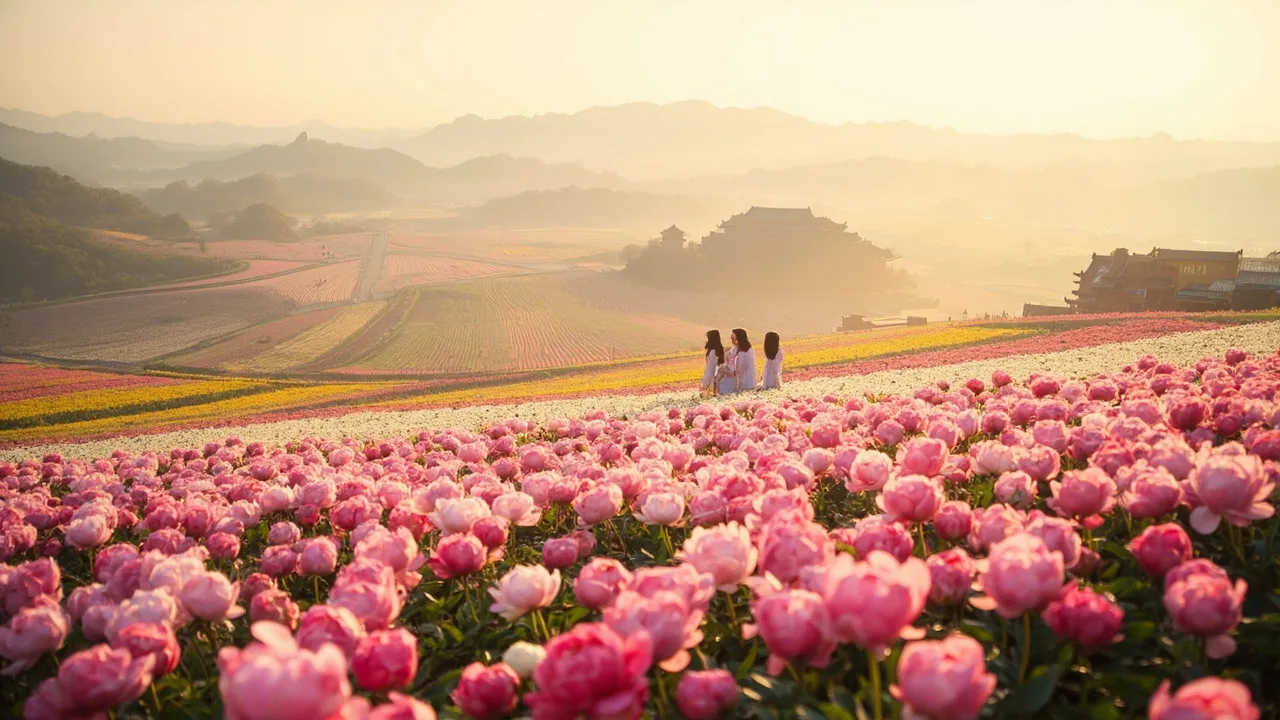
Every year between mid-April and early May, Luoyang stops being a normal Chinese city and becomes a flower.
The Luoyang Peony Festival (洛阳牡丹文化节, luò yáng mǔ dān wén huà jié) has been held annually since 1983, and it has grown into one of the most-visited floral events in Asia. In peak years, the festival draws over 25 million visitors to the city — more than three times Luoyang’s permanent population — over the course of its roughly three-week run. The total bloom count across the city’s parks and gardens during festival season is regularly estimated at over 10 million individual flowers.
The two anchor venues are Wangcheng Park (王城公园, wáng chéng gōng yuán) and the National Flower Garden (国家牡丹园, guó jiā mǔ dān yuán), both in the city’s central district. Wangcheng Park, built on the ruins of the Eastern Zhou royal palace, is the older and more crowded of the two, and it has the particular charm of having a 2,000-year-old archaeological site poking up between the flower beds. The National Flower Garden, opened in 1985 on the western edge of the city, is larger and more formally landscaped, with over 1,000 varieties in cultivation.
Timing the visit is everything. Peonies bloom fast and fade fast. The festival officially opens when the early varieties begin to show color, usually around April 10. Peak bloom — when the heaviest, most impressive flowers are fully open — usually falls between April 15 and April 25, depending on the year’s weather. A warm spring can push peak bloom a week earlier; a cold one can push it a week later.
Variety is another consideration. The peonies of Luoyang come in nine official color classes, ranging from pure white (Bai Ji) through yellow (Yao Huang) and pink (Zhao Fen) to deep red (Lu He Hong) and the legendary near-black purple (Mo Kui). The mid-April bloom is dominated by the early pinks and whites. The late-April peak brings the heavy yellows and reds. If you want to see specific colors, time your visit accordingly.
Symbolism, Souvenirs, and How to Plan Your Trip
In Chinese culture, the peony carries meanings that any traveler should know before visiting. The flower is most strongly associated with wealth and honor — the layered petals symbolizing abundance, the round bloom shape symbolizing completeness. Peony imagery is everywhere in Chinese art, from embroidered silk wedding dresses to wall scrolls painted for new homeowners. A single peony, fully open, is said to bring good fortune to a household for the year.
The peony is also the flower of romance. The phrase “peony fairy” (牡丹仙子, mǔ dān xiān zǐ) refers to an ideal beloved woman, and traditional Chinese wedding banquets traditionally featured peony arrangements to bless the marriage. Modern Chinese weddings still often include peony bouquets, even when held in cities far from any peony garden.
When you visit, here are a few practical tips:
Getting there. Luoyang has its own airport (Luoyang Beijiao, LYA), with direct flights from Beijing, Shanghai, and Guangzhou. High-speed rail connects Luoyang to Xi’an in 1.5 hours and to Zhengzhou in 40 minutes, making it an easy add-on to a longer China itinerary. The city’s subway system is small but functional, and most of the major gardens are within a 20-minute taxi ride of the train station.
Where to stay. Book early. Festival accommodations fill up by January for the April event. The Luoyang Marriott, the Friendship Guest House, and a clutch of boutique hotels near the Old Town offer the most convenient locations. Budget travelers can find clean hostels around the train station area, though these book fast.
What to wear. Spring in Luoyang is mild (15–25°C during festival weeks) but unpredictable. Bring layers. If you want to dress for photos — and many visitors do — consider renting a hanfu (汉服, hàn fú), the traditional Chinese clothing that has become wildly popular at scenic sites across China in recent years. Wangcheng Park has rental shops near the south gate offering basic hanfu for around 50 yuan per day, and you’ll see hundreds of visitors walking the flower paths in flowing silk robes. Photographing them is half the fun.
What to buy. Dried peony petals (牡丹花茶, mǔ dān huā chá) are sold in vacuum-packed bags at every garden exit. They brew into a pale pink tea with a faint floral scent, traditionally used in Chinese herbal medicine for its supposed calming properties. Peony paintings — both traditional ink-wash and modern oil — are sold along the main pedestrian street near Wangcheng Park; quality varies widely, so bring a discerning eye. Peony-themed embroidery, particularly on silk scarves and small handbags, makes a good lightweight souvenir.
What not to miss. Beyond the gardens themselves, the nearby Longmen Grottoes (龙门石窟, lóng mén shí kū) — a UNESCO World Heritage site with over 100,000 Buddhist statues carved into limestone cliffs along the Yi River — are within 30 minutes of the city center and worth at least half a day. The White Horse Temple (白马寺, bái mǎ sì), traditionally considered the first Buddhist temple in China, is even closer.
For more than a thousand years, peonies have been planted, painted, written about, and worshipped in Luoyang. Empress Wu may or may not have ordered them out of Chang’an, but the result was the same: the flower that refused to obey an empress became the flower of an entire city. Every spring, when the gardens fill with bloom and the crowds pour in, you can still see why the Tang poets were so moved. This is a flower that doesn’t apologize for being extravagant. It simply opens, layer by layer, and waits for you to look.