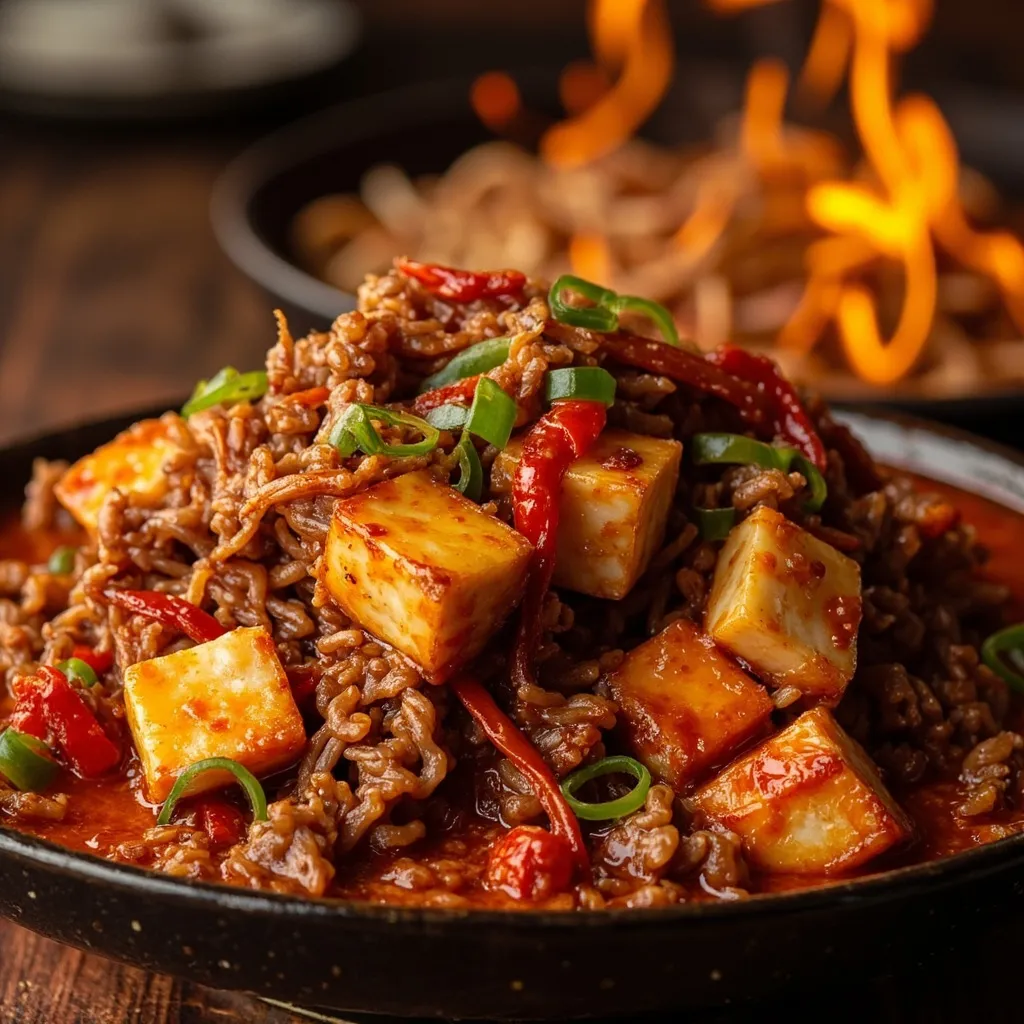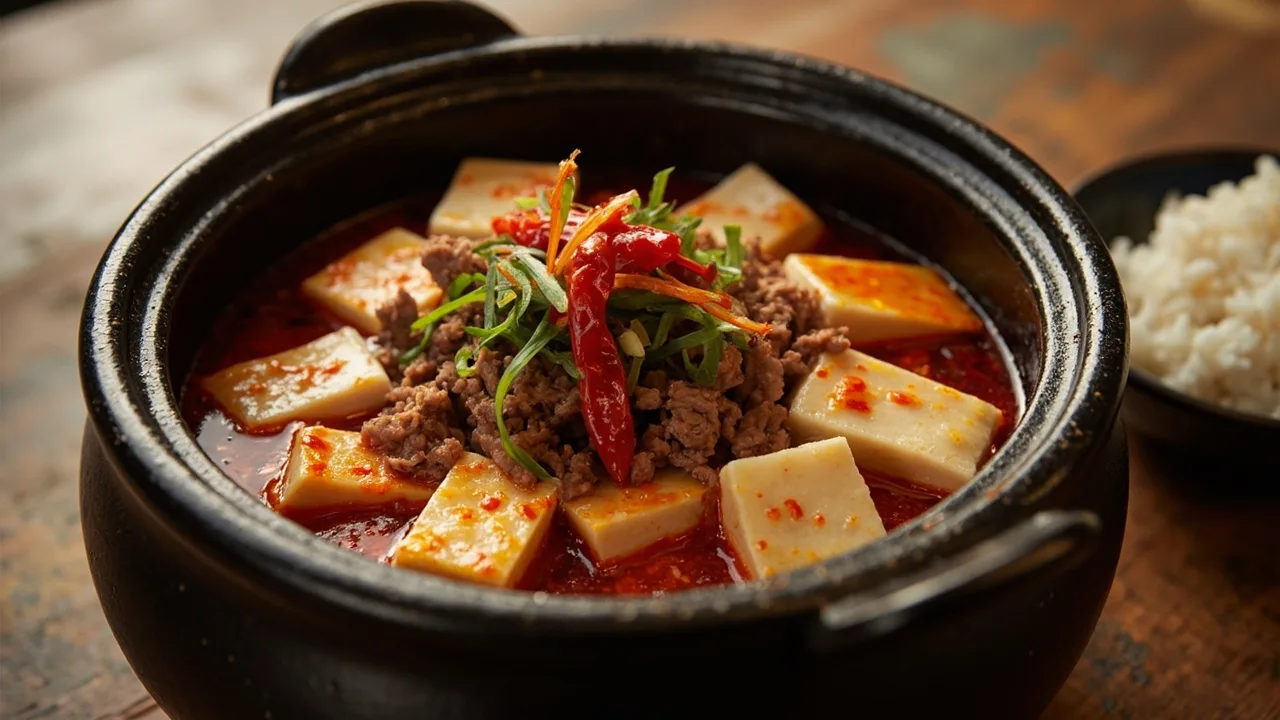
In 1862, on a quiet street corner in Chengdu, a woman with a pockmarked face opened a small food stall beside the Wanfu Bridge. She had no restaurant, no sign, and no formal training. What she had was a recipe—a bold, spicy, numbing combination of soft tofu, fermented broad bean paste, and Sichuan peppercorns—that would eventually become one of the most recognized Chinese dishes on the planet.
Today, you can find mapo tofu on menus from San Francisco to Singapore. It appears in food courts, in fine dining restaurants, and in home kitchens around the world. Yet beneath its famous red oil surface lies a story that most diners never hear: the story of a woman whose name became a legend, and whose dish sparked a conversation about gender, credit, and who gets remembered in Chinese culinary history.
The Pockmarked Woman of Wanfu Bridge
The woman who created mapo tofu was born Chen Qiongmei (陈繁mc), though some historical sources list her original name as Chen Xinghua or Chen Liu Shi. She was a native of Chengdu’s Wanfu Bridge area, and by all accounts she was not a professional chef. She was a widow, possibly running the stall as a way to support her family after losing her husband.
What set her apart was not just her recipe but her personality. Local accounts describe her as sharp-tongued and quick-witted—a woman who did not suffer fools gladly. When customers tried to haggle or when other food vendors copied her dishes, she reportedly responded with biting sarcasm that became almost as famous as the food itself. Her nickname, Pockmarked Old Woman (麻婆, mápó), was both a physical description and a reflection of her fiery reputation.
The name mapo itself has been a source of ongoing debate. The character 麻 (má) means “numb” or “sesame,” and 婆 (pó) means “old woman” or “grandmother.” Early interpretations connected the “ma” to her pockmarks (麻子, mázi), which would make mapo roughly “pockmarked old woman.” But some scholars argue this is a later folk etymology—that “ma” originally referred to the characteristic málà (numbing and spicy) flavor of Sichuan cuisine, and “po” simply meant a female cook, making the name something closer to “the numbing old woman.”
What is not debated is the impact. Within years, her small stall had attracted a devoted following. The dish she served—soft tofu cooked in a spicy, fragrant sauce with minced pork—was simple in ingredients but extraordinary in flavor balance.
Wanfu Bridge itself sat at a crossroads. The bridge crossed a small canal in eastern Chengdu, near the old city’s gates, and the surrounding streets were lined with the kind of cheap eateries that served laborers, sedan-chair pullers, and the small merchants who carried goods between Sichuan’s interior and the tea-horse trade routes to the west. These stalls competed fiercely for the same hungry crowd, and they had to be quick, cheap, and aggressive about flavor. Mapo tofu emerged from exactly this environment: a single-burner stove, a wok that barely cooled between batches, and a cook who could turn out a dozen portions in the time it took a customer to finish a bowl of tea. The pockmarked old woman was one of perhaps a dozen similar vendors within a hundred meters of the bridge, but hers was the one that travelers remembered.
After her death in the late 1870s or early 1880s—the exact year is disputed—her small daughter reportedly took over the stall. The daughter, whose own name is mostly lost to history, kept the recipe essentially unchanged and served it from the same Wanfu Bridge location for several more decades. By the early twentieth century, the original stall had grown into a proper restaurant, and mapo tofu had become a fixture of Chengdu dining culture. When the Sichuan Provincial Records of 1909 compiled a list of local culinary specialties, mapo tofu was included alongside dishes that had been served in wealthy households for centuries—a remarkable ascent for a peasant woman’s invention.
Breaking Down the Name: What Mapo Tofu Really Means
To understand mapo tofu fully, you need to拆解 each component of its name—and each word reveals something unexpected.
The character 麻 (má), most commonly translated as “numbing,” refers to the distinctive sensation of Sichuan peppercorns, which cause a tingling, almost electric numbness on the tongue. This is not a flavor in the Western sense but a physical sensation, and it is the defining characteristic of authentic Sichuan cuisine. The peppercorns (huājiāo, 花椒) are not actually pepper but the dried husks of the Zanthoxylum plant, and they create what Chinese chefs call málà—the dynamic duo of numbness and spiciness that makes Sichuan food unlike any other regional cuisine in China.
The character 婆 (pó) has generated the most controversy. The literal translation “old woman” or “grandmother” seems straightforward, but historians of Chinese food have pointed out that the term pópo (婆婆) in Sichuan dialect can also mean a mother-in-law or an older woman in general. The connection to pockmarks (麻子, mázi) appears in the Qing dynasty records of the dish’s origins, but modern food scholars like to note that calling someone mápó as a descriptive nickname would be unusual in 19th-century Chinese naming conventions.
The third component, 豆腐 (dòufu), is straightforward: soft, white tofu. But even here there is nuance—the best mapo tofu uses nène (嫩豆腐), an extremely soft tofu that wobbles when you touch it. In Chengdu, skilled home cooks press their own tofu for a few minutes to remove excess water while keeping it tender. The result is silky, almost custard-like.
So the dish’s name is itself a small mystery: Is it “pockmarked woman tofu”? “Numbing grandmother’s tofu”? “Numbing old woman tofu”? The answer depends on which historian you ask—and the ambiguity itself is part of the dish’s charm.
The Three Layers of Málà: How One Dish Changed Sichuanese Cooking
The genius of mapo tofu lies in its layered approach to flavor. This is not a dish that tastes the same from first bite to last. Instead, it evolves on your palate, revealing different dimensions as you eat.
The first layer is the má—the Sichuan peppercorn’s electrical tingle. When you first place a piece of tofu in your mouth, you feel a gentle buzzing on your lips and tongue. This is the peppercorns working their magic, activating the trigeminal nerve in a way that no other spice in the world can replicate. If you have never experienced málà, it is difficult to describe: not quite pain, not quite tickling, but something entirely its own.
The second layer is the là—the heat from the chili bean paste (dòubànjiàng, 豆瓣酱). This is not the sharp heat of fresh chilies but a deep, fermented warmth that builds gradually. Good Chengdu doubanjiang is made from broad beans and soybeans, fermented for months in large clay pots. It is reddish-brown, intensely savory, and deeply complex. When you see the bright red oil in mapo tofu, that color comes from doubanjiang, not from fresh chilies.
The third layer is what Chinese food writers sometimes call biāo qíng (表情)—the “expression” or emotional quality of the dish. This is the hardest layer to translate, but regular eaters of mapo tofu know it instinctively. It is the combination of the tofu’s softness, the pork’s savory richness, and the sauce’s lingering warmth that creates a feeling of comfort and satisfaction that goes beyond mere taste.
Modern Debates: How One Dish Became a Cultural Battleground
Like any dish with 160 years of history, mapo tofu has not escaped controversy. Over the decades, the recipe has been adapted, standardized, contested, and reimagined so many times that the “authentic” version is nearly impossible to pin down.
In the 1960s, during China’s Cultural Revolution, the dish underwent a political rebranding. The “pockmarked woman” association was deemed inappropriate for revolutionary cuisine, and the dish was renamed “Angel’s Hair Tofu” (麻婆豆腐 became 启元麻婆豆腐 in some state-run restaurants) or simply served without the traditional presentation. The story of the woman herself was de-emphasized in official accounts.
In the 1970s, the Sichuan Provincial Commercial Bureau attempted to standardize mapo tofu across the province, issuing strict guidelines that specified the ratio of doubanjiang to tofu, the exact variety of Sichuan peppercorn to use, and the cooking method. The standard called for pí dòufu (郫县豆腐), a specific type of doubanjiang from Pixian County, which remains the gold standard today. This standardization was an effort to preserve quality but also to make the dish reproducible in state-run restaurant kitchens.
In the 1980s, mapo tofu traveled to Japan and became wildly popular in Japanese Chinese restaurants. But the Japanese version was notably different from the Chengdu original: less oily, less spicy, and often served without the signature numbing sensation. Japanese chefs had kept the dish’s identity as a “spicy tofu” but adapted it to local Japanese palates that preferred milder flavors. When Chinese food writers first encountered the Japanese version, many were scandalized—how could you call something mapo tofu without the málà?
In the 2010s, as Chinese diaspora food culture matured, a new conversation emerged about who deserved credit for the dish. Some food historians began to question whether the “pockmarked woman” story was factual or a later embellishment. They noted that no written record from Chen Qiongmei’s lifetime (she died around 1874) confirms her exact recipe or even her name. What exists are oral histories, later newspaper accounts, and a 1912 publication that first printed the recipe under the name “Wanfu Bridge Mapo Tofu.” The absence of a contemporaneous written record does not prove the story is false, but it does complicate any claim to absolute historical certainty.
From Chengdu to the World: Mapo Tofu on the Global Stage
If you walk into a Chinese restaurant in the United States and order mapo tofu, what arrives on your table has traveled a long way from Wanfu Bridge. The American version typically features extra tofu, less pork, and a sauce that prioritizes visible redness over depth of flavor. In many cases, the dish has been adapted to local preferences so thoroughly that it barely resembles the original.
Yet the dish’s global journey tells its own story about Chinese food culture abroad. In the 1970s and 1980s, as Chinese immigration to North America accelerated, mapo tofu became one of the first Sichuan dishes that many Americans encountered. Unlike sweet and sour dishes or chop suey, mapo tofu was genuinely spicy—and for many American diners in the 1980s, it was their first experience of Sichuan peppercorn’s numbing sensation. The reaction was often memorable: confusion, delight, and sometimes alarm as people tried to describe a flavor that had no equivalent in Western food vocabulary.
Today, mapo tofu is a staple of Chinese food culture worldwide. You can buy premade mapo tofu sauce in Asian supermarkets from London to Los Angeles. You can find it on the menus of food halls and in the recipe indexes of serious Chinese cooking blogs. The dish has been analyzed, reverse-engineered, and reinvented more times than anyone can count—and yet, when made properly, it still carries the essential character that it had on that Chengdu street corner in 1862.