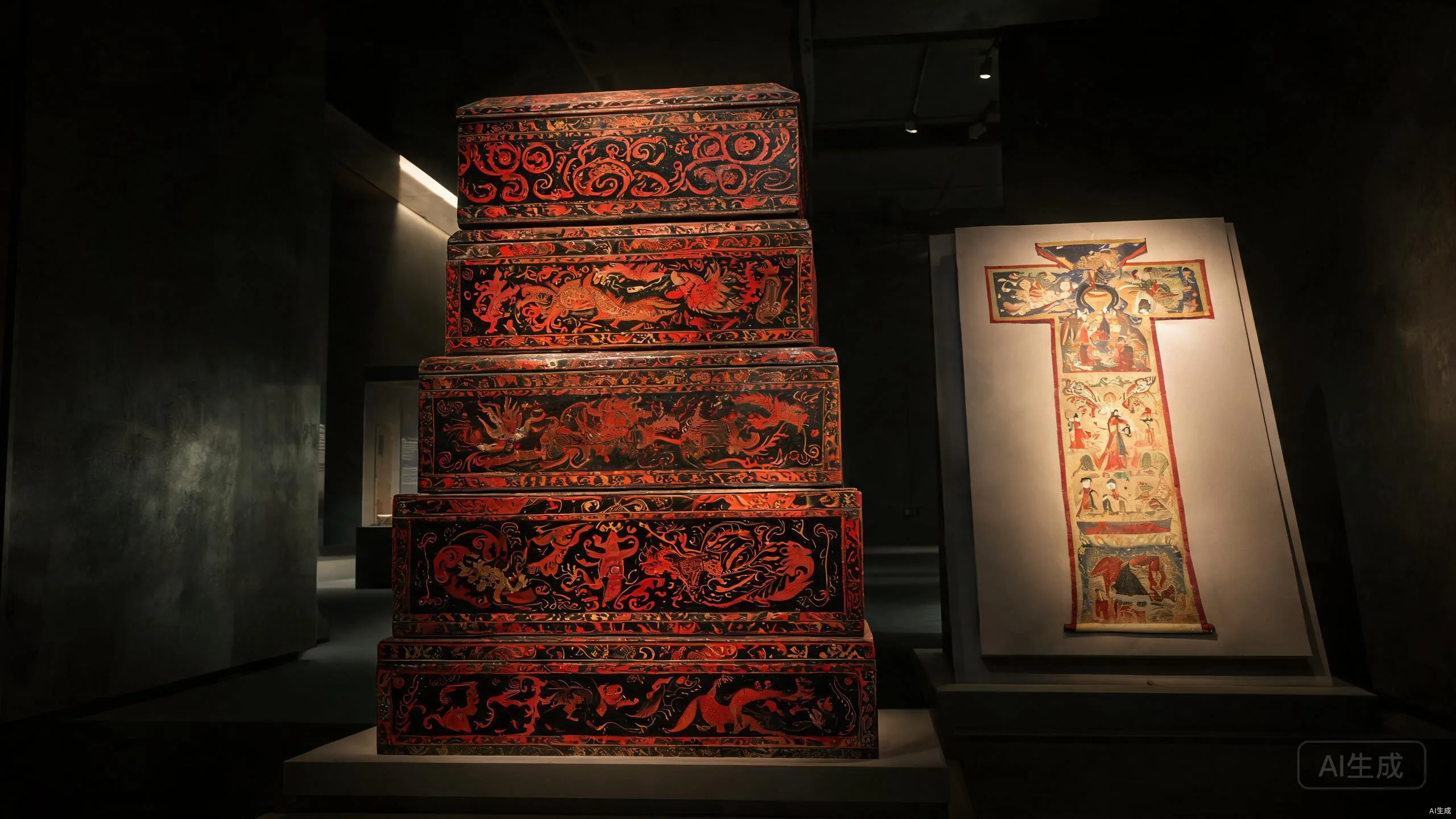
In the summer of 1972, a team of Chinese archaeologists was excavating a series of earth mounds on the outskirts of Changsha, in Hunan Province. They had been working for weeks, uncovering what appeared to be a necropolis—burial mounds from the early Western Han Dynasty, around 168 BC. The dig was proceeding normally until one of the workers’ shovels broke through a layer of charcoal and white clay and struck something unexpected: a hollow sound. Below them was a sealed space, untouched for over two millennia.
When they opened it, they found the most remarkable archaeological discovery in modern Chinese history. Inside the tomb were four nested lacquered coffins, surrounded by layer upon layer of carefully arranged funerary goods: silk garments, lacquerware, painted boxes, bamboo texts, and enough food and wine to sustain an aristocratic household in the afterlife. And lying in the innermost coffin, dressed in layers of the finest silk robes, was a woman. Her body was not a skeleton. It was, incredibly, recognizably human—skin still soft, joints still flexible, recognizable facial features preserved after 2,100 years.
The preservation was so extraordinary that when doctors performed an autopsy in the 1970s, they found that her major organs—heart, liver, lungs, intestines—were all intact and recognizable. They determined her cause of death was a heart attack, probably triggered by a dinner of cantaloupe—a food she apparently loved. They found evidence of illnesses she had suffered during her lifetime, including parasites and traces of ancient tuberculosis. Lady Dai became, in death, one of the most thoroughly examined humans from ancient history. Her body has been CT-scanned, DNA-tested, and repeatedly studied by medical researchers interested in how such preservation was achieved—and whether the techniques can be applied to modern medical challenges.
She was Lady Dai, and she would change everything historians thought they knew about the Han Dynasty.
The Woman Behind the Legend
Lady Dai’s personal name was Xin Zhui (辛追), and she was the wife of Li Cang (利苍), who served as the Marquess of Dai, a high-ranking official in the early Han government. She died around 50 years old, sometime between 170 and 160 BC. But it was not simply her noble status that made her tomb extraordinary—it was the unprecedented preservation of her body and the staggering array of artifacts that survived alongside her.
When modern physicians examined Lady Dai’s remains in the 1970s, they discovered the remains of a woman who had suffered through a remarkably complex medical history. Her corpse contained preserved specimens of parasites, including hookworm and tapeworm, confirming she had been infected with multiple intestinal diseases. She had coronary atherosclerosis—hardening of the arteries—which suggests heart disease was killing her even 2,000 years before the term existed. She also had gallstones, and a tumor in her pituitary gland that may have caused various hormonal imbalances. In her final years, she was likely in near-constant pain, yet she lived as an aristocrat in the Han capital, attended by servants and dressed in silk.
Her body was preserved through a combination of techniques that ancient Chinese embalmers had perfected over centuries. She was first washed and treated with resins, then placed in her innermost coffin, which was sealed inside three additional coffins. The entire burial chamber was filled with layers of charcoal—over 5,000 kilograms of it—covered in turn by a thick layer of white clay, a sort of ancient plaster. This created an airtight seal: no air could reach her body, no bacteria could infiltrate, and the temperature remained stable underground for two millennia. It was, in effect, the world’s most sophisticated vacuum-packed burial. The result was a body that looked, to the doctors who first examined it in 1972, as though she had died only days earlier.
A T-Shaped Painting That Captured Three Worlds
Lady Dai’s tomb was not just a grave—it was an entire microcosm of her world, preserved with obsessive care. Among the most significant finds were her funerary paintings, particularly a large silk painting known as the T-shaped silk painting, which draped over her coffin like a canopy.
The painting is divided into three registers—three realms of existence—that offer a window into Han Dynasty cosmology. The top section depicts the heavens: the sun and moon, constellations, celestial deities, and flying immortals. The middle section shows the human world, with Lady Dai herself depicted as a living aristocrat, surrounded by attendants and objects from her daily life. The bottom section illustrates the underworld—ghosts, spirits, and the various deities who governed the afterlife. For the Han Chinese, death was not an ending but a passage: Lady Dai would need all of these things in her journey through the afterlife, and her family had prepared carefully to ensure her comfort and safe passage.
Alongside the paintings, Lady Dai was buried with three major silk books. These were texts on military strategy, philosophy, and medical knowledge—copies of works that had circulated in the early Han court. One was a treatise on the art of war, another explored the principles of Yin and Yang and Five Elements cosmology, and the third was a medical text so advanced that modern physicians have studied it for clues about early Chinese approaches to diagnosing and treating disease. These texts were not copies of great classics—they were practical manuals, the working documents of an aristocratic household that engaged with the intellectual currents of its time.
The Silk Wardrobe and the Scholar’s Library
Among the most visually stunning objects in Lady Dai’s tomb were her garments. The tomb yielded more than 100 pieces of silk fabric, including robes, scarves, and ornamental pieces. One of the most extraordinary was a complete silk robe weighing just 49 grams—less than two ounces. The fabric was so finely woven and so gossamer-thin that it could be folded into a small box the size of a cigarette pack. When archaeologists first unfolded it, they could see through it like through a modern silk scarf.
This fabric, known as纱 (sha)—a plain-weave silk gauze—was a technological marvel. It required thousands of silkworm cocoons per meter of cloth, and the weaving technique was so demanding that it was eventually lost in China itself and not rediscovered until the 20th century. Lady Dai’s robe was found in perfect condition, its color vivid, its texture unchanged from the day it was buried.
But Lady Dai was not merely a wealthy aristocrat enjoying a lavish burial. The three silk books found in her tomb—the ones on military strategy, Yin-Yang cosmology, and medicine—tell us something important about the intellectual world she inhabited. These were not rare texts locked away in imperial libraries. They were working documents, handled regularly, annotated in places, passed down within a household that took seriously the business of education and strategy.
The military text discusses formations, terrain analysis, and the psychology of command in language that suggests it was used for practical training rather than ritual preservation. The medical text contains prescriptions for conditions ranging from colds to wounds to what appear to be early descriptions of diabetes symptoms. Lady Dai’s tomb tells us that the intellectual explosion of the late Warring States and early Han had penetrated even to the level of regional aristocrats. It was alive and active in the households of marquesses and their wives.
Why Lady Dai’s Body Survived When Others Failed
The question that fascinates every visitor to the Mawangdui exhibition is simple: why did Lady Dai survive when virtually every other ancient body—Egyptian mummies excepted—has turned to dust?
The answer lies in a combination of factors that came together almost miraculously at Mawangdui. First, the casket was sealed with extraordinary care: four layers of coffins, each lacquered and painted, surrounded by nearly a meter of compacted charcoal and clay. Second, the burial chamber itself was deep enough and stable enough in temperature that thermal fluctuations could not accelerate decomposition. Third, the soil chemistry at the site was slightly alkaline, which inhibited bacterial growth. Fourth—and this is the factor that archaeologists are still debating—the body had been prepared with some kind of preservation liquid, though its exact formula has never been definitively identified.
This last point is what makes Lady Dai scientifically unique. Egyptian mummies were preserved through deliberate and well-documented processes—evisceration, natron treatment, wrapping. Lady Dai was preserved without any known precedent in Chinese funerary practice. Whatever the ancient embalmers did, they did it once, perfectly, and the knowledge was then lost for two millennia.
Modern scientists who have examined the body note that Lady Dai’s preservation is genuinely anomalous. Her soft tissues—skin, muscle, internal organs—are recognizable and, in some cases, functionally intact. No other body from ancient China has been found in comparable condition, despite the enormous number of Han Dynasty tombs that have been excavated.
Visiting Mawangdui Today
The discovery at Mawangdui did more than just give the world a mummy. It rewrote the history of the Han Dynasty, forcing archaeologists to reconsider what they thought they knew about early Chinese civilization. Before Mawangdui, historians understood Han Dynasty culture largely through texts. Lady Dai’s tomb added an entirely new dimension—the everyday reality of Han aristocratic life. It showed us not what rulers and generals were doing, but what a noblewoman owned, wore, ate, read, and believed about the afterlife.
The medical discoveries alone were transformative. Lady Dai’s preserved organs, her blood samples, and the parasites in her system gave modern physicians an unprecedented look at disease in ancient China. The medical texts found in her tomb were among the oldest surviving Chinese medical documents, predating the classic Huangdi Neijing by a generation. They showed a medical culture already deeply sophisticated in its understanding of herbal remedies, surgical procedures, and the relationship between diet and health.
Today, the artifacts from Lady Dai’s tomb are housed in the Hunan Provincial Museum in Changsha, where they form the centerpiece of one of China’s most visited archaeological exhibitions. The body itself—carefully preserved and displayed in a climate-controlled case—remains one of the most striking objects in any museum in the world. Visitors to the exhibition walk through a recreation of the tomb chamber, surrounded by the painted coffins and the carefully arranged funerary goods exactly as they were found.
For Americans curious about Chinese history, Mawangdui offers something unique: it bridges the gap between ancient texts and living history. Lady Dai is not a name in a book—she is a face, a wardrobe, a set of medical records, a philosophical library, and a story that continues to unfold as scholars analyze what her tomb has revealed. She is the closest thing we have to a direct encounter with the Han Dynasty world. And the fact that she survived—that her body, her clothes, her books, and her cosmetics all made it through 2,100 years of silence—means that we can know her in a way that we can never know most historical figures. History is usually words on a page. Lady Dai is something far more rare: history you can see.
Image Prompt: Wide shot of Hunan Provincial Museum’s Mawangdui exhibition hall, showing the recreated tomb pit with four nested lacquered coffins surrounded by silk garments and funerary objects, warm lighting illuminating the ancient burial chamber, realistic museum setting.
Related Articles:
- Ancient Chinese Scientists and Inventions — the intellectual world Lady Dai’s silk books came from
- The Han Dynasty: China’s Imperial Golden Age — the broader context of the world Lady Dai lived in
Affiliate Products:
If you’re fascinated by Han Dynasty culture and Lady Dai’s story, these products will bring this ancient world into your home:
- Chinese History Book Collection — Academic and general-audience books covering the Han Dynasty, Mawangdui discoveries, and ancient Chinese archaeology.
- Hanfu Modern Set — Reconstructed Han Dynasty-style silk garments for men and women.
- Chinese Silk Scarf — Authentic silk scarves inspired by Han Dynasty textile patterns found at Mawangdui.
- Chinese Lacquerware Replica — Lacquered boxes and vessels modeled on the Han Dynasty lacquerware found in Lady Dai’s tomb.
- Han Dynasty Tea Set — Ceramic and bronze-inspired tea sets reflecting Han Dynasty aristocratic drinking culture.