In 1960, a merchant from Taiwan walked into a temple in Kumamoto, Japan, and was surprised to find a statue of Mazu, the sea goddess he had worshipped since childhood. He had not expected to encounter her in Japan. But the temple’s monks told him the statue had been there for centuries, brought by Chinese sailors who had stopped at Japanese ports during the Ming Dynasty period. The merchant took a photograph with the statue, posted it in his own temple back in Taiwan, and the connection between the two shrines was formally recognized.
This kind of transnational Mazu discovery happens regularly. Followers traveling abroad stumble on Mazu statues in unexpected places: a small shrine in a coastal town in Spain, a temple in a Caribbean port city, an altar in a Southeast Asian market. Each discovery reveals another thread in a global network of worship that began in a single fishing village in Fujian Province and spread across the world wherever Chinese people traveled.
Mazu is now recognized as one of the most widely worshipped deities on the planet. There are an estimated 300 million followers worldwide. There are Mazu temples on every continent, in countries that Chinese migrants settled generations ago and in places where Chinese communities are still relatively new. The goddess has been officially recognized by the Chinese government as an important part of China’s intangible cultural heritage. And in 2009, UNESCO inscribed Mazu worship on its Representative List of the Intangible Cultural Heritage of Humanity.
The remarkable thing about this global spread is that Mazu was originally just a human being, a young woman named Lin Moniang who lived in the 10th century.
The Origins of a Goddess
The story of Mazu begins on Meizhou Island, a small island off the coast of Putian in Fujian Province. According to the traditional account, Lin Moniang was born in 960, during the Later Tang Dynasty period that preceded the Song Dynasty. Her parents were fishermen, and she was the third daughter in a family that already had two daughters. The family was poor, as most fishing families were, and the birth of another daughter was not considered particularly significant.
From childhood, Lin showed unusual qualities. She was reportedly a vegetarian from birth, she did not play with other children, and she spent much of her time in meditation and prayer. These behaviors were interpreted by her family and neighbors as signs of spiritual giftedness, though they might also be read as signs of a quiet, introspective child who was not suited for the rough social world of a fishing community.
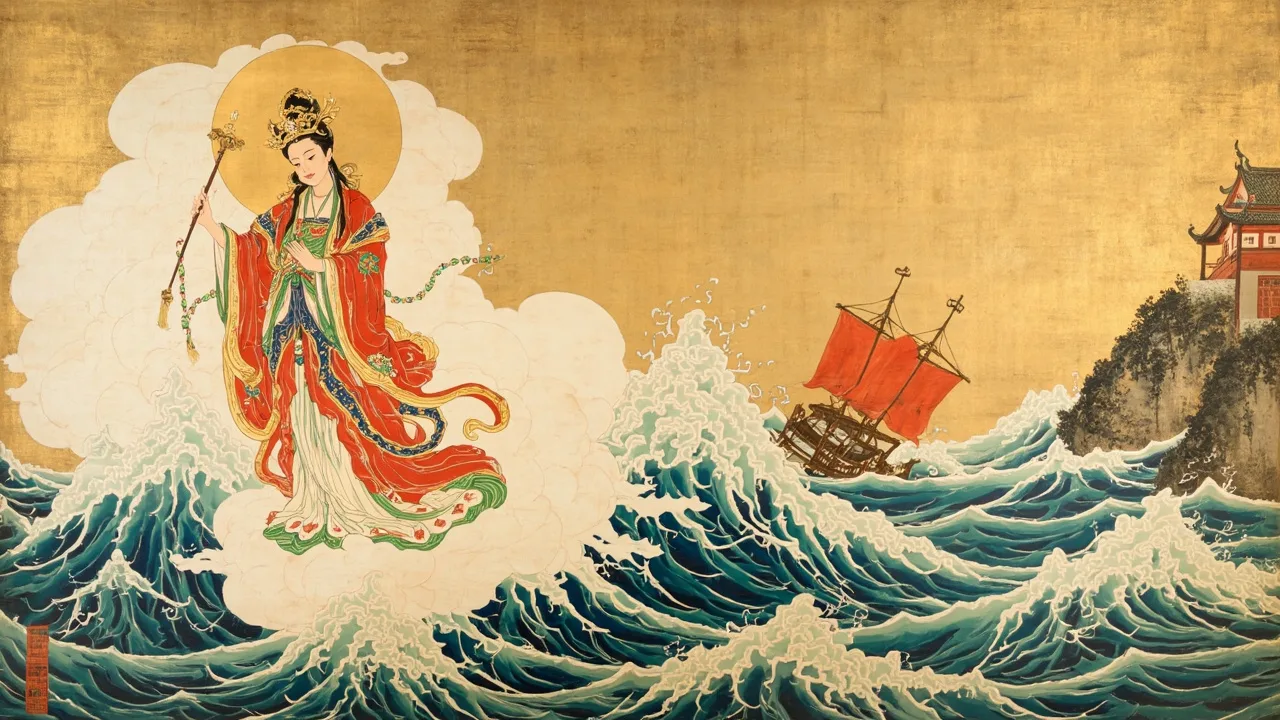
When Lin was about sixteen, according to the traditional account, her father and brothers were caught in a storm while fishing. Lin reportedly walked onto the water to rescue them, using her spiritual powers to calm the storm and guide their boat to safety. Her father and brothers survived. Lin was said to have drowned in the process, dying a virgin, which in traditional Chinese thinking made her a particularly powerful spiritual figure.
The death of Lin Moniang at sixteen became the founding event of her cult. The people of Meizhou Island, who depended on the sea for their livelihoods and lived in constant fear of storms and accidents, found it natural to venerate someone who had demonstrated such power over the waters. They built a small shrine on the spot where she had died, and they began to pray to her for protection on voyages.
This is the historical kernel of Mazu worship. Everything else — the temples, the festivals, the millions of followers, the global network — grew from this modest beginning.
The Spread Through China
For the first few centuries after Lin’s death, Mazu worship remained primarily a local Fujian phenomenon. The goddess was considered a useful local deity who protected fishermen and sailors in the dangerous waters around the province’s coast. Sailors sailing from Fujian ports would carry small statues or images of Mazu with them, which is how her worship began to spread geographically.
The Song Dynasty government played an important role in formalizing and promoting Mazu’s status. Beginning in the 12th century, Song emperors granted Mazu official titles, a process that elevated her from a local folk deity to a nationally recognized goddess. The titles were incremental: first she was called “Lady,” then “Consort,” then “Princess,” and eventually “Empress of Heaven,” which is the meaning of her title Tianhou, the name most commonly used in southern China.
This titling process was typical of how Chinese governments dealt with folk religious practices. The state did not create Mazu’s worship, but it recognized and channeled it. By granting official titles, the Song government gave Mazu a legitimate place in the imperial religious hierarchy. This legitimization helped her worship spread faster, because local officials who might otherwise have suppressed unauthorized religious practices were now incentivized to support Mazu temples and festivals.
The key to Mazu’s appeal was her specificity. Unlike Buddhist bodhisattvas or Daoist immortals who had complex cosmologies and abstract spiritual goals, Mazu had a clear, practical function: she protected people at sea. Fishermen, sailors, and coastal traders all needed exactly this kind of protection. The stories about her were concrete and dramatic: she walked on water, she calmed storms, she appeared in dreams to warn sailors of danger. These stories were verifiable in the sense that any sailor who survived a storm could attribute his survival to Mazu’s intervention.
This practical orientation made Mazu especially popular among ordinary people rather than elites. Confucian scholars might have regarded her worship as superstitious, but even scholars recognized that the goddess served important social functions in coastal communities. The stories about Mazu also served as a form of risk management: if you believed a powerful goddess was watching over you at sea, you might be less paralyzed by fear when you had to sail into a storm.
Mazu and the Chinese Diaspora
The global spread of Mazu worship coincides almost exactly with the history of Chinese migration over the past 500 years. Wherever Chinese people went — whether voluntarily as merchants and laborers or involuntarily as refugees and convict exiles — they took their gods with them.
Mazu arrived in Taiwan early, probably during the Ming Dynasty when significant numbers of Fujianese migrants settled the island. Taiwan’s coastal geography and its dependence on maritime trade made it a natural extension of Mazu’s spiritual territory. Today, Taiwan has more than 1,000 Mazu temples, and the island’s most famous religious festival is the annual Mazu pilgrimage, in which a statue of the goddess travels by sedan chair from temple to temple across the island, attracting millions of participants.
From Taiwan, Mazu worship spread to Southeast Asia during the colonial period when Chinese laborers migrated to work in mines, plantations, and trading posts across the region. These laborers came primarily from Fujian and Guangdong Provinces, both coastal provinces with strong Mazu traditions, and they established temples wherever they settled. The temples served as community centers as well as religious spaces, providing a sense of continuity and protection in unfamiliar and often hostile environments.
In the 19th century, as Chinese migration expanded to the Americas and Europe, Mazu went with it. The first Chinese communities in San Francisco, New York, London, and other Western cities established temples that included Mazu among the deities worshipped. The goddess was particularly important in port cities with significant Chinese populations, where she served the same protective function she had always served: guarding people whose lives depended on the sea.
Today, major Western cities with historically significant Chinese communities have Mazu temples. San Francisco’s Tin How Temple, founded in the 1850s, includes Mazu among its deities. London’s Chinese community established a Mazu temple in the early 20th century. These temples are relatively modest compared to the grand Mazu complexes in Fujian and Taiwan, but they represent the same religious impulse and the same connection to a global network of worship.
The most dramatic example of Mazu’s global reach is in the Caribbean and Latin America. Chinese laborers who came to work in the sugarcane fields of Cuba, Peru, and other countries in the 19th century brought their religious practices with them, including Mazu worship. In Cuba, where the Chinese community was relatively large and well-organized, a Mazu temple in Havana survived into the 20th century. In Peru, archaeological evidence of Chinese religious practices from the colonial period includes references to Mazu-like figures worshipped by Chinese laborers.
Why Americans Should Know About Mazu and What Americans Can Learn
For American readers, Mazu’s story is interesting for several reasons. First, it reveals something about the scale and depth of Chinese migration history. Most Americans know that Chinese migrants came to the United States in the 19th century to work on railroads and in mines, and that they faced significant discrimination. What they may not realize is that Chinese migration was a global phenomenon, and that Chinese communities established themselves on every continent, often in very different circumstances from the American experience.
Second, Mazu worship illustrates how religion functions in diaspora communities. When people are separated from their homeland, their religious practices often become more rather than less important. The temple becomes a space where language, culture, and identity can be maintained across generations. The festivals become occasions for community gathering that reinforce social bonds that might otherwise weaken. Understanding how Mazu worship served these functions helps Americans understand the experiences of Chinese immigrant communities in the United States and elsewhere.
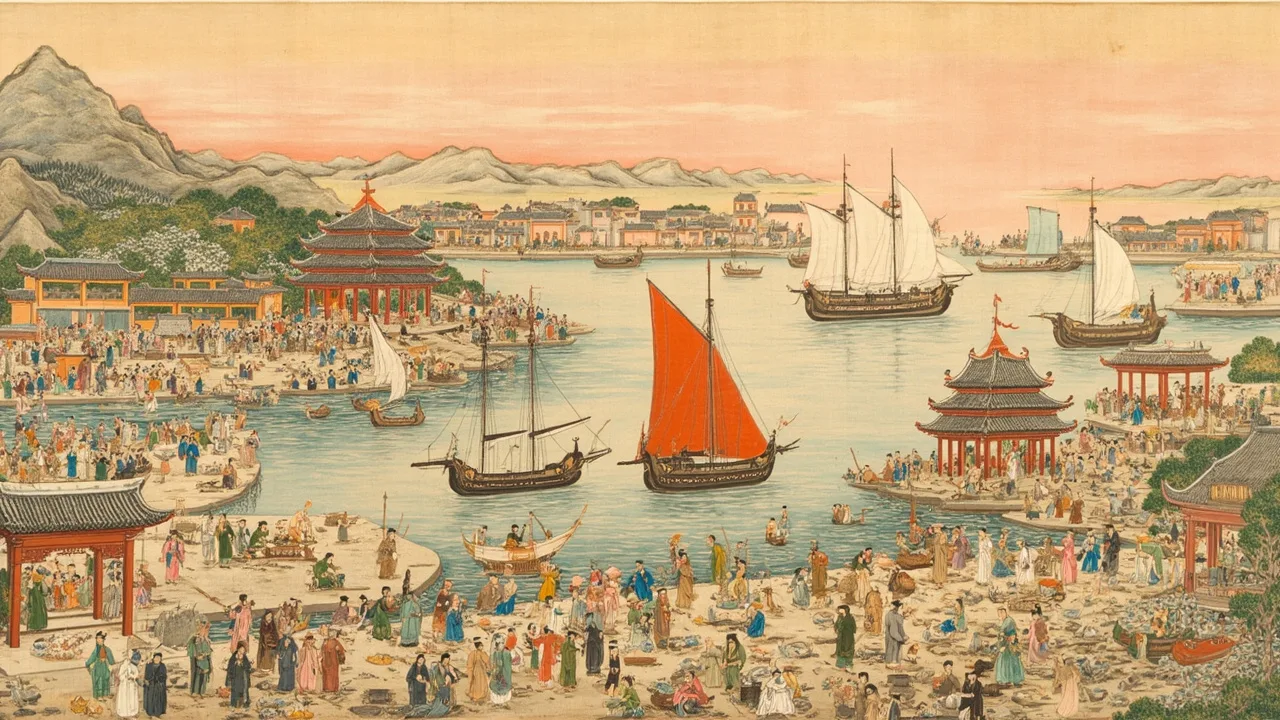
Third, Mazu’s global spread offers a window into global trade history that is different from the usual European-centric narrative. Most people learn that European maritime powers — the Portuguese, Spanish, Dutch, English — organized global trade from the 15th century onward. But Chinese merchants and sailors were active participants in maritime commerce for centuries before European arrival, and Chinese religious practices traveled along those same routes. Mazu temples in Southeast Asian ports predate European colonial control of those ports. The goddess was worshipped on Chinese ships that sailed to Japan centuries before Europeans arrived in East Asian waters.
This alternative narrative does not erase the European story of global trade and colonization, but it complicates it in useful ways. Global commerce was not purely a European creation; it was a genuinely global phenomenon in which many civilizations participated, even if European powers eventually achieved military and political dominance.
The Modern Mazu Festival
Today, the largest Mazu festival takes place in Fujian Province, centered on Meizhou Island where the goddess was born. The festival, which usually occurs in late April or early May, attracts hundreds of thousands of pilgrims from across China and from overseas Chinese communities. The pilgrims travel to Meizhou Island by boat and by road, and they participate in ceremonies at the original temple where Lin Moniang’s shrine was established.
The atmosphere at the festival is intense and joyful. Firecrackers are set off throughout the day and night. Processions carry statues of Mazu through the streets. Worshippers kneel before the statues and pray for protection, for children, for business success, for health. The temple is so crowded that moving through it requires patience and physical courage. Outside the temple, vendors sell food, incense, and religious souvenirs.
For visitors who attend, the Fujian Mazu festival offers a window into Chinese folk religious practice that is largely inaccessible in the major tourist centers. This is not the Buddhism of the famous temple complexes or the Confucianism of the historical academies. This is the religion of ordinary people, rooted in practical concerns and expressed in exuberant communal rituals.
The Taiwan Mazu pilgrimage is equally dramatic and perhaps more accessible to foreign visitors because Taiwan’s tourist infrastructure is well-developed and the island’s government actively promotes religious tourism. The pilgrimage route covers hundreds of kilometers and takes about nine days to complete. Pilgrims walk the entire route, carrying the goddess’s sedan chair from temple to temple. The sight of hundreds of people processing through Taiwanese countryside, accompanied by drums and banners, is visually striking and emotionally powerful.
Mazu herself — Lin Moniang, the young woman who reportedly drowned trying to save her family — represents something universal: the hope that our loved ones will be protected from the dangers that threaten them, and the gratitude we feel when that protection seems to work. Whether or not one believes in the supernatural powers attributed to her, the emotional logic of Mazu worship is one that people of any culture can recognize.
[AFFILIATE: “Mazu: The Sea Goddess of China” - Scholarly work on the history and global spread of Mazu worship]
[AFFILIATE: Taiwan Temple Pilgrimage Travel Guide - Practical guide to visiting the major Mazu temples and participating in the annual pilgrimage]
[AFFILIATE: Meizhou Island Heritage Map - Detailed map and guide to Mazu’s birthplace and the original temple complex]