Mending the Fold After the Sheep Are Gone: The Chinese Idiom About Closing the Barn Door
You’ve almost certainly heard the English version of this story: close the barn door after the horse has bolted. It’s a proverb about closing the gate after the livestock has already escaped — meaning, of course, that by the time you react to a problem, it’s too late. The damage is done. The opportunity for prevention has passed.
But the Chinese version of this story is different. And the difference matters.
The Chinese idiom is wáng yáng bǔ láo: 亡羊补牢. Literally: “when the sheep are lost, repair the pen.” The story ends not with mockery for the too-late repair, but with the acknowledgment that mending the pen — even after the wolves have already taken some sheep — prevents the next loss. The emphasis isn’t on what you failed to prevent. It’s on what you’re preventing from now on.
This is a subtle but profound shift in perspective. The English version is pessimistic: too late is too late. The Chinese version is cautiously optimistic: too late to fix the past, but not too late to fix the future. And in a world where we spend a lot of time worrying about what we should have done sooner, that distinction might be exactly the wisdom you need to hear.
The Original Story: A Shepherd, Some Wolves, and a Choice
The story appears in the Strategies of the Warring States (Zhangu Ce), a compilation of political and military advice from the Warring States period (475–221 BCE). Like many of the parables in that text, it’s set in the context of statecraft — but the core lesson applies broadly.
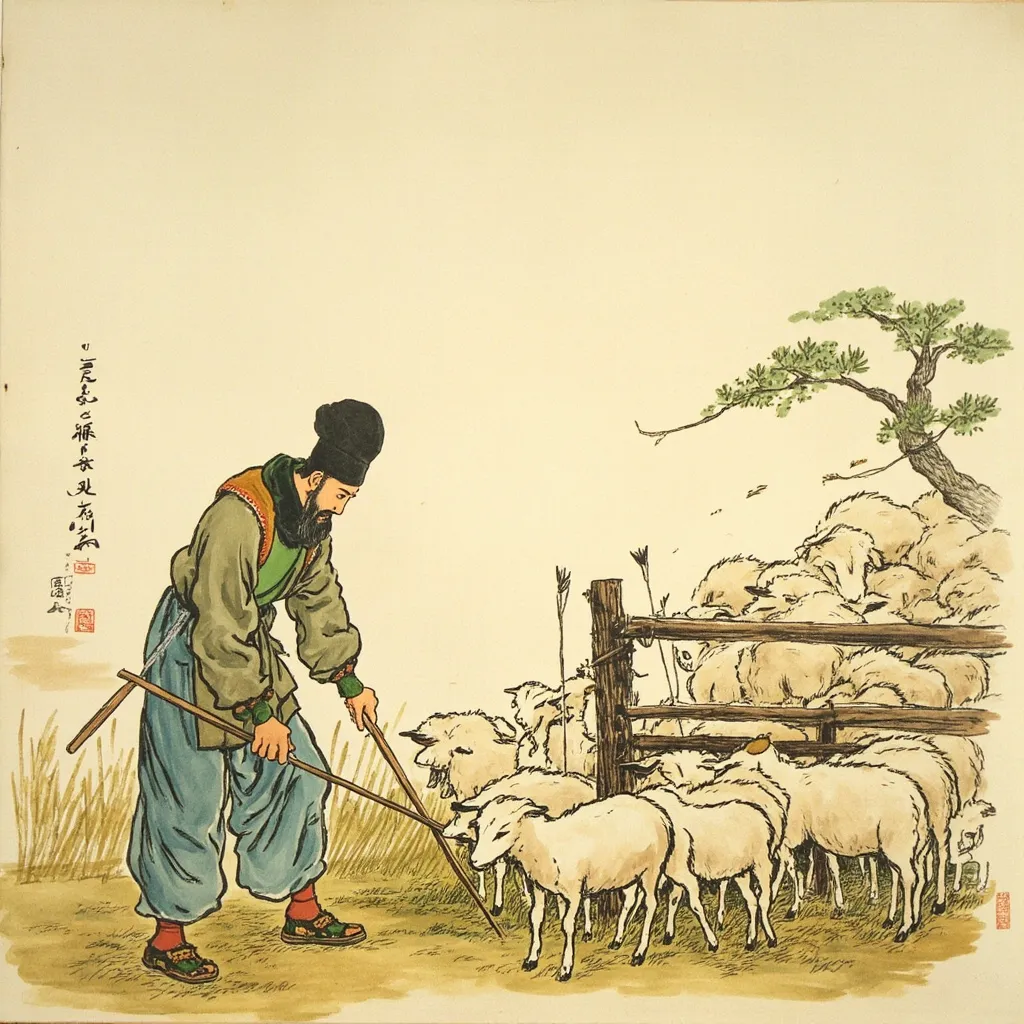
The setting is a village, a shepherd, and a flock of sheep. The shepherd keeps his sheep in a pen at night — a fold, as the traditional English translation has it — to protect them from wolves. But the fold has a weakness: one section of the fence is old, worn, and full of gaps. The shepherd knows about the problem. He’s known about it for a while. But sheep are expensive, wolves are unpredictable, and besides, the fence has been “fine so far.” He keeps putting off the repair.
Then one night, the wolves come. They find the weak point in the fence, squeeze through, and kill several of the shepherd’s sheep before he can respond. In the morning, the shepherd finds the carnage: dead sheep, scattered across the field, blood on the grass. His flock is diminished. His livelihood is hurt. He’s lost something that can’t be recovered.
Now here’s where the story diverges from the English version. The shepherd doesn’t shrug, complain, or give up. He looks at the damaged fence, at the gap where the wolves came through, and he makes a decision. He gets to work. He repairs the fold. He reinforces the weak sections. He makes sure the wolves can’t get through the same way again.
When his neighbors hear what happened, some of them say something along the lines of: “Why bother? The sheep are already dead. Mending the pen now doesn’t bring them back.”
And the shepherd’s response — or at least the response attributed to him in the historical record — is the moral of the story: “You’re right. This repair doesn’t bring back the sheep I’ve lost. But it protects the sheep I still have. And if I don’t mend the pen now, I’ll lose more.”
That line — practical, unsentimental, forward-looking — is the heart of 亡羊补牢. The loss has already happened. What matters now is preventing the next one.
What the Idiom Actually Means
The surface meaning of 亡羊补牢 is obvious: after suffering a loss, take steps to prevent future losses. But the idiom carries several layers that deserve to be unpacked.
The first layer is 接受已经发生的损失 — accepting the loss that can’t be undone. The shepherd can’t resurrect his dead sheep. No amount of fence-mending will change what happened that night. The past is fixed. The Chinese version of this story doesn’t pretend otherwise, and that’s important: the ability to accept what can’t be changed is the prerequisite for doing something useful with what comes next.
The second layer is 把注意力转向可控的部分 — redirecting attention to what you can control. After the loss, the shepherd’s behavior shifts from passive procrastination to active intervention. He can’t control the wolves. He can’t control last night. He can control the fence. The idiom endorses this pivot: don’t spiral into regret, don’t waste energy on the unchangeable, do what you can with what’s in front of you.
The third layer is 长期思维 — thinking in terms of the long run. The neighbor who mocks the repair is thinking about the dead sheep and the futility of the current effort. The shepherd is thinking about next month, next winter, the next time the wolves come. Mending the fold is an investment in future security, not a cure for past failure.
In modern Chinese usage, the idiom is applied to all kinds of situations where someone is finally addressing a vulnerability after a crisis makes it impossible to ignore. Someone who starts saving money after a financial emergency, finally upgrades their computer security after a hack, or begins exercising after a health scare — each of these is “亡羊补牢ing.” The connotation is slightly self-deprecating — you’re the person who waited until the sheep were gone — but it’s ultimately approving. Better late than never. Better to mend than to keep losing.
The Difference Between the Chinese and English Versions
This is worth pausing on, because the divergence between the Chinese and English versions of essentially the same story reveals something interesting about cultural priorities.
The English “closing the barn door after the horse has bolted” is almost entirely negative. It emphasizes the futility of the action, the irrevocability of the loss, and the folly of the person who needed a crisis to act. There’s an element of schadenfreude in it — the person who didn’t maintain their fence gets what they deserve. The emphasis is on prevention, and on how anyone who needed a loss to prompt action clearly should have acted sooner.
亡羊补牢 takes a more forgiving and pragmatic view. Yes, the shepherd should have mended the fence earlier. That’s implicit in the story. But the narrative doesn’t linger on the “should haves.” It pivots immediately to the present tense: what are you doing now? The emphasis is not on the prevented past but on the preventable future.
There’s a psychological difference here that matters. The English version can become an excuse for inaction: “Well, the horse has already bolted, so why bother fixing the door?” That’s defeatism dressed up as realism. The Chinese version pushes back on that: the door still needs fixing, because there are still animals inside that could escape. The “too late” for one recovery doesn’t mean “too late” for all protection.
The second cultural difference is the对待错误的态度 — the attitude toward mistakes. The English proverb treats the failure to maintain the fence as a moral failing deserving of mockery. The Chinese story treats it as a mistake that intelligent, practical people make, and focuses on the response to the mistake rather than the mistake itself. This fits a broader pattern in Chinese philosophy: the emphasis is on correction and improvement rather than on blame and judgment.
When History Applied the Lesson — and When It Didn’t
The Zhangu Ce, the text that contains the parable, was itself a guide for Warring States diplomats and rulers. The parable’s application to statecraft is obvious: a kingdom that suffers a military defeat should analyze what went wrong and fortify against future attacks, rather than either collapsing in despair or pretending the defeat didn’t happen.
One of the most famous applications of this principle in Chinese history is the transition from the Qin to the Han dynasty. The Qin empire — the first unified Chinese state — collapsed in part because it overextended itself, pushing massive infrastructure projects and military campaigns while the population was exhausted from generations of war. When the Han dynasty took over, the new rulers looked at theQin’s failure and “mended the fold.” They reduced taxes, scaled back military adventures, let the population recover, and built a more sustainable system of governance. The Han learned from Qin’s loss and prevented their own. That’s 亡羊补牢 at the civilizational level.
On the flip side, there are plenty of historical examples of rulers who didn’t take the lesson. The late Ming dynasty is a case study in failing to mend the fold. When theManchu threat emerged in the northeast, when peasant unrest grew across the empire, when economic crises mounted — the Ming court debated, procrastinated, and frequently made things worse through inaction. By the time the dynasty fell to the rebels in 1644, it was clear that the fold had been broken for too long. The sheep had been leaving for decades; the final collapse was just the last one.
The lesson isn’t that all problems can be solved if you just act in time. Some folds are too broken, some losses too severe. But the contrast between the Han and the late Ming is useful: both inherited difficult situations, both made mistakes, but the Han course-corrected while the Ming doubled down on patterns that weren’t working.
Modern Applications: Where the Idiom Shows Up Today
亡羊补牢 shows up constantly in contemporary life, usually in situations where someone is finally addressing a long-ignored problem after a crisis forces their hand.
Personal finance is the obvious example. Millions of people go years without an emergency fund, without adequate insurance, without a plan for retirement. Then something happens — a medical bill, a job loss, a global pandemic — and suddenly they’re scrambling to “mend the fold.” The loss has already happened. The emergency fund didn’t exist when they needed it. But the mending still matters: if they build the fund now, they protect themselves against the next crisis. Better late than later.
Cybersecurity is another area where the idiom is constantly relevant. Companies get hacked, discover their security was inadequate, and then face a choice: do something about it, or pretend it was a one-time event. The ones that mend the fold — implementing better authentication, segmenting networks, training employees — prevent the next breach. The ones that don’t, often because it’s expensive and inconvenient, find themselves in the news for a second, worse breach a year later.
Healthcare follows the same pattern. Someone has a heart attack, gets a wake-up call, and finally starts exercising, eating better, taking their medications seriously. The heart attack is the lost sheep. The lifestyle change is the fence repair. It’s not reversing the damage — it’s preventing more. Cardiologists use this idiom with patients constantly, and patients ignore it constantly, which is why secondary prevention is one of the harder problems in medicine.
In relationships, the parallel is obvious: couples who wait until a crisis — an affair, a separation, a devastating fight — to finally address the underlying problems that have been festering for years. The crisis is the lost sheep. The counseling, the difficult conversations, the changes in behavior — that’s the mending. It doesn’t undo the pain, but it repairs the vulnerability that allowed the pain to happen.
At the national and international level, climate policy is perhaps the most global instance of 亡羊补牢 in action. The “sheep” that have already been lost — the species extinctions, the island inundations, the extreme weather events — can’t be recovered. But the advocates for stronger climate action argue constantly that every fraction of a degree of warming prevented is a fence mended, another crisis averted, more losses avoided. The opposition, essentially, is the neighbor saying “why bother, the sheep are already gone.” The response is: there are still sheep in the fold.
The Deeper Wisdom: Why We Wait Until the Sheep Are Gone
If 亡羊补牢 is such sensible advice, why do so many people — and organizations, and governments — wait until the crisis to mend the fold? The psychology is worth examining, because it explains why the idiom needs to exist at all.
Part of it is normalcy bias — the tendency to assume that because things have been okay so far, they’ll continue to be okay. The shepherd’s fence was weak, but the wolves hadn’t come yet. That was taken as evidence that the fence was good enough. Each night without a wolf attack was confirmation that the fold was fine. The system was in balance, and humans are wired to resist disrupting a system that’s “working,” even when it’s working on borrowed time.
Part of it is competing priorities. The shepherd had other things to do. Sheep needed tending, other fences needed attention, life needed living. The weak section of the fold was on the list, but it was never at the top. This is the tragedy of urgent versus important: the fence never became urgent until it was catastrophically urgent. Preventive maintenance is always getting deprioritized in favor of things that feel more pressing right now.
Part of it is loss aversion. People generally feel the pain of a loss more acutely than the pain of a missed opportunity. The shepherd could see the dead sheep in the morning — visceral, concrete, devastating. The hypothetical future sheep he might lose if he didn’t fix the fence — abstract, theoretical, easy to dismiss. Human beings are bad at trading concrete present losses for abstract future gains. That’s why insurance is hard to sell and smoke detectors are easy to ignore.
And part of it is simply optimism bias — the belief that bad things happen to other people, but probably not to us. The shepherd might have known, intellectually, that his fence was vulnerable. But some part of him was sure the wolves would pick someone else’s flock, or wouldn’t come at all, or wouldn’t find the weak spot. Until they did.
The Second Part of the Idiom Nobody Talks About
Most discussions of 亡羊补牢 focus on the “bǔ láo” — the mending. But the “wáng yáng” — the lost sheep — is equally important, and not just as a cautionary element. The lost sheep are the price of the lesson. They’re what make the mending possible.
This sounds dark, but it’s actually strangely hopeful: the loss isn’t just a loss. It’s also information. It’s evidence that the fence was wrong, that the system was vulnerable, that something needed to change. Without the dead sheep, the shepherd would have kept deferring the repair indefinitely. The crisis made the invisible problem visible.
In modern systems thinking, this is called “stress testing” — the idea that pushing a system to its breaking point reveals weaknesses that wouldn’t show up under normal conditions. A company that weathers a recession learns things about its business model that a company that’s never faced adversity doesn’t learn. A person who goes through a health scare comes away with a different relationship to their body than someone who’s never been forced to confront their mortality.
The key is what you do with the information. The shepherd could have mourned his sheep and done nothing — the “barn door” response. Or he could have overcorrected, torn down the whole fold and started from scratch in a burst of crisis-driven radicalism. The idiom implicitly endorses neither of these. Instead, it says: take what you’ve learned from the loss, and apply it precisely to the vulnerability. Mend the fold. Don’t abandon the flock, and don’t burn everything down. Just fix what needs fixing.
Practical Applications: How to Mend Before the Sheep Are Gone
While 亡羊补牢 is often applied after a crisis, the underlying wisdom can be used before one. The question is: how do you identify which folds need mending before the wolves come?
The first approach is regular audit of systems you depend on. The shepherd might have noticed the weak fence during routine checks, before any wolves appeared. The equivalent in modern life is periodic review: Is your fire detector working? Is your backup system tested? Are your passwords rotated? Is your health screening up to date? These aren’t glamorous, but they’re the fence-checking that prevents the sheep-loss.
The second approach is seeking out uncomfortable information. The shepherd had probably noticed the fence was weak. He may have been avoiding looking too closely, because looking closely would mean admitting he needed to fix it. The practice of actively seeking feedback — asking people who might tell you things you don’t want to hear, reviewing data that contradicts your narrative — is essentially compensating for the fact that humans are wired to avoid information that would require action.
The third approach is building a culture where early warnings are rewarded, not punished. Organizations are particularly bad at this: the person who flags a potential problem early is often seen as a troublemaker, while the person who missed the problem is sometimes protected because acknowledging it would be embarrassing. The best organizations create structures where identifying a weak fence is valued more than the person who quietly hoped it would hold.
The fourth approach is simulating losses. One of the most useful exercises in business continuity planning is the " tabletop exercise" — walking through a scenario where a key system fails and seeing how you’d respond. The exercise doesn’t prevent the loss, but it reveals which fences are weak before the wolves arrive. The shepherd could have staged a midnight wolf encounter in his imagination and asked himself: where would they get in? That imagination exercise might have prompted the repair before any sheep died.
Conclusion: The Fold Is Still There
The shepherd in the story lost sheep because his fence was weak. He couldn’t undo that loss. But he could prevent the next one. And in the end, that’s what matters — not the sheep that are gone, but the flock that remains.
亡羊补牢 is a story about second chances. Not a second chance to prevent the past — you don’t get that. But a second chance to prevent the future from repeating the past’s mistakes. The fold is still there. There are still sheep inside. The wolves are still out there. Mend the fold.
It’s a message that cuts against our natural tendencies — to deny, to procrastinate, to assume it’ll be fine. But it’s also a message of hope, in a dry, practical, Chinese-philosophy kind of way. The loss has happened. The question is what you do next. And the answer is: you mend the fold. Not because it undoes anything, but because it’s the only thing you can do that matters. The rest is just deciding whether you’re going to protect what you have left.
Disclosure: This article contains affiliate links. We earn a commission on qualifying purchases.